
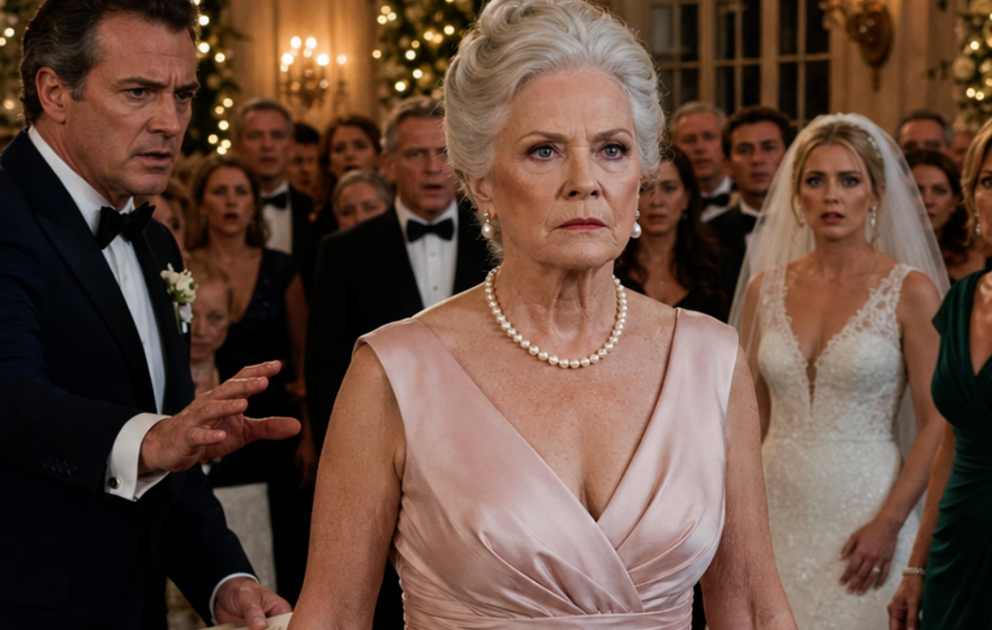
My name is Denise Parker. At seventy-two years of age, having weathered the quiet devastation of widowhood, I am the sort of woman who was raised to maintain a perfectly straight posture even as her heart splinters into a thousand irrecoverable pieces. It is a generational armor, woven from pride and silent endurance.
My son halted my progress at the velvet-roped entrance to my eldest granddaughter’s wedding, standing before an audience of two hundred distinguished guests, to inform me that my name was conspicuously absent from the guest list.
Yet, in their meticulous curation of the perfect evening, they had neglected one foundational detail: I was the solitary benefactor who had financed the entirety of the opulent affair.
I had surrendered the entirety of my morning to the rituals of preparation. My Clara’s wedding was the quintessential milestone, the day a grandmother envisions through the hazy lens of decades. My mind was a carousel of cherished memories: the powdery scent of her infancy, the afternoons spent teaching her the precise alchemy of Robert’s favorite rice pudding, and the conspiratorial moments watching her steal cinnamon from the wooden spoon when she believed I was otherwise engaged.
My heart swelled with a profound, almost painful pride. I had selected a pink silk gown, a garment preserved in the dark of my closet for years awaiting an occasion of this magnitude. Clasped around my neck was my mother’s heirloom pearl necklace, and on my wrists, the faint mist of a French perfume reserved strictly for grand jubilees. Staring into the mirror, I felt an undeniable elegance; I felt worthy of the lineage I had cultivated.
I wanted Clara to look upon me and see a matriarch—a joyous, unshakeable pillar of her history. I was tragically unaware that in the calculating eyes of my son, Richard, I was perceived as little more than an expiring liability.
For six grueling months, my existence had been entirely tethered to the orchestration of this event. Richard and his wife, Susan, would routinely descend upon my apartment. They would settle into the plush depths of my velvet sofa, sip the meticulously brewed coffee I served them, and orchestrate their requests in soft, practiced tones that now evoke a visceral revulsion within me.
“You know, Mom, the economic climate is dreadfully unforgiving right now,” Richard would lament, massaging his temples in a pantomime of stress.
“We simply want Clara to experience the fairytale wedding she truly deserves,” Susan would seamlessly interject, her voice dripping with a saccharine sincerity that masked her avarice.
Operating under the perilous delusion of maternal duty, I opened my heart, and consequently, my ledger. When I inquired about the cost of this “fairytale,” they produced a glossy, gilded brochure. The venue was a sprawling, palatial estate nestled in the elite enclaves of Westchester. The culinary arrangements boasted imported lobster and truffles. The bridal gown alone carried a price tag commensurate with a luxury sedan.
I subsidized every single exorbitant detail. The total expenditure eclipsed one hundred thousand dollars.
This vast sum was entirely extracted from the financial reservoir my late husband, Robert, had meticulously accumulated—funds explicitly designated to secure my independence and to serve as a safety net for our descendants in times of genuine peril. I signed the labyrinthine contracts, negotiated with temperamental florists, approved the cascading floral arrangements, and fielded endless telephone inquiries from frantic vendors. Every legally binding document, every receipt, every wire transfer bore the unmistakable signature of Denise Parker.
When my cab eventually rolled to a halt before the imposing wrought-iron gates of the Green Valley Estate, the sheer beauty of the spectacle momentarily suspended my breath. Colossal arches of white roses framed the grand entryway, while thousands of fairy lights wove through the ancient oaks, casting a celestial glow over the manicured grounds. A string quartet breathed soft, melancholic classical notes into the balmy evening air.
Guests were arriving in a continuous, glittering tide. They were draped in their finest evening wear, a chorus of laughter, air-kisses, and the delicate clinking of crystal champagne flutes. It was a congregation of our shared history: family, long-standing neighbors, and distant acquaintances. Two hundred individuals, all partaking in a spectacle I had willed into existence.
Many caught my eye, offering warm smiles and effusive compliments on the breathtaking nature of the celebration. I glided toward the main promenade, the rhythmic tapping of my heels on the cobblestone sounding like a quiet drumbeat of triumph.
Richard and Susan were positioned at the apex of the entrance, performing the roles of gracious hosts. My son cut a formidable figure in a bespoke, razor-sharp suit. Beside him, Susan shimmered in an emerald green gown so heavily encrusted with embellishments she resembled a garish holiday ornament.
“Richard, my dearest, the evening is absolutely magnificent,” I beamed, extending my arms to embrace the boy I had raised.
He did not reciprocate. He remained rigidly in place.
His eyes were terrifyingly devoid of affection; they were the cold, assessing eyes of an absolute stranger. Susan immediately averted her gaze, suddenly feigning an intense preoccupation with a nearby floral centerpiece.
“Mom,” Richard articulated, his tone adopting a flat, glacial resonance, “what exactly are you doing here?”
A soft chuckle escaped my lips, born of the naive assumption that this was a poorly executed jest. “What am I doing here? I am attending my firstborn granddaughter’s wedding, Richard.”
With a sharp, dismissive movement, he snatched the leather-bound guest registry from the bewildered receptionist. The surrounding atmosphere seemed to immediately thicken, the ambient music suddenly feeling distant and hollow. Behind me, the steady hum of two hundred conversational threads unraveled into a suffocating, collective silence.
“Your name is not on the list,” he announced, his volume deliberately calibrated to ensure the surrounding crowd caught every syllable.
The smile evaporated from my face, replaced by a cold dread. “What on earth are you implying, Richard? What manner of joke is this?”
“It is not a jest,” he countered with surgical precision. “It is likely a clerical error in the invitation distribution process.”
“A clerical error? I was the individual who financed the printing of those invitations. Furthermore, I sat beside Susan at my dining table and painstakingly verified every single name to guarantee no one was marginalized.”
The heat of a profound, public humiliation began to sear my cheeks. I shifted my gaze toward Susan. She was smiling—a thin, cruel smirk that she made absolutely no effort to conceal.
I was standing there, stripped of my dignity, treated as a belligerent interloper at a festival I had physically built and financially sustained. I drew a long, ragged breath. A lifetime of cultivated grace does not simply evaporate in a single, ugly transaction unless you willingly surrender it. I was resolutely determined not to allow an ungrateful offspring to shatter mine.
Adjusting my mother’s pearls, I locked my gaze onto the icy depths of my son’s eyes.
“Very well, sweetheart,” I stated, my voice eerily calm and devoid of tremor. “If my presence here is indeed a mistake, I sincerely apologize for the inconvenience.”
I executed a precise pivot and walked away, my chin held at a defiant angle. The assembled crowd parted instinctively, forming a silent aisle of spectators. Not a single hand reached out to offer solace; not a single voice was raised in my defense. I marched back beneath the towering floral archway I had purchased, retreating to the cab that had not yet departed.
“Did you forget something, ma’am?” the young driver inquired, his cheerful demeanor faltering at the sight of my face.
“Yes,” I murmured, staring into the encroaching twilight. “I temporarily forgot the exact nature of the son I raised.”
The journey back to the city was enveloped in a heavy, suffocating silence. The twin specters of rage and humiliation had taken up residence in my chest, a weight so immense it eclipsed the capacity for tears. They had methodically drained the reservoir of my maternal goodwill and discarded me the very second my utility had expired. They desired my capital, not my company. They were fundamentally mortified by the presence of their elderly mother.
Upon returning to my cavernous apartment, the silence was agonizing. The pink silk dress now felt like a tragic costume. I unzipped it, allowing it to pool on the hardwood floor—a discarded relic of my former naivety.
My eyes gravitated toward the framed portrait of Robert in the hallway. He would never have permitted such a transgression. He would have looked Richard dead in the eye and irrevocably disowned him. But Robert was a ghost, and I was the sole remaining guardian of our legacy.
I possessed the option to weep. I could have consumed a sedative and sought oblivion in sleep. However, the humiliation had served as a brutal catalyst, resurrecting a dormant iteration of myself. It awakened the woman who had operated her late husband’s sprawling logistics empire for a decade following his sudden demise. It summoned the executive who negotiated ruthless contracts, managed complex finances, and understood the absolute leverage of every single dollar.
I did not shed a single tear.
Instead, I marched purposefully into my private study, unlocked the mahogany filing cabinet, and extracted a thick, cream-colored dossier emblazoned with Clara’s Wedding. Contained within was an arsenal of unassailable proof: the venue contracts bearing my signature, the catering invoices billed to my address, and the wire transfer confirmations permanently linking my accounts to the event’s existence.
I reached for the telephone and dialed Martin Hayes, my fiercely loyal legal counsel of thirty years.
“Mrs. Parker,” he answered smoothly. “What a delightful coincidence. Tonight is Clara’s grand celebration, is it not?”
“Martin, I require you to be the most ruthless attorney in New York by tomorrow morning,” I stated, my voice devoid of warmth. “Do you have five minutes?”
“I have the entire evening for you, Denise. What has occurred?”
“I was publicly expelled from the wedding I bankrolled,” I articulated with slow, deliberate precision. “My son and his wife are under the dangerous illusion that they can expropriate my wealth while treating me like refuse. I need your immediate assistance in violently correcting that misconception.”
I settled into my high-backed leather chair, spreading the dossier across the polished mahogany of my desk. The emotional laceration was still bleeding, but beneath it, a cold, calculating architecture of retribution was already rising. Richard believed he had merely barred me from a banquet; he was blissfully ignorant that I was about to lock him out of his own life.
The true revelation of the evening was not about humiliation at all. It was an education in power. To them, I was not a matriarch; I was a municipal utility, a fountain of capital that they assumed would never run dry. And when they believed the fountain was no longer necessary for their aesthetic perfection, they simply shut off the valve.
They possessed absolutely no concept of the reality of my financial standing. When I eventually sold Parker Logistics five years prior, Richard and Susan assumed I was merely living comfortably on standard retirement funds. They believed the hundred-thousand-dollar wedding expenditure was a colossal, agonizing sacrifice on my part.
“Martin,” I spoke into the receiver, the lingering tremor in my voice replaced by steel. “Retain the wedding file as circumstantial evidence, but it is not our primary weapon. Where are Richard and Susan currently?”
“I believe Clara mentioned they depart for their honeymoon in Paris late tonight,” he replied.
“Excellent,” I purred. “Let them indulge in the City of Light.”
I strode over to Robert’s heavy iron safe, input the combination, and withdrew a slim, navy-blue folder. When Martin arrived the following morning, I placed it before him.
“This,” I declared, “is the documentation of my reclaimed sovereignty.”
Contained within were two master property deeds. The first belonged to the sprawling, three-bedroom Manhattan apartment Richard and Susan currently occupied—a residence boasting a private balcony and a twenty-four-hour doorman.
“Everything is registered strictly in your name,” Martin noted, his eyebrows ascending.
“Naturally,” I replied smoothly. “I purchased it a decade ago as a long-term investment. They have resided there without a formal lease, without contributing a solitary dime toward rent, property taxes, or exorbitant building maintenance fees. I have subsidized their entire domestic existence.”
“And the second deed?”
“The coastal property in the Hamptons,” I continued. “The ‘little paradise’ they endlessly flaunt on social media. That estate is also entirely mine. Furthermore, sitting in my subterranean garage is the luxury sedan Richard operates under the guise of a ‘company car.’ I retained ownership of the vehicle when I liquidated the business.”
I then opened my banking application—the very software Susan had once mockingly suggested was too technologically advanced for my aging brain—and navigated to the scheduled transfers portal.
Allowance: Richard Parker. $4,000.00 Monthly.
I pressed Cancel, watching the screen flash green to confirm the termination of their lifeline.
“They are going to despise you with a biblical intensity, Denise,” Martin observed, studying me with a newfound reverence.
“They already despise me, Martin. They simply suppressed it beneath a veneer of familial duty because my capital was necessary for their survival. Let them hate me from afar, stripped of my resources.”
The subsequent fifteen days were a masterclass in strategic dismantling. While Richard and Susan meandered through Parisian cobblestone streets, consuming expensive cheeses and vintage wines under the delusion of total security, I systematically dismantled the infrastructure of their privilege.
Martin executed my directives with lethal efficiency. The locks on the beach house were replaced within forty-eight hours, and a private security detail was contracted to patrol the perimeter. I ruthlessly purged my own apartment, tossing the expensive, imported linens Susan had demanded I purchase for the guest room into heavy black trash bags.
When the first of the month arrived, I brewed a pot of dark roast coffee and situated myself by the window. I envisioned the exact moment the illusion would shatter. Susan, marching into a Parisian boutique, confidently handing her card to a clerk, only to be met with the humiliating beep of a declined transaction. Richard, attempting to settle a brasserie tab, met with the exact same fate.
The frantic messages soon flooded my secondary mobile device. Mom, did something happen? The money didn’t clear.
Not an inquiry regarding my emotional state. Merely a panic over the severed financial artery. I deleted the message without a flicker of hesitation.
In the interim, I reclaimed the dimensions of my own existence. I engaged a private tutor to master advanced financial software, transferring ninety percent of my liquid assets into highly secure, encrypted investment portfolios, leaving a paltry thousand dollars in the account Richard monitored. I visited a salon, shedding the matronly hairstyle for a sharp, modern cut, watching the frail grandmother vanish into the floor sweepings.
When Richard and Susan finally landed at JFK and arrived at the Manhattan apartment, they were greeted not by the comfort of their home, but by a formal, legally binding eviction notice adhered directly to their front door. Thirty days to vacate the premises.
The telephone rang incessantly that evening. When I finally answered, the receiver practically vibrated with Richard’s apocalyptic rage.
“You’re throwing your own son out onto the street?!” he bellowed, the sound of Susan hysterically weeping echoing in the background.
“I am merely reclaiming my real estate portfolio,” I replied with chilling serenity. “You blocked me at the entrance to a ballroom, Richard. I am blocking you from the entirety of my life. You have twenty-nine days remaining.”
His arrogance blinded him to the reality of his situation. He attempted to requisition his ‘company car’ the following morning, only to be stonewalled by the building’s doorman, who informed him the vehicle was legally grounded under my strict authorization. Bereft of transportation, devoid of their monthly stipend, and facing imminent homelessness, their carefully constructed facade crumbled into dust.
Their ultimate capitulation occurred in the lobby of my building. They arrived looking like hollowed-out refugees of their own hubris. Susan’s immaculate grooming had deteriorated into a chaotic mess; Richard’s face was contorted into a mask of desperate malice.
“You’ve lost your mind,” Richard spat, threatening me with forensic psychiatric evaluations and legal injunctions to seize my assets.
I merely laughed—a deep, resonant sound that echoed off the marble walls of the lobby. I withdrew my phone and displayed my newly minted, highly complex investment dashboard.
“You labor under the delusion that I survived purely on finite retirement funds,” I stated, my voice dropping to a dangerous, commanding register. “When I sold Parker Logistics, I did not liquidate the real estate. I retained ownership of six massive commercial warehouses. They are currently leased to Amazon, FedEx, and an international pharmaceutical conglomerate.”
I watched the blood rapidly drain from their faces as the monumental scale of their miscalculation finally took root in their minds.
“Do you comprehend the monthly rental yields on those properties?” I whispered. “The hundred thousand dollars I spent on your daughter’s wedding is equivalent to what I pay in municipal property taxes. It was pocket change. It was a gift born of love, and you spat on it. I am not merely a grandmother; I am the architect of this family’s wealth, and underestimating me has engineered your total ruin.”
I instructed the doorman to summon security to remove the trespassers, turned on my heel, and departed for my newly scheduled Italian language immersion class.
At precisely five o’clock on the thirtieth day of their eviction notice, a courier delivered a nondescript brown envelope to my residence. It contained the keys to the Manhattan apartment and the beach house. There was no accompanying letter of apology, only the heavy, metallic silence of absolute surrender. They subsequently relocated to a cramped, dilapidated apartment in the distant suburbs, financed by a high-interest loan.
My granddaughter, Clara, did not materialize until months later. She arrived at my door stripped of her bridal radiance, weeping and confessing that her new husband had promptly divorced her upon discovering her parents had been entirely disinherited. He, too, had only been enamored with the Parker wealth.
“I was a coward, Grandma,” she sobbed onto my velvet sofa, the very site where her parents had plotted my financial drain. “I watched them humiliate you, and I remained silent.”
I poured her a cup of chamomile tea, studying the broken young woman before me.
“Dignity, Clara, is not a currency we are required to surrender as we age,” I instructed her softly, taking her trembling hands in mine. “It is our very skin. What I executed was not vengeance; it was the ultimate act of self-preservation. I chose my dignity over a toxic illusion.”
I did not offer Clara a financial bailout. Instead, I offered her the sanctuary of my guest room, an old laptop, and the opportunity to rebuild her own life from the ground up, free from the corrupting influence of unearned luxury.
Today, the silence in my apartment is no longer a void waiting to be filled by ungrateful dependents. It is the tranquil silence of absolute sovereignty. The moment I was physically barred from that lavish celebration was the exact, beautiful moment I finally gained entrance back into my own extraordinary life.