
Rain fell relentlessly over the stone streets of San Miguel de Allende, striking the old cobblestones with an almost deliberate rhythm, as if the sky itself were knocking on a door, demanding to be heard.
Water rushed down the narrow gutters, carrying away dust, petals, and fragments of a day that refused to remain whole.
In the back of a black armored SUV, Diego Salazar watched it all through the tinted window. Thin streams of water slid down the glass, distorting the colonial façades, bending reality into something softer, sadder. At thirty-six, Diego possessed more than most men would ever dare to dream of: servers, patents, companies spread across several continents. He could buy time, silence, influence.
But there was one thing money had never returned to him.
Loss leaves a particular mark. Not visible, but undeniable. It lived behind his eyes, in the way his gaze lingered too long on strangers, in the tightness that closed around his chest whenever he saw young couples laughing, whenever he passed playgrounds, whenever someone spoke names he no longer heard.
The light ahead turned red. The driver slowed down and stopped.
Diego barely noticed.
Then he saw her.
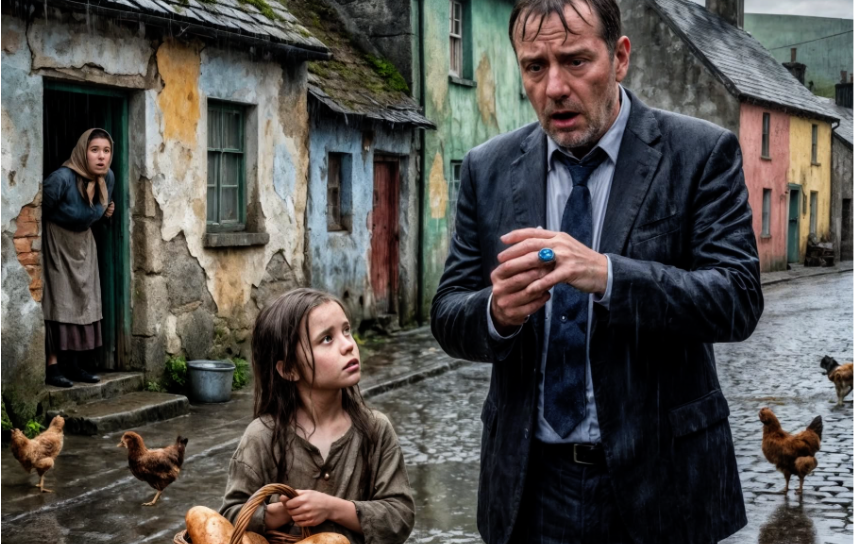
On the flooded sidewalk, a young girl was walking barefoot through the rain. She could not have been more than fifteen. Her dress was too thin for the weather, clinging to her knees, darkened by water. Her hair — long, black, heavy with rain — stuck to her cheeks and neck. She bent slightly forward, protecting against her chest a woven basket covered with a white cloth already soaked through.
She walked as if stopping were not an option.
As if what she carried mattered more than warmth, more than pain, more than the storm.
“Stop,” Diego said suddenly.
The word came out rough, unfamiliar in his throat.
The driver looked at him in the rearview mirror.
“Sir… it’s raining very hard.”
“Stop.”
The SUV slid toward the edge of the sidewalk.
Before the driver could even open the door, Diego stepped out into the downpour. The rain struck him like a wall — cold, heavy, immediate. His tailored jacket darkened within seconds, water slipping beneath his collar, soaking his shirt. He felt nothing.
He approached the girl slowly, deliberately, stripping his posture of any authority and his voice of any command. He did not want to frighten her.
She noticed him and stopped. Her shoulders stiffened. Her eyes — large, brown, watchful — lifted toward him with the instinctive caution of those who learn too early that the world does not always offer kindness for free.
“Are you selling bread?” Diego asked softly.
The young girl hesitated, then nodded. With careful fingers, she lifted the edge of the cloth. Inside were rolls, conchas, small loaves — still warm, a faint steam rising despite the rain. She had wrapped them with care, as if they were fragile.
Then Diego saw her hand.
On her left ring finger shone a silver ring. Simple at first glance, but unmistakably shaped with the care of someone who loved. The metal was engraved, not industrial. In the center, a pale blue topaz caught the gray light of the storm and returned it softly.
The world shifted.
Diego’s breath stopped — not violently, not dramatically — but as if his lungs had simply forgotten how to work.
He knew that ring.
He had designed it himself sixteen years earlier, sitting in a small workshop with a jeweler who charged too much and spoke too little. He had insisted on the stone. Insisted on the hidden engraving inside, invisible unless you knew where to look.
D & X. Forever.
He had slipped that ring onto Ximena’s finger the night before she disappeared.
She was three months pregnant.
She had left a letter. A letter he could recite without effort. A letter that lived in his bones.
Diego swallowed.
“What is your name?” he asked, forcing his voice to remain steady.
The girl clutched the basket to herself.
“Cecilia… sir,” she answered quietly.
The name fell like a blow.
Cecilia.
Ximena had said it a hundred times. If it’s a girl, her name will be Cecilia — like my grandmother. Gentle, strong, unbreakable.
Diego did not think. He reached into his pocket, took out money, and bought the entire basket. He paid far more than necessary, then added another bill without looking.
Cecilia’s eyes widened.
“No, sir… it’s too much.”
“No,” he said gently. “And if you or your mother ever need anything — anything at all — call me.”
He handed her a business card. Not the one with assistants and corporate titles. The one with a private number that very few people had ever received.
She took it carefully, as if the paper might dissolve between her wet fingers.
Rain streamed down Diego’s face — water, now indistinguishable from everything else. He stood there, motionless, as she walked away, barefoot on the flooded stone, disappearing into the curtain of rain.
His entire body screamed at him to follow her.
To take her hand.
To turn the ring and check the engraving.
To ask where her mother was.
To say the words he had carried in silence for sixteen years:
I am your father.
But he did not.
He stood still, his heart trembling, letting the storm soak him to the bone, because some truths — when they appear too quickly — must be held gently, or they break.
Behind him, the light turned green.
Diego did not move.
That night, in his apartment in Polanco, the city glittered beyond the windows, and Diego could not sleep.
He took out a yellowed letter from Ximena, folded so many times it seemed ready to tear. Her delicate handwriting still burned him:
“My Diego… forgive me for not telling you face to face. If I look you in the eyes, I won’t have the strength to leave. I have to leave to keep you alive. My brother Damián has become involved with dangerous people… I am three months pregnant. Don’t look for me. Please…”
For years, he had hired investigators, followed false leads, changed names. He had never married, never loved anyone without feeling as though he were betraying a ghost.
And now a young girl wearing Ximena’s ring had appeared, selling bread in the rain.
The next day, Diego called a discreet man, the kind who did not ask questions.
“Find Cecilia. But gently. Don’t scare her. Don’t let her suspect anything.”
Three days passed, and they felt like three months. The report arrived: Cecilia lived on the outskirts of San Miguel with her mother. Her mother cleaned houses, was ill, and the registered last name was Salazar. There was a photo. Cecilia was smiling, with features identical to Ximena’s.
Diego waited no longer. He arrived on a cloudy afternoon. The path was nothing but mud and puddles, chickens pecking among old boxes, but there were flowers: bougainvillea climbing along the fence, white roses in improvised pots. He knocked on the wooden door.
“You… the man from the bread,” Cecilia murmured.
“Yes… I need to speak to your mother.”
Ximena appeared, thinner, her face marked by hardship, her eyes sunken. She trembled as she held the curtain. Their eyes met, and the world disappeared once again.
“Diego…” she breathed.
“Why… why did you never come back?” His voice broke.
Ximena told him everything: the fear, the danger, the cancer. Diego knelt before her, holding her cold hands.
“You had no right… I was dead inside for sixteen years… and she… she is our daughter.”
Cecilia brought a hand to her mouth, and the ring shimmered in the sad light of the house.
“My name is Diego,” he said carefully. “And if you allow me… I am your father.”
Cecilia took a small step toward him. Ximena sobbed.
“You were never a tragedy,” Diego said. “You were the most beautiful thing that ever happened to me. And if fate is giving us a second chance, I will not waste it.”
Diego moved heaven and earth: he took Ximena to the best hospital in Querétaro, arranged treatments, clinical trials, new medications. Cecilia and Diego learned to know each other. The young girl studied, made small objects, and read passionately.
A few months later, the doctor smiled: the tumor was shrinking. Ximena cried with joy, Diego held her in his arms, and Cecilia joined them.
They married in a small ceremony: Ximena wore the same ring, and Cecilia was the bridesmaid, in a blue dress matching the topaz.
Diego kissed Ximena and whispered:
“Forever.”
“It always was,” she replied.
Later, they settled near the sea, in Nayarit.
Cecilia had a room with a view of the water, a scholarship for school, and Diego learned the simple things: taking her to class, listening to her, being there.
One afternoon, as they watched the sun sink from the terrace, Ximena asked:
“Can you imagine if you hadn’t stepped out of the car?”
“I don’t like to think about it,” Diego replied.
Cecilia was running along the sand, laughing, the ring shining on her hand.
“Forever,” he repeated.
“Forever,” Ximena said.
For the first time in sixteen years, Diego felt that he was finally home.