For twenty-two years, I existed as the load-bearing wall of the Donovan family—essential to the structure, yet entirely unnoticed unless I developed a crack. My sister, Meredith, was the ornate chandelier: fragile, expensive, and constantly demanding the spotlight. My parents, Douglas and Pamela, spent their lives ensuring her light never dimmed, even if it meant leaving me in the shadows.
By my senior year of college, I was a ghost inhabiting a skin of exhaustion. I worked twenty-five hours a week at a local café to fund a life my parents refused to subsidize, all while maintaining a perfect 4.0 GPA. I was the Valedictorian of my class, a feat of academic endurance achieved through sheer spite and caffeine.
“Grace, did you pick up the napkin samples for the engagement party?” Mom asked one afternoon, not looking up from a bridal magazine.
“I have finals, Mom. And I’m writing my commencement speech,” I replied, my voice thin.
“You’ll manage. You always do,” she said. It was the family mantra. My reliability was my prison sentence.
That night, the first warning sign arrived: a blinding migraine that felt like a hot needle behind my left eye. I dismissed it as stress. I didn’t know that a silent predator was growing within me—a tumor pressing against my frontal lobe, mirroring the emotional pressure my family placed on my soul. Graduation morning was a blur of searing heat and agonizing pressure. I had received a selfie from my parents and Meredith earlier that morning. They were at Charles de Gaulle airport in Paris. The caption read: “Family trip! Finally—peaceful vibes only.”
They had traded my crowning achievement for a celebratory vacation for Meredith’s engagement. They claimed I was “strong enough” to be alone.
Standing at the podium, looking out over 3,000 faces, I searched for the only anchor I had left: Grandpa Howard. He sat in the front row, his eyes bright with a pride my father had never managed to conjure. Beside him sat my best friend, Rachel. And beside them? Two empty, velvet-cushioned seats. Reserved for “Family.”
“I stand before you today…” I began, but the world tilted. The stadium lights bled into a singular, blinding white. The microphone slipped from my numb fingers. The last thing I saw before the darkness swallowed me was Grandpa Howard leaping to his feet, his face a mask of terror. While I lay on a cold operating table, my brain exposed to the steady hands of neurosurgeons, my family was 30,000 feet in the air.
Rachel had called them forty-seven times. When Douglas finally answered, his response was a masterclass in emotional desertion. “Dad, we’re about to take off,” he told Grandpa Howard. “Can you just handle it? We’ll call when we land.”
Grandpa’s response was a vow: “If you get on that plane, Douglas, do not bother calling me again.”
They boarded. They chose the Eiffel Tower over a hospital waiting room. They chose “peaceful vibes” over the possibility of their daughter’s death.
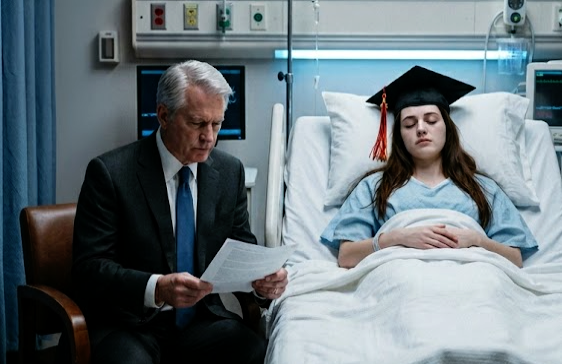
I woke up three days later to the rhythmic thrum of a heart monitor. The tumor was benign, but the family dynamic was malignant. I checked my phone to find the Instagram post that would eventually break the final tether. There they were, smiling with crepes and champagne, while I had been learning how to speak again. The confrontation happened in a sterile hospital room that smelled of antiseptic and shattered illusions. My parents arrived five days late, draped in faux-concern and shopping bags from Le Marais.
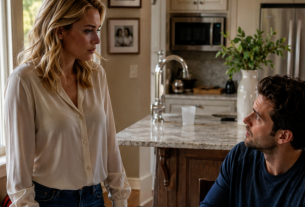
“We came as fast as we could,” Mom whispered, reaching for my hand. I pulled away.
“Lou posted a photo of you yesterday,” I said, my voice raspy. “You were three hours away by flight. You chose to stay.”
The argument that followed unearthed the rot at the foundation of our family. My mother, pushed to a breaking point by Grandpa’s accusations, finally screamed the truth: “Every time I look at you, I see her! Eleanor!”
Eleanor was my grandmother. She had been a formidable woman who never found my mother “good enough.” I was her genetic twin—the same eyes, the same stubborn chin, the same relentless intellect. For twenty-two years, my mother hadn’t been raising a daughter; she had been relitigating a grudge against a dead woman. I was being punished for a face I didn’t choose. The true reason for their return wasn’t guilt—it was greed. Grandpa Howard revealed the existence of the “Freedom Fund,” a substantial inheritance left by Grandma Eleanor specifically for me.
My parents had already embezzled my tuition checks from Grandpa years prior, using them to fund Meredith’s lifestyle and home renovations. They assumed this new fund would be managed by them.
“This money is mine,” I told them, sitting upright despite the ache in my skull. “It’s not for a kitchen. It’s not for Meredith’s wedding. It’s the price of my independence.”
I didn’t scream. I didn’t cry. I simply set a boundary that was as cold and unyielding as iron. “If you want to be in my life, you have to earn it. You have to see Grace, not a ghost.”
A year later, the landscape of my life has shifted. I am an 8th-grade English teacher. My apartment is small, filled with plants and books, and notably absent of drama.
Meredith’s engagement collapsed when her fiancé, Tyler, realized the depth of her family’s cruelty. She is in therapy now, learning for the first time that the world does not owe her a standing ovation. My father calls every Tuesday at 7:00 PM. We talked about the weather, my students, and what I had for dinner. It is stilted, but it is honest.
Grandpa Howard remains my North Star. He recently gave me a letter Grandma Eleanor wrote before I was even born. It said: “To my granddaughter: They will try to tell you who you are based on who they need you to be. Don’t listen. Be the storm, not the shelter.” Grace’s story is a textbook example of Parental Projection and Scapegoating. When a parent cannot resolve their own trauma, they often cast a child in the role of their antagonist. Grace wasn’t a daughter; she was a trigger.