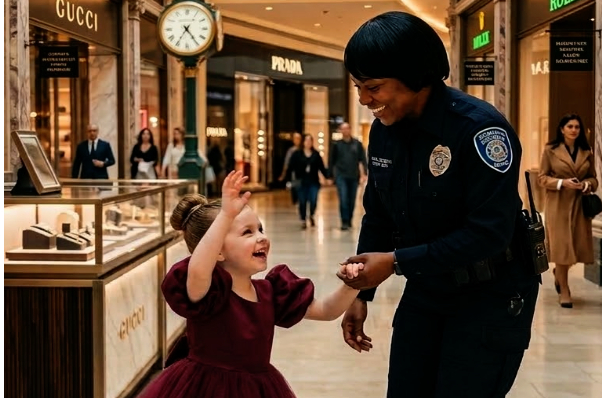
The air at Polaris Fashion Place usually smelled of vanilla candles and expensive leather, a sensory lullaby for the weekend crowds. For Staff Sergeant Maisie Barnes, however, the mall was a “low-threat environment” that felt unnervingly soft. After three tours in Iraq, the absence of a rucksack and the presence of a shimmering blue dress on her eight-year-old daughter, Abby, felt like a beautiful, fragile hallucination.
But in an instant, the butter cookies and jazz music vanished. It started with a squeeze—not the playful tug of a child wanting a pretzel, but the bone-deep grip of a human being in sheer terror. Abby’s fingernails dug into Maisie’s wrist as they stood in the tiled silence of the mall restroom.
“Mom, shh… don’t move,” Abby whispered. Her voice was a ghostly thread, barely audible over the hum of the ventilation.
Maisie didn’t ask questions. She didn’t offer a platitude. She followed her daughter’s gaze to the gap beneath the stall door. A pair of oversized, polished leather shoes had stopped directly in front of their stall. They didn’t move toward the sinks. They didn’t move toward another door. They hovered there, oppressive and predatory.
In that heartbeat, Maisie’s civilian “mom” persona evaporated. Her heart rate, instead of spiking, settled into a cold, rhythmic thrum—the “black zone” of combat focus. Her right hand swept toward her hip, searching for the grip of a sidearm that wasn’t there. She felt the phantom weight of her gear, the muscle memory of a woman who had cleared rooms in Fallujah.
Then, the voice came. It was a low, oily baritone, vibrating through the thin metal door. “Target acquired. Maisie Barnes’s daughter. She’s wearing a blue dress.”
The words were a clinical assassination of Maisie’s peace. This wasn’t a random mall creep; this was a professional hit on her reality.
Maisie operated with the surgical detachment of a hunter. She lowered her phone, switching it to video mode, and slid it toward the gap. The screen captured the charcoal wool of the man’s trousers and his reflection in the floor tile—a man who looked like he belonged in a skyscraper, not a restroom stall.
“Tink, tink, tink.” He tapped his knuckles against the metal. “Abby, I have some candy for you, sweetie.”
The artificial sweetness was nauseating. Maisie didn’t scream; screaming was for the defeated. Instead, she utilized a tactical decoy. She lunged toward the adjacent stall, kicking the metal door with the force of a breaching charge. The bang echoed like a gunshot. As the stalker lunged toward the noise, Maisie scooped Abby into a fireman’s carry and burst through the exit.
They didn’t stop until they reached the neon safety of the security office. But the “safety” was an illusion. The head of security, a man whose most dangerous daily encounter was a shoplifting teenager, looked at Maisie’s short-cropped hair and calloused hands with a condescending smirk.
“Take a breath, ma’am,” he said, waving a half-eaten pretzel. “Probably just a confused dad.”
Maisie didn’t argue. She slammed her military ID onto his desk. “I am Staff Sergeant Barnes, U.S. Army. There is a predator in the second-floor ladies’ room. You will pull the footage now, or I will report you for obstructing a federal investigation. Do I make myself clear, Sergeant?”
The shift in the room was instantaneous. The guard saw the fire in her eyes—the kind of fire that only grows in the dark. Ten minutes later, Brian Hartman was in handcuffs. But as he was led away, he fired the first shot in a different kind of war.
“She’s a wild animal in a uniform!” Hartman shouted to the gathering crowd of shoppers. “Look at her. Short hair, grease under her nails. She doesn’t know how to be a mother. I’m a private investigator. I’m doing that girl a favor by getting her away from a freak like this!”
The whispers of the crowd—the judging eyes of “perfect” mothers clutching Starbucks cups—felt sharper than any shrapnel.
The true horror didn’t reveal itself until they were at the precinct. Brian Hartman was already being met by a lawyer whose suit cost more than Maisie made in a year. As Hartman passed Maisie, he leaned in, his voice a low, metallic purr.
“My client thinks the military environment is too coarse for a young lady. She thinks you’re staining the girl with gunpowder.”
Coarse. The word was a fingerprint. There was only one person in Maisie’s life who used that word: Margaret Louise Miller, her mother-in-law. A woman who lived behind a glass wall of “Old Money” and Upper Arlington pedigree.
Then, the second betrayal arrived via a phone call. It was Mike, Maisie’s brother-in-law.
“Maisie, I heard there was a situation at Polaris! I’m coming to get you,” he said, his voice frantic.
Maisie froze. “How did you know we were at Polaris, Mike? The police haven’t released any names.”
The silence on the other end was the sound of a crumbling lie. Maisie remembered Thanksgiving at the Miller estate—the fine china, the silver polished by nameless servants, and Margaret’s voice cutting through the air: “God created women to keep the fire in the kitchen, Maisie, not to carry a rifle in the mud. David’s death was the price of your pride.”
Mike had sat in silence then, eating his pumpkin soup while his mother dismantled Maisie’s soul. Now, he was the “hero” coming to the rescue of a situation he helped coordinate.
The ride home with Mike was a study in counter-surveillance. Maisie sat in the passenger seat, watching the “deception indicators” she’d been trained to spot: the dilated pupils, the trembling hands, the avoidance of eye contact.
When they pulled into her driveway, a small yellow slip of paper fluttered from Mike’s pocket as he caught his coat on the seatbelt. Maisie snatched it. It wasn’t a grocery receipt. It was a wire transfer confirmation for $5,000.
Recipient: Hartman Investigative Services. Memo: Project Polaris, initial retainer.
The betrayal was complete. Her own brother-in-law had sold her daughter’s safety for the price of a used sedan. Maisie tucked the paper into her pocket, her heart turning into a block of black ice.
Inside the house, she found the “Trojan Horse.” Behind a framed wedding photo of her and David—the only sanctuary she thought was sacred—she found a small black listening device. A high-gain bug. Margaret hadn’t just been judging her; she had been harvesting her life.
When Mike walked in with a pizza, acting the part of the doting uncle, Maisie didn’t see a relative. She saw a traitor caught in the wire. She held up the bug, the tiny red light blinking like a heartbeat.
“Is this what your mother calls ‘normal,’ Mike?”
The pizza box hit the floor. The confession that followed was as pathetic as it was predictable. Mike owed $50,000 to an offshore gambling site. Margaret had bought his loyalty. “She said you weren’t stable,” he sobbed. “She said David would have wanted me to protect the family.”
“Don’t you ever mention his name with that filthy mouth,” Maisie hissed. “David died for honor. You sold yours for digital poker chips.”
The following day, a detective handed Maisie a cerulean folder recovered from Hartman’s SUV. It was labeled: Target Reconstruction Project.
It was a masterclass in dehumanization. Inside were hundreds of photos spanning eight years.
Photo 1: Maisie in the hospital, pale and exhausted, holding newborn Abby. Margaret’s handwriting beneath: “The mistake began on this day. Needs correction.”
Photo 2: Maisie collapsed on her sofa in mud-caked fatigues after a 48-hour drill. Caption: “Subject in state of extreme fatigue… environment of neglect.”
Photo 3: A Friday night at McDonald’s. Caption: “Poor nutritional standards… maternal absence.”
The file contained a pre-filled contract for a military boarding school 800 miles away. Margaret didn’t want to raise Abby; she wanted to “wash her clean” of Maisie’s influence. The final document was a spreadsheet comparing Maisie’s Sergeant’s pay to the Miller family trust. The conclusion was highlighted in red: “Recommend using economic leverage to force immediate surrender of parental rights.”
To Margaret, motherhood was a commercial transaction. She thought love had a price tag.
The final confrontation took place in the county sheriff’s office. Margaret Louise Miller arrived in a Chanel suit the color of a winter storm, flanked by a “Shark” lawyer. She didn’t look at Maisie. She spoke to the sheriff as if Maisie were a piece of low-class debris.
“My granddaughter needs culture,” Margaret stated, her diamond ring flashing. “Maisie is a violent woman, a byproduct of her environment. I will not have a Miller raised by someone who thinks a rifle is a substitute for a soul.”
Maisie stood up, her Class A dress uniform crisp, her medals gleaming.
“You speak of coarseness, Mrs. Miller?” Maisie’s voice came from her boots. “Coarseness is hiring a man to watch a child through a bathroom stall. Coarseness is buying your son’s soul to betray his brother’s memory. You have the mansion, but you are morally bankrupt.”
Maisie stepped forward, quoting Roosevelt: “The credit belongs to the man who is actually in the arena, whose face is marred by dust and sweat. That’s me. I’ve been in the arena for my country, and I’m in the arena for my daughter. You? You’re just a spectator in Chanel, throwing stones from the sidelines.”
The door opened, and a social worker brought Abby in. Margaret spread her arms, offering gardens and ice cream.
Abby didn’t move toward the pearls. She tucked herself behind Maisie’s leg, her small hand gripping the fabric of the uniform.
“No,” Abby said. “Grandma, you made my mommy sad. I don’t want a garden. I want my mommy.”
At that moment, Margaret’s millions were worthless. She had everything, but she owned nothing.
The court issued a permanent restraining order: 5 years, 1,000 feet. Maisie purged her house of everything Mike had ever touched. The victory, however, felt like ash. She had saved her daughter, but she had become an island.
Then came the rain.
For eight days, it poured. On the eighth day, Maisie saw a figure standing across the street. It was Mike. He didn’t have an umbrella. He didn’t move. He stood exactly 1,001 feet away—honoring the boundary with a devotion that bordered on religious.
In the mailbox, Maisie found an envelope. No money. No pleas. Just a voluntary, irrevocable waiver of Mike’s rights to Abby’s trust fund. He had locked himself out of the Miller fortune forever.
“I’m working at a warehouse in Grove City,” the note read. “I’m not asking for forgiveness. I’m just trying to be a man David wouldn’t be ashamed of.”
Maisie realized that resentment was a poison she no longer wanted to drink. She walked to the edge of the driveway with an umbrella.
“Go home, Mike!” she shouted. “Get dry. And be here at 5:00 tomorrow for dinner. Do not be late.”
Forgiveness wasn’t a second chance; it was probation. But as they sat over a simple meatloaf the next night, watching Abby show Mike her science project, Maisie saw the first plank of a new bridge being laid.
Six months later, the scene changed to Wright-Patterson Air Force Base.
Maisie stood on the stage as the commanding officer unpinned her old rank and replaced it with the three chevrons and three rockers of a Master Sergeant.
“Motherhood isn’t a distraction from duty,” Maisie told the crowd of soldiers. “It is the ultimate motivation. We endure the mud and the silence of deployment so our children can sleep in houses where the only sound is the wind in the trees.”
As she walked off the stage, Abby ran to her. Maisie placed her service cap—the one with the silver eagle—on her daughter’s head.
“Mommy,” Abby whispered. “I want to be a soldier just like you.”
“No, Abby,” Maisie replied, kneeling down. “Be better than me. Be stronger. And never let anyone tell you your value is written in a bank ledger. I didn’t leave you a mansion. I’m leaving you the knowledge that you are a Barnes. And we do not break.”
The Millers were gone. The “perfect image” was shattered. But in its place was something Margaret Miller’s money could never buy: a family built on honor, grit, and the kind of love that survives the abyss.