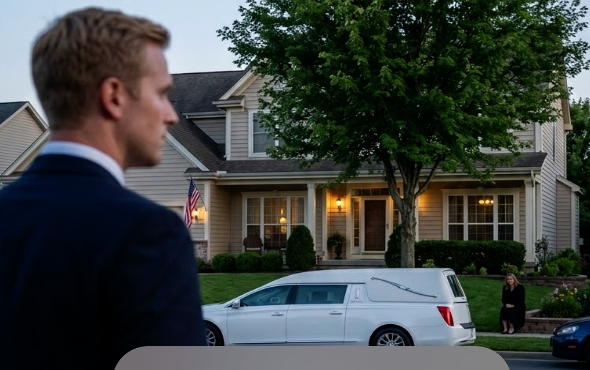
My name is Sierra. I am thirty-one years old, a woman built from the bricks of my own labor and the mortar of a silence that spanned nearly two decades. To understand why I sold a $770,000 house while my brother was dancing his first dance inside it, you have to understand the day the world split in two.
It was a Tuesday in October. I was fourteen. My mother, Linda, passed away after a two-year war with ovarian cancer. She was the only person in the Mercer household who understood the concept of a level playing field. If Dalton, my older brother by two years, received a new bike, I received one. If he needed help with his algebra, she was there; if I needed help with my history, she was there. She didn’t believe in favorites; she believed in equity.
The funeral was a study in gray. At the graveside, my father, Gerald, stood with a heavy hand on Dalton’s shoulder. He looked at my sixteen-year-old brother—already tall, already the image of a younger Gerald—and said, loud enough for the mourners to hear, “You’re the man of the house now, son.”
I stood three feet away, a ghost in a black dress. No one looked at me. No one told me I was the woman of the house. I was simply the girl who was left over.
However, there was one witness to my mother’s final wishes. Patricia “Patty” Callahan, my mother’s best friend, gripped my hands that day. My mother had seen the writing on the wall. She knew Gerald’s penchant for traditionalism—or rather, his obsession with the male heir—would consume the family once she was gone. She had secretly appointed Patty as my legal godmother, a binding role that would prove to be my only safety net in the years of famine to come. In the wake of the funeral, the Mercer household became a tale of two realities. Dalton lived in a world of abundance. For his sixteenth birthday, a Mustang appeared in the driveway. His college fund was a growing fortress, topped up monthly by Gerald’s generous salary. He had golf lessons, new clothes, and the constant, buzzing attention of a father who saw himself reflected in his son.
My world was defined by the “budget.” Whenever I asked for necessities—textbooks, a winter coat to replace one with a broken zipper, or even basic school supplies—Gerald wouldn’t even look up from the television.
“Ask your brother,” he would say. “I already gave him the budget for the month.”
It was as if our family’s resources were a single pie, and Dalton was allowed to eat until he was full. I was expected to survive on the crumbs left on the tin. I started working at a coffee shop at 4:30 a.m. before school just to buy my own calculator.
The cruelty wasn’t just in the money; it was in the indifference. When I had a scholarship interview—the only way I could afford to escape—the bus wasn’t running early enough. I begged Dalton to borrow the Mustang for two hours.
“Not my problem,” he said, scrolling through his phone.
I walked two and a half miles in the pre-dawn darkness. I got the scholarship. I learned early that if I wanted to survive, I had to be my own hero.
Years later, Patty helped me uncover a darker truth: my mother had left an equal college fund for me. Within a year of her death, Gerald had quietly moved every cent of my inheritance into Dalton’s account. He didn’t just favor Dalton; he actively cannibalized my future to further his son’s. I left the day after high school graduation. Gerald didn’t offer a hug or a “call when you get there.” He just told me to lock the door on my way out.
For the next decade, I disappeared into work. Real estate became my calling. I understood the value of a home because I had been homeless in my own family. By twenty-nine, I was a top-tier broker. I had closed over forty deals in a single year. I was successful, independent, and yet, there was a small, wounded fourteen-year-old girl inside me who still wanted her father to love her.
When Gerald called after three years of silence, I thought—naively—that this was the turning point.
“Your brother needs a place,” he said, skipping the pleasantries. “He’s getting serious with a girl from a good family. He can’t be renting some apartment. Help him out.”
I bought the house. A $770,000 four-bedroom colonial. I told myself it was an investment, but it was really a bribe. I was buying a seat back at the family table.
Patty, ever the voice of reason, made me promise one thing: “Keep the deed in your name, Sierra. Don’t sign it over. Not yet.”
I listened. Dalton moved in, and for a while, I waited for the thank-you that never came. Instead, the “editing” began. It started with missed invitations. Thanksgiving was “too crowded.” Christmas was “at the Ashford’s.” (The Ashfords were the wealthy family of Dalton’s fiancée, Nicole).
I began to see my life through the lens of Nicole’s Instagram. There were photos of “Family Christmas” in the house I paid for. There was my father, Gerald, laughing at the head of the table I had bought. The captions read: “Just us, a small family. And that’s all we need.”
I wasn’t just uninvited; I was being systematically deleted from the narrative. Dalton was performing the role of the successful, only-child scion of a wealthy family. He told Nicole’s family that Gerald had bought the house. He told them I was a “distant, difficult relative” if I was mentioned at all.
The final straw came when a colleague told me Dalton had been inquiring about adverse possession. He was looking for a legal loophole to steal the title from me after living there for a few years. He didn’t just want the house; he wanted to erase the fact that he owed me anything. The wedding invitation for Dalton and Nicole went out to 200 guests. I found out about it from my friend Karen. I wasn’t on the list.
When I confronted Dalton via text, his response was a chilling masterpiece of gaslighting: “Nicole’s family takes priority. Don’t make this about you. It’s been my house for two years. Everyone knows that.”
I called Gerald. He told me, “You’ll be fine, Sierra. You always are.”
That sentence was the death knell. He used my resilience as a justification for his neglect. Because I was strong enough to survive being thrown off a cliff, he felt no guilt in pushing me.
I called my lawyer, Russell Tate. “List the house,” I said.
The timing was poetic, if brutal. We found a cash buyer—a family moving from out of state. The closing was set for June 14th. The wedding was June 15th.
On the afternoon of June 14th, at 4:17 p.m., I signed the papers. The house was no longer mine. It was no longer Dalton’s. It belonged to the Brennan family, and they wanted possession. On June 15th, while a string quartet played on the patio and 200 people toasted to a lie, I sat in my car down the street. I waited until the toasts began. Karen was inside, giving me the play-by-play.
Dalton stood up. He thanked Gerald for “giving me everything, including this beautiful home.” He mentioned my mother, saying she was “the only one missing tonight.”
I pressed ‘Send’ on an email to Dalton, Gerald, and Nicole.
The email contained three attachments: the recorded deed in my name, the final sale agreement to the Brennans, and a formal 30-day notice to vacate.
The chaos that followed was a slow-motion car crash. Dalton’s face went white. Nicole, curious, took his phone and read the email. The secret was out. The “only child” had a sister. The “father’s gift” was a sister’s charity.
The confrontation in the foyer, as reported by Karen, was the end of the Mercer myth.
“Who is Sierra Mercer?” Nicole’s mother, Margaret Ashford, demanded.
“She’s… a distant relative,” Dalton stammered.
“She’s his sister,” Karen cut in. “And she bought this house.”
The silence that followed wasn’t just the end of a party; it was the collapse of a foundation built on lies. Margaret Ashford, a woman of high standing, realized her daughter had married a man who could erase his own blood for a zip code. She walked out, and the 200 guests followed like a retreating tide. The calls the next morning were predictable. Gerald was incandescent with rage, accusing me of “ruining” the family.
“I didn’t ruin the family, Dad,” I told him. “I just stopped paying for the fiction.”
Dalton tried a different tactic: a desperate pivot to “we’re family, let’s work this out.” But he couldn’t even name what he was sorry for. He wasn’t sorry for the fourteen years of neglect; he was sorry the house was gone.
I didn’t keep the money to spite them. I used it to heal. I paid off the student loans that Gerald should have covered. I established the Linda Mercer Foundation, a scholarship for young women who have lost their mothers and are being “budgeted” out of their own lives.
I bought a new house. It’s smaller. It has a porch and a kitchen window that catches the sunrise. The deed has one name on it: mine.
I drove by the old colonial once. The new owners, the Brennans, have painted the front door a vibrant, welcoming red. It looks nothing like the house I bought for a brother who didn’t exist. It looks like a home.
If you are the “strong one” in your family, the one who is always expected to “be fine” while others take, remember this: your resilience is not a green light for their abuse. A boundary is not an act of war; it is an act of self-preservation.