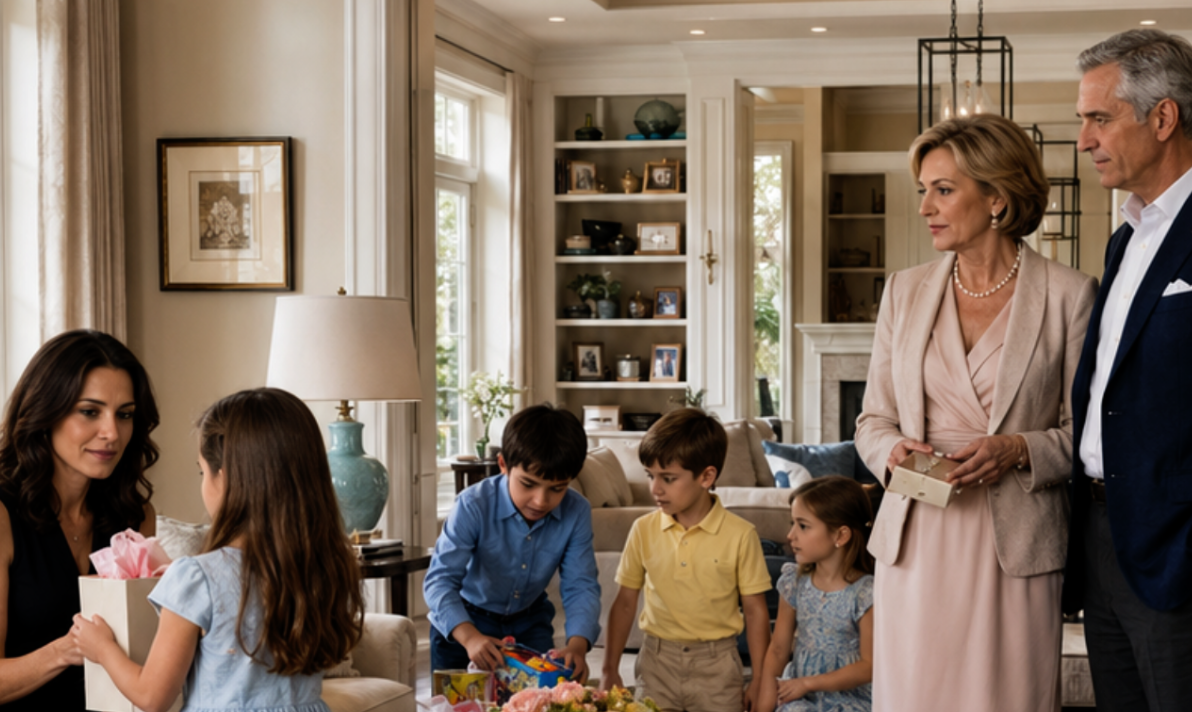
Easter Sunday at the Harrison Estate in suburban Ohio was never a mere family gathering; it was an exercise in ostentatious tradition and a meticulously curated display of generational wealth. My parents, George and Martha Harrison, treated religious holidays and familial milestones exactly like high-stakes corporate mergers. These events were grand, theatrical displays designed to reinforce the family hierarchy and remind everyone of their exact place within it. Their mansion, a sweeping, neo-colonial monstrosity characterized by imposing white pillars, slate roofing, and unnervingly perfect manicured hedges, felt significantly more like a sterile museum than a sanctuary of family warmth. The air inside was invariably thick, suffocating beneath the heavy scent of roasting garlic lamb, imported lilies, and the desperate, palpable need for social validation.
The vast living room, sunken and lined with floor-to-ceiling windows, looked as though a high-end, boutique toy store had suffered a spectacularly colorful, chaotic explosion. Mountains of shimmering gold-foil wrapping paper, embossed with designer logos, lay discarded like glittering autumn leaves across the antique silk Persian rug—a rug that Martha frequently reminded us was woven in the sixteenth century. My older sister, Megan, the family’s perpetual and undisputed “golden child,” squealed with a practiced, high-pitched delight that grated against my nerves. She watched as her three children violently ripped into their unearned spoils. George and Martha stood near the towering marble fireplace, arms crossed comfortably over their chests, beaming with a profound, radiant pride that they had never once directed toward my professional accomplishments, my academic milestones, or my life’s quiet victories.
“Look at the motorized Jeep! It has actual leather seats and a working radio!” Megan cried out, her voice echoing off the vaulted ceilings. She was already positioning her youngest toddler in front of the vehicle, aggressively framing an Instagram photo that would undoubtedly be captioned with hashtags proclaiming her blessed life and the unparalleled love of the grandparents. “And the newest iPads for all three of them! Oh, Mom, Dad, you really shouldn’t have! This is simply too much!”
“Nonsense, darling,” Martha countered smoothly, waving a perfectly manicured hand adorned with a blinding diamond solitaire, as if she were swatting away a peasant’s insignificant plea. “We want our grandbabies to have the absolute best. Only the best for the continuation of the Harrison legacy.”
In the furthest, darkest corner of the room, sitting on the very edge of an uncomfortable, stiff velvet sofa that likely cost more than my first three years of university tuition, was my eight-year-old daughter, Lily. Her small hands were entirely empty. Her woven wicker Easter basket sat abandoned at her feet on the hardwood floor, containing absolutely nothing but a single, neon-green plastic straw I had purchased from the local grocery store during a desperate, last-minute stop. I had been explicitly, firmly instructed not to bring gifts this year. Martha had called me the week prior, insisting that “Grandma and Grandpa had everything handled, so don’t you worry your busy little head about a thing.”
Lily watched in absolute silence as her boisterous cousins unwrapped custom Burberry trench coats, high-end electronics, and miniature luxury toy cars that easily cost a thousand dollars apiece. She sat perfectly still, her small chest rising and falling in shallow, rhythmic breaths. She didn’t cry. She didn’t beg. She simply observed the towering mountain of gold growing exponentially in front of her cousins, deeply feeling the deafening, oppressive silence that surrounded her own small person.
Martha glanced at Lily briefly, her cold blue eyes skating over my daughter’s quiet form as if she were a smudge on an otherwise pristine windowpane. She then swiftly turned her attention back to Megan’s swirling chaos.
“Oh, Sarah,” she said to me, her tone dismissive, airy, and laced with a patronizing edge. “We figured you’d have the ‘practical’ stuff covered for Lily. You’ve always been so painfully self-sufficient and… well, frugal. We didn’t want to overstimulate her with too much commercial fluff. You understand, don’t you? Megan’s brood… well, they need the extra magic to keep them spirited and engaged.”
I felt a cold, sharp lump form rapidly in my throat, a physical, jagged manifestation of a decade’s worth of swallowed resentment and forced politeness. It fundamentally wasn’t about the toys. I was a successful woman; I could easily buy Lily a tablet or a toy car. It was about the systematic, intentional erasure of my daughter’s inherent value. They hadn’t even bothered to buy her a single, inexpensive chocolate egg. To them, I was merely the utilitarian daughter who didn’t “need” emotional support because I was supposedly “strong.” By cruel extension, my child was treated as a ghost haunting her own family tree.
As I watched my father discreetly hand Megan a thick, unmarked white envelope—undoubtedly the “travel stipend” for her family’s next unearned luxury vacation—Lily reached down to gently touch the empty plastic straw in her barren basket. As the chaotic celebration roared on, I caught Lily staring at her cousins. She didn’t look envious; she looked profoundly hollow. It was the devastating look of a child who had just consciously realized she was an afterthought, a realization that, once settled in the bones, never truly leaves the soul. And as George pompously raised a crystal flute of champagne to toast “the bright future of the family,” I saw Lily whisper something to herself that made the blood in my veins turn to absolute ice.
The hour-long drive back to our apartment was utterly suffocating. The silence in the confined space of the car was a living, breathing thing—heavy, humid, and thick with unspoken grief. I repeatedly glanced at Lily in the rearview mirror; she was staring blankly out the window at the passing suburban sprawl, her reflection pale and ghost-like against the dark tinted glass. Every single time we passed a neighborhood house adorned with cheerful, pastel Easter decorations or inflatable bunnies, I felt a fresh, violent surge of nausea twisting in my stomach.
I couldn’t bear the harrowing thought of Lily going to bed with that hollow, defeated look permanently etched onto her face. Driven by an intense maternal panic, I abruptly pulled the SUV into a 24-hour CVS pharmacy. The parking lot was bathed in the harsh, buzzing, sickly-sweet glow of fluorescent lights. The damp air outside smelled strongly of impending rain, old cracked asphalt, and vehicle exhaust. It was, without a doubt, the least magical, least opulent place on earth, serving as a stark, gritty contrast to the manicured perfection of the Harrison mansion.
I practically ran through the sterile aisles with a frantic, desperate energy. My heart hammered against my ribs like a trapped bird desperately seeking a way out. I scoured the limited seasonal section and finally found a $60 professional-grade adult coloring book set, complete with heavy-stock paper and a full array of metallic, dual-tipped markers, alongside a large, premium bag of dark chocolates. It was objectively pathetic compared to the motorized Jeeps and the glittering Apple products, but it was the absolute best I could offer her in that desperate, fleeting moment. The plastic shopping bag crinkled sharply, violently loud in the stagnant quiet of the car as I leaned over the console to hand it to her.
“Here, baby,” I said, my voice thick with unshed tears and profound regret. “An extra surprise just for you.”
Lily sat motionless in the passenger seat, slowly taking the bag. She clutched the heavy coloring book to her chest as if it were a literal, physical shield designed to protect her against a hostile, uncaring world. She didn’t attempt to open it. When she finally spoke, her voice was barely a breath—fragile, trembling, and breaking into the quiet air.
“Mommy… did I do something wrong? Am I not a good girl like my cousins?”
That single, innocent question shattered my heart into a million jagged, irreparable pieces. The immense guilt I had suppressed for years—the guilt of repeatedly subjecting my vulnerable child to these toxic people in the desperate, foolish hope of gaining their discarded scraps of affection—boiled over into a sudden, blindingly icy clarity. I threw the car into park, unbuckled my seatbelt with shaking hands, and practically climbed over the center console, kneeling on the dirty floor mat of the passenger side. I took Lily’s small, soft face in my hands. Her cheeks were freezing cold, stained with the salty tracks of silent, dignified tears she hadn’t dared to shed within the oppressive walls of her grandfather’s house.
“No, baby,” I whispered fiercely, my voice vibrating with a new, dangerous, unfamiliar edge. “You are absolutely perfect. You are the smartest, kindest, most wonderful thing in this entire world. But Grandma and Grandpa just did something very, very wrong. They forgot that love isn’t something you are supposed to earn. And I swear to you, they aren’t going to get away with it. I promise you, Lily, you will never, ever feel like this again.”
In that exact, pivotal moment in a grim pharmacy parking lot, the persona of the “Reliable, Compliant Daughter” died a permanent death. I realized with staggering clarity that my prolonged silence wasn’t a manifestation of strength; it was absolute complicity. I had actively allowed my parents to treat my incredible daughter as a second-class citizen simply to maintain a fragile, fictional facade of family unity—a unity that only ever benefited the people sitting comfortably at the top of the hierarchy. I realized that George and Martha didn’t love my “strength” or my independence; they loved my lack of required maintenance. They loved that I was a free, inexhaustible resource they didn’t have to emotionally or financially invest in.
As I pulled the car back onto the rain-slicked main road, my mind shifted gears entirely. I began a meticulous, cold mental audit. I didn’t just see my parents as family anymore; I saw their assets, their intricate tax loopholes, their offshore accounts, and the entire decade of free, highly specialized professional labor I had provided to keep their sprawling estate solvent. I realized, with a thrilling surge of adrenaline, that I held the literal and figurative keys to their kingdom, and I was about to change the locks forever.
By trade and intense education, I am a Certified Public Accountant, specifically operating as a specialist in high-net-worth forensic auditing and complex wealth management. For ten grueling years, I had single-handedly managed the Harrison Family Trust, navigating my parents’ labyrinthine investment portfolios entirely for free. Through my meticulous oversight, I had saved them nearly $200,000 in billable professional fees, sacrificing my weekends and late nights optimizing their wealth so they could effortlessly afford to subsidize Megan’s luxury lifestyle—a lifestyle of relentless excess fueled entirely by my uncompensated, unseen labor.
The next morning, I did not wake up as a grieving, rejected daughter. I woke up as a cold, calculating strategist. I spent four uninterrupted hours in my home office, the harsh blue light of the dual monitors reflecting in my focused eyes. Moving with surgical precision, I changed the administrative passwords to every single digital financial portal, banking interface, and investment dashboard I managed. I migrated all of my personal and professional working files to a highly encrypted, secure external drive. I then drafted a formal, legally binding “Termination of Services” notice that was as cold, clinical, and final as a morgue slab.
I then opened the master ledgers of the Harrison Trust. My paternal grandfather had originally established it with strict stipulations, legally mandating it to be split equally between the “descendants of the Harrison line” upon a certain maturation date. But as I dug deeper into the historical transactions, utilizing the forensic skills I usually reserved for corporate embezzlers, I thoroughly documented the “borrowing.” George had been systematically treating the irrevocable trust like his own personal, limitless piggy bank. There were massive “loans” documented for Megan’s extravagant destination wedding, sheer “advances” for her underwater mortgage, and rolling “stipends” to cover her children’s exorbitant private school tuitions. Every single cent was illegally drawn from the principal sum that was legally bound to be protected and grown for all beneficiaries, which crucially included Lily.
My cell phone violently buzzed on the polished mahogany surface of my desk. The caller ID flashed Martha’s name. I let it ring three times before answering.
“Sarah, dear,” she began, her voice retaining that airy, supremely entitled lilt, utterly oblivious to the hurricane gathering just off her shore. “Megan left an absolute disaster in the east playroom yesterday—sticky candy fingers on the silk upholstery, you know exactly how it is with her lively bunch. Anyway, George and I have that important charity brunch at the country club this afternoon. Could you be a dear and pop over to handle the cleanup? Oh, and please bring those quarterly tax returns for us to sign. George wants them filed by Wednesday to avoid the end-of-month rush.”
I stared dead-eyed at the complex spreadsheet glowing on my laptop—the exact document that meticulously traced how George had illegally “borrowed” $50,000 from the family trust just last month to pay out-of-pocket for Megan’s new, custom-designed Italian kitchen.
“No, Mom,” I said. My voice was as smooth, flat, and impenetrable as polished glass, entirely devoid of the usual anxious tremor of the daughter forever trying to please.
“Excuse me? What on earth did you just say?” The shock in her voice was palpable.
“I’m afraid I’m incredibly busy. In fact, I’m going to be very busy for a very long time. You’ll find everything you require in the certified mail tomorrow morning. Do not call me again today, Martha. I have a significant amount of actual work to do for my paying, legitimate clients.”
“Sarah, honestly, don’t be so terribly dramatic. It was just a few silly toys. You’ve always been the strong, sensible one, the one we can universally count on. Don’t start being difficult and emotional now—it really doesn’t suit your temperament.”
I disconnected the call without uttering another syllable. I waited for the usual, familiar surge of anxiety, the cold sweat of guilt that usually accompanied any defiance of my parents. It never came. Instead, I felt a profound, heavy, anchoring peace. I then clicked over to my email client and hit “Send” on a heavily encrypted message to a top-tier forensic accountant and lawyer I had known since my university days, a ruthless man who specialized exclusively in trust litigation and fiduciary fraud.
Subject: Fiduciary Negligence and Embezzlement Inquiry: Harrison Family Trust. Attachments included.
I watched the small “Message Sent” notification flicker onto the screen. My parents arrogantly believed their absolute power was derived from the grand iron gates at the front of their property and the social weight of their last name. They were about to learn, in the most painful way possible, that their sprawling bank accounts only existed because I was the sole architect who knew exactly where the financial bodies were buried—and I was the architect who had just willingly handed the detailed treasure map to the authorities.
Forty-eight hours later, the desperately requested “Emergency Family Meeting” took place. They had demanded I come to the estate; I categorically refused. I forced them to travel across town and enter my modest, unassuming two-bedroom apartment. When my parents and Megan finally arrived, they looked as though they had been summoned to a hostile, high-stakes legal deposition. Megan stood awkwardly in the entryway, nervously clutching her authentic Birkin bag against her chest as if she were genuinely terrified that the thoroughly middle-class air circulating in my living room would somehow tarnish the expensive leather.
“This is absolutely ridiculous, Sarah, and incredibly unprofessional,” George blustered loudly, pacing the short length of my small, cozy living area, his face flushed with indignation. He aggressively threw a thick manila folder onto my glass coffee table. “You sent us an itemized invoice for $195,000? For backdated, retroactive accounting fees? We’re your parents, for God’s sake! You do not bill your own blood for family favors!”
“And I am a highly certified professional,” I replied, remaining seated across from them. I held a level of absolute, chilling stillness that clearly unnerved them more than screaming ever could have. “For ten consecutive years, I have acted as your unpaid Chief Financial Officer. I have rigorously tracked your volatile investments, filed your increasingly complex taxes, and managed a generational trust that you have systematically, ruthlessly looted to fund Megan’s endless series of financial failures.”
I slowly slid a single, crisp sheet of paper across the table. It was an executive summary outlining every illegal “loan” George had siphoned from the trust.
“You spent $2,300 on extravagant Easter gifts for Megan’s children,” I stated, my voice dropping to a dangerous whisper that instantly commanded the entire room, sucking the oxygen from the space. “That specific money was illicitly drawn from a trust fund that legally, undeniably half-belongs to Lily. You didn’t just emotionally neglect my daughter; you actively, knowingly stole from her future security to buy her cousins’ temporary affection. You committed textbook fiduciary negligence, Dad. That is a federal felony.”
George’s face rapidly drained of color, turning a ghostly, mottled shade of gray as the reality of the documentation set in. Megan looked as though she were about to physically faint, her hand moving instinctively to hover over her stomach as if she could protect her own financial interests from the impending blast radius.
“You have exactly forty-eight hours to entirely replenish the principal of the trust,” I continued, standing up. Though I was physically shorter than my father, in that defining moment, I towered over all of them. “Furthermore, you will pay my invoice for services rendered in full. If the wire transfers do not clear my accounts by Friday morning, the comprehensive forensic report I’ve prepared—complete with undeniable evidence of the co-mingling of restricted funds and tax evasion—goes directly to the state regulatory board and the IRS Criminal Investigation Division. I am not asking you, George. I am telling you. You will never, ever treat my daughter as ‘less than’ again, because you are going to pay a premium price for the sheer privilege of having had my competence in your life at all.”
Martha, sensing the absolute destruction of her social and financial standing, reached out with trembling hands to touch my arm. Her eyes filled with a highly performative, watery grief. “Sarah, please, darling, we’re family… Lily loves us, we know she does… we can make this right. We’ll buy her the motorized Jeep! We’ll buy her two of them! Whatever she wants!”
I pulled my arm away as if her touch burned, my eyes as cold and unforgiving as a bleak winter morning. “We were a family, Martha. Now, we are simply a legal settlement. You traded a fiercely loyal daughter for a remarkably greedy one, and you happily traded a granddaughter’s heart for a piece of plastic machinery. I truly hope the aesthetic was worth the price, because it is definitively the most expensive toy you have ever bought.”
George looked down at the staggering invoice, then back at the undeniable, meticulously formatted evidence of his own prolonged fraud. He realized, perhaps for the very first time, that the quiet daughter he had continuously dismissed as merely “self-sufficient” was the only person in the world who possessed the capability to keep him out of a federal penitentiary. He looked at me, really looked at me, and I saw stark, unadulterated terror in his eyes.
I did not wait around for them to formulate an apology. I knew intrinsically that a “sorry” originating from people who exclusively calculate the metric of love in dollars and cents was nothing more than a manipulative down payment on their next inevitable betrayal. True to their fear of incarceration, the funds cleared my accounts on Thursday afternoon. I took the settlement money—every single, legally owed cent of it—and immediately moved Lily and myself three hours away to a vibrant, progressive, and welcoming school district nestled in a community that placed a heavy, genuine emphasis on the arts, outdoor recreation, and character development over material accumulation. I utilized the capital to open my own boutique private firm, Miller & Associates, successfully migrating my highest-paying, most respectful clients with me.
Exactly six months after our departure, a massive, obnoxious, glittery box was unceremoniously dropped at the front door of our new, sunlit townhouse. It was an incredibly elaborate, custom-built, five-story wooden dollhouse that must have cost upwards of five thousand dollars. It featured working miniature chandeliers and real velvet drapes. Attached was a thick, embossed card from Martha, written in her elegant, increasingly shaky script:
To our darling Lily, with all our endless love. We miss you every single day. Please, please call us.
Lily came home from her new school a few hours later, her canvas backpack slung casually over her shoulder, her cheeks brightly flushed from aggressively playing soccer in the autumn air. She stopped in the foyer, looked down at the massive, overwhelming box, and then slowly shifted her gaze toward the simple wooden shelf in our cozy living room. Resting perfectly on that shelf sat the $60 coloring book from the CVS pharmacy. Its thick pages were now entirely filled with vibrant, chaotic, and beautiful metallic art that the two of us had spent countless hours creating together, sprawled out on the floor of our new, peaceful home.
“Do you want to open it, Lily?” I asked quietly, watching her reactions closely. I had vowed I wouldn’t stop her. I wanted her to have the agency to choose her own path.
Lily stared at the box for a moment longer, then firmly shook her head. There was a profound, newfound confidence settling in her posture, a bright, undeniable light in her eyes that had been entirely absent on that dark, oppressive Easter Sunday.
“No, thanks, Mommy. It looks like the kind of fancy toy that comes attached to a whole lot of rules and expectations. Can we just go to the neighborhood park and use the new soccer ball instead?”
I felt a massive, overwhelming surge of maternal triumph that no bank balance, trust fund, or corporate merger could ever possibly match. I hadn’t merely won a brutal legal and financial battle against my abusers; I had successfully, permanently deprogrammed my brilliant daughter from the toxic, generational cult of “performance love.” I realized, with a deep sense of poetic justice, that the absolute most expensive, valuable gift I had ever received in my life was that cheap drugstore coloring book—it was the physical key that had finally unlocked the heavy iron door to our permanent freedom.
The Harrisons’ lives, meanwhile, were predictably and spectacularly crumbling back in their affluent suburb. Without my constant, free labor protecting them from their own financial incompetence, George had disastrously botched their complex annual tax filings. This singular error triggered a massive, unyielding federal audit that ultimately cost them nearly a third of their remaining liquid estate in fines and penalties. Megan, sharply realizing that the endless well of subsidies had finally run dry, abruptly moved her entire family to South Florida in desperate search of a “wealthier circle” to leech from, completely stopping taking Martha’s frantic phone calls in the process. The perpetual “Golden Child” had absolutely no use or interest in aging parents who could no longer afford to pay the exorbitant toll for her presence. George and Martha were entirely alone, trapped inside their echoing museum of white pillars and imported silk.
I sat on the wide, wooden porch of my new home that evening. The crisp evening air smelled beautifully of freshly cut grass, blooming lilacs, and freedom. I watched with quiet joy as Lily ran wildly through the oscillating sprinklers with a chaotic group of neighborhood children, her unrestrained, genuine laughter serving as the only music I would ever need. I thought back to the $2,300 my parents had carelessly spent on that fateful Easter Sunday—a superficial price they believed they were paying for lavish gifts, but which was, in reality, the exact price they paid to permanently lose the only capable, loyal child they had ever produced.
As the sun began to dip below the treeline, my phone buzzed softly in my pocket. It was a lengthy text message from my father, sent desperately from a brand-new number I hadn’t yet had the opportunity to block:
Sarah. Megan has retained a ruthless attorney and is actively suing us for the primary deed to the mansion. She claims we legally promised it to her in writing three years ago. We are going to lose absolutely everything we have built. We’re getting older, and your mother is sick with the stress. We desperately need your help to untangle this mess. Please, please come home.
I stared at the glowing screen for a long, quiet minute. I didn’t feel a shred of pity. I didn’t feel a vengeful sense of spite or malice. I felt absolutely, wonderfully nothing at all, which I recognized as the ultimate, greatest victory a survivor could ever achieve. I calmly pressed the screen, permanently blocking the last remaining digital tether to my old, miserable life. I was no longer the reliable, “strong one” forced to carry their massive burdens solely so they could remain comfortably light and unbothered. I was simply a professional, a mother, and a woman who finally, unequivocally knew her true worth.
I realized then, with absolute certainty, that the toxic, insidious legacy of familial favoritism only survives and thrives for as long as the “unfavored” individual willingly agrees to sit at the rigged table and play the game. The exact, miraculous moment you stop desperately seeking their validation, their perceived power evaporates entirely, vanishing like morning mist under a blazing sun. My parents were ultimately left with exactly what they had cultivated: a spoiled daughter who actively hated them and a brilliant granddaughter who wouldn’t even recognize their faces on the street.
I picked up a new, heavy leather-bound notebook from the small table beside me. On the very first crisp, blank page, utilizing a fountain pen, I wrote in clear, bold, unyielding script:
For the first time in thirty-five years of existence, I knew exactly what the narrative of the next page would say, and I knew, with absolute joy, that I would be the sole author writing it. I was no longer a minor, supporting character trapped in the tragic Harrison family story. I was the master and author of the Miller legacy.
“You did it, Mommy!” Lily yelled happily, running up the porch steps, soaking wet and grinning brightly like a radiant sunbeam. “I kicked the ball all the exact way to the back fence, just like you showed me!”
“I saw you, baby,” I whispered softly, gently tucking a wet, smelling-of-summer strand of hair behind her delicate ear. “You are incredible. And you did it all on your very own.”
The sun slowly set over the vibrant horizon of our newly forged life, casting long, warm, golden shadows across the lawn that felt exactly like a sacred promise finally kept. I was entirely free. Lily was completely safe. And the Harrisons were finally, painfully learning the most universal truth of all: you cannot possibly buy a legacy when you have already bankrupt your own soul.