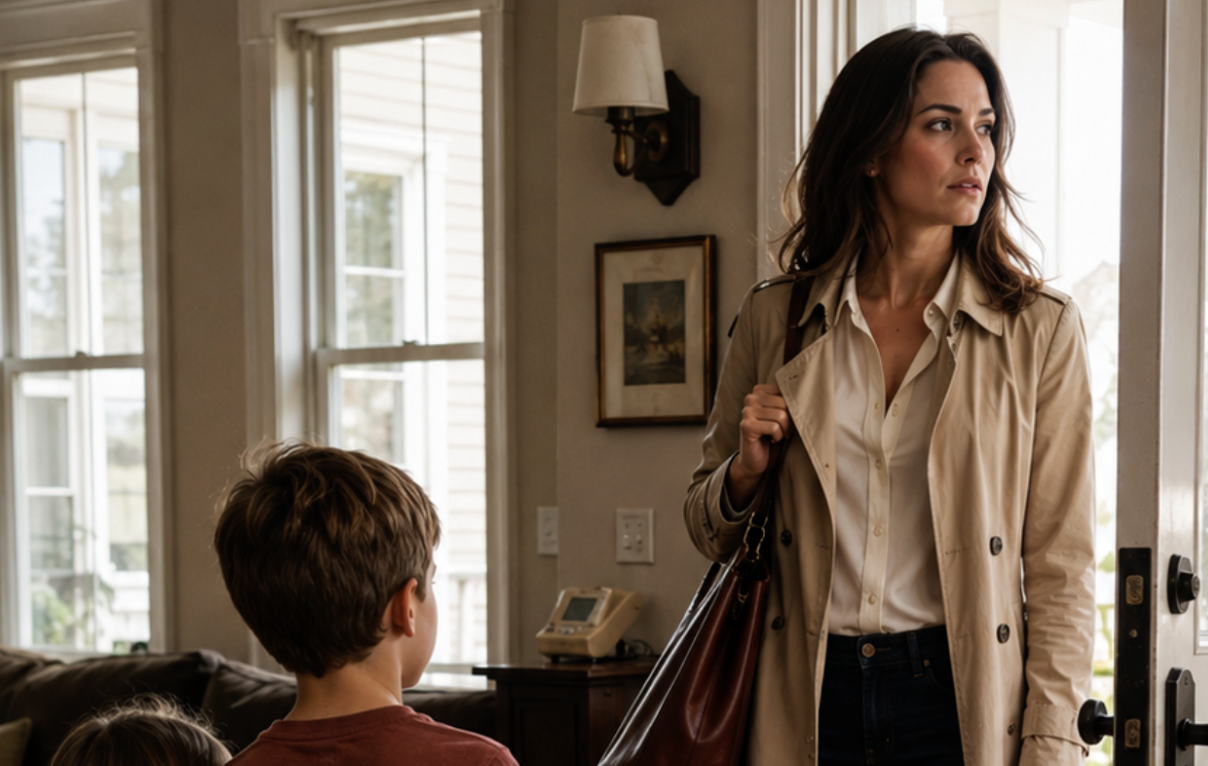
I answered with a distracted, “Hello?”
The boardroom of my downtown firm was humming with the low, sterile, and entirely predictable drone of corporate strategy. Vast spreadsheets bled their endless grids across the glowing projector screen, illuminating the twelve expectant faces waiting for me to dissect the quarterly projections. I had my heavy silver pen poised over a yellow legal pad, fully prepared to systematically dismantle a flawed marketing budget that had been irritating me all morning.
For one agonizing, suspended second, there was only static on the line. It was not the crisp silence of a muted microphone, but the faint, hollow rustle of movement, like someone fumbling blindly with a heavy receiver in the dark.
Then, a voice broke through the white noise. It was tight, raspy with deep exhaustion, and terrifyingly small.
“Dad?”
I was on my feet before my conscious brain could even fully register the sound or the implications of the caller ID. My knee clipped the thick edge of the mahogany table, sending a sharp tremor through the polished wood and rattling the water glasses, but I didn’t feel a singular ounce of pain.
“Micah? Why are you calling me from a different number? Where’s your mother?”
My six-year-old son sniffed hard into the receiver. It was that specific, ragged, and desperate intake of breath children use when they are trying with all their might to be brave, usually because they’ve been forced to be brave for far too long.
“Dad… Elsie won’t wake up right.” His voice cracked, splintering into a quiet sob. “She keeps sleeping and she feels really hot. Mom isn’t here. We don’t have anything left to eat.”
The opulent conference room, the glowing spreadsheets, the million-dollar projections—they instantly vaporized from my reality. The entire universe violently shrank to the exact dimensions of that tiny phone speaker. I shoved my leather executive chair backward with such violent force that it crashed loudly into the drywall. A coworker jumped, his eyes wide with alarm, but I offered no explanation. I didn’t apologize. I didn’t grab my expensive wool coat. I simply snatched my car keys from the table and sprinted for the heavy glass doors.
While sprinting down the carpeted corridor toward the elevator bank, my thumb desperately mashed the screen to dial Delaney.
It went straight to voicemail.
I slammed my palm against the elevator’s down button, leaning my weight into it as if the physical pressure could summon the car faster, and called her again.
Voicemail.
A cold, metallic dread began to rapidly coat the back of my throat, tasting like copper and panic. By the time I reached the concrete, echoing belly of the underground parking garage, my pulse was hammering against my ribs with the frantic force of a trapped bird. My hands shook so uncontrollably that I deeply scratched the painted door of my sedan just trying to force the key into the lock.
Earlier that week, Delaney had texted me a breezy, casual message stating she was taking the kids to a friend’s lake cabin for a long weekend. Service would be spotty, she had claimed. Because we were in the middle of our carefully choreographed and highly rigid custody rotation, and because our co-parenting dynamic had settled into a tense but functioning truce for the past eight months, I had believed her without question. I had selfishly enjoyed three days of uninterrupted quiet. Three days of focusing entirely on my career.
Now, as I tore out of the parking garage, my tires screaming in protest against the abrasive asphalt, the only sound echoing in my skull was Micah’s thin, hollow voice. We don’t have anything left to eat.
I called Delaney one final time, gripping the leather steering wheel until my knuckles turned an absolute, bloodless white. “Pick up,” I hissed at the windshield, violently swerving around a stalled delivery truck that dared to block my path. “Damn it, Delaney, pick up the phone.”
She didn’t.
I blew completely through a yellow light that had long turned a solid, undeniable red, my heart lodged firmly in my throat, violently praying to a God I rarely spoke to that I wasn’t already too late. I took the final corner onto her quiet, tree-lined street in East Nashville so fast the chassis shuddered. My eyes frantically scanned the property as the house came into view, and the breath completely and instantly left my lungs.
The front door was slightly ajar, swinging lazily in the warm afternoon breeze like an open, yawning grave.
I made the drive in twenty-two minutes flat, bumping hard over the concrete curb and violently throwing the transmission into park before the vehicle had even fully stopped moving.
The front porch looked entirely, horrifyingly wrong. There was no scattered, colorful chalk decorating the concrete. There were no discarded plastic tricycles or muddy shoes. There was just a suffocating, unnatural stillness that seemed to press down on the very air around the house.
I bolted up the wooden steps, taking them three at a time, my chest tight enough to snap my own ribs. “Micah!” I yelled, shoving the heavy front door wide open so it banged against the interior wall.
The silence inside the house was absolute and devastating. It wasn’t the peaceful, domestic quiet of sleeping children on a Sunday afternoon; it was the heavy, stagnant, rotting silence of an abandoned place. The air felt thick, smelling faintly of sour milk and desperation. It made my stomach enter a sickening free-fall.
Then, I saw him.
Micah was sitting on the living room rug, his frail knees pulled tightly to his chest, clutching a faded, embroidered throw pillow to his body like a medieval shield. His blonde hair was wildly matted to the left side of his forehead, darkened with sweat. His pale cheeks were heavily streaked with dried dirt and something dark that looked suspiciously like dried chocolate syrup. But it was his posture that truly broke me. His little body carried that unmistakable, horrifying stillness that traumatized children take on when they have moved far past crying, far past hoping, and have descended into pure, instinctual waiting.
He looked up at me, his blue eyes huge, glassy, and hollow. “I thought maybe you weren’t coming.”
I crossed the span of the living room in two massive strides and hit my knees so hard the old hardwood floorboards groaned in protest. I pulled his small frame into my chest, burying my face in his dirty hair. He smelled like stale sweat, unwashed pajamas, and pure fear.
“I’m here, buddy. I’m right here, I promise,” I choked out, my voice trembling. “Where’s your sister?”
Micah didn’t speak a word. He just pointed a trembling, frail finger toward the large sofa in the corner of the room.
Three-year-old Elsie lay curled tightly beneath a heavy, wool winter blanket, despite it being a humid, warm spring afternoon. Her round face was paper-pale, completely drained of life, yet two angry, burning red flags of fever stained her cheeks. Her small lips were severely cracked and bleeding slightly, her chest rising and falling in terrifyingly shallow, ragged, uneven hitches.
“Elsie,” I breathed, rushing over and pulling the thick blanket back.
I pressed my broad palm to her forehead and jerked it back instinctively. The intense heat radiating off her fragile skin was absolutely terrifying. It felt exactly like pressing my hand against a working radiator. I scooped her up immediately, cradling her to my chest. Her head lolled backward over my forearm with zero resistance, her small limbs heavy, dead-weighted, and entirely limp.
“We’re leaving. Right now,” I said, forcing a terrifyingly false veneer of absolute calm into my voice. “Shoes on, Micah. No questions right now. You stick right by my leg.”
He scrambled frantically to his feet, almost tripping over the unlaced strings of his own sneakers in his rush to obey. “Is she just sleeping, Dad?”
I swallowed the heavy, acidic lump of pure bile rising rapidly in my throat. “She’s sick, buddy. But we’re getting help. We’re going to the doctors.”
As I turned sharply toward the door, my eyes caught the kitchen, and my blood froze. It was a macabre tableau of severe neglect that would burn itself into my retinas for the rest of my life. An empty, brightly colored cereal box lay violently crushed on the counter. The metal sink was an overflowing mountain of foul-smelling, crusty dishes. The refrigerator door was propped slightly cracked open; peering inside, I saw there was only half a plastic bottle of cheap ketchup and a withered, brown lemon. There was no milk. No bread. Absolutely nothing a six-year-old could safely reach or prepare.
Beside the sink sat a small, plastic pink sippy cup with a dark, dried, sticky ring of ancient apple juice crusted at the very bottom.
I physically turned my head away before the rising, white-hot rage could completely blind me to the task at hand. I practically carried them both to the car, urgently ushering Micah into the back seat and buckling Elsie into her car seat with violently shaking hands. I slapped the hazard lights on, slammed my foot onto the gas pedal, and sped recklessly toward Vanderbilt Children’s Hospital.
Halfway there, over the distant, wailing sound of city sirens, a tiny, fractured voice floated from the backseat.
“Dad? Is Mom mad at me?”
I locked eyes with him in the rearview mirror, my heart shattering into a thousand irrecoverable pieces. “No, Micah. No one is mad at you. I need you to listen to me very carefully. I’ve got you both. You’re safe now.”
He was quiet for a long, agonizing moment, staring out the window at the blurred city streets. Then he whispered into the silence, “I tried to make Elsie crackers… but she wouldn’t chew them. She was too tired.”
My vision instantly blurred with thick, hot tears. I reached my arm back blindly, my fingers searching until I found his small, bony knee and squeezed it firmly. “You saved her life, Micah. You did exactly the right thing. You are a hero.”
I pulled aggressively into the ER bay, laying my hand flat on the horn to scatter the surprised pedestrians walking near the entrance. I unbuckled Elsie, pulling her disturbingly limp body into my arms, and kicked the heavy car door shut behind me. But as I sprinted toward the automatic sliding glass doors, Elsie let out a sharp, rattling, wet gasp against my shoulder, and the delicate rise and fall of her chest suddenly and completely stopped moving.
“I need help!” I roared at the top of my lungs, the sliding automatic doors barely parting fast enough as I burst into the brightly lit triage area like a madman. “She’s not breathing right! I need a doctor right now!”
The sterile, fluorescent-lit waiting room instantly erupted into a flurry of highly controlled, professional chaos. A triage nurse materialized with a rolling gurney in a matter of seconds, her face a mask of intense focus.
“How old?” she demanded sharply, her gloved hands already moving expertly over Elsie’s tiny, motionless frame.
“Three,” I choked out, running frantically alongside the gurney as they wheeled it down the hall. “Massive fever. Barely responsive. They’ve been home alone. I don’t know for how long. Days, maybe.”
The nurse’s dark eyes snapped up to meet mine, a hard, sharp, unmistakable flash of intense judgment flaring in her pupils before she expertly masked it back behind a wall of clinical detachment. “We’re taking her straight to Trauma One. You have to stay here.”
They crashed aggressively through heavy wooden double doors, leaving me completely stranded in the harsh, brightly lit hallway. The sudden absence of my daughter left my arms feeling useless and cold. I looked down. Micah was gripping the fabric of my suit pants so tightly his small knuckles were stark white, his entire, fragile body vibrating uncontrollably like a plucked guitar string.
I dropped to my knees, right there on the scuffed hospital linoleum, completely ignoring the sympathetic and horrified stares of the crowded waiting room. I pulled him fiercely tight against my chest, shielding him from the clinical environment. “They’re fixing her, buddy. I’m not going anywhere. I swear to you on my life, I am right here.”
“She’s gonna wake up, right?” he pleaded, his voice cracking with a sorrow too heavy for a child to bear.
I had never made a promise in my life with less certainty of the outcome, but I reached down deep and injected every single ounce of paternal authority and confidence I possessed into my voice. “Yes. She’s going to be absolutely fine.”
The next two hours morphed into a grueling, waking nightmare. I paced the waiting room floor until my dress shoes squeaked, gave my insurance information to a glassy-eyed clerk, and eventually found myself sitting in a cramped, windowless administrative office with a hospital social worker. Her name was Sarah, a deeply composed woman with thick, silver-rimmed glasses and a yellow legal notepad balanced casually on her knee.
I told her everything. The strict, court-mandated custody arrangement. Delaney’s casual, lying text message about the lake house. The harrowing sight of the empty kitchen. The crust in the bottom of the plastic cup. The chocolate syrup on my son’s face.
“Do you have any idea where their mother is currently located?” Sarah asked, her pen pausing over the paper, her tone carefully neutral.
“No,” I said flatly, the adrenaline finally ebbing enough to allow a dark, consuming anger to begin overtaking the sheer panic. “I haven’t heard her actual voice since Friday afternoon. She lied to me. She abandoned them.”
Sarah adjusted her glasses. “Are you fully prepared to take temporary full, emergency custody of both children while the state formally investigates this severe neglect?”
I leaned forward in the uncomfortable plastic chair, resting my elbows heavily on my knees, my voice dropping to a dangerous register. “I will burn the entire world down to the ash before I let them step foot back in that house.”
Before Sarah could formulate a diplomatic reply, a doctor gently tapped on the glass door and stepped into the cramped office. He looked incredibly exhausted, smelling of strong coffee and antiseptic, but the tight, grim lines around his mouth had noticeably softened. “Mr. Mercer? Elsie is stable.”
I dropped my heavy head into my hands, a jagged, tearing breath ripping its way out of my burning lungs.
“She was severely dehydrated and battling a remarkably nasty gastrointestinal infection,” the doctor explained quietly. “It escalated so rapidly over the weekend because her little body had absolutely no fuel or hydration to fight it off. We’ve got her on aggressive intravenous fluids and broad-spectrum antibiotics now. She’s sleeping naturally, not lethargically. You got her here just in time, Mr. Mercer. A few more hours, and her kidneys would have shut down entirely.”
I nodded dumbly, completely unable to form the words to thank him. I walked slowly back out to the waiting room to Micah, who was currently gnawing methodically on a dry graham cracker a kindly nurse had given him.
“She’s okay,” I whispered to him, kneeling to his eye level.
He instantly slumped forward against my shoulder, the immense, terrifying tension finally draining out of his tiny frame, leaving him limp and exhausted.
Just as I finally allowed my racing mind to believe the worst of the nightmare was over, the stern charge nurse approached me. Her face was completely unreadable, a professional blank slate. “Mr. Mercer? Can you please step out here to the desk for a moment?”
I patted Micah’s back and followed her into the bustling hallway.
“We ran a routine family notification trace in the system,” she said softly, keeping her voice low. “Another hospital in the network flagged the mother’s information based on the children’s profiles. Your ex-wife was admitted to Nashville General very early Saturday morning.”
My blood ran instantly cold. “Admitted? Admitted for what?”
“She was involved in a severe motor vehicle accident,” the nurse said, her eyes filled with pity. “She came into their ER as a Jane Doe. Completely unconscious. The man who was driving the vehicle fled the scene on foot before the paramedics even arrived.”
I stared blankly at the nurse, the low, electric buzzing of the overhead fluorescent lights suddenly becoming deafening in my ears.
An accident.
A hot, ugly, entirely visceral wave of pure fury washed over me first. She had deliberately abandoned our children—left a defenseless toddler and a kindergartener completely alone to slowly starve in a locked house—just so she could go out drinking with some nameless stranger who had ultimately left her bleeding and broken in a wrecked car.
But right beneath that blinding, white-hot rage was a darker, significantly more complicated knot of psychological horror. She hadn’t meant to disappear for three days. She hadn’t intentionally left them to die. She had been lying motionless in a hospital bed in a coma while her children slowly withered away, waiting for a mother who couldn’t physically return.
“Is she alive?” I asked, my voice entirely hollow, stripped of all emotion.
“She is currently stable,” the nurse offered gently. “Multiple bone fractures and a highly severe concussion. She just regained consciousness a few hours ago.”
I turned away without another word, scrubbing my hands brutally over my exhausted face. I walked deliberately down to the quiet, empty end of the corridor, pulled out my cell phone, and dialed Avery Kline, my utterly ruthless, brilliantly tactical family attorney.
“Avery. I need an emergency ex parte order for full, unyielding custody,” I demanded the absolute second she answered the line.
“Rowan? Slow down. Take a breath. What exactly is going on?”
“Delaney left the kids completely alone for days to go partying. She got in a massive wreck and ended up in a coma across town. Elsie is currently in the pediatric ICU on an IV because she almost died of dehydration. Micah thought his little sister was rotting away in front of him. I want full custody, Avery. I want the locks legally changed by tonight. I want her stripped of every single parental right she possesses right now.”
Avery’s voice shifted instantly from conversational to a razor-sharp, all-business tone. “Send me every single medical record, the doctor’s notes, and the DCS intake file immediately. I’ll have the motion drafted and sitting on a judge’s desk by 8:00 AM tomorrow.”
I hung up the phone, feeling the dark, metallic, satisfying taste of pure vengeance coating my tongue.
When I walked slowly back into Elsie’s recovery room, the sight before me instantly shattered whatever tough, impenetrable facade of masculine anger I was desperately holding onto. Micah had dragged a heavy, green vinyl visitor’s chair completely across the linoleum, right up to the metal railing of Elsie’s hospital bed. He was holding her little, pale hand through the steel bars, watching the steady rise and fall of her chest with the grim, vigilant, unblinking focus of a traumatized soldier standing watch in enemy territory. He clearly felt entirely, personally responsible for her continued survival.
A seasoned pediatric psychologist pulled me aside into the hallway an hour later.
“Mr. Mercer,” the doctor warned softly, her expression deeply serious. “Your son was forced to take on the massive psychological burden of a desperate parent trying to save a dying child. He is currently carrying a terror in his mind that will inevitably manifest in very ugly, difficult ways. You need to brace yourself for the fallout. Love alone isn’t going to be enough to fix this quickly. It is going to take relentless, exhausting, unyielding structure to make him feel safe again.”
I spent that entire night squeezed uncomfortably into a terrible, squeaking fold-out chair next to the bed, listening to the rhythmic, reassuring beep of Elsie’s heart monitor, my mind a turbulent ocean of fear and anger.
The very next morning, as the sun broke through the hospital blinds, Elsie fluttered her pale eyelids open. She looked around the bright, unfamiliar room, deeply confused and groggy, before her eyes finally landed on her older brother.
Micah instantly burst into violent, racking, uncontrollable sobs—the very first time he had shed a single tear since I found him sitting in that silent house. He scrambled frantically up onto the edge of the mattress and buried his wet face deep into the fabric of her hospital gown. “I missed you,” he sobbed, his small shoulders heaving.
Elsie patted his messy hair weakly with her IV-taped hand. “I was just sleepy, Mikey.”
I leaned over and smoothed their hair, kissed their warm foreheads, and silently promised them in my heart that I would absolutely never let anyone, especially their mother, hurt them ever again. Once they were happily settled with a morning nurse they seemed to like, and the kindly next-door neighbor I trusted most arrived to sit with them, I grabbed my car keys.
It was time to face the ghost. I drove directly across the city, my hands gripping the steering wheel so hard my wrists physically ached, fully preparing to walk into Delaney’s hospital room and completely, verbally destroy her.
The sterile halls of Nashville General Hospital smelled overwhelmingly of strong industrial bleach and burnt, stale coffee. I easily found Room 412, pushed the heavy, scuffed wooden door open with my shoulder, and stopped dead in the metal frame.
Delaney was sitting slightly propped up in the bed, staring utterly blankly at the beige wall opposite her. Her entire left arm was heavily encased in a thick, stark white plaster cast. A violent, mottled purple-and-yellow bruise painted the entire left side of her face, swelling her left eye completely shut. Her normally vibrant hair was greasy, limp, and matted to her skull. She looked incredibly frail, utterly broken, and easily a decade older than her thirty-two years.
Hearing the door, she turned her head slowly, wincing in obvious pain. When her one good eye finally registered my presence, she physically flinched, shrinking backward into the pillows like a beaten animal.
I stepped inside and stood squarely at the foot of her hospital bed. I didn’t yell. I didn’t raise my voice by a single decibel. I just looked down at her with an absolute, freezing, terrifying emptiness in my chest.
“The kids are alive,” I stated. The sheer, icy quietness of my voice seemed to echo much louder in the small room than a scream ever could have.
Delaney closed her good eye, a single tear instantly tracking down her unbruised right cheek. “I know. The local police came here. They told me everything.”
“What exactly did you do, Delaney?”
She couldn’t even look at me. She spoke directly to her trembling, pale hands resting on the blanket, her voice a ragged, pathetic whisper. “I was just so deeply tired, Rowan. I was so incredibly overwhelmed by the routine. I met a guy at the store. He said we’d just go out for one quick drink to unwind. I put the kids to bed. I locked all the doors tight. I genuinely thought I’d only be gone for two hours. Just two hours to feel like a normal, free person again.”
“You left a six-year-old child entirely in charge of a toddler with absolutely nothing to eat but half a bottle of ketchup in the fridge.”
She let out a suffocated, wretched sob, bending her broken body forward over her heavy cast. “I know. I know. We argued in the car on the way back. He was driving entirely too fast. I hit the dashboard and… everything just went totally dark. I woke up yesterday morning and… oh god, Rowan, I didn’t know. I swear I didn’t know.”
“Micah tried to feed her dry graham crackers because she was starving to death, Delaney. She almost died of massive dehydration. He sat in that silent, sweltering house for three full days, absolutely convinced his little sister was rotting away, just waiting for a mother who never came through the door.”
She clamped her uninjured hand over her mouth, wailing loudly now, the sound incredibly raw and pathetic, bouncing off the tiled walls.
I felt absolutely no pity for the broken woman in front of me. I felt only the cold, mechanical, evolutionary need to protect my bloodline from a predator.
“I’ve already had my lawyer file the emergency injunction,” I told her, my voice devoid of mercy. “I am legally taking full, legal, and physical custody of them both. You will have absolutely no access to them whatsoever unless a family court judge explicitly forces me to allow it. And I promise you, I will spend every dime I have to fight to make sure they never do.”
She looked up at me, her battered face contorting into a mask of absolute horror. “Rowan, please. Please. I made a terrible mistake. Are you really taking my babies away from me forever?”
“You did that to yourself,” I said coldly, turning sharply on my heel toward the door.
“Rowan, wait!” she pleaded, her voice cracking in desperation. “How are they? Please, just tell me how my babies are!”
I paused with my hand on the metal door handle, glancing back over my shoulder with a look of pure disgust. “Elsie will physically recover with time. But Micah… I genuinely don’t know if he will ever be able to trust another human being again.”
I walked out of the room, leaving her sobbing loudly in the sterile, lonely room. I honestly thought I had won the war. I thought legally cutting her out like a cancerous tumor would instantly fix the terrible infection in our family.
I couldn’t have been more devastatingly wrong.
That first week back at my house with the kids was a rapid descent into absolute psychological hell. Micah simply couldn’t sleep. He shadowed Elsie so obsessively during the day that if she merely closed the bathroom door to use the toilet, he would immediately bang his small fists against the wood until his knuckles bled, entirely terrified she was silently dying on the other side. I burned their dinners. I accidentally shrank all their clean clothes in the wash. I existed on a maximum of three hours of broken sleep a night, wandering the dark halls like a zombie.
On our fourth night home, at exactly 2:00 AM, a blood-curdling, terrifying scream ripped violently through the drywall of the house. I bolted out of my bed, grabbing a heavy brass lamp from my nightstand, entirely convinced a violent intruder was breaking in. I sprinted blindly down the hall and burst into Micah’s room.
He was thrashing violently in his tangled bedsheets, his blue eyes wide open but completely unseeing, trapped in a waking nightmare. “Wake up, Elsie! You have to wake up, please!” he shrieked into the darkness, frantically clawing at his own face with his fingernails.
I dropped the heavy brass lamp onto the carpet and immediately pinned Micah’s flailing arms to his sides, wrapping him tightly in a massive bear hug. I held him there, absorbing his frantic kicks, until the brutal night terror finally broke and he collapsed against my chest, sobbing uncontrollably into my t-shirt. I sat there and rocked his trembling body on the bedroom floor until the sun finally came up, realizing with absolute, crushing clarity that my immense hatred for Delaney wasn’t ever going to heal his broken mind. My righteous vengeance couldn’t act as a soothing psychological balm for my children’s profound trauma.
We started intensive trauma therapy the very next week. I formally stepped back from my demanding role at the downtown firm, taking a massive, humbling pay cut to work significantly reduced hours from my home office. I rapidly learned that true fatherhood wasn’t about being the cinematic hero who swoops in dramatically during a crisis to save the day; it was the grueling, invisible, entirely unglamorous, holy work of daily consistency. It was patiently folding tiny laundry at midnight. It was calmly answering the exact same fearful question—”Are you leaving today?”—twenty separate times a morning without ever losing my patience.
Meanwhile, entirely to my shock, Delaney surprised me.
She didn’t hire a sleazy lawyer to fight the emergency custody order. She seemingly accepted her absolute, devastating rock-bottom with a quiet dignity I didn’t know she possessed. She voluntarily started attending court-mandated psychological counseling, faithfully went to local AA meetings every single evening, permanently ended all contact with the terrible man from the car crash, and humbly moved into a tiny, depressing, incredibly cheap one-bedroom apartment right near the noisy highway.
Eventually, after months of stability, the court hesitantly ordered supervised visits at the sterile county family center.
The first visit was deeply agonizing for everyone involved. We sat awkwardly in a small, windowless room that smelled intensely of old, wet carpet and industrial bleach, a state social worker watching silently from a folding chair in the corner. Delaney sat rigidly on a plastic chair, her arm finally free of the cast but still supported in a black brace.
Micah immediately hid entirely behind my leg, absolutely refusing to make eye contact with her. Elsie clung to my neck like a terrified monkey.
Delaney didn’t push them. She didn’t selfishly cry and beg for their immediate forgiveness, desperately trying to place her own heavy emotional burden onto their tiny shoulders. She just sat down quietly on the dirty floor, opened a plastic box of colorful Legos, and methodically started building a small tower.
“I missed you guys,” she said softly into the room, deliberately not looking up at them, just gently snapping the plastic blocks together. “I’m right here if you want to play with me. If you don’t want to, that’s perfectly okay too. I’m just happy to see you.”
By the third painfully awkward visit, Elsie was bravely waddling over and handing her yellow blocks. By the tenth visit, Micah was bravely sitting cross-legged next to her on the floor, enthusiastically telling her an intricate story about a cool bug he had found in my backyard. Children are wonderfully pragmatic survivors; they naturally bend toward the steady light of consistency and safety. Delaney was showing up, entirely sober, entirely emotionally present, week after grueling week.
Four long months later, the dreaded date for the permanent custody hearing finally arrived.
I sat tensely in the grand, mahogany-paneled courtroom, dressed impeccably in my best tailored navy suit, a massive, thick file of glowing therapy notes and pediatric reports sitting proudly on the wooden table in front of me. Delaney sat quietly across the wide aisle. She wore a simple, modest beige blouse, her hair neat and clean, her facial bruising fully and entirely healed. She looked absolutely terrified, like a woman walking to the gallows.
Her public attorney spoke first, proudly highlighting her massive personal turnaround, laying out months of clean drug tests, and proving her steady, reliable employment. Then, Avery Kline stood up tall for me. She ruthlessly and clinically detailed the severe, near-fatal neglect, the lingering trauma Micah still battled at night, and formally asked the judge to make my full custody permanent, allowing Delaney only alternate weekends under strict, continued supervision.
The judge, a deeply stern, older man with heavy, intimidating jowls, peered silently over his reading glasses at me. He flipped slowly through a thick document on his desk, his brow deeply furrowed.
“Mr. Mercer,” the judge rumbled, tapping his expensive pen against the wood. “I am looking at a letter here directly from the children’s pediatric psychologist. It seems there is a significant irregularity in your legal request today.”
My stomach completely dropped. Avery stiffened noticeably beside me.
“An irregularity, Your Honor?” Avery asked smoothly, recovering quickly, though I could clearly see a tiny bead of nervous sweat forming at her hairline.
The judge ignored the lawyer and looked directly into my eyes. “The therapist notes that while the initial trauma was indeed severe and life-threatening, both children are currently showing remarkable, rapid progress during their supervised visits with their mother. The therapist formally recommends a gradual, structured shift to unsupervised, shared custody. Yet, you are aggressively pushing for maximum, permanent restriction. Mr. Mercer, stand up.”
I stood up slowly, mechanically buttoning my suit jacket, my heart thudding a frantic rhythm against my ribcage.
“Do you honestly believe their mother is a permanent, ongoing danger to their safety?” the judge asked bluntly, cutting through all the legal jargon.
I looked slowly across the wide aisle. Delaney was holding her breath, her hands clasped so incredibly tightly in her lap that her knuckles were bone white. She looked exactly like a doomed woman bracing for the executioner’s heavy axe to finally fall. I thought deeply about the blinding, righteous rage I had carried so proudly in the hospital hallway. I thought about the immense legal power I held in my hands right at this very moment to legally and permanently erase her from our daily lives forever.
But then I thought about my son, Micah, carefully handing her a blue Lego brick just yesterday afternoon, a tiny, genuine smile finally cracking his heavily guarded face.
“No, Your Honor,” I said clearly, and the entire courtroom went instantly, dead silent. Avery hissed my name angrily under her breath, grabbing my sleeve, but I completely ignored her.
“My children needed absolute safety, and I provided it for them,” I continued, my voice steady and resolute, echoing in the large room. “But they also deeply, fundamentally love their mother. She broke them, yes. That is an undeniable fact. But for the last four months, I’ve sat and watched her sit on a dirty carpet and patiently try to glue the broken pieces back together without once making an excuse for her actions. If the medical professionals say it’s safe for her to have them more, I will not stand in their way. I refuse to win a bitter war if the ultimate victory means my kids have to lose their mother entirely.”
Delaney let out a sudden, choked gasp, violently burying her face in her trembling hands as tears spilled over her fingers.
The judge’s intensely stern expression softened by just a fraction of an inch. “A highly wise father,” he murmured approvingly.
He struck his wooden gavel loudly against the block. He formally ordered primary physical custody to remain legally with me, but instituted a comprehensive, progressive schedule for Delaney, stepping up steadily to unsupervised weekends over the course of the next six months.
When we eventually walked out into the bright, blinding afternoon glare of the courthouse steps, Delaney approached me hesitantly on the concrete. She looked incredibly exhausted, thoroughly drained, but the haunting, vacant deadness in her eyes was finally gone.
“Rowan,” she said, her voice shaking with raw emotion. “Thank you. Thank you for not completely destroying me today when you had absolutely every legal right to.”
I looked at her, truly seeing her for the first time in years. I saw the vibrant woman I used to deeply love, the reckless woman who had utterly broken my heart, and the humbled woman who was finally, desperately trying to be a real mother.
“This was absolutely never about destroying you, Delaney,” I said softly. “It was always about saving them.”
The subsequent transition into our new routine wasn’t beautifully cinematic or perfect. It was incredibly clunky, often deeply awkward, and heavily littered with minor setbacks and emotional missteps. But slowly, inevitably, the very architecture of our daily lives shifted. Saturday afternoon supervised visits seamlessly became Wednesday night dinners at her small apartment. Then, eventually, overnight stays on the weekends.
One crisp, cool evening, I drove to her apartment building to pick the kids up after a long weekend visit. I knocked on the thin door, fully expecting the usual, chaotic, noisy scramble for lost shoes and scattered backpacks.
Instead, Micah opened the door almost immediately. He was beaming, grinning from ear to ear. “Dad, you have to come look at this!”
I stepped cautiously inside the warm apartment. Delaney was sitting peacefully at a small, cheap kitchen table, gently wiping white baking flour off Elsie’s little nose with a towel. They had been baking cookies. Delaney looked up at me, a tentative, incredibly genuine smile spreading across her face.
“Look what I drew, Daddy!” Elsie yelled happily, running over on her little legs and shoving a crumpled piece of bright construction paper directly against my knees.
I knelt down on the linoleum and took the paper from her hands. It was a crude, messy, beautiful crayon drawing. There were two distinct houses on the page—one painted blue, one painted red. Between the two houses, a massive, wildly colored, completely disproportionate rainbow connected the two separate roofs. Underneath the vibrant arc, four distinct stick figures were happily holding hands in a line.
“It’s us,” Elsie announced incredibly proudly, pointing a flour-dusted finger at the paper. “We live in two different places now, but we all go together.”
A heavy, emotional lump the exact size of a golf ball rapidly formed in the back of my throat. I looked up over Elsie’s head and directly met Delaney’s eyes. We quietly exchanged a long look that held so much heavy, unspoken history—deep betrayal, absolute terror, sheer fatigue, and ultimately, profound forgiveness. It wasn’t romance by any stretch of the imagination. We were never, ever going back to what we once were. It was something much harder to build, and significantly stronger. It was true, unconditional partnership for the sake of the children.
“Yeah, sweetheart,” I whispered, gently kissing the top of her messy, flour-dusted head. “We absolutely do.”
Later that exact same night, after I finally tucked them both safely into their warm beds in my house, I stood alone in the quiet, dim hallway. I deliberately left both of their bedroom doors cracked open, just enough so the small, amber hallway nightlight cast a warm, golden beam of safety across their bedroom rugs.
The profound silence of the house no longer felt like a terrifying, suffocating grave. It felt exactly like a hard-won sanctuary.
I leaned back heavily against the wooden doorframe, deeply reflecting on the terrible, grueling journey of the past year. I thought about the blinding, cold panic of that initial phone call, the sharp, antiseptic smell of the ER, the grueling, desperate nights on the carpet fighting Micah’s unseen demons, and the brutal, necessary humility required to finally let my righteous anger go.
I had come dangerously close to losing the entire shape of my family to a single, devastatingly reckless night. Instead of surrendering to the ruin, we had all waded through the toxic ashes of our old life and painstakingly forged something entirely new out of the rubble. It certainly wasn’t the pristine, picture-perfect nuclear family I had naively envisioned when Micah was first born. It was deeply scarred, highly complicated, and required constant, exhausting, daily maintenance.
But as I stood there and listened to the soft, steady, rhythmic breathing of my two children—safe, well-fed, and deeply, undeniably loved by two highly flawed but fiercely committed parents—I finally knew it was real. We had successfully survived our own absolute destruction, and we had built something beautiful in its place.