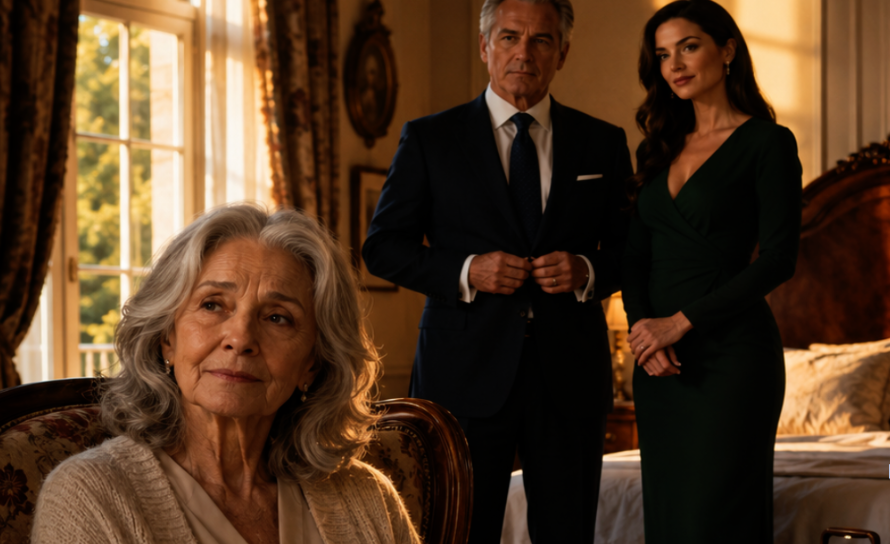
The morning Margaret arrived at the sprawling, ivy-draped stone estate, the sun had not yet dared to breach the horizon. The sky was a bruised, melancholic canvas of indigo and charcoal, weeping a steady, rhythmic rain that drummed softly against the slate roof. Inside the cavernous foyer, the house still carried the undeniable, suffocating weight of Arthur’s absence. It was a tangible thing, that absence—a sudden vacuum in the architecture of the life they had built together over nearly half a century. In the pristine, marble-tiled kitchen, one solitary coffee mug remained locked in the rack of the dishwasher, a porcelain ghost of a morning routine abruptly shattered. His tortoiseshell reading glasses, slightly smudged from fingerprints, rested exactly where he had abandoned them on the polished oak side table in the den. A charcoal cashmere sweater hung carelessly over the back of his favorite leather wingback chair in the living room, draped exactly where he had left it two nights earlier before walking out into the dark.
Forty-six years of marriage do not simply evaporate into the ether because someone decides to close a heavy oak door behind them. They do not vanish with the signing of a document, the packing of a suitcase, or a sudden, cruel confession. Instead, those decades linger maliciously in ordinary things. They hide in the scent of cedar in the closet, the familiar creak of the third stair, and the indented shape left behind on a down mattress. Margaret, carrying the heavy burden of both legal counsel and lifelong confidante, quietly placed her battered leather briefcase onto the expansive surface of the mahogany dining table. She did not immediately snap the brass clasps to remove the dense legal files. Instead, she walked with measured, silent steps around the table and gently squeezed Evelyn’s trembling shoulder.
Neither woman spoke. In a world obsessed with filling every void with meaningless chatter, their silence was a profound sanctuary. It was not empty; it was laden with a deeply respectful grief. When Evelyn finally lifted her gaze from the untouched porcelain teacup resting between her hands, her eyes were shadowed with an exhaustion that went far deeper than a lack of sleep. They were the eyes of a woman who had fought a phantom war she never asked to join.
“I kept thinking…” Evelyn’s voice was fragile, like dry parchment, and it faded into the quiet hum of the sleeping house. She took a slow, rattling breath before finding the strength to finish the thought. “…that growing old together meant we had already survived the hardest part. I thought the tempests of our youth, the early financial panics, the illnesses we battled—I truly thought we had outrun the storms.”
Margaret slowly pulled out the high-backed chair beside her dearest friend, her own face set in a mask of professional stoicism that barely concealed her personal sorrow. “Sometimes, Evelyn, people reveal their absolute true nature only after they believe they no longer need your kindness. They wear masks of devotion until the precise moment they feel invincible enough to discard them.”
Evelyn turned her head, looking past Margaret and out toward the rain-speckled bay window that overlooked the manicured, drenched gardens. “I miss the man he used to be,” she whispered to the cold glass. A long, agonizing pause followed, filled only by the sound of the storm battering the estate. “Or maybe…” She inhaled carefully, as if the air itself possessed sharp edges. “…I miss the man I believed he was. The man I invented in my own mind to justify staying.”
With a quiet sigh, Margaret reached over and unclasped the briefcase, pulling out the first of several thick, leather-bound folders. Every single document within those folders had been meticulously prepared two full years earlier. Property deeds to the various global estates. Complex, labyrinthine trust agreements. Voting share certificates. Unanimous board resolutions. Ironclad medical directives and irrevocable power of attorney transfers. Every single page carried Evelyn’s precise, elegant signature. Each monumental decision had been made quietly, systematically, and without a drop of malice, in the dark, terrifying weeks following her initial, devastating medical diagnosis—a time when Arthur had been too busy planning his new life to notice she was securing the old one.
“You wanted to protect the company,” Margaret said, running a hand over the immaculate paperwork that represented years of brilliant, covert legal maneuvering.
Evelyn nodded slowly, her posture straightening as the grief momentarily gave way to the steel spine that had built an empire. “I wanted to protect everyone who depended on it. I couldn’t let his midlife terror destroy a century of work.”
And there were so many who depended on it. Thousands of employees who walked the factory floors in three different states. Generations of working-class families who relied on the corporate health insurance to afford their children’s life-saving medications. The dozens of university scholarships funded by the corporate treasury. The carefully managed retirement funds that promised a dignified old age to men and women who willingly gave the best years of their bodies to the assembly lines.
Arthur, blinded by his own towering narcissism, had truly believed the company existed solely to reward him. He viewed the profit margins as a personal tribute, the corporate jets as his royal carriages, and the employees as disposable cogs in his wealth-generating machine. Evelyn, conversely, had always believed the company was a living, breathing ecosystem—an entity that existed to outlive both of them, a sacred stewardship passed from one generation to the next.
Three days later, Arthur Carter strode into the towering glass-and-steel lobby of the corporate headquarters with the obnoxious, unearned confidence of a returning conqueror expecting a ticker-tape parade. He wore a bespoke Italian suit, his silver hair perfectly coiffed, anticipating the familiar, intoxicating rush of power that usually greeted his arrival. Yet, as he crossed the expanse of the polished terrazzo floor, employees stopped and watched him pass. Something in the atmospheric pressure of the building felt distinctly, aggressively different. People who normally rushed to offer obsequious smiles and sycophantic greetings offered only stiff, polite nods before hurriedly looking away. The lead receptionist, a woman who usually had his preferred artisanal coffee waiting, aggressively avoided eye contact, suddenly fascinated by the glow of her monitor.
Ignoring the sudden chill in the air, Arthur confidently pressed his thumb against the biometric scanner and waved his executive access card at the private elevator bank.
Nothing happened. The heavy steel doors remained firmly shut.
The small LED light on the card reader flashed a harsh, unforgiving red. Frowning, adjusting his silk tie in annoyance, Arthur swiped the card a second time.
Red.
“What on earth is this?” he muttered to himself, turning toward the security desk with a deep scowl. “Is the entire system malfunctioning?”
Before he could demand a manual override, the head of building security approached, flanked by two quiet, physically imposing guards. “I’m sorry, Mr. Carter. I cannot let you proceed.”
Arthur’s frown deepened into a mask of pure, unadulterated indignation. “There must be a mistake, Tom. My card is glitching. Fix it immediately.”
“There isn’t a mistake, Arthur.”
The quiet, resonant voice answered from directly behind him. Arthur spun around to find Margaret standing in the center of the lobby. She was perfectly composed, holding a familiar leather folder against her chest, and she was flanked by two of the most senior, influential members of the corporate board of directors.
“Yesterday morning,” Margaret said, her tone devoid of malice but completely absent of sympathy, loud enough for the paralyzed lobby to hear, “the board of directors unanimously recognized the new ownership structure that Mrs. Carter established legally and irrevocably two years ago.”
Arthur stared at her, an incredulous, mocking laugh bubbling in his throat. “What ownership structure? I am the majority shareholder. I am the Chief Executive.”
Margaret stepped forward and pressed the heavy folder against his chest, forcing him to take it. “You owned far less than you believed, Arthur. You traded your actual ownership for liquid capital years ago, and you didn’t even notice who was absorbing the shares.”
The emergency board meeting that followed in the mahogany-paneled conference room on the top floor lasted exactly twenty-two minutes. It was a corporate execution disguised as a legal formality.
Every single share Arthur had arrogantly assumed belonged to his personal portfolio had been legally and irrevocably transferred into a heavily protected, blind philanthropic trust long before. The lucrative patents for their flagship manufacturing processes. The intellectual property rights spanning three continents. The prime commercial real estate housing their central factories. The super-voting rights that ultimately controlled the board. Even the legal rights to the company name itself. Each transfer, each restructuring, each catastrophic dilution of his power had been meticulously documented over twenty-four months, precisely while Arthur himself recklessly signed annual compliance reports, blindly initialing pages without ever bothering to read the details, too eager to return to his golf games, his country club lunches, and his secret rendezvous.
His own blinding arrogance had happily approved the very documents that stripped him of his empire. He had willingly handed Evelyn the knife, and she had surgically removed his power while he smiled.
The venerable chairman of the board, a man who had known Arthur’s father, folded his hands on the massive table. “Arthur…” His voice carried a genuine, heavy disappointment that stung worse than any shouted anger. “You completely stopped asking how this company survived. You stopped caring about the intricate architecture of our success. You only asked how much it earned, and how much you could extract for yourself. You became a parasite on your own legacy.”
Arthur looked desperately around the massive room, seeking a friendly face, a loyal ally, or even a sycophant willing to speak up. He found only averted eyes and stony expressions. No one defended him. It was not because they feared Evelyn’s sudden monopoly on power. It was because they profoundly respected her. They knew exactly who had steered the ship through the brutal financial crises of the last decade, and it wasn’t the man sitting at the head of the table.
The vote for his immediate termination was entirely unanimous. His employment ended officially at 9:14 that morning. He was escorted to his office not by his usual retinue of fawning assistants, but by building security. He left the glittering skyscraper carrying a pathetic, brown cardboard box. Inside it was one framed photograph of a yacht he could no longer afford, and one brass desk clock. Nothing else in the room legally belonged to him.
Meanwhile, across the sprawling city, Lila was waiting in the opulent, glass-walled penthouse apartment. An expensive bottle of vintage champagne chilled aggressively in a silver bucket on the kitchen island. She was lounging on the velvet sofa, scrolling aimlessly through her phone, smiling a perfectly practiced, adoring smile when the private elevator doors finally slid open.
“So?” she purred, expecting tales of his victorious, ruthless conquest over his ailing wife. “Is it done?”
Arthur didn’t answer. He couldn’t formulate the words. He walked mechanically into the pristine, marble-countered kitchen and placed the sad cardboard box onto the counter. The dull thud of the cardboard against the stone echoed loudly in the cavernous, silent space.
“Everything’s temporary,” he whispered, staring blankly at the ticking brass clock inside the box.
Lila laughed, a nervous, high-pitched sound that shattered the silence. “You’ll fix it. You have the lawyers. You have the money. You always fix it, Arthur.”
He finally looked up at her. For the very first time since they had met, she noticed how profoundly tired and aged he seemed. The intoxicating aura of invincibility, the powerful scent of endless wealth that had initially drawn her to him, had completely evaporated. It left behind only a hollow, terrified man in a bespoke suit that suddenly looked far too large for his shrinking frame.
“I don’t own this apartment, Lila.”
She froze, the crystal champagne flute pausing halfway to her lips. “What are you talking about?”
“The penthouse. It’s leased through a corporate subsidiary. A subsidiary I no longer control. I don’t own the cars in the garage down below. They’re corporate fleet vehicles.”
She stared at him, her beautifully sculpted face draining of all color. “The offshore accounts… the investment portfolios…”
His voice broke, a pathetic, ragged sound of total defeat. “…aren’t mine either. They were leveraged as collateral. Evelyn moved the underlying assets two years ago into a protected trust. I have absolutely nothing.”
The profound silence that stretched between them in the aftermath of his confession was not the comfortable silence of devoted lovers facing adversity together. It was the frantic, calculating silence of a transaction gone horribly bankrupt. Slowly, deliberately, Lila reached across her wrist and unclasped the heavy diamond bracelet she wore. It was the same antique, heirloom bracelet Arthur had secretly taken from Evelyn’s private safe just a month prior.
She placed the glittering diamonds onto the cold marble counter. The soft clink sounded exactly like a judge’s gavel falling.
“I didn’t sign up for this, Arthur. I am not a charity worker,” she said, her voice entirely devoid of the warmth and affection she had so expertly feigned for months.
Arthur closed his eyes, leaning heavily against the counter for physical support. The massive penthouse apartment suddenly felt infinitely larger than before, transforming into a cavernous, echoing tomb of his own making. When he finally found the courage to open his eyes again, Lila was already in the master bedroom, aggressively throwing designer clothes into matching leather suitcases. She left the apartment before the sun set over the city skyline. She did not say goodbye. She did not look back.
Weeks bled into months. The city’s financial newspapers began to joyously celebrate Evelyn’s triumphant and unexpectedly progressive leadership. The company’s stock quickly stabilized, then soared to record heights, bolstered by a renewed public sense of ethical governance. Shortly after taking the helm, Evelyn used the company’s massive charitable foundation to announce the largest, most comprehensive employee assistance program in the corporation’s long history.
Instead of expanding executive bonuses or initiating stock buybacks to artificially inflate the share price, she fundamentally restructured the social contract of the company. She vastly increased healthcare coverage for every single worker, covering complex medical treatments, comprehensive mental health care, and experimental therapies that traditional insurance categorically denied. When the news broke across the internal networks, grown men and women—parents burdened by the crushing weight of medical debt—wept openly and hugged one another in the asphalt parking lots of the manufacturing plants.
Retirees, long accustomed to being forgotten the moment they punched out for the last time, wrote tear-stained letters thanking her for the sudden, life-changing increase in their pension stipends. One afternoon, Margaret brought Evelyn a piece of mail that had deliberately bypassed the corporate filters. It was a child’s drawing, executed in vibrant, messy crayons, depicting a stick-figure family standing happily in front of a factory. Across the top, written in crooked, uneven letters, were the words: Thank you for helping my daddy stay healthy.
Evelyn sat alone in her quiet, sunlit study, holding the wrinkled piece of construction paper for several long minutes. A single tear tracked down her cheek. She then stood, walked to the ornate fireplace mantle, and quietly placed the drawing in a silver frame right beside her most cherished family photographs. She did not display it because it was a valuable piece of art, nor to stroke her own ego. She displayed it because it served as a permanent, grounding reminder of exactly why she had bled, fought, and built the company in the very first place. It was never about the money. It was always about the people.
One crisp, deeply colored autumn afternoon, as the wind began to strip the ancient oaks of their golden leaves, Arthur formally requested a meeting. Margaret, ever protective and fiercely loyal, immediately asked whether Evelyn wished to decline, offering to have security ensure he never approached the estate’s gates again.
Evelyn looked out across the sprawling gardens behind her home, watching the dead leaves drift lazily into the reflecting pool. “No,” she said softly. “Let him come. Ghosts lose their power over us the moment you force them to stand in the daylight.”
They met on the expansive back porch, a place where they had once spent countless summer evenings drinking wine and planning a future that now felt like a poorly written fictional story. The air was cool, carrying the sharp, earthy scent of decay and inevitable transition. Arthur looked a full decade older. His broad shoulders no longer carried the arrogant certainty that had defined his posture for half a century. They carried only weight, gravity, and the crushing realization of his own foolishness. He stood several feet away, lingering near the edge of the stairs, as though profoundly unsure if he even deserved to step onto the same wooden planks as his former wife.
“I’ve rehearsed this conversation for weeks,” he began, his voice hoarse, lacking its usual commanding, theatrical resonance.
Evelyn remained entirely silent. She offered neither cruelty nor swift forgiveness. She simply sat in her wicker chair, a thick woolen shawl draped over her shoulders, watching him with the detached, clinical curiosity one might afford a stranger on a train.
He lowered his eyes to the wooden floorboards, unable to meet her gaze. “I kept trying to blame Lila. I told myself she manipulated me, that she poisoned my mind with her youth. Then, when that lie failed to hold weight, I blamed the lawyers. I blamed Margaret. I blamed the board of directors for betraying me.” A weak, self-deprecating smile crossed his weathered face, lacking any real humor. “Eventually, when I ran out of monsters to point at… there was only me left in the room.”
Evelyn continued to watch him. She was simply listening, bearing witness to the final, pathetic collapse of his lifelong delusions.
“I traded forty-six years of profound loyalty…” His voice shook violently, and he pressed a trembling hand to his mouth to steady himself. “…for applause that lasted a single season. I threw away an impenetrable fortress for a fragile house made of paper.”
A sharp autumn breeze stirred between them, lifting a flurry of amber leaves into the turbulent air.
“I was terrified of growing old, Evie,” he whispered, using the intimate pet name he hadn’t spoken in years. He looked up at her, and his eyes were completely full of a terrifying vulnerability—something he had aggressively denied and buried beneath his cutthroat ambition for decades. “I felt my youth slipping away, and I panicked. I made you feel unwanted, I made you feel invisible, simply because I couldn’t accept my own paralyzing fear of mortality. I needed someone to look at me and see a god, not a dying man.”
The brutal confession hung in the cold air between them. No defense followed his words. No pathetic excuse was offered to mitigate the damage. He presented only the naked, ugly truth of his absolute cowardice.
Evelyn absorbed the confession, letting the silence stretch out until the tension was nearly unbearable. Finally, she spoke, her voice steady, calm, and clear as a ringing bell. “I spent years, Arthur. Years wondering exactly what I had done wrong. Wondering how I had failed to keep your interest, wondering if my illness had made me repulsive to you. I tortured myself every night, looking for my own flaws to explain your cruelty.”
Arthur closed his eyes tightly, a tear finally escaping and tracing a jagged path down his cheek. “You loved me. That was all you ever did.”
She nodded slowly, the absolute truth of it settling permanently into her bones. “Yes. I did. And that was never the mistake. My love was genuine, and it was steadfast. Your complete inability to carry it is your tragedy, Arthur. Not mine.”
She rose slowly from her wicker chair. She did not step forward to embrace him. She did not raise her voice to send him away. She simply stood, claiming her space, immovable, victorious, and whole.
“I hope you find peace, Arthur. I truly do. I hope you find a way to live with the man you actively chose to become.”
He looked up, a final, desperate plea flickering in his wet eyes. “And us? Is there… is there any path back?”
A long, profound silence enveloped the porch. It was long enough for another dead leaf to detach from the oak branch above, spiral through the cool air, and settle gently onto the wooden deck exactly between where the two of them stood.
“There isn’t an ‘us’ anymore, Arthur.” Her words were incredibly soft, lacking any vindictive edge, but they possessed the undeniable, terrifying gravity of a falling guillotine. “There hasn’t been for a very long time.”
Some doors in life close with explosive anger, shattering frames and leaving behind jagged splinters of resentment that constantly demand attention. But others close with a quiet, absolute acceptance. Those quiet closures are the truly terrifying ones, for they are the doors that will absolutely never, under any circumstances, reopen.
Arthur nodded once, a sharp, jerky motion. He understood the absolute finality of the moment. He turned slowly and walked down the wooden stairs, moving across the lawn toward the wrought-iron gate, walking back into the hollow life he had chosen, without ever turning back to ask again.
Months later, the harsh, unforgiving winter melted into a brilliant, blooming spring, and Evelyn found herself attending the grand opening of the Carter Community Health Center. It was a sprawling, state-of-the-art medical facility built entirely with funds generated from the protective trust she had so carefully established in the dark days of her illness. The bright, airy halls were already filled with patients. Children’s laughter echoed through the vibrantly painted pediatric waiting room. Doctors and nurses in crisp scrubs walked the corridors, greeting working-class families by their first names, offering a level of dignified, top-tier care that had previously been utterly inaccessible to them.
Above the main glass entrance, a heavy bronze plaque bore a beautifully simple inscription: Built with profound gratitude. Sustained with endless compassion.
A young, bright-eyed nurse, carrying a thick stack of medical charts, recognized Evelyn standing quietly near the entrance. She paused, her eyes widening in immediate recognition, and hurried over.
“Mrs. Carter? Excuse me, I just… I had to say something.” The young woman paused, her eyes suddenly shining with unshed tears. “My mother worked on the assembly line for your company for thirty years. Two years ago, she got incredibly sick. The new corporate healthcare program… the one you pushed through when you took over… it covered her experimental treatments. It saved her life. I wouldn’t have my mother today if it weren’t for you.”
Evelyn looked at the young woman, overwhelmed by a sudden, intense surge of emotion. She reached out and gently squeezed the young nurse’s warm hand. No words came to her lips, and in that beautiful, transcendent moment, absolutely none were needed. The firm grip of their hands communicated a shared humanity that completely transcended language.
As Evelyn finally stepped outside the bustling clinic, the lowering evening sun bathed the sleek modern building in a rich, liquid gold. For a very long time, she simply stood there on the pavement, closing her eyes and feeling the profound, radiant warmth of the sun on her aging face.
Arthur had spent his entire existence fiercely believing that wealth, power, and the ultimate measure of a successful life were strictly determined by what a person could aggressively take from the world. He had measured his worth in acquisitions, corporate conquests, and the subjugation of others.
Evelyn had learned, through the brutal crucible of a seventy-three-year journey marked by profound love, devastating illness, and ultimate betrayal, an entirely different truth. She had learned that the richest, most meaningful life was not measured by what one could hoard or control, but by what remained standing after the fires of betrayal had burned everything else to the ground.
And what remained for Evelyn Carter was beautiful in its absolute purity.
What remained was her unshakable dignity. Her profound, life-giving purpose. And a monumental, breathing legacy of compassion that absolutely no one, no matter how greedy or arrogant, could ever steal from her.