The line went utterly silent. It was not a sudden, static-filled disconnection, nor was it the abrupt drop of a lost signal. Instead, it was a heavy, pulsating quiet that seemed to swallow the ambient noise of the world around me. For a suspended moment in time, all I could hear was the soft, melancholic piano music drifting through the dimly lit hotel restaurant and the delicate, civilized clink of polished silverware striking fine porcelain.
Then, Ethan finally spoke.
“…What?”
His voice sounded remarkably smaller now. Just minutes before, it had carried the frantic, demanding edge of a groom accustomed to having his emergencies instantly neutralized by the women in his life. Now, the anger had evaporated. He sounded less like a man commanding a room and more like a lost boy. He was profoundly confused.
I slowly picked up my wineglass. The crystal felt incredibly cool and grounding against my fingers, a tactile reminder that I was here, anchored in this peaceful room, miles away from the brewing storm.
“I said, don’t wait for me,” I repeated, my tone even and measured.
A terrible, stretching pause followed.
“Or the buffet,” I added softly.
The silence on his end stretched further, pulling taut like a fragile thread about to snap. Across the carpeted expanse of the dining room, a white-coated waiter materialized like a ghost, gently placing a basket of fresh, steaming artisan bread beside my plate before quietly retreating into the shadows. The sheer normalcy of the gesture felt almost surreal compared to the tectonic shift occurring through the phone pressed to my ear.
Ethan inhaled sharply, the sound jagged and desperate. “Mom… where are the kids?”
I closed my eyes for just a fleeting second, letting out a breath I didn’t realize I had been holding. There it was. The absolute confirmation of everything I had quietly accepted over the past six months of grueling wedding preparations.
He did not ask, Where are you? He did not ask, Are you okay? He did not ask, Why aren’t you here on the most important day of my life?
His very first question, the instinctual reaction bubbling up from his panic, was about the children. It was exactly as I had expected. It was the question that proved, beyond a shadow of a doubt, that my absence was not felt as the absence of a mother, but as the absence of a utility.
“I don’t know,” I answered simply.
“You don’t know?” The panic was back, rising in pitch.
“No.”
“I imagine they’re with their parents,” I offered calmly, swirling the dark red liquid in my glass.
His breathing became erratic, his words tumbling over each other. “Mom, there are eleven children here. Eleven! Nobody can find anyone to watch them. They’re running everywhere.”
“I know,” I said.
“Mom…” His voice cracked, the polished veneer of the confident groom shattering entirely. “The ceremony starts in exactly twenty minutes.”
I looked out the tall, floor-to-ceiling restaurant windows. A soft, silver rain had begun falling across the manicured hotel gardens, blurring the vibrant green leaves and pooling on the cobblestone pathways. It was peaceful.
“It’s a beautiful afternoon for a wedding,” I murmured.
When the call finally ended, I didn’t cry. Society dictates that a mother should weep when she is absent from her son’s wedding, that she should be wracked with guilt and sorrow. But the tears did not come. Not immediately.
Instead, I lowered the phone, placed it face down on the crisp white tablecloth, and looked down at my untouched plate of lobster ravioli. The steam, which had been rising in thick ribbons when the dish was served, had almost completely disappeared. Yet, the food remained warm.
For the first time in what felt like an eternity—perhaps years, perhaps decades—nobody needed anything from me.
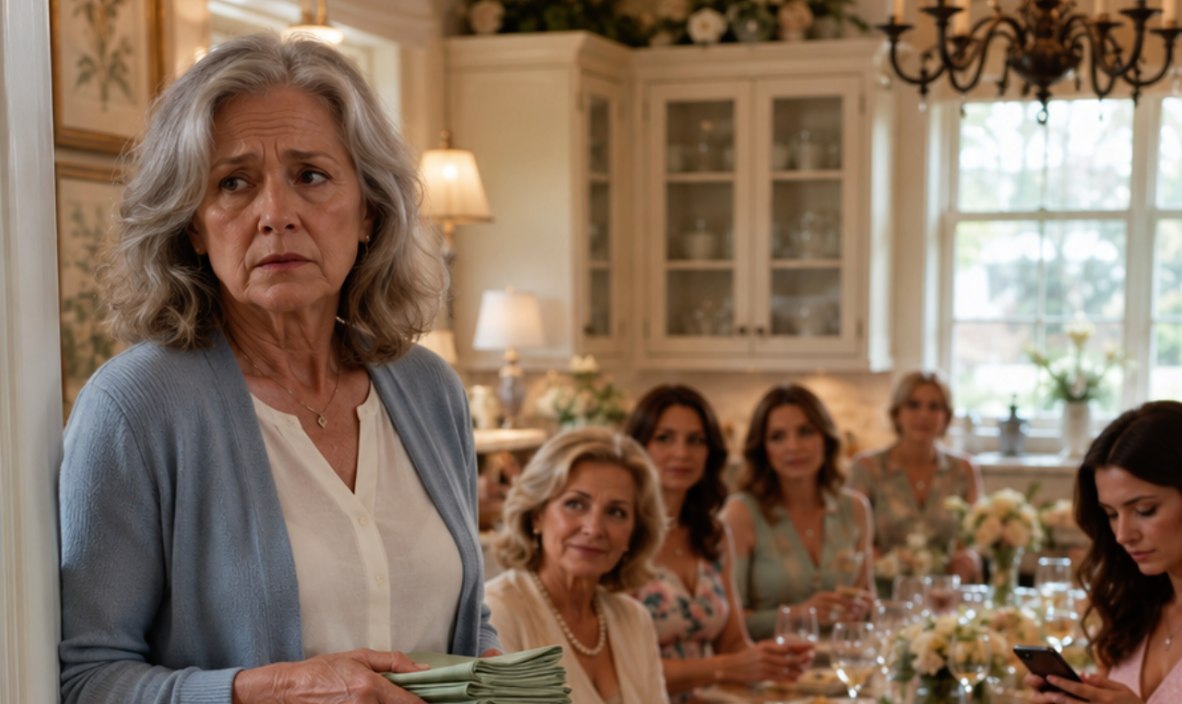
Nobody needed me to urgently sew another fallen hem on a bridesmaid’s dress because someone had stepped on it. Nobody needed me to fold another two hundred linen napkins into the shape of swans because the catering staff was short-handed. Nobody needed me to quietly solve another logistical crisis that had been entirely preventable but was somehow always deemed my responsibility. I was not the emergency fund. I was not the human shock absorber for everyone else’s stress.
For one quiet, uninterrupted hour in a rain-slicked city, I was not “Ethan’s mother” or “the groom’s mom.” I was simply Linda.
I picked up my silver fork, cut a delicate piece of the pasta, and took my first bite while it was still warm. The flavors burst across my palate—rich butter, sage, and sweet lobster. It tasted entirely like freedom.
Across town, a very different scene was unfolding. Panic did not merely spread through the historic stone church; it metastasized, consuming the bridal party and the guests in a wave of utter, unadulterated chaos.
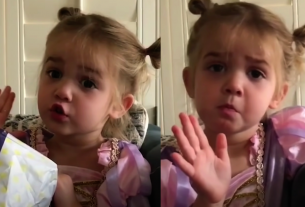
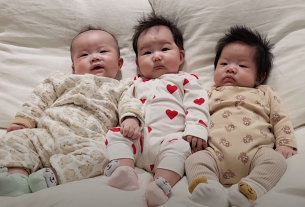
Without a designated caretaker to corral them, the eleven children—all under the age of seven, all dressed in stiff, uncomfortable formal wear—had been unleashed upon the fellowship hall like a swarm of beautifully dressed locusts.
One little boy, clad in a miniature tuxedo that cost more than my first car, had already climbed beneath the heavily draped gift table and was refusing to come out, occasionally swiping at the ankles of passing guests. Two flower girls were sitting in the center of the hallway, crying hysterically because one had looked at the other with the wrong expression. A mischievous three-year-old had managed to locate the heavily guarded basket of imported, hand-dyed rose petals. With a look of profound, victorious joy, he had proudly emptied the entire contents onto the muddy linoleum floor of the coatroom before the ceremony had even begun.
The adults, entirely unused to managing their own offspring during such high-stakes social events, were unraveling. Parents argued in hushed, vicious whispers in the corners of the sanctuary. Grandparents, who had arrived expecting to passively enjoy the aesthetics of the day, flatly refused to abandon their comfortable pews to chase toddlers. Teenagers, sensing the impending labor draft, had strategically disappeared into the bathrooms or out to the parking lot.
Every frantic phone call made by the bridal party produced the exact same, devastating answer.
“I’m so sorry, we have no availability today.”
Every professional babysitter, nanny service, and on-call childcare provider within a thirty-mile radius had already been booked.
This was not a coincidence. It was not a stroke of terrible luck or an anomaly of the local childcare market.
Three days earlier, after returning home from a profoundly humiliating afternoon in the kitchen of Chloe’s mother, Vanessa—where I had been explicitly told that I would not be needed for the professional family photographs because my dress clashed with the “visual palette,” but that I was expected to manage the “childcare room” during the vows—I had quietly sat at my kitchen table.
I hadn’t screamed. I hadn’t argued. I had simply opened my laptop and methodically called every licensed childcare service, agency, and independent contractor I knew in the county. One after another, I inquired about their availability for the afternoon of the wedding.
I reserved them all. I paid the deposits. I ensured that every booking was fully refundable according to their standard 48-hour cancellation policies. None of the agencies knew why a single woman was reserving eighteen different sitters for the same afternoon. I simply gave them my credit card, thanked them for their time, and closed my laptop.
Then, twenty-four hours before the cancellation window closed, I called them all back and canceled the reservations, securing my refunds.
By then, it was too late for anyone else. The agencies had turned away any last-minute inquiries for that weekend. The schedules were locked. No one else was available.
It wasn’t revenge. Revenge implies a desire to cause harm for the sake of causing harm. This was something entirely different. It was an educational exercise. It was the only tangible way to make these people—my son, his bride, her elitist mother, and their entire social circle—understand a fundamental truth that they had willfully ignored: Childcare is labor.
It is actual, demanding, exhausting work. It is not a casual favor to be unilaterally assigned to a middle-aged woman without having the basic decency to ask if she is willing to do it.
In the opulent bridal suite, Vanessa, usually a portrait of unshakeable, wealthy confidence, was pacing the floor, her heels clicking aggressively against the hardwood.
“This is unbelievable,” she snapped, gesturing wildly at the door where the sounds of screaming toddlers echoed down the hallway. She looked sharply toward Ethan, who was standing frozen by the window. “Call your mother again. Tell her she is ruining the schedule.”
“I already did,” Ethan said, his voice hollow.
“Then make her come back! Tell her to get a taxi right now!” Vanessa demanded, her perfectly contoured face contorting with stress.
Ethan stared down at the glowing screen of his smartphone. His thumb hovered over my contact name. Mom. But he didn’t press the button. He didn’t call.
Because somewhere beneath the sheer panic of the moment, beneath the overwhelming pressure of his soon-to-be mother-in-law’s screaming, a quiet, horrifying realization was blooming in his chest. He finally understood the gravity of the silence on the other end of the phone.
She had never forgotten him. She had never forgotten the wedding. She had simply decided, for the very first time in her sixty years on this earth, to stop allowing herself to be forgotten.
Across the room, Chloe stood silently before the antique floor-length mirror. Her custom silk veil remained unpinned, draped lifelessly over a chair. A dark smudge of mascara trembled dangerously beneath her left eye, threatening to ruin her flawless makeup.
“Can’t your aunt watch them?” Chloe asked, her voice trembling as she looked at Vanessa.
“My aunt left to get her hair touched up,” Vanessa snapped.
“What about your cousin?”
“She has her own kids, she refuses to watch anyone else’s in this dress!”
Vanessa’s polished, impenetrable confidence finally began to shatter completely. The carefully constructed Pinterest-perfect aesthetic was crumbling under the weight of reality. “But Linda always…”
She stopped speaking. The words caught in her throat. The unfinished sentence hung heavily in the suffocating air of the bridal suite, an indictment of them all.
Linda always fixed everything. Linda always sacrificed her time. Linda always stepped out of the way.
No one, not Vanessa, not Chloe, and tragically, not even Ethan, had realized just how much of the monumental architecture of this wedding rested quietly and invisibly on the shoulders of the woman they had explicitly decided they didn’t want in the permanent photographs. They had removed the foundation, expecting the house to remain floating in the air.
Forty-five minutes later than scheduled, the ceremony finally began. It was a spectacular collision of high-society aspiration and feral reality.
Children cried relentlessly during the exchange of the vows, their wails echoing off the vaulted stone ceilings and drowning out the soft acoustics of the string quartet. One little boy, the same one who had hidden under the gift table, suddenly stood up in the third row and shouted at the top of his lungs that he urgently needed to use the bathroom. Another toddler, wearing a silk sash, broke away from his exhausted father and wandered halfway up the marble steps toward the altar, happily chasing floating dust motes that looked like bubbles.
Guests shifted uncomfortably in their pews, biting their lips to suppress nervous laughter. The expensive, highly sought-after photographer ducked and weaved desperately around the chaos, trying to capture moments of serene romance while physically dodging errant children.
And later, when the time came for the heavily curated, carefully composed family portraits… the chaos subsided into a heavy, uncomfortable silence. In every single photograph taken that day—the ones that would be framed in silver, the ones that would be bound in leather albums, the ones that would be sent to distant relatives—one place remained glaringly, loudly empty.
The seat belonging to the groom’s mother.
That evening, long after the rain had stopped and the dark twilight had bruised the sky purple and black, there was a heavy, hesitant knock at my hotel door.
I didn’t need to look through the peephole. I already knew exactly who was standing on the other side.
When I unlatched the lock and pulled the door open, Ethan stood in the softly lit hallway. He was still wearing his custom tuxedo, but the sharp elegance of the morning was entirely gone. His black silk bow tie hung completely loose around his unbuttoned collar. His expensive jacket was draped carelessly over one shoulder, dragging slightly. The exotic, expensive white boutonnière pinned to his lapel had been crushed and wilted, its petals bruised and browning at the edges.
For several agonizing seconds, neither of us spoke. The silence between us was profound, heavier than the one we had shared over the phone.
I studied my son’s face. He looked years older than the bright, eager young man who had woken up that morning. He looked exhausted, drained, and deeply sad. I knew why. He had looked into the mirror of his own actions today, and disappointment has a ruthless, inescapable way of becoming a mirror that forces you to see exactly who you have allowed yourself to become.
Finally, he swallowed hard, his Adam’s apple bobbing in his throat. He whispered, his voice incredibly rough.
“You booked every babysitter in the county.”
It wasn’t a question. It wasn’t an accusation. It was a statement of profound realization. He had done the math. He had figured out the impossible odds.
I stood in the doorway, my posture straight, my expression neutral. I nodded once, a slow, deliberate movement. “I did.”
He looked at me, his eyes searching my face for anger, for malice, for anything he could use to defend himself. But he found nothing but calm certainty.
“Why?” he breathed.
I looked at the boy I had raised, the boy whose scraped knees I had bandaged, whose heartbreaks I had soothed, whose life I had organized and protected for nearly three decades.
“Because,” I said, my voice quiet but carrying the weight of a judge’s gavel, “I wanted exactly one afternoon where everyone else had to actually solve the problem they had already unilaterally decided belonged to me.”
Ethan physically recoiled. He lowered his head, his chin touching his chest. His fingers, pale and trembling slightly, tightened their grip around the collar of the jacket slung over his shoulder.
“I didn’t think…” he started, his voice barely a whisper.
“No,” I answered, my tone gentle, devoid of any cruelty. “You didn’t.”
The words struck him with physical force. They hurt him deeply, not because they were sharp or delivered with malice, but because they were undeniably, terrifyingly true. He had simply not thought of me as a person. He had thought of me as a function.
His broad shoulders trembled once. He leaned back against the hallway wall as if he could no longer support his own weight. “I kept telling myself it wasn’t a big deal. That watching the kids for an hour wouldn’t be a burden for you.”
“I know you did.”
“I thought you’d understand. I thought you’d want to help us out. You always help.”
“I always did,” I agreed softly.
Another silence fell over the hallway, long and aching. It stretched out between us, pulling tight, long enough that I could see the moisture gathering heavily in his eyes before he finally found the courage to look up at me again.
“I never asked you whether you actually wanted to do it,” he said, his voice breaking on the final word.
“No, Ethan. You never did.”
“I just expected you would. Because you’re my mom. And because you always just… handle things.”
The carpeted hallway of the fifth floor became incredibly still. The faint hum of the ice machine down the corridor was the only sound in the world. He took one deep, slow, shuddering breath, a man trying to pull himself back together from the inside out.
“I’m sorry, Mom.”
It was not the hurried, defensive apology people often throw like a shield to end an uncomfortable argument. It was the slower kind. The heavy kind. The kind of apology that physically costs something to say, tearing a piece of pride away as it leaves the lips.
“I spent my whole wedding looking for you,” he confessed, tears finally spilling over his lower lashes and tracking down his pale cheeks. His voice broke entirely, fracturing into a sob he couldn’t hold back. “And I realized… I realized during the vows…”
He swallowed hard, fighting for breath.
“…the only person I never made any room for today, was the one who made room for me my entire life.”
This time, hearing those words, witnessing the absolute destruction of his ignorance, I finally cried.
Tears slipped down my cheeks, quiet and hot. I didn’t cry because the hurt of being dismissed and hidden away by his new family had suddenly disappeared. I cried because, for the first time in years, my son had finally, truly seen it. He had seen the invisible scaffolding that held up his life, and he had recognized the weight it bore.
I stepped forward out of the doorway. I reached out and wrapped my arms around his broad, shaking shoulders. He collapsed into the embrace, burying his face in my shoulder, hugging me with the desperate, clinging strength he had used as a little boy after waking up from terrible nightmares in the dark.
We stood there in the hallway, clinging to each other. Neither of us spoke for a very long time. The silence was no longer heavy or punishing; it was the quiet, exhausting stillness of a storm that had finally passed.
Sometimes, true healing does not actually begin with the act of forgiveness. Forgiveness is a destination. Sometimes, the journey of healing begins simply with finally being seen.
Time, as it always does, moved forward, carrying the debris of the past away and leaving new landscapes in its wake. The icy awkwardness of the post-wedding months slowly thawed. Boundaries had been established. Lines had been drawn and, more importantly, respected.
Months later, when the seasons had fully turned and the bitter winter had given way to the first blooms of spring, Chloe went into labor.
When she finally gave birth to a beautiful, healthy baby girl, the very first person she called from the quiet hum of the hospital maternity ward wasn’t a professional babysitter. It wasn’t a nanny service.
It was me.
My phone rang as I was sitting in my garden, reading a book. When I answered, I heard the exhaustion and the overwhelming, terrifying love in her voice. But more importantly, I heard something else. I heard a distinct shift in the fundamental architecture of our relationship.
This time, she did not assume. She did not command. She did not draft me into service.
She asked.
“Linda…” Her voice was soft, hesitant, treading carefully on the new ground we had built between us. “If you’re free, and only if you want to… would you like to come to the hospital and meet your granddaughter?”
I looked out over my garden, the sun warming my face. I felt a deep, profound sense of peace settle in my chest.
I smiled. “I would absolutely love to, Chloe. I’ll be right there.”
Respect, I have learned through the hard, sharp lessons of time, rarely arrives on a silver platter, nor does it magically appear alongside perfect, aesthetic weddings and carefully curated photographs.
Sometimes, the truest form of respect simply begins the very first time someone remembers to ask.