Some families do not disintegrate in a sudden blaze of broken affection or spectacular betrayal. They do not fall apart when the love runs out, because in some families, love was never the foundational mortar to begin with. They fall apart when the money does.
This is the meticulous, quiet story of a military veteran who spent a decade holding her family’s fragile ecosystem together with direct deposits and paid premiums. She did this until a single afternoon in a diner illuminated exactly what her blood relatives thought of the orphaned child she was raising, and by extension, what they thought of her. What followed was not a screaming match. It was a methodical, permanent severing.
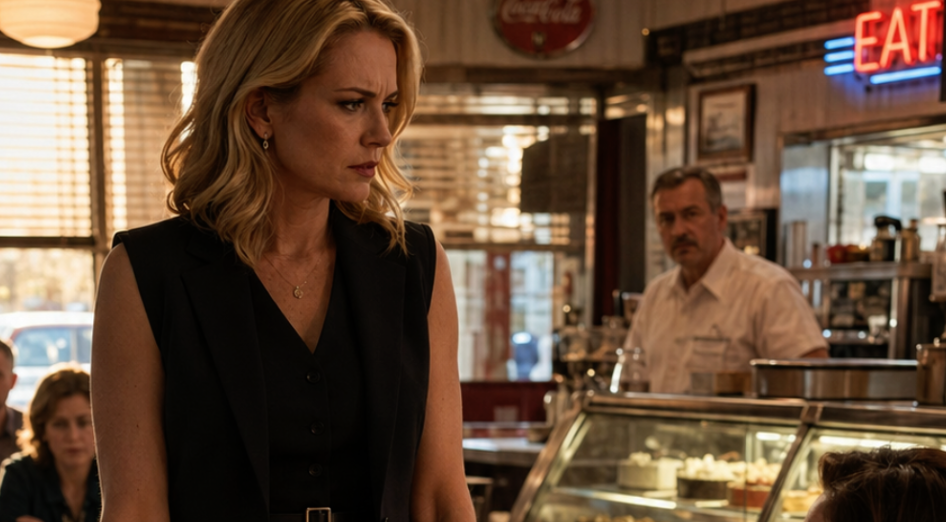
The catalyst arrived on a Saturday in early October, accompanied by the pale, slanting autumn light that makes everything look softer than it truly is. We were at the Maple Junction Diner, an establishment my father had frequented for thirty years. It was the sort of place defined by its laminated, sticky menus, a rotating pie case near the register, and a waitress named Donna who poured his coffee black and dangerously hot before he even asked. My father was turning sixty-seven. To celebrate, I had orchestrated the entire afternoon. I secured the reservation, pre-ordered a custom bakery cake, and drove two hours from Kansas City with eight-year-old Owen buckled in the backseat, anxiously asking for arrival updates every forty-five minutes.
I had paid the bill in its entirety before we even took our seats. In the architecture of this story, that detail is the load-bearing beam.
Owen had never attended a birthday gathering where an entire, pristine cake was commissioned for a single individual. He sat in the vinyl booth, twisting his small torso to reverently guard the white bakery box resting on the counter. In a hushed, serious tone, he asked me if the frosting was the “good sweet” or the “too sweet” kind. When I assured him it was the former, he accepted the intelligence with absolute gravity.
My father sat at the head of the table wearing his good navy flannel. For twenty minutes, the illusion held. He smiled genuinely, recounting tales from his auto garage, and the table echoed with laughter. Then, Donna carried the cake toward us. My father looked at the frosted writing, glanced at Owen, and offered the boy a genuine, warm smile.
That was the precise moment my sister, Vanessa, chose to speak.
She did not lower her voice. She did not falter. Reaching for her ice water with the casual indifference of someone commenting on the changing weather, she said, “Owen doesn’t deserve the cake. Save it for a real family.”
The silence that followed was absolute. I have replayed that exact sequence of seconds in my memory relentlessly, and the inventory remains identical every time. I noted that Donna had turned away, spared from the ugliness. I noted that my father stared down at his stainless-steel fork, choosing the cowardice of silence. I noted that my mother placed her hand over mine, whispering a pleading, “Let it go, Karen.” Most importantly, I noted Owen. His small face had frozen into the specific, guarded stillness children adopt when they recognize danger but lack the vocabulary to name it.
I did not experience a blinding, hot rage. The anger that makes your pulse hammer and your vision blur never arrived. Instead, I felt a sensation that was infinitely colder and far more dangerous. It was the distinct, satisfying sensation of a heavy door clicking permanently shut.
I slipped my hand out from beneath my mother’s grasp. I stood up, adjusting my posture.
“Then keep the cake,” I said, my voice perfectly level. “And you pay for the dinner.”
I took Owen’s hand, and together, we walked out of the Maple Junction Diner, leaving the illusion of our family rotting on the table.
The Logistics of Obligation
To understand the absolute finality of that afternoon, you must understand the decade of invisible infrastructure that preceded it. The silence in the diner did not occur in a vacuum; it was the culmination of a ten-year supply chain of guilt and obligation.
I spent ten years in the United States Army as a logistics specialist. I was extraordinarily competent at analyzing supply routes, predicting deficits, and balancing resources. Tragically, I applied these exact same principles to my family in Springfield. The money I sent home was rarely greeted with profound gratitude; it was treated as a public utility. Like running water or electricity, my family did not thank the current. They simply expected it to flow.
When I was twenty-six, the transfers became a monthly ritual. By twenty-eight, they had calcified into a rigid expectation of roughly fourteen hundred dollars a month. There was never an inquiry into my own financial health, my savings, or my exhaustion. There were only questions about whether the transfer could arrive on the twelfth instead of the fifteenth.
The memory that haunts me most vividly occurred on a freezing Tuesday night in February. I was stationed at Fort Leavenworth, thirty years old, lying in a narrow government bunk at midnight when Vanessa called. Her credit card had been declined at the grocery store, she had sixty dollars to her name, and her children needed school lunches. I walked to the communal bathroom for privacy, opened my banking application under the fluorescent lights, and wired her two hundred and fifty dollars. She exhaled a tight breath of relief, muttered a hollow promise to repay me—a promise she kept exactly twice in a decade—and hung up. I stood in that bathroom for four minutes, profoundly hollowed out, acknowledging that I had become nothing more than an emergency ledger.
This financial ecosystem persisted until 2023, when I adopted Owen. Upon his arrival, I reduced my family’s monthly stipend to four hundred and fifty dollars. I sent a clear, concise message explaining that I was now solely responsible for raising a child, and my overhead had fundamentally changed.
The reaction was not empathy. It was a sharp, offended grievance. Vanessa told me I had changed, that they used to be able to “count on me.” It was spoken as though I were a defective ATM that had inexplicably lowered its withdrawal limit. I spent a year making excuses for them, telling myself they were merely adjusting to the new reality of my father’s failing knees and his declining garage revenue.
Walking to my car with Owen’s hand secured in mine, I finally understood the truth. They had not been adjusting. They had been waiting. They were waiting for me to apologize, to abandon my boundaries, and to restore the fourteen-hundred-dollar equilibrium. Owen was merely the obstacle standing between them and their utility payment.
The Ghosts of Fort Campbell
Owen’s presence in my life was not an accident, nor was it a fleeting charitable impulse. It was the fulfillment of a solemn, unbreakable contract forged with ghosts.
I met Elliot Graves during my second year at Fort Campbell. He was an infantry sergeant, a man anchored by a quiet, gravitational decency. He was the kind of soldier who would slip a granola bar onto your desk before a grueling briefing without ever demanding acknowledgment. A few months later, I met Paige Holloway, a combat medic whose sharp, rapid-fire competence perfectly balanced Elliot’s grounded nature. I watched them fall in love, marry in a cramped Tennessee courthouse, and bring Owen into the world in the spring of 2015.
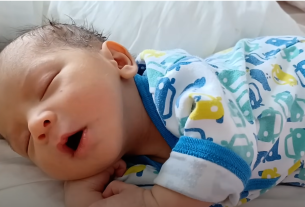
I drove down to Kansas City the day after his birth. Paige, pale and exhausted in the sterile hospital bed, handed me her son before I even unbuttoned my coat. Owen possessed the heavy, warm, absolute gravity of a newly arrived soul. Paige looked at me with assessing, piercing eyes and asked a question that was not really a question: “Will you?”
“Nothing is going to happen,” I deflected.
“Karen,” she warned, cutting through the platitudes.
“Yes,” I promised. “I promise.”
Elliot was killed during a logistics movement in Afghanistan in 2019. He was thirty-four. Two years later, Paige’s vehicle was struck by a truck running a red light outside Kansas City. She was thirty-two.
Suddenly, I was the last living signatory of that hospital room contract. Owen, an eight-year-old boy who had learned far too early how easily the universe can strip away everything you love, came to live with me. I did not view him as a burden. He was a profound, non-negotiable fact of my existence. What I failed to calculate was how violently my biological family would resent this new reality.
When I brought him to Springfield for an introductory visit, he double-knotted his good school shoes, desperate to make a favorable impression. He spent the afternoon vibrating with the careful, hyper-vigilant energy of a child assessing a new environment for threats. During that visit, Vanessa asked him where his “real parents” were. My mother pulled me aside on the porch to ask if I could still cover the bills.
On the drive home, Owen stared out the window and quietly observed, “They like that you send them money, don’t they? They kept talking about money stuff every time you were in the same room.”
At eight years old, he had diagnosed the central pathology of my family in three hours—a pathology I had spent a lifetime refusing to name.
Forty-One Minutes of Severance
The drive back to Kansas City after the diner incident was swallowed by the dark, silent expanse of the highway. Owen slept soundly against the glass. I drove with the radio off, existing in a state of supreme, crystalline clarity.
When we arrived home, I tucked him into bed, listening to his steady breathing. I walked into the kitchen, brewed a dark cup of coffee, and opened my laptop. I did not write a manifesto. I did not draft a single angry message. I simply executed my training.
For ten years, I had managed supply chains for the United States military. I knew exactly how to terminate a line item.
Operating with absolute, chilling efficiency, I began dismantling the financial life support I had provided for a decade. It took exactly forty-one minutes. I called the bank and drained the joint account, transferring the balance to my personal ledger. I logged into the credit card portal and permanently revoked Vanessa’s authorized user privileges. I accessed the automated payment schedules and ruthlessly deleted them all: the monthly transfer to my parents, the car insurance premiums keeping Martin’s vehicle legally registered, the quarterly property tax payments for my father’s garage. I even logged into the cellular provider and severed my mother’s phone line from my family plan, ensuring it would go dark at the end of the billing cycle.
By the time I closed my laptop at 9:44 PM, my coffee was cold. I did not feel a rush of vindictive triumph. I felt the profound, physical relief of an administrator who has finally audited a hopelessly corrupt budget and closed the books. I washed my mug, placed it in the drying rack, and went to sleep. I slept for seven uninterrupted hours, the deepest rest I had experienced in a year.
The Digital Betrayal
The retaliation began at dawn. By 7:00 AM, my phone was a vibrating monument to their panic. There were calls from my mother, texts from Vanessa, and incredibly, a missed call from Martin, a man who actively avoided direct communication unless compelled by absolute desperation. I left the phone face down on the granite counter and scrambled eggs for Owen, engaging in a deeply serious debate regarding whether or not sharks possess the capacity to dream.
It wasn’t until Owen left for the bus stop that I finally turned the screen over. Amidst the barrage of missed calls was a singular text message from my younger brother, Daniel. It contained a screenshot and a three-word directive: You need to see this.
The screenshot illuminated a group chat titled Family Planning. The sheer, audacious absurdity of the title struck me first—an active, populated summit of my entire immediate family, operating under a title that reduced me to an uncooperative municipal budget.
The timestamps revealed that while I was systematically severing their financial lifelines the night before, they had been colluding. My mother had initiated the post-mortem, expressing disbelief that I had “made a scene.” Vanessa immediately weaponized Owen’s existence, claiming I had been hostile ever since “that kid” arrived.
Then came the message that stopped the air in my lungs. Vanessa wrote: Honestly, maybe the kid would be better off back in the system.
Martin rapidly agreed, asserting that if Owen were removed from the equation, my financial contributions would revert to their historical baseline. Exactly. Normal, Vanessa replied. The thread concluded with Daniel, the silent observer, finally breaking his silence to state, This is not okay, before permanently exiting the chat.
Standing in the morning sunlight of my kitchen, I did not break down. I did not weep. I felt a profound, absolute zero temperature settle into my bones. They did not merely dislike Owen; they had completely dehumanized him. To them, he was not an orphaned boy grappling with monumental grief. He was a logistical inconvenience, a sudden tariff placed upon their revenue stream. Returning him to the foster system was, in their sociopathic calculus, merely a necessary market correction.
Three days later, Vanessa demanded a meeting. I refused to let her contaminate my home, dictating that we meet in the neutral, unyielding environment of a grocery store parking lot. She arrived vibrating with aggressive entitlement, demanding I reinstate the credit cards, the phone plans, the insurance. She attempted to dismiss her cruelty in the diner as a misunderstood joke.
I did not argue. I simply held up my phone, displaying the screenshot of the Family Planning chat.
For the first time in her life, I watched Vanessa’s rehearsed indignation entirely evaporate. She stared at her own words, her expression flattening into a cornered panic. She attempted to pivot, accusing me of abandoning the family, of unilaterally destroying our dynamic. She told me I was letting “that kid” ruin everything.
“No,” I said.
She paused, confused. “No what?”
“No, I am not turning the payments back on,” I stated, my voice devoid of any negotiable softness. “No to the credit card. No to the insurance. No to the phone plan. No. That is the entire answer.”
She stared at me, thoroughly disoriented by the realization that her primary resource had achieved permanent autonomy. She drove away in her silver sedan, and I stood in the empty parking lot, marveling at how a two-letter word could possess so much structural integrity.
The Mechanics of True Affection
When the demolition is complete, the only remaining task is construction.
A year has passed since the diner. The silence from Springfield is largely intact, punctuated only by rare, excruciatingly cautious phone calls from my mother. My father’s knees have deteriorated further, the garage is struggling, and Vanessa is currently navigating the crushing reality of high-interest debt without my subsidized capital. I hear these updates through Daniel, and I receive them without malice or triumph. I simply observe them as the natural consequences of a system adjusting to gravity.
The life Owen and I are building in Kansas City is defined by its quiet, rhythmic consistency. In November, I stood in the freezing wind of a church parking lot for three hours, watching him relentlessly attempt to ride a bicycle without training wheels. He fell eleven times. When he finally completed a full rotation, he simply rode over to me, nodded with exhausted satisfaction, and stated, “I think I have it now.” I watched him, recognizing Elliot’s stubborn resilience etched into his small face.
In January, I opened a high-yield college savings account in Owen’s name. I established a recurring, automated transfer for the exact amount I had once wired to Springfield: four hundred and fifty dollars. Every month, the capital that once fed a bottomless well of familial entitlement is routed directly into the future of a boy who earned it simply by surviving. When I told him the funds could be utilized for university, trade school, or the marine biology program he had spent weeks researching, he nodded gravely and returned to his encyclopedia.
Our defining moment arrived on a bright September Sunday at the local park. Owen sat beside me on a wooden bench, meticulously turning a fallen twig over in his hands. Without looking up, he asked the question I had spent a year mentally rehearsing for.
“Why don’t they like me?”
I could have offered him a sanitized, age-appropriate fiction. I could have softened the blow. But looking at this boy, who had endured the collapse of his entire world with such stoic grace, I knew he was entitled to the architecture of the truth.
“They had a picture in their heads of what family was supposed to look like,” I explained slowly. “And when you came to live with me, the picture changed. Instead of finding a way to make room for the new picture, they decided the new picture was the problem.”
He absorbed the data, categorizing it with his usual precision. “So it was about money.”
“It was about what they thought family was for, and they got it wrong.”
He looked up at me, his blue eyes sharp and unblinking. “What is family for?”
“Family is for showing up for the ordinary days, not just the important ones,” I told him, ensuring my voice carried the absolute weight of a promise. “For checking if someone ate something. For sitting on a bench at a park on a Sunday. For making sure a person knows they are not alone in the world.”
Owen considered my definition. He dropped the twig, leaned his small shoulder heavily against my arm—a monumental declaration of trust—and asked if we could stay at the park for another hour.
We stayed. We drove home, ate grilled cheese sandwiches in an apartment that hummed with the safety of our shared routine, and continued the slow, beautiful labor of building a life. Paige had asked me not to let him grow up alone, and I finally understood what she meant. You do not build a family with blood, and you certainly do not build it with direct deposits. You build it by standing in the cold, watching a child balance on two wheels, and refusing to let them fall.