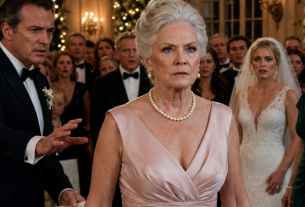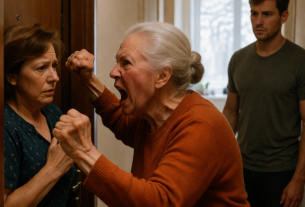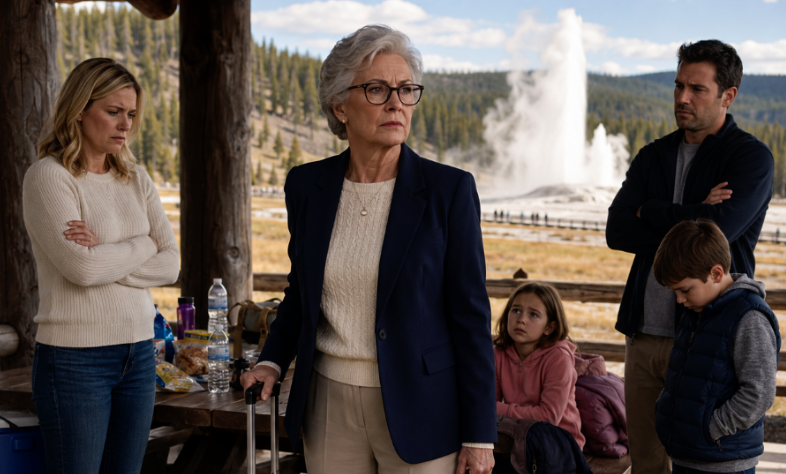
She said, “You’re here to watch the kids, not to sightsee.”
The sentence did not come crashing down like a sudden thunderclap or a shout. That was the very first thing I understood about it. It arrived neat, steady, and entirely public, delivered in the exact polished, even voice Sophie used with airline flight attendants, restaurant hosts, school secretaries, and anyone else she wished to manage without appearing overtly unkind.
We were standing beneath the roof of a picnic shelter near the southern end of Yellowstone National Park. The wooden posts smelled faintly of sun, old rain, and the warm dust of the American West. The floorboards beneath our shoes had been smoothed by decades of tourists with heavy cameras, folded trail maps, and tired children tugging at their hands. Beyond the edges of the shelter, the mountains rose blue and clean into the late afternoon, and the sky stretched wide over Wyoming like nothing my quiet life in Ohio had ever taught me to expect.
My son Daniel stood by the red cooler with his hand resting on two plastic bottles of water. He looked at me, then at his wife, then down at the trail map spread across the picnic table, as if the topographical contour lines might offer him a miraculous way out of choosing a side. Little Lily was near the edge of the shelter, trying with gentle patience to coax a butterfly onto her index finger. My grandson Ethan sat half turned away on the bench, one earbud stubbornly in, pretending he had not heard what everyone in the shelter had so clearly heard. A family in matching Yellowstone sweatshirts walked past holding paper cups of lemonade. Somewhere farther off, a car door slammed. The wind moved through the lodgepole pines with a dry western hush that had faithfully followed us through the park all week.
Even the sun stayed beautiful. Especially the sun. It poured over the gravel turnout, the wooden trail sign, Sophie’s expensive hiking leggings, Daniel’s exhausted face, and my scuffed navy carry-on suitcase, as if all of us standing there deserved equal light.
I had spent much of my adult life mistaking that kind of domestic stillness for safety. I used to deeply believe that if nobody raised a hand or a voice, then whatever was wrong could not be entirely wrong. It could still be managed. Smoothed over. Explained away to neighbors and friends. Endured in silence. But some sentences do not need volume to completely alter the weather inside a life. That was one of them.
So I stopped watching the children. I stopped watching Daniel’s face for some belated sign that he might finally find the courage to defend me. I stopped watching Sophie’s mouth to see if she would soften the blow of what she had just said. I reached down, picked up my canvas tote from the wooden bench, and then pulled my rolling carry-on from beneath the picnic table. The handle clicked into place with a sound so small and final that all four of them turned toward it.
The movement felt almost ceremonial, though I do not think anyone truly understood that right away. There are departures that begin long before a physical door ever closes. This particular departure had begun over years of Christmas mornings, over dinners where I was given a chair but never a true place, over phone calls left unreturned, over favors requested as if my own time had absolutely no weight, over all the little humiliations people tell you not to make too much of because each one, taken individually, is so easy to explain away. By the time Sophie finally said those words in Yellowstone, I had already been walking toward that exact moment for a very long time.
Daniel looked at me only briefly. “Mom,” he said, as if the word itself possessed the magic to stop me.
Sophie gave a short, clipped laugh that never once reached her eyes. “Please don’t be dramatic.”
That, more than the original sentence, almost made me laugh aloud. Dramatic. As if I were the one who had mistaken a mother for hired help in one of the most beautiful places in America. As if leaving quietly were somehow the greatest offense taking place at that table.
I did not answer either of them. I started walking toward the ranger station near the trailhead, my suitcase wheels catching awkwardly in the gravel at first and then finding a steady rhythm. Behind me, Daniel called my name again. Then Lily’s voice rose, smaller and infinitely sharper.
“Grandma?”
I stopped once. Only once. It tightened something deep and vital in my chest to hear her call after me. That sweet child had done nothing wrong except love me openly in a family that had grown entirely used to rationing its tenderness. For a second, I nearly turned around for her. Not for Daniel. Not for Sophie. For Lily and her ink-smudged fingers and the way she leaned into my side whenever she wanted to show me a new drawing.
But leaving was not the same thing as abandoning. That is a hard truth I had to learn too late, and all at once. Lily had parents. What she did not have, at least not yet, was an older woman showing her that love does not require you to completely disappear in order to earn it. So I kept walking.
It had all begun in March, in my kitchen in Ohio, with a text message and a mug of coffee growing cold between my hands. The winter had finally loosened its grip, and the maple tree behind my fence had started to blur with soft buds. My phone buzzed on the counter. It was Daniel. “Mom, Sophie and I want to do Yellowstone this summer. The kids would love it. Come with us. It’ll be a family trip.”
I read it twice. Then a third time. I have seen younger women mistake mere hope for foolishness, and maybe sometimes it is, but they are not the identical thing. Hope, at least the kind I intimately knew by then, was not bright or naive. It was careful. It was scarred. It had thick calluses. It knew exactly what disappointment looked like in a holiday dining room, in a one-word text reply, and in a daughter-in-law’s politely fixed smile. Even so, I felt something stir inside me. Not joy exactly—joy would have been far too easy. It was something more tender and cautious. Something like maybe. Maybe people changed. Maybe years softened people. Maybe Daniel had finally recognized what I had been trying not to see clearly for far too long: that we were not close anymore in any honest sense of the word.
What had once been an easy mother-and-son relationship had narrowed over the years into sheer logistics. Birthday calls. A Mother’s Day bouquet ordered mechanically online. Short Sunday check-ins that became every-other-Sunday, then every third Sunday, then somehow devolved into just text messages asking if I could watch the children on a teacher in-service day. Maybe he was trying to fix something broken between us. I wanted that to be true more than I wanted to protect myself from being wrong. So I said yes before I had even finished my coffee.
By June, the trip had become a rigid grid of plans. Sophie emailed a “master family checklist” with color-coded sections. She was an efficient woman, impressive to people who only knew her from a distance. But like many useful qualities, her efficiency could become a weapon when paired with a desperate need to control the narrative.
When Daniel picked me up the morning of the trip, the rented SUV smelled of pine air freshener. Sophie sat in the passenger seat with her travel coffee and a clipboard. When she saw my single suitcase, she said, “Oh, you only brought one bag? Good. We might need room for the cooler on the way back.” It was a small, almost invisible phrasing, but I noticed it. Not thank you for traveling light. Her first instinct was already moving toward my utility.
The drive west out of Ohio was long, the landscape shifting from cornfields to distribution centers to the flat expanse of Nebraska. Each time we stopped for gas, Sophie redistributed tasks with the breezy, unquestionable authority of a camp director. I took Lily to the restroom, washed hands, found wet wipes, reapplied sunscreen, and searched for lost stuffed animals. By the second rest stop, I had already become the default holder of all things. The snack bag, the half-finished lemonade, the folded sweatshirts. I do not know exactly when a person becomes the designated place where a family sets what it does not wish to hold. But the transformation is breathtakingly fast once you have trained everyone that your hands are always available.
The true nature of the arrangement was confirmed our first night at a motel in Nebraska. Standing outside the rooms under a buzzing exterior light, Sophie handed me a single key card. “Okay,” she said briskly. “We’re in 214, and you’re in 216 with the kids. Ethan can take the cot.” I stared at the key in my hand. We. It is astonishing how much utter control can hide inside that one word. I did not mind sleeping beside Lily, but I minded deeply not being asked. I minded learning, halfway across the country, that arrangements had been made on my behalf before anyone ever invited me to come.
The pattern solidified into a suffocating routine over the next few days. At breakfast, Daniel ordered biscuits and gravy for me before I could speak, ignoring my preference for oatmeal. In South Dakota, Sophie handed me a mountain of jackets and bags to hold while she lined up her husband and children for photographs against the wide American sky. Not once did she say, “Come stand with us.” When I finally stepped forward and asked for a picture of all of us, she blamed the lighting and said “maybe later.” We never took it. That was the first time I let the truth form in a full sentence inside my head: She has decided I am not part of what she wants to remember.
At a highway steakhouse, Sophie laughed and told the waitress I would probably just have soup. When I confidently ordered the same steak as Daniel, she fell silent. When the bill arrived, Daniel casually slid it toward me and asked me to cover my own, noting he had “only budgeted for four.” It was as if the arrangement had been universally understood: being invited on a trip and being included in its costs were entirely separate concepts. I paid for my meal without a single word of thanks from either of them, though Lily silently reached over and rested her small hand on mine until Sophie scolded her for leaning across the table.
Yellowstone itself was magnificent, a place of stunning scale and primal beauty. But being quietly sidelined while sunlight burns gold on a geothermal basin sharpens the contrast until you simply cannot look away. The beauty becomes a silent witness, making human smallness feel almost obscene.
Sophie’s laminated schedule, kept in the cup holder like an employee badge, revealed my exact purpose. Beneath the hiking windows she and Daniel had reserved for themselves, my role was neatly handwritten: Child care support. Not Grandma. Not family time. Support. It was human resources language for what they were doing to me. On our second afternoon, she left me at the visitor center with Lily while she and Daniel took a difficult trail. When they returned, flushed and pleased, Sophie glanced down at her daughter and asked, “Did Grandma take good care of you?” in the exact detached tone one uses for a hired babysitter.
The final fracture occurred the next morning at the southern end of the park. Sophie announced they would hike the full three-mile trail while I waited at the picnic area with the children. I agreed, deeply curious to see just how compliant they expected me to remain. Two hours later, they returned, bickering over a detour. When Sophie impatiently stated she hadn’t signed up to babysit her mother-in-law, and then asked me to take the children to the gift shop so she and Daniel could “talk logistics,” I finally refused. I told them I was happy to spend time with my grandchildren, but I had not traveled across the country to sit at picnic tables while they hiked. I had come because I was told it was a family trip.
That was when she said the sentence. And that was when I walked away.
The woman at the ranger station had kind eyes and the calm manner of someone used to tourist emergencies. She helped me arrange a shuttle to Jackson, where I paid for an expensive flight home without a shred of guilt. Landing in Ohio close to midnight, the simple fact of driving my own car back to my own quiet house felt luxurious. I sat in my dark kitchen with a cup of tea, feeling a profound sense of self-recognition. For fifty-one years, my usefulness had been the central architecture of my identity. I had finally learned that a woman can set all that down and still remain fully herself.
The next morning, I called my financial adviser and permanently stopped the automatic monthly transfers I had been sending to Daniel to help with their mortgage. Then I called my attorney and removed Daniel as my emergency medical contact, replacing him with my reliable neighbor, Ruth. Paperwork should always tell the truth, and the truth was that my son was no longer the person most likely to show up for me without making my crisis about his own inconvenience.
For three days, I ignored Daniel’s phone calls. I woke up feeling the exquisite absence of obligation. I bought expensive coffee and ate exactly what I wanted. On the fourth day, Daniel arrived at my door, looking stripped of his usual certainty. He sat at my kitchen table, and I refused to do the invisible emotional labor of smoothing over his discomfort.
When he admitted he should have defended me, I told him the unvarnished truth. I told him I had loved him his entire life, through every sacrifice and hardship, but I was sixty-seven years old and refused to spend my remaining years being treated as an obligation people could outsource their guilt onto. I told him to go home and show me, through consistent behavior over time, that things would change.
A week later, Sophie called. Her voice was stripped of its professional polish. She admitted she had been wrong—a crucial, undeniable word. I accepted her apology but laid out my strict terms: I wanted a real relationship, not a polite performance enacted only when they needed a favor.
The rebuilding has been careful and highly measured. Careful means the break was real, and we are not lying about the repair. Sophie no longer assumes I am free; she asks directly. Daniel calls every single Sunday, and the pauses in our conversations are filled with genuine thought rather than avoidance. Ethan texted me, and we spent forty minutes discussing the universe, bridging the gap with the awkward sincerity of a teenager. And Lily, sweet Lily, calls me to recount every detail of her days, mailing me crayon drawings of “My Grandma Going On An Adventure.”
There was no grand, cinematic reinvention. There was only the quiet, necessary establishment of boundaries. I finally paid the balance on my own self-erasure by walking away from that picnic table in Wyoming. My life fits me now. It is smaller in some ways, but infinitely truer. And that, at sixty-seven, is more than enough.