I never anticipated that my twenty-eighth birthday would culminate in my own sister attempting to have me forcibly escorted from the premises of a prestigious country club. Then again, operating under the assumption that my family might one day behave with a semblance of normalcy was a fallacy I should have abandoned years ago.
The Madison Estate Country Club sat enthroned upon forty acres of pristine, meticulously manicured Connecticut coastline. Its white-columned facade gleamed with an almost weaponized brilliance in the afternoon sun, standing as an architectural manifestation of old money attempting to preserve itself in marble and glass. I had arrived wearing my preferred armor for the day: comfortably worn denim jeans, a simple, breathable cotton blouse, and a pair of sensible sneakers. I had driven straight from my apartment in the heart of the city, responding to a characteristically abrupt text message from my sister, Clare.
Family lunch at the club, 1:00 p.m. Don’t be late.
There had been no mention of a formal occasion. There had been no warning regarding dress codes or expectations. It was, as it always was, a setup. I truly should have known better.
Clare stood positioned near the grand entrance, draped in a designer dress that undoubtedly cost more than the average citizen’s annual rent. Her highlighted hair was perfectly coiffed to give the illusion of effortless grace, and her jewelry caught the light with every calculated turn of her head. Beside her stood our mother, armored in head-to-toe Chanel, holding court with a flock of similarly adorned women who looked as though they had materialized directly from the glossy pages of a luxury lifestyle magazine.
“There you are,” Clare announced the moment her eyes locked onto me. Her voice was drenched in a saccharine sweetness that failed to mask the underlying venom. “We’ve been waiting.”
The heavy emphasis she placed on the word waiting was designed to immediately establish me as the problem, conveniently glossing over the utter vagueness of her morning summons.
“Sorry,” I replied, keeping my tone intentionally breezy and unbothered. “Traffic was notoriously bad coming from the city.”
“The city?” Mom repeated, accompanying the word with a delicate, practiced sniff. “Still residing in that microscopic apartment, I see.”
“It functions perfectly well for me,” I said.
Clare’s companions had paused their murmuring to stare. Their collective gaze traveled up and down my casual attire with a disdain they barely bothered to conceal. It was a deeply familiar look, one I had been subjected to my entire life by this particular socio-economic circle. To them, I was an anomaly, a glitch in their carefully curated aesthetic.
“Well,” Clare chirped brightly, turning on her heel. “Shall we proceed inside? I am absolutely famished.”
We crossed the threshold into the grand lobby. My sneakers squeaked faintly against the imported marble floors, a distinctly rebellious sound in the cavernous, hushed environment. The interior was precisely what one would expect from an institution terrified of the modern age: soaring vaulted ceilings, cascading crystal chandeliers that fractured the sunlight, and imposing oil portraits of long-dead founders gazing down in perpetual judgment.
“The Thompson party,” Clare announced to the hostess, projecting the entitled air of someone who fully expected to be recognized on sight.
“Of course, Miss Thompson. Right this way.”
We were ushered to a prime table situated beside expansive windows that offered a breathtaking, panoramic view of the rolling green golf course. It was an undeniably beautiful setting, the epitome of exclusivity and refinement. And there I sat, dressed as though I had just finished running weekend errands—which, in the interest of factual accuracy, I had.
“So,” Mom began the moment the hostess retreated, not bothering to lift her eyes from the embossed leather of the wine list. “Clare has some rather exciting news to share.”
“Do tell,” I prompted, mustering genuine curiosity.
Clare practically radiated a smug, incandescent glow. “Richard proposed.”
“Congratulations,” I said, offering a warm and sincere smile. “That is truly wonderful news.”
“We’ve decided to host the engagement party right here, next month,” she continued, waving a manicured hand to encompass the sprawling dining room. “And the wedding itself will follow here as well. Naturally, this club is the only acceptable venue. It’s wonderfully exclusive.”
“Very,” she paused, allowing her gaze to deliberately drop to my cotton blouse, “refined.”
“It is a beautiful venue,” I agreed amiably, refusing to take the bait.
“Yes, well, we are exceedingly fortunate to possess memberships here,” Mom stated, finally looking up. “Your father’s business connections initially made it possible, of course. Though Clare and Richard’s elevated status certainly helps secure our standing moving forward.”
The unspoken implication hung heavily over the white linen tablecloth: I, with my jeans and my city apartment, contributed absolutely nothing to the family’s social capital.
“Richard’s family has maintained a membership here for three consecutive generations,” Clare added, ensuring the pedigree was fully established. “His grandfather actually served on the board of directors.”
“That’s impressive,” I noted, meaning it.
“Unlike some individuals,” Mom interjected, her tone sharpening into a pointed blade, “who cannot even manage to dress appropriately for a simple family luncheon.”
I took a slow, deliberate sip from my water glass. “You specified a ‘family lunch.’ You completely omitted the detail that it was a formal affair.”
“Any meal taken at the Madison Estate is a formal affair, Emily. One would assume that to be blindingly obvious.”
The timely arrival of our waiter spared me the necessity of crafting a diplomatic response. The ordering process was a performance in itself. Clare selected the market-price lobster; Mom requested the Dover sole. I opted for the roasted chicken salad. Once the menus were cleared, the true theater commenced.
“We are currently curating the engagement party guest list. We’re capping it at sixty guests,” Clare announced, her eyes gleaming with tactical planning. “Strictly the right demographic, naturally. Richard’s senior business partners, our closest friends, and essential family.”
“It sounds like it will be lovely,” I offered.
“Of course, we will need to exercise extreme discretion regarding whom we invite,” Mom added, her eyes locking onto mine. “The club maintains rigorous standards. We simply cannot have just anyone walking through those doors.”
I could see the trajectory of this conversation with absolute clarity.
“Which actually brings me to a delicate point,” Clare said. Her voice adopted an artificial layer of apology that failed entirely to reach her eyes. “Regarding the engagement party… we are really attempting to keep it highly intimate. Just our absolute inner circle.”
“I understand completely,” I replied, maintaining a perfectly even tone.
“Do you really?” Mom challenged, leaning forward slightly. “Because the last time we hosted a family gathering, you arrived looking… well, like this.”
“That was Thanksgiving,” I calmly reminded her. “At your private residence. You explicitly stated the dress code was casual.”
“Casual does not equate to impoverished,” Clare laughed—a sharp, brittle sound. She gestured dismissively toward my torso. “Honestly, Emily, you are twenty-eight years old. When exactly do you plan to get your life together?”
“My life is entirely together,” I stated simply, grounding myself in the factual reality of my existence.
“Living in a cramped studio apartment, laboring away at…” Mom’s voice trailed off, her hand waving vaguely as if trying to dispel a foul odor. “Whatever it is you do with computers. Data analysis?”
“Yes, precisely that.”
She uttered the words as though I had confessed to scrubbing floors at a local fast-food franchise. “The overarching point, dear, is that you are not exactly where we envisioned you would be at this stage in your life. Clare was already engaged to a successful man by twenty-six. Look at her current trajectory: a magnificent home in Greenwich, a brilliant fiancé, memberships at all the elite institutions.”
“I am genuinely happy for Clare’s successes,” I said.
“But you possess zero ambition for yourself,” Mom concluded with a heavy sigh. “It is profoundly disappointing, Emily. Your father would be heartbroken to see you like this.”
Invoking the memory of my father, who had passed away three years prior, was a profoundly low blow—but emotional manipulation had always been my mother’s preferred currency.
“I firmly believe Dad would be quite proud of me,” I countered quietly.
“For what, exactly?” Clare asked, her brow furrowing in what appeared to be genuine perplexity. “What have you actually accomplished of note?”
I possessed the capability to end the charade right then and there. I could have meticulously detailed exactly what I had been quietly, ruthlessly building over the past six years. I could have retrieved the leather-bound portfolio from my bag and presented the audited financial documents that proved the staggering magnitude of my accomplishments. But my family had taught me a deeply valuable lesson over the decades: they lacked the capacity to listen. They had pre-authored the narrative of my life, casting me as the perennial failure, and no volume of empirical evidence would rewrite their script.
“I am doing just fine,” I said instead, allowing the silence to settle.
Our beautifully plated food arrived, enforcing a temporary, uneasy truce. For several minutes, the only sounds were the clinking of heavy silver against fine china. Then, Clare’s phone vibrated violently against the table. She snatched it up and let out a piercing squeal.
“Oh my god, Mom, look at this! The Hendersons just RSVP’d yes to the engagement party. And they are bringing the Vanderbilts as their plus-twos.”
“Sensational,” Mom beamed, practically vibrating with pride. “This is rapidly becoming the social event of the season.”
“We will absolutely need to elevate the menu,” Clare mused, already typing furiously. “Perhaps upgrading to the filet mignon instead of the salmon. And vintage champagne, obviously. None of the house varieties.”
“Spare absolutely no expense,” Mom agreed fervently. “This is a foundational celebration of your future.”
I methodically continued eating my chicken salad, allowing the tidal wave of their social climbing to wash over me. I had developed an exceptional psychological immunity to these discussions.
“We must be extraordinarily strategic regarding the seating chart,” Clare noted. “The Vanderbilts cannot be seated anywhere near the Prescotts, given their ongoing litigation. And Richard’s mother will demand a window seat.”
“What about the family table?” Mom inquired.
“Well, Richard’s parents will naturally join us at the head table. His siblings and their spouses at table two. Uncle James and Aunt Patricia at table three.”
I chewed slowly, waiting for the inevitable. My name was conspicuously absent from the roster.
“Where exactly are we placing Emily?” Mom finally asked, her tone heavily implying she would rather place me in a storage closet.
Clare slowly lowered her phone. She arranged her facial features into a mask of carefully constructed sympathy. “Actually, Mom, I’ve been meaning to broach that topic with you both. The reality is… with such strictly limited spatial capacity and an overwhelming number of high-profile guests, I am simply not certain we can accommodate everyone we originally intended to.”
“You are officially uninviting your own biological sister from your engagement party?” I asked, stripping away the subtext.
“It isn’t that black and white,” Clare deflected rapidly. “It is simply that this event is a critical juncture for Richard’s professional trajectory. Senior partners will be in attendance. Prospective, high-net-worth clients. We must project an immaculate impression.”
“And my presence would fracture that impression,” I concluded for her.
“Do not resort to theatrics,” Mom scolded. “Clare is demonstrating necessary pragmatism. This gathering could forge vital connections for Richard’s firm. We simply cannot have…” she gestured toward me with her fork, “…this.”
“This being your youngest daughter,” I clarified.
“This being a grown woman who fundamentally refuses to observe basic social standards,” Mom corrected sharply. “Examine yourself, Emily. You are sitting in one of the most rigorously exclusive country clubs in the state of Connecticut, wearing denim and athletic shoes. You work some obscure computer job no one can decipher. You inhabit a microscopic box in the city. You drive that atrocious, decaying Honda.”
“It boasts excellent safety ratings and reliability,” I noted.
“It is a rolling embarrassment!” Clare snapped, her composure fracturing. “Do you have any concept of what Richard’s mother asked when she witnessed you exiting that vehicle at Christmas? She genuinely inquired if you were a member of the hired catering staff.”
“And did you correct her misconception?” I asked.
“Eventually,” Clare muttered, looking away. “But the reputational damage was already inflicted. She now suspects our family is covertly experiencing financial insolvency.”
I nearly laughed aloud. The irony was so dense it possessed its own gravitational pull. “So, the logical remedy is to surgically remove me from all family milestones?”
“Just this singular event,” Clare pleaded quickly. “Just the engagement party. You are, of course, still welcome at the actual wedding ceremony. We will find you a discreet seat near the back.”
“Your generosity is staggering,” I replied dryly.
“Stop acting like a martyr,” Mom commanded. “We are attempting to educate you on how the actual world functions. Aesthetic appearances possess currency. Connections dictate survival. You cannot navigate high society looking like a vagabond and expect to be granted respect.”
“I have never once asked for their respect, nor do I care about high society,” I pointed out.
“Then why do you dress like a pauper?” Clare demanded, her volume rising to a register that caused a neighboring table of elderly men to glance in our direction. “Why do you stubbornly remain in the city instead of purchasing real estate in a respectable zip code? Why do you squander your potential at a nameless company?”
“I find deep fulfillment in my work,” I stated plainly.
“You could find fulfillment at an institution that commands respect,” Mom argued. “Clare’s fiancé operates out of Whitmore and Associates. Prestigious. Deeply entrenched in the elite.”
“I am well aware of their portfolio,” I interrupted gently.
“Then you grasp the gravity of this situation,” Mom pressed. “You understand why we cannot risk any… complications.”
Complications. That was the sum total of my existence in their eyes. A logistical hazard to be mitigated.
“I comprehend the situation flawlessly,” I assured them.
Clare immediately exhaled, her posture relaxing. “I knew you possessed enough rationality to see reason. And honestly, you will be significantly more comfortable absenting yourself. These galas are dreadfully tedious. Endless superficial dialogue with strangers.”
“I am familiar with most of the attendees,” I corrected quietly.
“You are familiar with them,” Mom amended, drawing a strict linguistic boundary. “That is vastly distinct from functioning as an accepted member of their echelon—which, objectively, you are not.”
The waiter materialized to clear our china and present dessert options. Mom and Clare both selected the crème brûlée. I politely declined. For the remainder of the meal, I sat in contemplative silence, tracing the ring of condensation my water glass had stamped onto the pristine tablecloth. I watched as Clare proudly displayed digital mood boards of white roses and gold filigree, while Mom offered rapid-fire critiques and enhancements.
I had long ago ceased fighting for a voice in these dialogues. They did not desire my perspective; they required an audience. They needed a witness to validate the supremacy of their choices. The fact that the witness was the very sister they were currently ostracizing was merely a convenient bonus.
Eventually, the plates were cleared. Mom summoned the leather billfold with a sharp snap of her fingers, dramatically reviewing the itemized receipt before producing a sleek credit card with a practiced flourish.
“This meal is my treat,” she declared magnanimously. “An early celebration of Clare’s triumphant future.”
“Thank you, Mom,” Clare beamed, leaning over to air-kiss her cheek.
“Emily,” Mom said, her voice dropping into a register of stern maternal guidance as we rose from our chairs. “I sincerely hope that the next time we share a family meal, you will apply some rudimentary effort to your presentation. If not for your own dignity, then out of respect for Clare.”
“I will carefully catalog that advice,” I replied neutrally.
We navigated our way through the dining room and entered the expansive marble foyer. Mom and Clare were deeply engrossed in a debate regarding the logistics of wedding dress fittings. I trailed a few paces behind—the invisible, deficient sibling.
We were mere yards from the grand mahogany exit doors when Clare abruptly froze.
“Oh!” she gasped softly. “There is Melissa Harrison. She is a critical addition to the invite list. I must go secure her address.” She immediately pivoted and practically sprinted toward a woman decked in stark white tennis apparel, leaving Mom and me stranded beside an ornate, bubbling marble fountain.
Mom turned to face me, her expression hardening into something resembling pity. “Emily. I hope you process today’s conversation with maturity. We are not acting out of malice. We are actively protecting your sister’s socio-economic future. This marital union is critical to maintaining our family’s standing in this community.”
“I understand the mechanics of your decision,” I said.
“I severely doubt that you do,” she sighed. “Sometimes I question your grasp on reality. Richard hails from legitimate, generational wealth. His network holds the power to unlock doors for our entire family—but only if we relentlessly project the correct image.”
“And my current form contradicts that image,” I stated, devoid of emotional inflection.
“Categorically, yes,” Mom admitted without hesitation. “But it is not a permanent sentence! If you merely applied yourself—acquired a sophisticated wardrobe, secured an impressive corporate title, perhaps aligned yourself with a gentleman from a prominent lineage—your entire world could transform.”
“I am thoroughly satisfied with the world I currently inhabit,” I said.
“That is solely because you are ignorant of what you are missing,” Mom countered, her voice dropping to a harsh whisper. “You have accepted a life of mediocrity, and you have convinced yourself it is a feast. You could be exceptional, Emily, if you simply tried.”
Before I was required to formulate a response, Clare reappeared, her cheeks flushed with the adrenaline of successful networking. “Melissa is confirmed for the party!” she announced breathlessly. “And her husband, who just secured a partnership at his firm, will accompany her. Richard will be ecstatic.”
“Brilliant work, darling,” Mom praised.
We resumed our march toward the exit. However, as I reached out to press against the brass handles of the main doors, Clare suddenly seized my forearm. Her grip was startlingly tight, her perfectly manicured nails digging slightly into my cotton sleeve.
“Wait,” she hissed, a frantic edge entering her voice. “I just realized a massive oversight.”
“Which is?” I asked, calmly looking down at her hand until she released me.
“You absolutely cannot exit through these main doors dressed in that manner,” she declared, her eyes darting nervously around the populated foyer. “People will observe you leaving and conclude that you are… well, not an official member.”
“Clare,” I said, my voice dropping to a quiet, dangerous calm. “I am a member.”
She let out a sharp, derisive bark of laughter. “You? Emily, do you possess even a rudimentary comprehension of the financial requirements of this institution? The initiation fee alone is $150,000. The annual dues run $15,000. You can barely finance your studio apartment.”
“She makes a valid point,” Mom interjected smoothly. “It was humiliating enough that you paraded through the dining room looking like a vagrant. Let us not compound the disaster by allowing members to witness you utilizing the primary exit. Please, use the service corridors in the rear.”
I stared at the two women who shared my DNA. “You are explicitly instructing me to leave through the service entrance.”
“Just this once,” Clare pleaded, though it was a demand wrapped in a request. “I cannot risk someone seeing you and assuming…”
“Assuming what?” I pressed, refusing to let her off the hook.
“That we are poor!” Mom supplied bluntly, dropping all pretense. “If our peers witness you exiting these doors, they will deduce that we are not the caliber of members who truly belong in this establishment.”
A subtle shift in the atmosphere occurred. Several members lingering near the concierge desk had halted their conversations, their attention snagged by the escalating tension. I recognized several of them—wealthy industrialists, old-money inheritors, the very ecosystem my mother worshipped.
“I will not be utilizing the service entrance,” I stated with absolute clarity.
“Emily,” Clare threatened, her voice a venomous whisper. “Do not instigate a public spectacle.”
“I am simply departing through the front door, precisely like every other member in good standing,” I replied.
“Except a legitimate member would not be dressed like a charity case!” Mom snapped loudly.
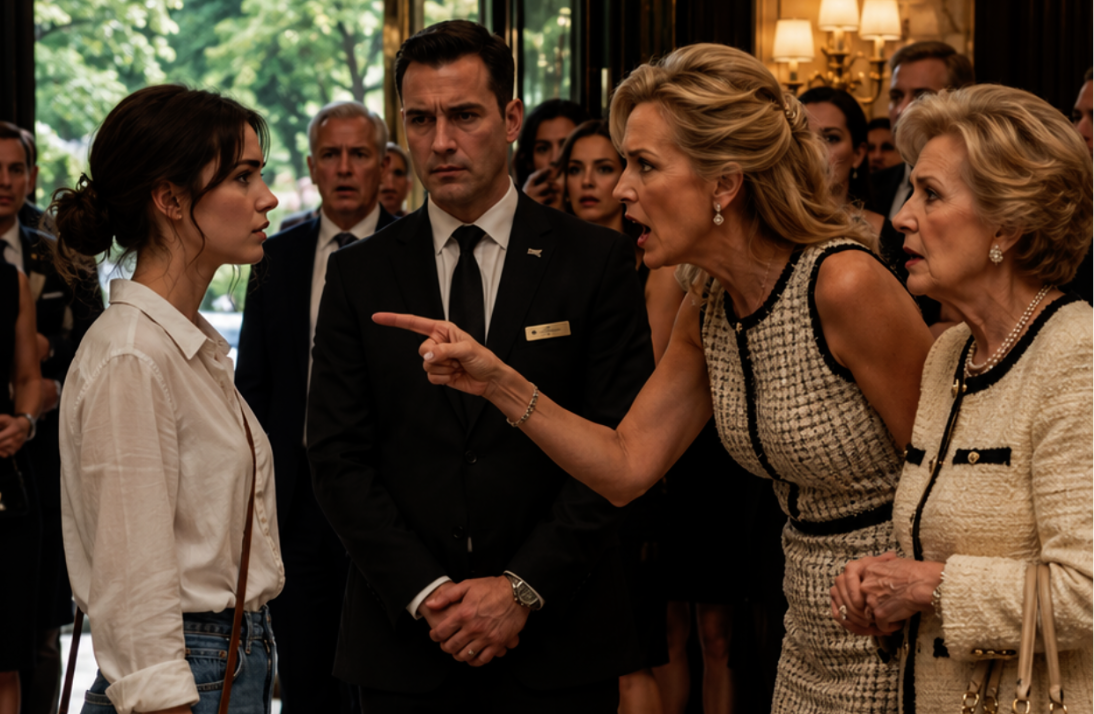
That was the precise moment Clare committed a fatal, irreversible tactical error. Desperate to maintain control of the narrative, she spun around and flagged down the nearest security guard—a sturdy, professional man in his fifties wearing a brass nameplate.
“Excuse me, officer,” Clare commanded, wielding her voice like a riding crop. “Could you please immediately escort this aggressively underdressed individual off the premises? She is causing a disruption.”
The guard paused, his brow furrowing as he looked between my calm demeanor and Clare’s frantic indignation. “Ma’am, I—”
“She does not possess a membership here,” Clare escalated, her volume projecting across the marble acoustics of the hall. A genuine crowd was now forming. “Look at her attire. She clearly does not meet the standards of this club. We cannot permit unauthorized vagrants to loiter in the lobby.”
“Clare,” I warned softly. “Stop. Do not do this.”
“Why shouldn’t I?” she fired back, turning her fury fully upon me. “You endlessly humiliate us! For once in your miserable life, can you not simply accept that you do not belong in a space like this?”
“The guard is merely executing his duties, Emily,” Mom added smoothly, attempting to reframe the cruelty as protocol. “Had you adhered to the dress code, this unpleasantness would be entirely unnecessary.”
The security guard looked visibly distressed. “Ladies, I am not entirely certain…”
“Remove her immediately!” Clare shrieked. “I am a paying member of this club, and I am formally requesting that this trespasser be expelled!”
The foyer descended into a profound, suffocating silence. Nearly two dozen distinguished guests had frozen in place, their luxurious afternoon violently interrupted by raw, unvarnished family warfare. I stood perfectly still, my breathing slow and measured, waiting for the inevitable culmination.
The crowd parted slightly, and David Morrison stepped into the epicenter of the crisis.
David was the executive director of the Madison Estate, a dignified, silver-haired gentleman in a bespoke suit who had managed the club’s operations with flawless precision for over two decades. He had undoubtedly been summoned by a staff member who recognized that this altercation required diplomatic intervention far above the paygrade of standard security.
“What exactly seems to be the disturbance?” David inquired, his voice a masterclass in soothing, authoritative modulation—a tone specifically calibrated to de-escalate the tantrums of the ultra-wealthy.
“Finally,” Clare exhaled, crossing her arms. “Mr. Morrison. Thank goodness you are here. This individual,” she thrust an accusing finger at my chest, “requires immediate removal from the estate. She is violating the dress code and harassing members.”
David shifted his gaze to me. For a fraction of a second, I saw a flash of absolute recognition, immediately followed by profound, deeply concealed alarm.
“Miss Thompson,” David addressed me, his words chosen with surgical care. “Is there an issue we need to address?”
“I am Miss Thompson,” Clare interrupted aggressively, tapping her own chest. “I am Clare Thompson. This is my mother, Patricia Thompson. We are members in excellent standing. This,” she pointed at me again, “is my estranged sister. She holds no membership and must be removed.”
David did not flinch, but I observed the microscopic tightening of his jawline. “I see,” he said slowly, drawing out the syllables. “And you are officially requesting that I have your sister physically escorted from the property.”
“Immediately,” Clare confirmed. “Before she inflicts any further reputational damage upon us.”
“She looks like a vagrant,” Mom chimed in, seeking solidarity from the director. “It is entirely unacceptable. Surely a man of your standards can see that.”
David turned his attention fully to me. In his eyes, there was a silent, urgent question. I met his gaze and offered a microscopic, barely perceptible nod of authorization.
“Miss Thompson,” David said. When he spoke again, his voice had undergone a tectonic shift. The soothing, deferential tone of a hospitality manager vanished, replaced by the crisp, unyielding formality of a corporate subordinate speaking to an executive. “Shall we proceed with revoking their memberships?”
The acoustics of the lobby seemed to swallow the sound. The silence that followed was absolute.
Clare’s face went entirely slack, her aggressive posture dissolving into raw confusion. “Excuse me? What did you just say?”
David did not look at her. He kept his eyes locked respectfully on me. “I repeat: Shall we proceed with revoking their memberships?” He slowly retrieved a tablet from his jacket pocket. “Mrs. Patricia Thompson and Ms. Clare Thompson are currently classified as sponsored guests operating under a primary membership account.”
“What on earth are you talking about?” Clare demanded, her voice trembling slightly. “We have possessed memberships here for decades! My father—”
“Your late father’s primary membership was officially transferred five years ago,” David corrected smoothly, tapping the screen of his device. “Upon his passing, the master account and all associated financial privileges were legally transferred to the designated heir listed in his estate.”
Mom’s face drained of color, taking on the pallor of wet ash. “That is an impossibility. I possess the physical membership card. I have been paying the monthly statements.”
“You have been utilizing the physical card and its associated privileges,” David clarified, his tone polite but devastatingly firm. “However, the primary membership itself belongs to an entirely different entity. An entity who has been silently underwriting every single cost associated with your presence at this club for the past five years. This includes your monthly dues, your extensive dining charges, your guest passes, and your access to all recreational facilities.”
The surrounding crowd had subtly pressed closer. I saw the glint of smartphone camera lenses rising in the periphery.
“Who?” Clare whispered. The bluster was entirely gone, replaced by a dawning, horrifying realization.
David turned toward me, executing a distinct, respectful bow of his head. “Miss Emily Thompson has been the sole registered primary member since 2019. She legally owns the membership profile you have been exploiting.” He paused, tapping his screen once more. “And, for the sake of complete transparency, she owns considerably more than a mere membership.”
“What exactly does that mean?” Mom asked, her voice cracking.
“The Madison Estate Country Club, including all assets and liabilities, was fully acquired by Thompson Holdings LLC three years ago,” David announced, his voice carrying clearly to the back of the room. “Miss Emily Thompson is the founder, CEO, and sole proprietor of Thompson Holdings. Therefore, Mrs. Thompson, your youngest daughter does not merely own the membership you have been using. She owns the building you are standing in. She owns the entire club.”
If the previous silence had been absolute, the current silence was practically a vacuum. Clare’s mouth opened and closed in a silent mimicry of a fish on dry land. Mom reached out blindly, gripping the ornate back of a mahogany chair to prevent her knees from buckling.
“That is… structurally impossible,” Clare finally gasped, shaking her head. “Emily is a mid-level data analyst. She inhabits a studio apartment! She drives a ten-year-old Honda!”
“Miss Thompson does indeed maintain a private, modest residence within the city limits,” David provided helpfully. “However, public records will also verify that she owns three sprawling estates in Connecticut, including the very land upon which this club was built. As for her choice in motor vehicles, I am told she values engineering reliability over aesthetic posturing.”
“The entire club,” Mom whispered, staring at the floor as her worldview shattered into jagged fragments.
“All forty acres,” David confirmed without mercy. “The primary structures, all athletic facilities, and the adjoining championship golf course. It was acquired in 2021 for a sum of $47 million. The transaction was executed with strict confidentiality, as Miss Thompson vastly prefers to maintain a low profile.”
I had remained utterly silent throughout this surgical dismantling of their reality. I watched their faces as the decades of assumed superiority violently evaporated.
“Emily,” Clare choked out, turning to me with wide, terrified eyes. “Is any of this factual?”
“Yes,” I stated clearly.
“But how? And more importantly, why did you never inform us?”
“Because you never once inquired,” I answered, my voice steady and devoid of malice. “You operated purely on assumptions. You unilaterally decided I was an irredeemable failure, an embarrassment to the family lineage. No data set I could have provided would have overridden your preconceived biases. Consequently, I ceased providing data.”
“But the cramped apartment,” Mom stammered weakly, grasping at straws. “The obscure job? The terrible car?”
“I am quite fond of my apartment; it offers an optimal commute to my headquarters,” I explained patiently. “The ‘obscure job’ is the predictive financial modeling firm I personally founded six years ago. We manage data infrastructure for top-tier global investment banks. And as I have stated previously, the Honda is highly reliable. I feel no internal compulsion to leverage my transportation to solicit validation from strangers.”
“Six years,” Clare repeated, the math slowly clicking into place. “You have possessed this level of wealth for six years, and you hid it.”
“I attempted to share it,” I corrected her. “Recall when I invited you both to my corporation’s inaugural launch gala? You both declined, citing trivial social conflicts. When I casually mentioned purchasing real estate in Connecticut, you immediately mocked me for buying what you assumed was a dilapidated condo. When Dad passed away and bequeathed the club membership to me, you openly speculated it was a pity prize because I was destitute.”
The unvarnished, undeniable truth settled heavily upon them.
“Every single time you complained about the burden of club dues,” I continued, “I was the one quietly routing the payments. Every luxurious meal you charged to the account, every high-profile guest you entertained to bolster your own status, every exclusive event you attended—I underwrote all of it. I have heavily subsidized your social existence for five years.”
“But why?” Mom asked, a genuine note of wounded betrayal in her voice. “If you possessed these resources… why allow us to treat you this way? Why live this elaborate lie?”
“Because I required empirical evidence of your capacity to love me,” I said softly. “The authentic version of me. Not a sanitized, wealthy version engineered to impress your peers. Just me. And today, you provided the final, conclusive data point I required.”
Clare’s carefully applied mascara was now a ruined, streaky mess, tracking dark lines down her pale cheeks. “Emily, please… I—”
“You actively attempted to have me physically thrown into the street,” I reminded her, holding up a hand to stop the apologies. “You commanded security to expel me because my cotton blouse offended your sensibilities. You explicitly uninvited me from your engagement celebration because my presence threatened your fragile social facade. And Mom, you weaponized Dad’s memory to inflict maximum psychological damage.”
“I did not truly mean—”
“You meant every single syllable,” I interrupted gently, dealing strictly in facts. “To you, I was a tragic cautionary tale. Someone who failed to meet the rigorous metrics of your approval.”
David remained standing at rigid attention, a consummate professional, though a faint glimmer of profound respect softened his eyes. “Miss Thompson,” he said. “We await your official instructions regarding their accounts.”
This was the precipice. I held the absolute power to terminate their memberships, severing them from the elite social oxygen they required to survive. It would be the ultimate, symmetrical revenge. Yet, as I surveyed the wreckage of my mother’s pride and my sister’s manufactured reality, I felt no triumphant vindication. I felt only a deep, settling exhaustion.
“Their memberships will remain active,” I finally commanded. “For the present moment. However, I want the administrative records permanently updated to reflect their status purely as sponsored guests. They possess absolutely zero authority to dictate club policy, influence membership applications, or restrict guest access. And they most certainly lack the authorization to command security personnel.”
“Understood implicitly,” David replied with a crisp nod. “The database will reflect these restrictions immediately.”
“Wait!” Clare cried out, taking a desperate step forward. “Emily, please. I am so profoundly sorry. We were blind. We didn’t understand who you were.”
“You did not care to understand,” I corrected her, drawing a vital distinction. “You were only ever concerned with how my existence reflected upon your personal brand.”
“The engagement party,” Clare begged rapidly. “You must attend. Please. I will mandate that you sit at the head table. I will announce your success to the entire room!”
“I have no desire for you to announce anything,” I replied, adjusting the strap of my bag. “I attended this lunch today because, against all available evidence, I still harbored a fractional hope that we could simply interact as a family. You definitively proved that is an impossibility unless I conform to your artificial parameters.”
“You are being entirely unreasonable,” Mom protested, though the fight had left her voice.
“Am I?” I challenged calmly. “When was the last documented instance that you inquired about my life without attaching a critique? When did you last demonstrate genuine curiosity about my home, my career, or my joy? When did you last treat me as an autonomous human being rather than a public relations crisis to be managed?”
They stood in wretched, suffocating silence. They possessed no data to refute my claim.
“The club remains at your disposal,” I concluded. “I will not strip you of the only thing you seem to value. But I am permanently resigning from the role you assigned me. I am finished apologizing for failing to meet standards I never agreed to.”
I turned my attention back to David. “Thank you for managing this altercation with your usual exceptional professionalism, David.”
“It is my distinct privilege, Miss Thompson. Shall we prepare your preferred table for afternoon tea?”
“Not today,” I smiled faintly. “But please ensure their lunch charges are routed to my personal account. As always.”
I turned and walked toward the grand exit.
“Emily, wait!” Clare called out, her voice echoing off the marble. “The engagement party… your invitation!”
I paused, placing my hand against the cool brass of the heavy door, and looked back over my shoulder one final time. “Mail me the invitation. If you genuinely desire my presence as your sister—as an individual you value intrinsically—I will take it under advisement. But if you merely require the CEO of Thompson Holdings to serve as a wealthy prop for your social theater, save the postage.”
I pushed through the doors, stepping out into the brilliant, unfiltered afternoon sunlight. My sneakers squeaked against the stone one last time, a triumphant sound of departure. Behind me, the muffled cacophony of the lobby erupted as two dozen smartphones furiously transmitted the greatest scandal the Madison Estate had witnessed in a decade. By nightfall, the truth would saturate their entire network.
As I approached my reliable, perfectly engineered Honda, my phone vibrated. A secure message from David.
Your executive office transmitted the quarterly analytics. Club membership applications have increased by 15% this quarter. The infrastructure upgrades you authorized for the tennis pavilions are already generating significant revenue. Exceptional foresight, Miss Thompson.
I smiled, locking the screen. I had not purchased the Madison Estate Country Club as a vanity project or a spiteful investment. I bought it as a silent, monolithic testament to my own capabilities—a space I owned unconditionally, completely divorced from my family’s toxic metrics of success. The staggering irony that they had been unwittingly parading around inside my personal kingdom for years was merely a poetic footnote.
My phone began to ring as I merged onto the scenic coastal highway. The caller ID flashed Clare’s name. I let it ring out into the digital void. Moments later, Mom called. Then Clare again. They would likely flood my inbox for weeks, constructing elaborate apologies, attempting to retrofit their behavior to accommodate my newly discovered net worth. Perhaps they would even convince themselves they meant it.
But I had secured the final variable in my equation today. Their affection was, and always had been, strictly conditional. It was contingent upon my aesthetic presentation, my financial utility, and my compliance with their rigid dogmas.
I was officially finished living conditionally. I had an immensely profitable enterprise to helm, a diverse real estate portfolio to govern, and a profoundly peaceful life that required absolutely no external validation.
As the skyline of the city materialized on the horizon, my thoughts drifted to my father. He had clawed his way into this elite circle through sheer, unrelenting grit, enduring the subtle sneers of the generational wealth that surrounded him. When he drafted his final will, he bypassed my mother and sister entirely, leaving the master membership to me. Attached to the legal transfer had been a single, handwritten post-it note:
For Emily. The only one who never required anyone’s permission to be extraordinary.
He had accurately modeled the behavioral algorithms of his own family. He knew precisely the exclusion I would face, and he had quietly armed me with the ultimate trump card. I had kept the membership active all these years because I refused to be driven by my mother’s vanity or my sister’s pettiness. I did not measure human worth in seating charts or revenge tactics.
But the administrative ledgers were now permanently open. Every single time they walked through those colonnaded doors, every time they signed a receipt or ordered a glass of vintage champagne, they would be forced to process the inescapable reality: the daughter they had deemed defective, the sister they had attempted to banish through the service corridors, owned the very earth beneath their designer shoes.
And statistically speaking, that was consequence enough.