My name is Nora Whitfield, and I learned on my wedding day that not every interruption deserves a reaction.
Some interruptions deserve a boundary.
I met Caleb Monroe three years before our wedding, in a bookstore café in Portland, Maine. It was raining outside, the kind of cold spring rain that makes everyone walk faster with their shoulders raised. I was sitting by the window, marking essays for my evening writing class, when a man at the next table spilled coffee across a stack of architecture sketches.
He froze.
I handed him napkins without looking up.
“Tragic,” I said. “But the building still looks structurally optimistic.”
He laughed.
That was Caleb.
Warm laugh. Tired eyes. Gentle voice. The kind of man who seemed thoughtful before he tried to seem impressive.
He was an architect, recently returned to Maine after several years in Boston. I was a community college instructor and freelance editor. We were both in our thirties, both carrying quiet histories, both old enough to know that chemistry was easy but peace was rare.
Our first conversations were slow.
Books.
Old houses.
The best diner pie in the city.
Why people renovate kitchens but ignore front porches.
He never rushed me.
That was what I noticed first.
With Caleb, I did not feel like I had to perform charm. I could be thoughtful, tired, funny, quiet, uncertain. He accepted every version without trying to rearrange me into a woman easier to explain.
Three months into dating, he told me about his ex.
Her name was Vanessa Blake.
He did not say it bitterly.
He said it carefully.
“We were engaged once,” he told me, as we walked along the waterfront after dinner. “It ended badly.”
I waited.
He continued, “Vanessa loved being admired. At first, I mistook that for confidence. Then I realized she didn’t want a partner as much as she wanted an audience.”
That sentence stayed with me.
He told me they had planned a big wedding in Boston. Vanessa wanted everything photographed, sponsored, posted, admired. Caleb wanted something smaller, meaningful, real. They argued constantly. When he finally called off the engagement, she told everyone he had become “afraid of a woman who knew her worth.”
For months, mutual friends treated him like the villain.
“She’s very good at telling a story,” Caleb said.
I looked at him. “And what’s your story?”
He smiled sadly.
“That I stayed too long because I thought love meant being patient with someone who kept moving the finish line.”
I understood that more than I wanted to.
My own past was not dramatic, but it had taught me caution. I had spent years with men who liked my softness until they realized it came with standards. Men who loved that I listened, then resented when I spoke. Men who called me “calm” when I forgave them and “cold” when I finally stopped.
Caleb and I became careful with each other in the best way.
We did not pretend we were blank pages.
We read the old chapters with respect.
When he proposed, it was not in front of a crowd. We were in the old bookstore café where we met. He had asked the owner to reserve the window table. Outside, rain tapped against the glass.
He placed a small ring box beside my coffee.
“Nora,” he said, “I don’t want to make a scene. I want to make a promise. Will you build a quiet, honest life with me?”
I said yes before he finished.
We planned a small wedding at a renovated seaside inn near Cape Elizabeth. Eighty guests. Wildflowers. Family-style dinner. A string trio. No luxury performance. No pressure to impress people who did not truly know us.
My mother cried when she saw the venue.
“It feels like you,” she said.
Caleb’s father shook my hand and said, “Thank you for making my son smile like himself again.”
Everything felt simple.
Until Vanessa heard about the wedding.
At first, it was small.
A friend sent Caleb a screenshot of Vanessa’s post.
Some people move on quickly when they never knew how to love deeply.
Caleb showed it to me because he had promised not to hide things that involved us.
I read it and handed the phone back.
“She wants a reaction.”
“Yes,” he said.
“Are you going to give her one?”
“No.”
That answer mattered.
Then came another post.
Funny how men choose quiet women after they fail to handle powerful ones.
Then another.
Wishing everyone healing, even those who rewrite history.
Caleb blocked her.
I did not.
Not because I wanted to watch her.
Because sometimes it helps to know what kind of weather is forming.
A month before the wedding, Vanessa sent Caleb an email.
He read it beside me at our kitchen table.
Caleb,
I heard about your wedding. I hope she knows the version of you that disappears when things get hard. I hope she knows you once promised me forever too. I won’t interfere. I simply think truth deserves air.
Vanessa.
I looked at Caleb.
His jaw was tight, but his voice stayed calm.
“I’m sorry.”
“You didn’t write it.”
“No. But I brought that history into our life.”
I took his hand.
“History isn’t the problem. Lack of boundaries is.”
He nodded.
Then he did something that showed me exactly why I was marrying him.
He forwarded the email to our wedding planner, our venue coordinator, and his best man with a short note:
Vanessa Blake is not on the guest list. If she appears, please do not escalate. Notify me directly. Nora and I will handle it together.
Together.
That word meant everything.
Two weeks before the wedding, I received a message from an unknown account.
It was a photo of a white dress.
Long. Elegant. Almost bridal.
The message said:
Hope you’re secure enough not to mind.
I stared at it for a long time.
My first feeling was not anger.
It was sadness.
Not for me.
For her.
Because how lonely must a woman be to believe attention is the same thing as power?
I showed Caleb.
His face changed in a way I had never seen before.
Not panic.
Not guilt.
Quiet resolve.
“She’s coming,” he said.
“Maybe.”
“No,” he said. “She is.”
I sat beside him on the couch.
“What do you want to do?”
He looked at me.
“What do we want to do?”
Again, together.
I loved him for that.
We talked for hours.
Not about revenge.
Not about humiliation.
About boundaries.
About how to protect the ceremony without giving Vanessa the dramatic scene she clearly wanted.
Caleb said, “If she comes in white, she wants people to compare you.”
I smiled faintly.
“That won’t work. I’m not competing.”
“I know.”
“But guests will react.”
“Yes.”
“And if security removes her, she gets to say we were cruel.”
“Exactly.”
We decided on something else.
Something quieter.
Something she would not know how to use.
Caleb called our officiant, Marjorie, a retired literature professor with silver hair and a voice that could calm a room without effort. He explained everything.
Marjorie listened.
Then she said, “Some people arrive dressed as a question. The ceremony can answer without naming them.”
That was why we loved Marjorie.
The wedding morning arrived bright and windy.
The sky was blue. The sea looked silver. The inn smelled like cedar, salt air, and flowers. My dress was simple: soft ivory, long sleeves, no sparkle except the small pearl comb my mother placed in my hair.
My bridesmaids wore sage green.
Caleb wore a charcoal suit and the expression of a man who had already decided where he belonged.
Before the ceremony, he sent me a note.
Whatever walks into the room today, I am walking toward you.
I pressed the note to my chest.
At 4 PM, guests gathered on the lawn overlooking the water. White chairs faced a wooden arch covered in greenery and small flowers. My mother sat in the front row, dabbing her eyes before anything had even happened.
I stood inside the inn with my father, waiting for the music.
Then my maid of honor, Elise, entered quietly.
Her face told me before her words did.
“She’s here,” Elise said.
I closed my eyes.
“What is she wearing?”
Elise hesitated.
“White.”
My father’s hand tightened around mine.
“Want me to handle it?” he asked.
I smiled.
“No. Caleb and I already did.”
Outside, I heard the guests shift.
A ripple moved through the lawn.
I imagined Vanessa walking in slowly, letting people see her. I imagined the white dress. The lifted chin. The soft smile meant to look wounded and powerful at the same time.
Five years ago, maybe I would have felt small.
That day, I felt strangely calm.
The music began.
My father and I stepped into the doorway.
And there she was.
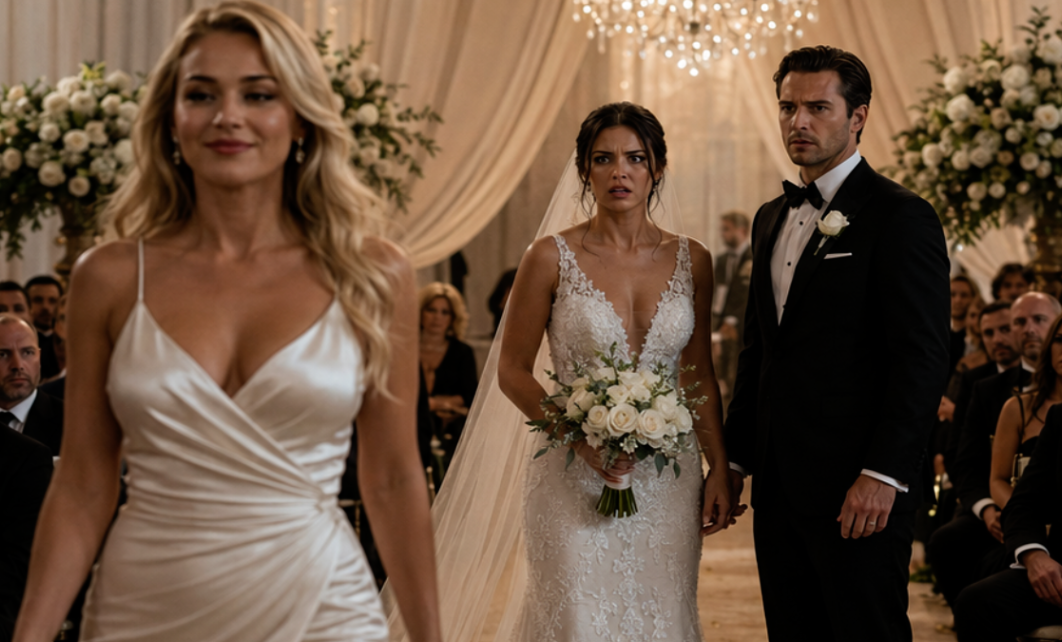
Vanessa Blake stood near the third row in a white dress, hair perfectly styled, red lips curved in a faint smile. She looked directly at me, waiting.
Waiting for my face to fall.
Waiting for my step to falter.
Waiting for the room to turn into her stage.
But I looked past her.
Caleb stood under the arch.
His eyes were on me.
Only me.
Then, just as I reached the aisle, he stepped forward and turned to the guests.
“Before Nora walks to me,” he said calmly, “I want to say something.”
The entire lawn went silent.
Vanessa’s smile flickered.
Caleb held my gaze.
“Today is not about the loudest person in white,” he said. “It is about the woman who taught me that peace can be stronger than performance.”
A soft murmur moved through the guests.
Caleb continued.
“So if anyone came here hoping to distract from love, I hope they learn this: attention is not the same as importance.”
Vanessa’s face changed.
And then Caleb smiled at me.
“Come here, Nora. I’ve been waiting for you.”
The guests stood.
My father whispered, “That’s my kind of son-in-law.”
And I walked down the aisle, not as a bride being challenged, but as a woman being chosen in front of everyone.
My name is Nora Whitfield, and the most profound, indelible lesson I learned on my wedding day was that not every interruption deserves the dignity of a reaction; some simply require the unyielding architecture of a firm boundary.
I first encountered Caleb Monroe three years prior to our wedding, taking refuge from a biting spring rain in a Portland, Maine, bookstore café. The rain outside had that particular coastal chill that forces shoulders up, hurries footsteps, and washes the color from the afternoon. I was deeply occupied with grading essays for my evening literature seminar, a red pen in hand, when a man at the adjacent table clumsily knocked his ceramic mug of coffee over a meticulously drawn stack of architectural schematics.
He froze in pure, unadulterated dismay. Without breaking my gaze from my students’ papers, I silently handed him a thick stack of paper napkins.
“Tragic,” I noted dryly, watching the brown liquid pool near a beautifully rendered doorway. “But the building still looks structurally optimistic.”
He let out a warm, resonant laugh that instantly shifted the atmosphere. That laugh perfectly encapsulated Caleb—tired but kind eyes, a gentle vocal cadence, and an innate thoughtfulness that preceded any desire to seem impressive. A recently returned architect from Boston, he, like myself, carried the quiet, complicated histories typical of our thirties. We both intimately understood, through the trial and error of past relationships, that while romantic chemistry is easily sparked, true psychological peace is an exceptionally rare commodity.
Our initial courtship moved at a deliberate, unhurried pace. We debated literature, the enduring charm of historic homes, the superior diner pies in the city, and the peculiar modern habit of renovating interior kitchens while entirely neglecting welcoming front porches. Caleb never rushed my heart or my trust. I never felt the exhausting need to perform charm for him; he embraced my tired, quiet, and uncertain facets without ever attempting to mold me into a more convenient, easily digestible narrative.
Three months into our relationship, Caleb delicately unpacked his past. He spoke of his ex-fiancée, Vanessa Blake, not with residual bitterness, but with a cautious, highly measured tone.
“We were engaged once,” he explained as we walked along the cobblestone waterfront after dinner. “It ended badly.”
He elaborated, painting a portrait of a dynamic that was fundamentally misaligned. Vanessa thrived on admiration. Caleb admitted he had initially mistaken her thirst for an audience as genuine self-confidence, a common enough error. However, he eventually realized she did not desire a partner so much as she demanded a permanent spectator. Their doomed Boston wedding plans had been a battleground of aesthetics versus authenticity—she demanded a sponsored, heavily photographed, public spectacle, while he yearned for something intimately real. When Caleb finally severed the engagement, Vanessa preemptively spun a narrative to their social circle, claiming he was simply intimidated by a woman who knew her worth, successfully casting him as the villain among their mutual acquaintances.
“She is very good at telling a story,” Caleb noted.
I looked at him, recognizing the weight he carried. “And what is your story?”
He smiled sadly. “That I stayed too long because I falsely believed love meant being endlessly patient with someone who kept moving the finish line.”
My own past, heavily scarred by men who adored my calmness until it evolved into firm standards, had taught me similar caution. I had endured men who loved my ability to listen, but deeply resented when I finally spoke. We approached each other not as blank slates, but as worn books, respectfully reading each other’s old chapters and acknowledging the damage without letting it dictate our future.
When Caleb proposed, he entirely eschewed any grand, public spectacle. He reserved our window table at the very bookstore café where we first met, the rain once again providing a familiar, rhythmic soundtrack against the glass. Sliding a modest, velvet ring box beside my coffee cup, he bypassed the theatrics.
“Nora,” he said softly. “I don’t want to make a scene. I want to make a promise. Will you build a quiet, honest life with me?”
I accepted the proposal before he even finished his sentence.
Our wedding preparations reflected our shared ethos: an intimate gathering of eighty carefully chosen guests at a restored seaside inn near Cape Elizabeth. We envisioned wildflowers, a family-style dinner where guests passed plates, and a string trio. There was zero pressure to perform luxury for acquaintances who did not truly know our hearts. My mother wept at the venue’s authenticity, and Caleb’s father quietly thanked me for returning his son’s genuine smile. Everything felt exquisitely simple.
The tranquility held perfectly until Vanessa caught wind of our impending nuptials.
The provocations began as subtle digital ripples. A mutual acquaintance forwarded Caleb a screenshot of Vanessa’s passive-aggressive social media post mocking those who “move on quickly.” Caleb, honoring our sacred pact of absolute transparency, showed it to me immediately. I identified it instantly as a desperate bait for a reaction. Caleb firmly declined to provide one. Subsequent posts grew increasingly pointed, framing men as cowards who seek “quiet women” because they cannot handle power. Caleb silently blocked her accounts. I chose not to, understanding that it is often wise to monitor the horizon when a storm is visibly brewing.
A month prior to the wedding, the storm breached our inbox. Vanessa emailed Caleb directly, feigning well-wishes while insidiously suggesting he was a coward who abandoned his promises, noting that she hoped I knew the version of him that “disappears when things get hard.” Caleb read it at our kitchen table, his jaw tightly clenched. He apologized for the ghosts of his history haunting our present. I took his hand, firmly reminding him that history is merely context; the true, actionable issue was her profound lack of boundaries.
What Caleb did next solidified my absolute certainty in our union. He forwarded her email directly to our wedding planner, our venue coordinator, and his best man with a definitive, unambiguous directive: Vanessa Blake was officially barred, and any appearance was to be handled discreetly by us, together. That word—together—became the bedrock of our strategy.
Two weeks before the ceremony, the ultimate provocation arrived via an anonymous message to my phone: a photograph of a stunning, decidedly bridal white gown. The accompanying text was a taunt challenging my personal security: Hope you’re secure enough not to mind.
Staring at the glowing screen, I felt a profound wave of melancholy—not for my own wedding or my own ego, but for a woman so totally consumed by loneliness and insecurity that she equated negative attention with actual power. When I showed Caleb the image, his expression shifted into a mask of quiet, unyielding resolve.
“She’s coming,” he stated, his voice devoid of panic but heavy with certainty.
Sitting shoulder-to-shoulder on the sofa, we meticulously strategized, not out of a desire for vengeance, but for the preservation of our peace. If Vanessa arrived in white, her goal was forced comparison, whispered gossip, and ultimately, a theatrical ejection she could later weaponize as victimhood. We absolutely refused to grant her that stage. Seeking wise counsel, Caleb contacted Marjorie, our chosen officiant and a retired literature professor possessing a voice that naturally commanded peace without ever raising its volume.
Marjorie listened intently to the dilemma and offered a brilliant, philosophical perspective: “Some people arrive dressed as a question. The ceremony can answer without ever naming them.” With that profound advice, our quiet, devastatingly effective counter-strategy was forged.
Our wedding day dawned spectacularly bright, the coastal Maine winds sweeping vigorously off a silver, sun-dappled sea. The historic inn was beautifully redolent with the scent of raw cedar, salt air, and fresh florals. My attire was intentionally understated yet elegant: a long-sleeved, soft ivory gown, devoid of heavy sequins or tulle, accented only by my mother’s heirloom pearl comb in my hair. Caleb waited in a tailored charcoal suit, radiating the calm expression of a man who had unequivocally found his true north.
Before the ceremony commenced, he sent a handwritten note to my suite: “Whatever walks into the room today, I am walking toward you.” I pressed the paper to my chest, completely grounded by his devotion.
At four o’clock, the guests congregated on the oceanfront lawn. I waited indoors with my father, my heartbeat steady, until Elise, my maid of honor, slipped into the room with a grim, tense confirmation. Vanessa had arrived. And yes, she was draped in brilliant white. I politely declined my father’s protective, immediate offer to intervene with security, armed instead with the peaceful certainty Caleb and I had proactively cultivated.
Stepping into the doorway as the string music swelled, I beheld the scene. There, deliberately positioned in the third row, stood Vanessa Blake. Her white gown was immaculate, her hair styled to perfection, her red lips curved into a wounded yet victorious smile, waiting for my composure to visibly shatter. I looked straight past her theatricality, fixing my eyes entirely on Caleb, who stood resolute beneath the lush greenery of the floral arch.
As I began my walk down the aisle, Caleb executed our plan. He stepped forward, raising a hand to pause the music, commanding the absolute, breathless silence of the gathering. Holding my gaze securely, he addressed the crowd.
“Before Nora walks to me,” he declared, his voice unwavering and clear, “I want to say something. Today is not about the loudest person in white. It is about the woman who taught me that peace can be stronger than performance. So if anyone came here hoping to distract from love, I hope they learn this: attention is not the same as importance.”
A soft, comprehending murmur rippled through the guests. Vanessa’s triumphant, manufactured facade visibly fractured, the color draining slightly from her cheeks. Caleb smiled exclusively at me, calling me forward. The guests rose in a unified wave of support, and I walked the aisle not as a bride engaged in a petty, territorial competition, but as a woman profoundly and publicly chosen.
Throughout the ceremony, Caleb’s focus never deviated from my face. Marjorie seamlessly wove our reality into the proceedings, noting that true marriage is built when “two people choose each other even when distraction stands nearby wearing a beautiful costume.” Our vows deeply reflected our unwavering commitment to honesty over performance, promising to never let old stories become louder than the life we were actively writing.
At the reception, Vanessa’s final attempts to command the room floundered completely. She lingered awkwardly near the champagne table, desperately awaiting an audience that Caleb’s poignant speech had masterfully dismantled. He had taught our guests a crucial behavioral lesson: feeding disrespect with attention only empowers the disruption.
Midway through the evening dinner, Vanessa finally approached our table. The immediate vicinity quieted slightly. Caleb placed his fork down but remained seated, radiating absolute clarity. When she softly claimed she hadn’t intended to cause trouble, Caleb calmly pointed out that she had chosen the wrong dress for the wrong reason. When she protested the unfairness of his assessment, I interjected with gentle firmness. I told her that walking into another woman’s wedding hoping to exploit her insecurity for personal power was what was truly unfair.
She attempted to play the emotional card, stating she had loved him first. I reminded her, quietly, that love is not a chronological queue. Seeing Caleb reach for my hand, physically joining us as a united front, Vanessa finally recognized the impenetrable fortress of our union. There was no jealousy to mine here. She departed the venue before dessert was served, an actor exiting a stage that entirely refused to applaud her monologue.
Weeks later, when the photographer delivered our gallery, we found the inevitable image. In the corner of a wide shot capturing our sunlit vows, Vanessa sat in her white dress, a slightly blurred interruption in our perfect narrative. When Caleb found me staring at it, we honored our commitment to deeply honest conversations. I admitted it bothered me, but simultaneously realized her presence in the photo was a vital testament. She stood as literal, photographic proof that someone could arrive wearing the universal symbol of bridal importance and remain utterly, fundamentally irrelevant to the actual promise being forged at the altar.
We decided against sharing that specific image online, decisively denying Vanessa any retrospective spotlight. Instead, we posted a singular, beautiful capture of Caleb reaching for my hand, captioned simply: “We chose peace, truth, and each other.”
As the adrenaline of the wedding faded into memory, we happily settled into the profound beauty of ordinary life. Grocery runs, broken cabinets, shared coffee—these routine, highly mundane moments solidified my understanding that genuine love thrives in repeatable, unglamorous kindness, not in constant dramatic proofs.
My final, unscripted encounter with Vanessa occurred months later at a downtown art market. Stripped of audiences and formal wear, the tension was surprisingly blunt. The conversation peeled back her polished veneer, revealing a profound exhaustion born from the desperate, lifelong need to be seen. She confessed that Caleb had made her feel “ordinary” when he left. I challenged this worldview, explaining that the “ordinary”—bills, tired evenings, quiet jokes—is where authentic life resides, and rejecting it dooms one to a life of exhausting, perpetual theatricality. When she quietly apologized for attending, I offered a nuanced truth: I harbored no anger, but forgiveness is not a backdoor access pass to our lives. I left with a newfound, unexpected closure.
As the years flowed by, the saga of the “ex in the white dress” evolved from shocking gossip into a foundational philosophy of our marriage. The phrase “Attention is not importance” became our shared, guiding mantra. It functioned as an emotional anchor during difficult workplace meetings with difficult clients, navigating internet negativity, or managing intrusive family opinions. It reminded us continually to prioritize substance over spectacle.
Five years into our marriage, Caleb and I purchased a weathered, beautiful historic house near the water. On our first night, sitting on the bare floorboards amidst unopened boxes, eating takeout while the rain tapped against the glass, we toasted to our quiet, honest life. I unpacked the framed note Caleb had given me on our wedding morning, placing it carefully on my dresser as a daily reminder of what intentional, directed love truly feels like.
Partnership is truly revealed when pressure mounts. Caleb did not act as a traditional savior rescuing me from Vanessa’s theatrics; I was already standing firm. He simply chose to stand shoulder-to-shoulder with me, broadcasting to the room that I was not alone. That is the true essence of love—not possession, not performance, and certainly not jealousy, but unwavering, reliable presence.
For anyone navigating the intrusion of an old story into a new joy, remember this paramount truth: you never have to compete for the center of your own life. You are already occupying it. You need not validate your worth by reacting to those desperate to unsettle you. The right partner will never ask you to diminish yourself to accommodate someone else’s desperate plea for the spotlight. They will stand beside you, articulate boundaries with absolute, unwavering clarity, and then pivot back to the promise you share. Attention is fundamentally different from importance, and an authentic love ensures its partner never stands alone on the battlefield of life.