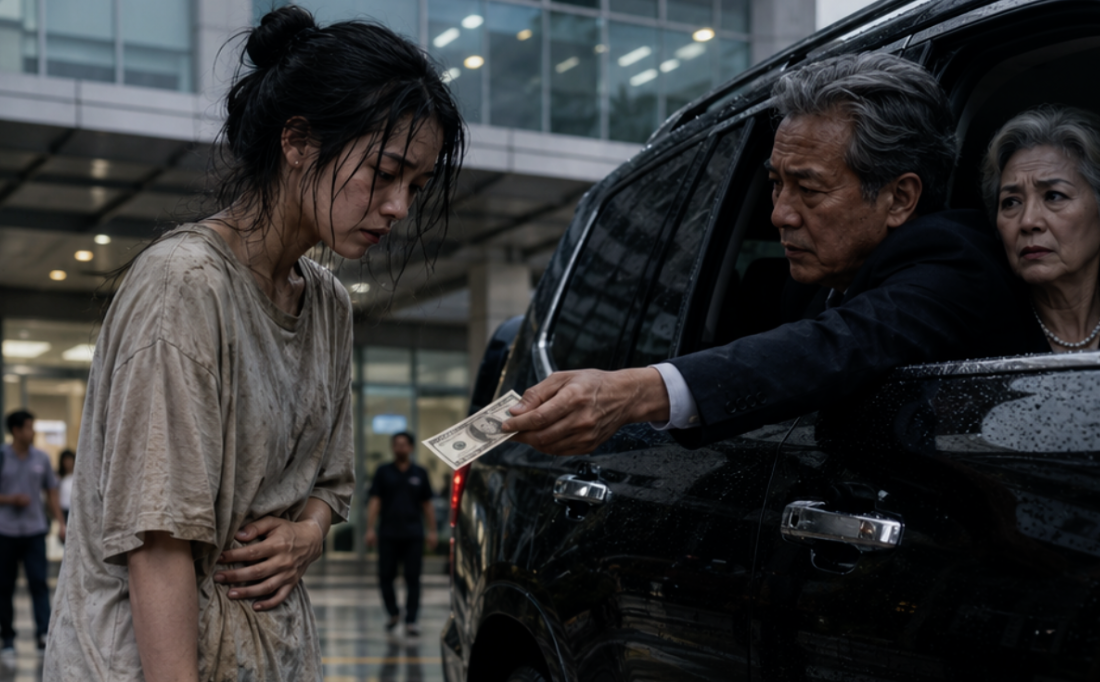
The exact market value of thirty-four years of unconditional loyalty is twenty dollars. I know this with absolute, clinical certainty because I watched that exact sum flutter from my mother’s manicured fingers, drift through the humid North Carolina air, and land squarely in an oily puddle at my feet.
My name is Zoe Jenkins. Forty-eight hours prior, a trauma surgeon had sliced my abdomen open to save my life. Now, I stood on the curb outside a Charlotte hospital, vibrating with a level of physical agony that felt as though I was being unzipped from the inside out. I had begged my parents for a simple fifteen-minute ride home. Against the mountain of actuarial data proving they were entirely incapable of altruism, a tiny, idiotic spark of hope had convinced me they might, for once, act like parents.
When the sleek, $65,000 black Chevy Tahoe—a monolith of modern engineering I had purchased for them seventy-two weeks ago—finally glided to the curb, it didn’t park. It hovered like a predatory shark, blocking traffic. The heavy, safety-rated doors remained sealed. Instead, the tinted passenger window hummed down exactly one inch. My mother, Celeste, did not look at me. She merely extended a hand heavy with a five-carat diamond I had paid for, and dropped the crumpled bill.
“Take a taxi, Zoe,” her metallic voice drifted through the narrow gap. “Your father does not want the new car smell ruined. I will not have my car smelling like hospital disinfectants all afternoon. Do not call us until you can behave properly.”
My father, Graham, sat at the wheel, his profile illuminated by the dashboard. He didn’t even turn his head. A second later, the tinted glass sealed shut, and the $75,000 machine accelerated into the midday traffic, leaving me suffocating in a cloud of diesel fumes and profound rejection. The humiliation hit harder than the surgical incision. But as I stared at the oily water seeping into George Washington’s paper face, the desperate, frightened daughter inside me died. In her place, the CEO of Meridian Harbor Risk Advisory woke up.
I did not cry. There was zero emotional capital left to burn. Bending at the waist, ignoring the blinding, white-hot shriek of my freshly sutured muscles tearing, I plucked the wet bill from the filth. This was no longer a tragedy; it was opening capital. I pulled out my phone and ordered a car, not to the sprawling five-bedroom country club estate I had bought for them, but to a 98th-floor glass-and-steel downtown penthouse. I had acquired it as a distressed asset three years ago. To my parents, it didn’t exist. To me, it was ground zero for the systematic, brick-by-brick demolition of their fraudulent empire.
My entire existence had been a masterclass in high-functioning masochism. I built Meridian Harbor from a folding table in a windowless studio into Charlotte’s premier crisis management agency. I managed million-dollar accounts, subsisting on black coffee, adrenaline, and fourteen-hour workdays. While I navigated hostile boardrooms, Graham and Celeste perfected the art of professional leisure. They wore their luxurious, unearned lifestyle like a bespoke suit. I funded their sprawling estate, the exorbitant property taxes, the country club dues, the winter ski trips, the summer European escapes, the organic groceries, and the premium concierge medical insurance. They viewed my bank accounts not as a gift, but as an unlimited black card with a pulse—a baseline standard of living they were fundamentally owed simply for bringing me into the world.
I was a human stock ticker to them. They didn’t call to ask if I was sleeping; they called to demand $20,000 credit limit increases for antique French dining chairs. They bragged to their high-society friends about teaching me everything I knew, while simultaneously complaining that my exhaustion was ruining the aesthetic of the catered dinner parties I was paying for. The realization had been a slow, agonizing erosion. I was a draft horse strapped in heavy leather, pulling a gilded carriage while they sat on velvet cushions, complaining the ride was too bumpy.
The dam finally broke on a crisp October evening. After an eleven-hour hostile takeover negotiation, I sat at the mahogany table I had imported from Milan for my mother, desperate for a quiet meal. Instead, Graham cleared his throat and announced they had found a lakefront vacation home. They needed me to wire a $300,000 earnest money deposit by Friday morning to secure their social standing among the country club elite.
For the first time in my life, I said no. I explained calmly that Meridian Harbor was facing a temporary cash-flow bottleneck due to a client’s internal audit. I needed to protect my sixty-five employees’ payroll. I expected a sigh of disappointment. Instead, the dining room erupted into a courtroom. Celeste slammed her fists on the wood, shrieking that my fiscal responsibility was a deliberate, malicious attack designed to humiliate her. Graham’s eyes dripped with surgical condescension, accusing me of fabricating the crisis to dodge my obligations. He made it terrifyingly clear: their prestigious reputation was vastly more important than the survival of the company I had built from nothing.
I left the house that night and drove to the industrial loft of Brier McCall, a ruthless, terrifyingly sharp media strategist and my only genuine friend. Over neat bourbon, Brier delivered the truth with the precision of a scalpel: I was a hostage in love with my captors. She devised a loyalty test. We would simulate a catastrophic asset freeze. I would claim a federal injunction had locked down my accounts pending an audit. We would strip away the gold plating and see what kind of parents remained when the cash flow stopped.
Accompanied by my notoriously sharp attorney, Nolan Voss, we finalized the illusion. I packed three duffel bags of cheap denim and unbranded sweatshirts. I drove a rented economy sedan to the estate and delivered the performance of my life, crying about frozen accounts and begging to stay in the guest suite. What they didn’t know—what Nolan had masterfully buried in dense legal jargon five years ago—was that the estate was owned entirely by my blind trust. They were glorified, non-paying tenants. I was asking permission to stay in a house I legally owned.
The moment the front doors clicked shut, the maternal performance Celeste had put on for a passing neighbor vanished. My request for the guest suite was denied. I was banished to a cramped, windowless storage room adjacent to the laundry machines. It smelled sharply of damp lint and bleach. My bed was a squeaky, rusted cot. Graham stood in the doorway, dictating brutal new regulations: five-minute showers to conserve hot water, a ban on using their imported detergent, and a locked thermostat.
Lying in the dark, staring at exposed copper pipes, I listened to them upstairs. They didn’t mourn my ruined reputation. They hyperventilated over their canceled Amalfi Coast villa and the crushing humiliation of facing their golf-club peers. Within fourteen days, the physical claustrophobia of the basement was eclipsed by their psychological warfare. Graham padlocked the walk-in pantry and the custom wine cellar—stocked entirely with vintages I had purchased. Celeste dramatically left highlighted utility bills on my placemat. When a rainstorm hit, they refused to let me drive the $75,000 Tahoe to the grocery store, forcing me to wait for a rideshare in the freezing rain so the neighbors wouldn’t see their pristine vehicle associated with my tarnished reputation.
But the ultimate betrayal surfaced when I was ordered to clean Graham’s office. In the wastebasket, I found a crumpled meeting agenda from a boutique wealth management firm. The handwritten margins detailed a legal strategy to establish conservatorship. Brier’s private investigators confirmed it within forty-eight hours: my parents were aggressively building a medical and legal dossier to petition the courts for emergency financial power of attorney. They wanted to declare me legally insane to raid my remaining capital before the fictional federal authorities could seize it. They weren’t just greedy; they were active, malicious predators.
I became a silent ghost in my own home, meticulously archiving their every move. The climax arrived on a Saturday evening as Celeste prepared for a twilight dinner party. Despite my severe abdominal pain, she forced me to haul heavy crates of crystal glassware down the steep outdoor staircase. For weeks, I had emailed Graham high-resolution photos of the severe wood rot eating the handrail. He had arrogantly dismissed the repairs as an unnecessary expense.
As I descended the stone steps, a blinding spike of pain caused my knees to buckle. I grabbed the cedar railing. It disintegrated into damp, spongy splinters. I plummeted, my lower abdomen slamming with devastating force against the solid stone corner of the landing. I lay crumpled in the wet grass, gasping, my vision blacking out. Graham didn’t check my pulse; he screamed from the landing about the cost of the shattered Italian crystal. Celeste whined that the catering staff was arriving, later instructing the emergency dispatcher to have the ambulance park down the street without sirens to avoid distressing her high-society guests.
At the trauma center, facing my emergency surgery for severe internal hemorrhaging, the hospital administrator asked Graham for an initial payment method. Graham carried a platinum card tied directly to my fully funded corporate accounts. He looked the administrator in the eye, explicitly refused to use it, and abandoned me financially at the threshold of the operating room.
While I was under the knife, Brier executed a tactical strike. She secured the hospital admission logs documenting his refusal to pay, the paramedic dispatch recording Celeste’s vanity request, and the timestamped emails proving Graham knowingly ignored the rotting stairs. They had enthusiastically built their own legal coffin.
Which brought me back to the 98th-floor penthouse, staring at the wet twenty-dollar bill. Nolan Voss and Brier McCall sat at my massive quartz dining table, looking like a military tribunal finalizing a drone strike. I gave the execution orders with a voice completely devoid of mercy.
“Cut them off,” I instructed Nolan.
Within minutes, every secondary credit card, platinum travel account, and exclusive charge line was terminated with extreme prejudice. I canceled the automated monthly allowance wire transfers. I revoked the premium insurance policy on the black Tahoe, legally allowing my security team to remotely trigger the engine immobilizer via the onboard satellite system. The vehicle was now a $75,000 paperweight.
Finally, Nolan activated the nuclear option. He drafted a formal eviction notice terminating their conditional residency, giving them exactly ninety-six hours to vacate before the county sheriff arrived. Coupled with this was a spoliation of evidence mandate, legally forbidding them from repairing the broken staircase, trapping them in a brutal civil liability corner for my near-fatal injuries.
Brier slid a manila folder toward me. While I was unconscious, Graham and Celeste had made their move. They had submitted a fabricated durable power of attorney to a private equity firm, complete with a forged notary seal and doctored physician statement. The brokerage’s fraud department had instantly flagged it. My parents had crossed the definitive line from emotional abuse to actionable federal financial fraud.
From the absolute silence of my penthouse, I watched the digital notifications of their downfall. At a high-end horology boutique, Graham’s card was loudly declined in front of his wealthiest friends. Across the plaza, Celeste abandoned a mountain of imported cosmetics when three separate platinum cards failed. They retreated to the sweltering parking lot, only to find the Tahoe bricked. Sitting in the baking, silent car, an automated email informed them their country club membership was suspended for unpaid dues.
When Graham finally called my phone, screaming feral threats and demanding I unlock the accounts, I felt nothing. I calmly informed him of the eviction notice taped to his door. I listened to Celeste shrieking in the background as she realized her private accounts were frozen. When Graham threatened to sue me, I casually mentioned the forged power of attorney file sitting on my desk, ready for the district attorney. The blustering arrogance evaporated, replaced by the terrifying silence of an ego hitting a concrete wall.
Desperate, they launched a vicious suburban smear campaign, claiming I had suffered a psychotic break. Graham hired a discount litigator who filed a frantic injunction to stall the eviction, while Celeste performed theatrical, weeping displays in my building’s lobby, begging her delusional daughter to come home. I simply had security add her to the trespasser list.
We met in a stark, fluorescent-lit courtroom two weeks later. Graham and Celeste dressed in wrinkled, dull clothing, playing the role of terrified, elderly victims. Graham committed blatant perjury on the stand, testifying that I was an unstable megalomaniac reacting to imaginary slights.
Nolan didn’t yell. He simply handed the judge the ironclad trust documents, proving they were mere tenants. Then, he dimmed the lights. The courtroom watched the crisp security footage—the Tahoe, the dropped twenty-dollar bill, my bleeding agony. He submitted the hospital administrator’s affidavit, the ignored emails about the stairs, and finally, the forged power of attorney document.
The judge didn’t even recess. Disgusted, he upheld the eviction, ordering them out within twenty-four hours, and formally forwarded the forged documents to the district attorney for felony fraud investigation.
As I walked into the marble hallway, they scrambled after me, stripped of their arrogance, weeping and begging for mercy. I opened my slim leather briefcase, retrieved the oil-stained twenty-dollar bill, and placed it on the wooden bench between them.
“Take a taxi,” I said, my voice steady and hollow. “I do not want my life smelling like you two anymore.”
I stepped into the elevator, the polished steel doors sliding shut, permanently severing the connection, and rode down in absolute, unbroken peace.