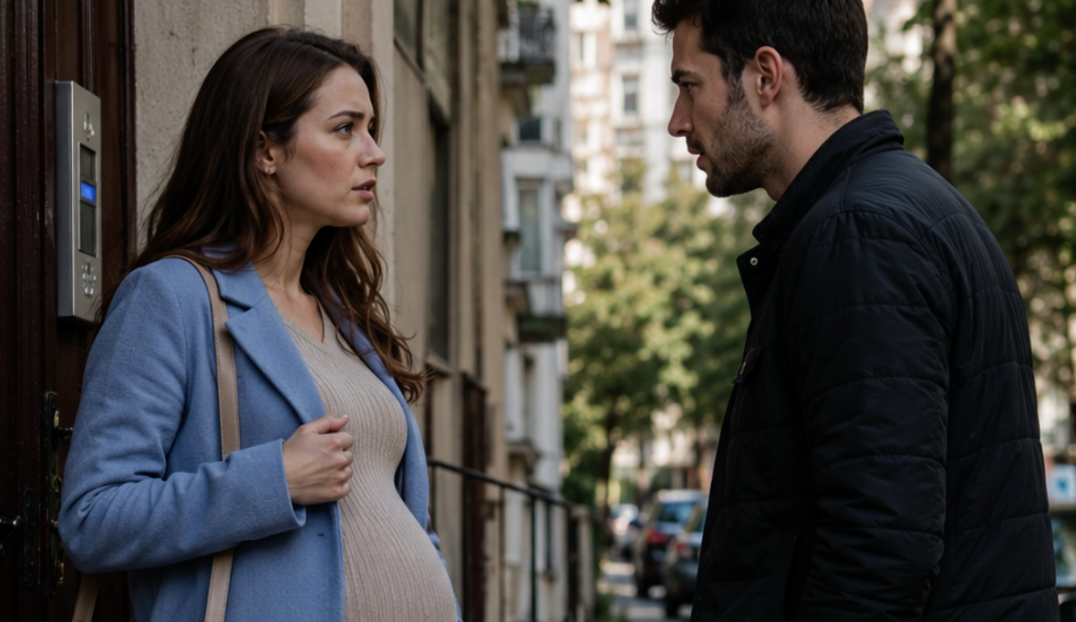
“Six months since we divorced, and you’re already pregnant? You moved on fast,” her ex said, his eyes fixed on Ksenia.
She did not stop at the entrance right away. She took two more steps, as if checking whether those words had really been spoken aloud, and had not merely brushed against her hearing with the edge of someone else’s insolence. In one hand she held a small bag from the pharmacy; in the other, her keys. The key ring quietly struck the metal keychain when she tightened her fingers around them.
Denis was standing by the bench near the entrance, as if he had been waiting specifically for her. His jacket was unbuttoned, his chin slightly raised, his gaze sharp and unpleasantly familiar. He used to look at her purchases that way, at her phone, at any message that arrived after nine in the evening. Now he was looking at her stomach.
Ksenia did not cover it with her bag, did not turn away, did not quicken her pace. She only turned to face him and calmly asked:
“What does my life have to do with you now?”
Denis blinked. He had clearly expected something else: excuses, embarrassment, explanations, maybe the old Ksenia, the one who, during their marriage, had tried to smooth over every sharp edge just to avoid another heavy conversation that lasted all night.
But the old Ksenia was no longer standing in front of him.
She stood straight in her dark coat, her hair pulled back, tired after a workday but composed. There was no guilt on her face, no desire to prove anything. Only the attentive, cold calm of a person who had lived too long under someone else’s control and had finally stopped letting him into her life.
Denis smirked, but the smirk came out short.
“So that’s how it is. You couldn’t have children with me, but now it happened right away?”
Ksenia looked at him in such a way that he almost lowered his eyes.
“Denis, we are divorced. Through court. There was nothing to argue about on your initiative, because there was nothing to divide. What was mine remained mine. What was yours remained yours. We had no children. Since that day, you have been a stranger to me.”
He shook his head, as if she had said something indecent.
“A stranger? After five years of marriage?”
“After five years of marriage, you could have at least learned not to stick your nose where you weren’t invited.”
She turned toward the entrance door, but Denis took a step after her.
“Wait. I asked normally.”
Ksenia stopped sharply. Not fearfully, not in confusion — simply in such a way that he had to stop too.
“No. Normal people ask about health, about work, about documents, if there are still shared matters. But you are standing at my entrance discussing my stomach. That is not normal.”
The neighbor from the first entrance, Aunt Lida, was passing by with a small dog on a leash. She slowed down, quickly glanced at Denis, then at Ksenia, but did not interfere. Only the dog pulled its nose toward the pharmacy bag, and Aunt Lida quietly led it away.
Denis noticed the neighbor and lowered his voice.
“At least tell me whose child it is.”
Ksenia turned the key in the intercom door and only then replied:
“That is none of your business.”
“So there really is someone already?”
She opened the door but did not go in. She stood on the threshold, holding the door with her hand.
“Denis, I will repeat this once. You are no longer my husband. You are not my relative. You are not my guardian. You are not a person I report to. If it is hard for you to accept that, talk to a specialist, to friends, to anyone you want. Just not to me.”
He clenched his jaw. During their marriage, this had been the first sign that pressure was about to begin: silent resentment, sharp phrases, slamming cabinet doors, a demonstrative walk out of the kitchen. Ksenia knew that sequence well. Before, she had tried to stop the storm in advance. Now she simply looked at him.
“You’ve changed,” he said.
“Yes.”
One short word sounded calmer than any explanation.
She entered the building and closed the door. Denis remained outside. Through the glass she saw him stand still for a few more seconds, then turn sharply and walk toward the road.
Ksenia went up to the third floor without hurrying. The landing smelled of wet shoes and fresh paint from the stair railings. She opened the apartment, stepped inside, locked the door with both locks, and only then allowed herself to exhale more deeply.
The apartment was quiet. Her quiet apartment.
Once, Denis had called it “our little corner,” even though Ksenia had bought it long before the marriage. She had been twenty-seven then, working as a procurement manager at a small manufacturing company, saving money, taking evening side jobs, counting every payment. She bought the apartment before she met Denis. It was not spacious, but it was bright, with a decent kitchen, a separate room, and windows facing the courtyard.
After the wedding, Denis quickly grew used to saying “ours.” Our apartment. Our renovation. Our car, even though the car was registered in Ksenia’s name and had also been bought by her before the marriage. Our money, even though his income appeared and disappeared, while he called her stability “a woman’s habit of controlling everything.”
At first, Ksenia thought it was just the adjustment period. Then she thought he was going through a difficult time. Then she thought she needed to argue less. Then she understood: Denis did not need peace. He needed to have the last word.
He could take offense because she stayed at work forty minutes late. He could ask why she had bought herself a new bag without discussing it. He could remind her for weeks about his “male dignity” if she paid for a large purchase herself. It became especially hard when his mother, Lyudmila Pavlovna, began visiting them without warning.
Ksenia did not like remembering those visits, but sometimes they rose before her eyes on their own: someone else’s outerwear in the hallway, an owner-like gaze across the shelves, comments about how a woman should be softer, more patient, more yielding. Lyudmila Pavlovna spoke as if gently, but every word landed on the table like an inspection.
“Denis needs comfort, not your endless rules.”
“A man needs to feel like the master.”
“An apartment is an apartment, but family is more important than paperwork.”
Back then, Ksenia still tried to answer calmly. She explained that the apartment was hers, that the order in it was also hers, that coming without calling was inconvenient. Denis would sit beside her during those moments and pretend it had nothing to do with him. Then, in the evening, he would say:
“You could have been softer with Mom. She isn’t a stranger.”
Gradually, Ksenia began to understand: the softer she spoke, the further the others went.
One day, Lyudmila Pavlovna suggested registering Denis at the apartment “for convenience.” Ksenia refused. Denis then barely spoke to her for three days. Later he said she was humiliating him.
“I live here as if I’m a guest.”
“You live here as my husband,” she had answered then. “But that does not change the ownership.”
After that, the conversations repeated more often. At first cautiously. Then more brazenly. Denis reasoned that if the apartment were registered in both their names, he would feel responsible. Lyudmila Pavlovna insisted that “normal wives don’t count square meters.” Ksenia listened, drew conclusions, and explained less and less.
The turning point came at the beginning of winter.
Denis had lost yet another job then. He did not tell her right away. For two weeks he left home in the morning, returned in the evening, complained about being tired, and then Ksenia accidentally saw a notification on his phone from a former colleague asking whether Denis had found anything new after being fired.
She did not make a scene. She simply placed the phone in front of him and asked:
“Why didn’t you tell me?”
Denis first got angry about the phone, then declared that he had wanted to “sort it out himself,” then shifted the conversation to the fact that Ksenia always looked down on him. Within an hour, she was the one who was supposed to be guilty: she had not supported him, had not understood him, had not created an atmosphere in which a man could open up.
That night, for the first time, Ksenia did not argue herself into exhaustion. She closed her laptop, cleared the documents from the table, and said:
“Denis, I am tired of being guilty for everything you did not do.”
He laughed roughly then.
“Well, divorce me if you’re so independent.”
She looked at him and realized that the word he had thrown out as a threat sounded to her like an exit.
The divorce was not immediate. At first Denis did not believe she would actually file. Then he said she would “cool down.” Then Lyudmila Pavlovna got involved, calling with reproaches, coming to the entrance, demanding “a human conversation.” Ksenia answered briefly and only to the point.
Since they had no children, and the apartment belonged to Ksenia before the marriage and was not jointly acquired property, there was almost nothing to dispute. Denis tried to cling to household appliances, some furniture, certain expenses he could not confirm. Then he quickly realized that loud words did not replace documents.
When he finally moved out, Ksenia changed the locks. Without announcements, without dramatic trips to institutions. She simply called a locksmith, chose a new set, and kept all the keys for herself. That evening, for the first time in a long while, she walked barefoot through the apartment and did not listen for someone else’s footsteps behind her.
The first weeks after the divorce were strange. The silence felt unfamiliar. No one asked why she came home late. No one assessed what she had bought. No one demanded that she smile at guests she had not invited. Ksenia was learning anew how to live without the inner readiness to defend herself.
She began staying later after work more often, not because she was afraid to go home, but because she could calmly finish her tasks. On Saturdays she walked to the embankment, bought herself coffee in a paper cup, and sat on a bench by the water. Sometimes she simply looked at passersby and thought about how many years she had spent explaining herself to a person who had never intended to listen.
She met Sergey in a way that was neither romantic nor beautiful, the way people tell it in other people’s stories. It happened in a queue at a multifunctional center. Ksenia had come to process documents for replacing her passport after changing back to her maiden name. Sergey stood ahead of her, holding a folder of papers, unable to find the right ticket. The machine by the entrance had frozen, people were irritated, and the guard waved toward another window.
Ksenia helped him figure out the queue number because she had already been through the system herself and knew where to press. Sergey thanked her without unnecessary insistence, stepped aside, and then ten minutes later returned and asked whether she had lost a small plastic card from her documents. It was indeed her card from a medical center, which had slipped out between the papers.
They began talking. Not about personal things right away. About tickets, queues, strange wording in applications. Then, when their windows turned out to be next to each other, they crossed paths again at the exit. Sergey offered to walk her to the bus stop because outside there was heavy wet snow and wind. Ksenia agreed not out of politeness, but because he did not pressure her.
He did not ask why she was changing her surname. He did not make a sympathetic face. He did not try to look like a rescuer. He simply walked beside her and talked about how the city had finally repaired the underpass near the station, and how his nephew had tied his shoelaces by himself for the first time yesterday and now demanded applause for every attempt.
That was the first time in a long while that Ksenia laughed without caution.
Sergey was four years older than her, worked as a commissioning engineer at a factory, and lived in a neighboring district. He had a calm voice, a habit of checking whether something was convenient for her, and a rare quality — he did not fill the entire space with himself. With him, silence was possible, and that silence did not become punishment.
Their relationship developed slowly. Ksenia did not throw herself into a new life like into water after a fire. She checked herself, her reactions, her boundaries. Several times she told Sergey directly that personal space was important to her, that she was not ready for sudden decisions, and that she did not want to repeat old mistakes.
Sergey did not take offense.
“Then we’ll move at a pace that feels peaceful for you,” he said once.
That simple phrase touched her more deeply than any beautiful promises. Because there was no attempt in it to demand immediate gratitude from her.
When Ksenia found out she was pregnant, she sat for a long time on the edge of the bathtub, looking at the test. She did not cry, did not laugh. She simply held the thin strip of plastic and felt as if, somewhere inside her, a door was opening into a life she had almost stopped thinking about.
In her marriage to Denis, the subject of children had always been painful. At first they said they were not in a hurry. Then Denis began hinting that “it was time.” Then, when pregnancy did not happen quickly, his mother began bringing advice, doctors’ phone numbers, strange articles, and her own conclusions. Ksenia went through examinations, had tests done, listened to recommendations. Denis was also supposed to undergo an examination, but every time he found a reason to postpone it.
“Everything is fine with me,” he would say. “You’d better get yourself checked properly.”
Ksenia got checked. Again and again. The doctors saw no serious obstacles. One specialist carefully said that both partners needed to be examined, otherwise the picture would be incomplete. Denis left the office irritated that day and rode home in silence.
After the divorce, Ksenia stopped perceiving the absence of children as her personal failure. She decided that her life did not have to prove her female worth to anyone. And exactly then, when she stopped living under someone else’s countdown, everything happened simply and quietly.
Sergey accepted the news in a way Ksenia remembered in every detail: first he put a glass of water on the table, then sat beside her, very carefully took her hand, and asked:
“How are you?”
Not “what are we going to do,” not “are you sure,” not “why so fast.” Exactly that: how she was.
Ksenia answered honestly then:
“I’m afraid. But not because of the baby. Because of the past.”
Sergey nodded.
“The past will not be in charge in our home.”
She looked at him attentively. There was no loud oath in those words. But there was what she had lacked before: respect for her experience.
They did not move in together right away. Sergey visited, helped with errands, went with her to appointments, read lists of necessary examinations, and did not argue with doctors to feel important. Ksenia remained in her apartment. She decided for herself when and whom to let into her everyday life. Sergey accepted this without demonstrative offense.
The pregnancy became noticeable closer to spring. Ksenia bought a looser coat, began walking more slowly, and paused more often on the stairs. At work, only her closest colleagues knew. She did not want discussions, unnecessary advice, other people’s versions.
And now Denis was standing by her entrance, trying with his tone to return her to the place she had escaped from.
After that encounter, Ksenia took off her coat, washed her hands, placed the pharmacy bag on the kitchen counter, and took out her phone. On the screen was a message from Sergey: “Are you home? Is everything okay?”
She looked at the message and did not answer immediately. She did not want to frighten him, but she was not going to hide anything either.
“Denis was at the entrance. He commented on the pregnancy. I’m inside. Everything is calm.”
Sergey called almost immediately.
“Did he touch you?” he asked without any unnecessary preamble.
“No. He only talked.”
“Do you want me to come?”
Ksenia went to the window. Denis was no longer in the courtyard. A teenager with a phone was sitting on the bench, and near the garbage containers, the yard worker was raking wet snow.
“Not urgently. I handled it.”
“I know you handled it. That’s not the point.”
Her face softened slightly.
“Come later. No heroics.”
“Agreed. And Ksyusha…”
“What?”
“You don’t owe him an answer to a single question.”
“I’ve already understood that.”
After the call, she sat at the table and opened the notebook where she kept her to-do list: tests, comfortable shoes, doctor’s appointment, documents. Now she added one more item: “Do not speak to Denis in person. Only messages, if necessary.”
She was not naive. Denis could appear again. Not because he loved her. Not because he regretted anything. It bothered him that his ex-wife was not destroyed, not lonely, not waiting for his return. It bothered him that she was pregnant by someone else. Especially after all those conversations in which he had placed her in the position of the guilty one.
The next day, he wrote.
“We need to talk.”
Ksenia read the message in the morning while getting ready for work. She did not answer right away. First she buttoned her coat, checked her documents, put the phone in her bag. Already in the elevator, she took it out again and wrote:
“We have nothing to talk about. You can write here about matters related to the divorce. I do not discuss personal topics.”
The reply came quickly:
“Do you even understand how this looks?”
Ksenia looked at the screen and turned it off. Not everything required a reaction.
The workday was packed. A supplier was delaying a shipment, the department head asked her to clarify deadlines, and a new employee mixed up the items in a request. Ksenia handled things with her usual concentration. She liked that work problems were solved through action: call, clarify, double-check, send an email. No one demanded that she guess someone’s mood.
At lunch, her friend Vera called. She knew almost the entire story with Denis and knew how to listen without unnecessary drama.
“He showed up?” Vera asked after Ksenia briefly told her about the encounter.
“Yes. At the entrance.”
“Classic. As long as you were suffering, he would have been fine with it. But once you start living further, suddenly he needs explanations.”
Ksenia gave a faint smirk.
“He asked whose child it was.”
“And you?”
“I said it wasn’t his question.”
“That’s exactly right. And don’t you dare let him into the building, even if he starts pretending to be remorseful.”
“I won’t.”
“And tell Sergey everything as it is.”
“I already did.”
Vera was silent for a moment, then added more gently:
“Just don’t let Denis ruin this time for you. He has already taken enough.”
Ksenia looked out the window of the office kitchen. Outside, people hurried along the wet sidewalk, and cars crawled slowly through traffic. She placed her palm on her stomach — not demonstratively, not for anyone else’s eyes, but quietly, for herself.
“I won’t let him.”
That evening, Sergey arrived with a bag of groceries and a small set of baby socks. Ksenia saw the socks and raised her eyebrows.
“Seriously?”
He became slightly embarrassed.
“I went in for apples. Saw them. Couldn’t resist. If it’s too early, we’ll put them away.”
Ksenia took the socks. They were tiny, gray, with small white stripes. She ran her finger over the fabric and smiled genuinely for the first time that day.
“It’s not too early. Just unexpected.”
Sergey did not immediately ask about Denis. He helped unpack the groceries, poured her water, put the bag away. Only then did he sit across from her.
“Will you tell me in detail?”
She told him. Without exaggeration. About the entrance, the look, the phrase, the question, the morning messages. Sergey listened attentively, did not interrupt, and did not try to solve everything for her immediately.
“I don’t want you meeting him alone if he starts coming again,” he said after a pause.
Ksenia looked at him warily.
Sergey noticed this and immediately clarified:
“Not because you can’t handle it. Because he has already crossed a boundary. If a person waits by the entrance and interferes in his ex-wife’s pregnancy, he may decide he has the right to take the next step.”
She relaxed her fingers, which had imperceptibly tightened around the edge of a napkin.
“I agree.”
“Can we install a camera by the door?”
“On the landing?”
“At least a video doorbell. Without violating the neighbors’ privacy. So you can see who came.”
Ksenia nodded.
“That’s a good idea.”
They discussed it calmly: no orders, no “I said so,” no male display of power. Sergey suggested; Ksenia decided. For her, this was still unfamiliar even after months. Sometimes she still expected a hidden catch where there was none.
Three days later, Denis appeared again. This time not at the entrance, but near the store beside the building. Ksenia came out after work, bought bread, milk, and apples, and saw him by the exit. He seemed to be choosing the moment, but it was too obvious that he was looking specifically at her.
She stopped under the store awning. It was drizzling outside.
“Are you stalking me?” she asked.
Denis pretended to be surprised.
“Oh, come on. It’s a shared neighborhood.”
“You live on the other side of the city.”
“I can be wherever I want.”
“You can. But if you keep waiting for me near my home and the store, I will start documenting it.”
His face changed. He did not look frightened, but he became harder.
“Are you threatening me now?”
“No. Setting boundaries.”
He smirked.
“Did Sergey teach you that?”
Ksenia heard Sergey’s name from his mouth for the first time and immediately understood: Denis had been finding things out. Through mutual acquaintances, old connections, maybe social media. An unpleasant fatigue rose inside her, but she did not let it show.
“Denis, this is the last conversation on the street. Anything concerning the past marriage, write in a message. Anything concerning my personal life does not concern you in any way.”
“And what if the child is mine?”
Ksenia looked at him in silence for several seconds. Then she said very clearly:
“Do not humiliate yourself.”
He jerked his shoulder.
“Anything can happen.”
“Our marriage ended long before the official divorce. You know that. I know that. And there is no need to put on a performance where you have no role.”
Those words hit their mark. Denis turned pale — not dramatically, but noticeably. In their marriage, physical intimacy had disappeared months before the court. Not because of someone’s affair, but because Ksenia could no longer let close a person who pressured her during the day and expected tenderness in the evening as if nothing had happened.
He knew that. He had simply counted on her not saying it aloud.
Ksenia walked around him and headed home. Denis did not follow. Apparently, directness worked more powerfully than persuasion.
But he did not stop there.
A week later, Lyudmila Pavlovna called. Ksenia had long since stopped saving the number, but she recognized it immediately. At first she wanted not to answer, then decided it would be better to state everything clearly once.
“Ksenia, hello,” her former mother-in-law’s voice was deliberately even. “We need to talk.”
“About what?”
“About the situation.”
“What situation?”
“Don’t pretend. Denis saw you. You’re pregnant.”
Ksenia closed her eyes for a second, then opened them. She was standing at home by the kitchen counter; beside her lay test results in a transparent folder.
“Lyudmila Pavlovna, my pregnancy is not your family situation.”
“You were my son’s wife.”
“I was. I am not anymore.”
“But people see things. Six months after the divorce, and already this. Have you thought about how it looks?”
Ksenia picked up a glass of water, took a sip, and replied:
“I do not live so that it is convenient for you to explain my life to the neighbors.”
Irritated breathing came from the other end.
“You were always sharp.”
“No. For a long time, I was far too patient.”
“Denis is upset.”
“That is his responsibility.”
“He has a right to know.”
“He does not.”
“Are you sure?”
Ksenia placed the glass on the counter. She did not throw it, did not slam it — just set it down evenly.
“If Denis or you continue bothering me, I will save the calls and messages. If necessary, I will go somewhere where such things are explained officially. Goodbye.”
She ended the call and immediately blocked the number. Her hands were not shaking, but her fingers were cold. Ksenia warmed them under hot water, then wrote to Sergey: “Lyudmila Pavlovna called. She also wants to participate in my life. Blocked her.”
Sergey replied: “Right decision. We’ll install the video doorbell tonight.”
That evening he really came with a box, tools, and a clear plan. The neighbor from the fourth floor, Viktor Andreevich, came out onto the landing, looked at what they were doing, and nodded approvingly.
“About time. Anything can happen these days.”
Ksenia thanked him. It was important to her that everything was being done calmly, legally, without unnecessary fuss. Not because she feared Denis to the point of helplessness, but because she no longer wanted to be a convenient target.
After installation, Sergey showed her how everything worked. The landing in front of the door appeared on her phone screen. Ksenia looked at the image and felt a strange relief. A small thing, but it gave back control.
“Thank you,” she said.
“This isn’t a heroic deed.”
“It matters to me.”
Sergey sat beside her, not touching her without permission. Then he carefully covered her hand with his.
“I’m beside you. But the decisions are still yours.”
Ksenia turned her head and looked at him. In moments like this, she understood especially clearly the difference between support and control. Denis had also liked saying “I’m beside you,” but usually it meant: “Do as I need.” Sergey spoke differently and acted differently.
A few days later, Denis wrote again.
“Mom said you were rude to her.”
Ksenia answered:
“I set boundaries. No more calls or meetings are needed.”
He wrote:
“Do you think Sergey will protect you?”
She stared at that phrase for a long time. It contained everything: wounded pride, an attempt to regain power, a desire to place her in dependence on a man, even a new one. As if Ksenia herself did not exist as a person capable of protecting herself.
She typed:
“I protect myself. Sergey is beside me, not instead of me, but with me. That is hard for you to understand.”
There was no reply until night.
And at night came a short message:
“You’ll regret this.”
Ksenia took a screenshot. Then another. She saved the correspondence in a separate folder. In the morning she called Vera, then consulted a lawyer she knew. He said exactly what she had expected: save everything, do not meet alone, and if the threats repeat, contact the authorities officially.
Ksenia did not like conflicts for the sake of conflict. But she no longer confused calm with defenselessness.
At work, she asked security not to let her ex-husband in if he suddenly appeared. She told her department head briefly: “There is a personal situation after the divorce. Please do not give my schedule to outsiders.” The department head, a serious man who asked no unnecessary questions, nodded.
“Understood. I’ll warn the checkpoint.”
That was enough.
Denis apparently felt that the old methods were not working. He began writing less often, but every message was an attempt to hook her.
“You still won’t become different.”
“He’ll leave you when he finds out what you’re like.”
“Are you using the child to prove something to me?”
Ksenia did not answer. She saved screenshots. She did not delete the messages. Sometimes anger rose inside her, heavy and exhausting, but she directed it not into correspondence, but into action: documents, safety, consultations, support.
One evening, the video doorbell rang. Ksenia opened the app and saw Denis on the landing. He was standing too close to the door, his hands in his jacket pockets, looking straight into the camera.
Her phone immediately vibrated with a message from him.
“Open. We’ll talk normally.”
Ksenia did not open. She wrote:
“Leave. I did not invite you.”
He raised his head toward the camera.
“Ksenia, don’t make a circus out of this. I know you’re home.”
She started recording. Her voice was even:
“Denis, I do not want to talk to you. Leave the building.”
He smirked, but his eyes were darting.
“Are you afraid?”
“No. I’m documenting this.”
The word had an effect. Denis looked at the video doorbell differently, as if he had only now understood that his behavior had stopped being hidden. He stood there a little longer, then struck the wall beside the door with his palm — not hard, more for the sound — and went toward the stairs.
Ksenia saved the recording.
At that moment, the baby inside seemed to move — or perhaps she imagined it. It was still too early to be certain, but she placed her palm on her stomach and said quietly:
“It’s all right. We’re home.”
Sergey arrived forty minutes later. He did not burst in, did not demand Denis’s address, did not promise to “settle it like a man.” He watched the recording, asked how she felt, and suggested that they draft a statement together if Denis appeared again.
Ksenia nodded.
“I don’t want to wait until he decides he can do more.”
“And you don’t have to.”
The next day, she went to the police station with a statement about unwanted visits and the threatening message. They accepted it without theatrics, dryly wrote down the circumstances, attached the screenshots and video. Ksenia did not expect an immediate miracle. It mattered to her to establish that this was no longer “family drama,” no longer “exes sorting out feelings.” This was a boundary he was violating.
After that, Denis disappeared for almost two weeks.
Those two weeks became unexpectedly light for Ksenia. She went to the doctor, chose a comfortable sleeping pillow, cleaned out the closet, freeing a shelf for future baby things. Sergey brought a small chest of drawers, but did not decide on his own where to put it. Ksenia chose the place; he helped assemble it.
They laughed when one part refused to fit into the groove. Sergey read the instructions three times, then admitted:
“The engineer has lost to the dresser.”
Ksenia laughed so hard she had to sit down and catch her breath. Sergey immediately leaned toward her in concern, but she waved him off.
“Everything’s fine. You’re just funny.”
“Is that my official characteristic?”
“For now, it’s preliminary.”
On evenings like that, the past retreated. It did not disappear completely, but it lost its power. Ksenia increasingly imagined not Denis at the entrance, but a morning several months from now: quiet light in the room, tiny things on the shelf, Sergey whisper-arguing with the kettle so it would not make noise.
But Denis did appear again.
It happened on the day of a scheduled appointment. Sergey was supposed to drive Ksenia to the medical center, but he was delayed at work because of an emergency call. Ksenia said she would calmly take a taxi. She had already left the building when she saw Denis by a car near the courtyard.
This time he looked different: not brazen, but tense. Shadows under his eyes, hair carelessly arranged, phone in hand.
“They called me,” he said without greeting.
Ksenia stopped at a safe distance.
“Who?”
“The police.”
“Then you understand why.”
He sharply raised his eyes.
“Are you serious? A statement against me?”
“Yes.”
“For what? Because I wanted to talk?”
“For threats, uninvited visits, and pressure.”
He gave an uncertain scoff.
“You twist everything.”
Ksenia took out her phone.
“I’m calling a taxi. There will be no conversation.”
“Wait. I wanted…” He stopped short, as if the word had stuck. “I wanted to understand how you crossed everything out so quickly.”
She looked at him more carefully. For the first time in all that time, there was not only irritation in his voice. But pity for him did not appear. Too often, exactly these half-tones had once pulled her back in.
“I did not cross it out quickly, Denis. I spent a long time erasing myself to save the marriage. You only noticed the day I stopped.”
He was silent.
“Do you really think it all began after the divorce? No. It ended earlier. When you lied about work. When your mother took charge of my life. When you demanded trust but gave neither respect nor honesty. When the topic of children became a way to blame me, not a shared pain. When you refused even to be examined, but allowed your mother to hint that the problem was me.”
Denis looked away toward the road. Cars passed, water from a puddle splashing under their wheels.
“I didn’t think you saw it that way.”
Ksenia quietly smirked.
“I said it. It was just more convenient for you to call it whims.”
He ran a hand over his face.
“And now that’s it? Completely?”
“It ended on the day of the divorce. And in truth, even earlier.”
“Do you love him?”
Ksenia did not answer right away. Not because she doubted it, but because Denis had no right to that answer. But then she said:
“Next to him, I do not become smaller. That is enough for me not to return to the past, even in my thoughts.”
Her taxi pulled up to the entrance. The driver looked out the window, checking the house number.
Denis took a step, but stopped himself.
“The child…” he began.
Ksenia interrupted calmly:
“Do not continue.”
“I just…”
“No. You don’t ‘just’ anything. You are again trying to enter a place that is closed to you.”
She opened the car door, sat in the back seat, and gave the address. Denis remained on the sidewalk. This time he did not shout, did not write after her, did not knock on the window. He simply stood and watched as the car left the courtyard.
At the medical center, Ksenia sat in the hallway, holding her folder of documents. On the wall hung a poster about routine examinations; nearby, a woman was talking with her husband about a shopping list for the baby. Everything was ordinary, everyday, almost peaceful.
When the doctor turned on the machine and a small movement appeared on the screen, Ksenia stopped thinking about Denis. The doctor explained something in a gentle voice, showing the size, the term, the heartbeat. Ksenia looked at the screen and felt all the foreign words, glances, and reproaches retreat before this tiny reality.
Later Sergey rushed over straight from work, apologizing for not making it, though she had not blamed him. Ksenia handed him the picture. He took it so carefully, as if the paper might crumble.
“This is…” He fell silent.
“Yes.”
Sergey sat beside her in the car, looked at the image for a long time, then covered his eyes with his hand. Ksenia noticed how his fingers trembled.
“Are you crying?” she asked quietly.
“No,” he answered too quickly.
“Of course.”
He laughed, wiped his face, and said:
“All right. A little.”
Ksenia rested her head against the seatback. She felt warm and calm. Not perfect, not like in a beautiful picture. Just real.
A month later, Denis wrote one last long message. Everything was mixed together in it: resentment, regret, accusations, an attempt to look noble. He wrote that he had never wanted harm, that Ksenia “had not been easy either,” that Sergey had “received an already happy woman,” while Denis had supposedly gone through difficult years with her.
Ksenia read it to the end. Before, she would have answered point by point, explained, proved where he was wrong. Now she did not.
She wrote briefly:
“I wish you to sort out your life, but without my participation. Do not write to me anymore.”
After that, she blocked the number.
Not out of anger. Out of self-respect.
Lyudmila Pavlovna tried to pass through a mutual acquaintance that Ksenia had “acted badly.” Ksenia did not react to that at all. The mutual acquaintance, embarrassed, changed the subject herself. For the first time, Ksenia did not feel obligated to defend her reputation before people who would choose the convenient version anyway.
Spring grew warmer. In the courtyard, benches began drying after the rain, the first bicycles appeared near the entrance, and children drew crooked suns with chalk on the asphalt. Ksenia went out for evening walks, slowly circling the block, sometimes with Sergey, sometimes alone. Her stomach had become more noticeably rounded. Now the glances of passersby did not wound her. She had learned to distinguish ordinary curiosity from intrusion.
One day, near the entrance, she again met Aunt Lida with her dog. The woman looked at her, smiled, and said:
“You look well, Ksenia.”
“Thank you.”
Aunt Lida was silent for a moment, then added:
“And that one doesn’t come around anymore?”
Ksenia understood whom she meant.
“No.”
“And rightly so. No reason for him to stare around here. An ex is no longer a position.”
Ksenia unexpectedly laughed.
“That is a very accurate way to put it.”
That evening she told Sergey. He laughed too, then said seriously:
“We need to remember that.”
Ksenia sat beside him on the sofa, sorting through the small things they had already begun buying without haste: several bodysuits, a soft little hat, a pack of wipes, a funny toy shaped like a gray bunny. All of it lay on the table not as proof of a new life, but as its natural part.
“You know,” she said, “I used to think that after divorce, the main thing was to stop loving.”
Sergey looked at her.
“And now?”
“Now I think the main thing is to stop explaining yourself to someone who has already lost the right to ask.”
He nodded.
“That is stronger.”
“It is calmer.”
Ksenia placed her palm on her stomach. Inside, there was another light movement, already more confident. She smiled, and Sergey immediately noticed.
“What?”
“I think someone agrees.”
He carefully placed his hand nearby, not hurrying, as if asking permission even from that tiny movement. Ksenia covered his hand with hers.
It was growing dark outside the window. The apartment was quiet. Not the tense silence in which you wait for someone else’s complaint, but the normal evening silence of a home where no one demands an explanation for the right to be happy.
Ksenia remembered Denis at the entrance: his gaze, his phrase, his certainty that the past gave him power over her present. In that moment, she could have justified herself. She could have explained dates, relationships, circumstances. She could have proven that she was not guilty.
But she chose something else.
She chose not to let his question inside her life.
And with each passing day, she understood more clearly: the divorce did not end with a stamp or a court decision. It truly ended when she stopped answering someone else’s “How dare you?” and began living from her own “I have the right.”
The past remained behind a closed door.
And behind that door, her life was beginning — without her ex’s permission, without his judgments, without other people’s reproaches.
And in that life, Ksenia no longer intended to prove to anyone that she had the right to happiness.