The phone call that ended my marriage arrived with the sound of heavy machinery grinding in the background, a mechanical roar that chewed through thirty years of my history.
“I demolished your house,” Scott said. His voice was steady, purged of the usual irritation he reserved for my “emotional outbursts.” He sounded like a man who had finally finished a tedious chore and expected a gold star for his efficiency.
I didn’t scream. I didn’t drop the phone. Instead, I leaned against the cool, marble-topped counter of a mountain resort and laughed. It was a sharp, crystalline sound that startled the concierge. I laughed because Scott, in his hubris, had just burned down a kingdom he didn’t own. He thought he was destroying my leverage; he didn’t realize he was merely destroying his own future.
But to understand the laughter, you have to understand the architecture of the life we had built—and the two very different houses that defined it. My name is Amy Jackson. At 52, I had spent over two decades convinced that I was living a “good enough” life. I married Scott when I was 30, a time when stability looked more like a virtue than a cage. He was a man of construction—literally. He worked for a regional supplier, and our lives were physically situated in a corporate townhouse tied to his employment.
It was a functional space, but it was never ours. It was a “company house,” a beige box in a quiet American suburb where the walls were thin and the sense of permanence was an illusion we all agreed to maintain. We raised two children there—Eric and Judy. We had soccer games, grocery store sheet cakes, and the rhythmic, predictable drudgery of the middle class.
For twenty-two years, I practiced the art of “endurance.” I thought compromise was the same thing as peace. When Scott’s parents—people who treated kindness as a weakness to be exploited—would make cutting remarks about my family, I would simply soften my expression and change the subject. I was the shock absorber for our family’s friction.
My parents, however, lived forty minutes away in a house that breathed. It was a modest split-level with cedar siding that had faded to a regal silver over the decades. It had a deep front yard, a line of lilacs that smelled like heaven in May, and a kitchen with yellowed vinyl flooring that held the ghost-scents of every Sunday roast of my childhood.
It wasn’t a “valuable” house in the way Scott’s father, a man who viewed every square foot of earth through the lens of resale value, measured things. But it was a repository of memory. The winter of my fifty-first year was a season of disappearing. My father died first—a sudden, violent subtraction on an icy road. He was 68, a man with a million more hours of puttering in his garage left in him.
My mother followed him, though more slowly. She didn’t die of a broken heart; she died of a body that simply stopped wanting to be here without him. When the oncologist delivered the news—advanced, inoperable, terminal—I felt the world tilt.
I told Scott I was moving into my mother’s house to care for her.
“We just finished one funeral,” he said, looking at me with the weary entitlement of a man whose weekend plans had been ruined. “Now you want me dragged into another year of your family’s problems?”
That was the moment the first crack appeared in the foundation. He didn’t see my mother as a human being; he saw her as a logistical hurdle. He agreed to my departure only after I promised that his life wouldn’t be inconvenienced—that I would still handle the “invisible labor” of our marriage while acting as a full-time hospice nurse for my mother.
I spent a year in that house. I learned the intimate, brutal details of decline. I learned how to time morphine, how to make the bed with a body still in it, and how to smile while my heart was being pulverized. Scott was a “resentful tenant.” He complained about the drive, the “sick-room smell,” and the fact that I wasn’t there to cook his dinners.
His parents were worse. They visited like inspectors, judging the “resale value” of a home while a woman was dying ten feet away.
My mother died in the spring. At the funeral home, while I was trying to choose a casket that didn’t look like a cheap hotel room, Scott stood in the corner with his father, laughing at something on a phone.
The breaking point didn’t come when they insulted my parents’ “burden” on the family. It came after the burial, in the quiet of the wake. I walked into the hallway and found Scott’s mother carrying my mother’s purse.
“Can I keep this?” she asked, inspecting the leather. “Scott said I should take a keepsake.”
My mother’s body hadn’t even been in the ground for twenty-four hours. When I said no, the mask of “ordinary stability” finally shattered. Scott’s mother called me an outsider. Scott’s father demanded an apology. Scott himself turned red-faced—not with shame for his mother’s theft, but with rage that I had embarrassed her.
He left with them that night. The silence that followed was the most honest thing our marriage had produced in years.
A week later, Scott returned with an olive branch. Or so I thought.
He handed me an envelope of travel vouchers. “You’ve had a rough year,” he said, his voice uncharacteristically soft. “Take the kids. Go to that spa resort in the mountains. Get away for a few days.”
I was so exhausted, so starved for a shred of tenderness, that I took the bait. I spent three days in the mountains with Eric and Judy. We sat in mineral pools and talked about my parents until the memories stopped hurting and started to warm us. I thought, Maybe he’s trying. Maybe we can survive this.
I didn’t know that while I was soaking in hot springs, my husband was overseeing the destruction of my childhood.
When I drove back into my mother’s neighborhood, the sky looked wrong.
There was too much light. Too much space.
The house was gone.
Not just damaged—erased. The lot was a jagged wound of mud, splintered cedar, and blue bathroom tile. My father’s dogwood tree had been snapped like a toothpick.
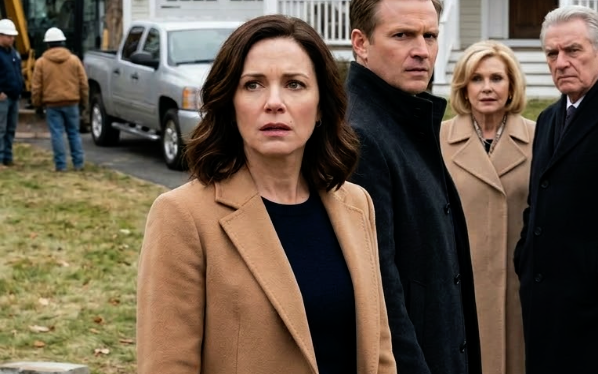
Scott stood there with his parents, looking like a man who had successfully conquered a kingdom. “Finally free of that burden,” he called out. “Now, bring the inheritance over. No point dragging this out.”
His mother’s eyes were bright with greed. They had planned this perfectly: destroy the house so I had no choice but to move into Scott’s parents’ home, where they could control me and, more importantly, the “millions” they assumed I had inherited.
That was when the laughter started.
“There is no inheritance,” I said.
The silence that followed was deafening.
“What?” Scott’s father barked.
“My brother and I settled the estate months ago,” I explained, my voice as cold as the mud at my feet. “He took the liquid assets—the cash, the stocks, the retirement funds. I took the house. But probate hasn’t even cleared yet. This property didn’t belong to me, Scott. It still belongs to the estate. You just demolished a house that wasn’t yours, without a permit, while trespassing on estate land.”
The blood drained from Scott’s face. He had spent his life thinking he was the smartest man in the room, but he had forgotten the most basic rule of his own trade: you never break ground until you’ve checked the title.
I didn’t go back to the corporate townhouse. I went to Linda Mercer.
Linda was a probate attorney with a face like a flint. She didn’t offer me tissues; she offered me a strategy. Within forty-eight hours, we discovered that Scott hadn’t even hired a licensed company. His father had borrowed equipment and “recruited some buddies” to do the job.
A neighbor’s security camera had caught the whole thing—my husband, in work gloves, directing an excavator as it clawed through the roof where my mother used to sing while she folded laundry.
“We have property destruction, unlawful demolition, and civil liability,” Linda said. “But we also have a gift.”
The “gift” was the second betrayal. Judy found it first—a Facebook Marketplace account with nearly fifty listings. My mother’s strawberry apron. Her ceramic mixing bowls. Her hand mirror. Scott’s mother was selling my mother’s life for ten dollars a pop.
When I confronted them with a police report for theft, the “family” dynamic collapsed. Scott’s father, already frail, spiraled into a terminal illness. In a moment of poetic—if dark—justice, he accused me of being heartless for not caring for him.
“I’m not being heartless,” I told him. “I’m being accurate. You told me my parents were a ‘burden.’ I’m just taking your advice and refusing to be burdened.”
After Scott’s father passed away, the universe delivered its final, most symmetrical blow.
He had left his own house to Eric. It was a crumbling, neglected structure, filled with the same toxicity that had defined the man. Eric, who had watched his father destroy my history, didn’t hesitate.
He invited me to the property one afternoon. A professional demolition crew—fully permitted, fully licensed—was backing in.
“What are you doing, Eric?” I asked.
“Making a clean break, Mom,” he said. He looked exactly like the boy I had raised, but with the steel of a man who had seen too much. “Dad told me once that you have to make a clean break before sentimental people make things harder. I’m just following his lead.”
Scott and his mother arrived, screaming about “family homes” and “ingratitude.” Eric didn’t even blink. He signaled the crew, and the house that had birthed Scott’s arrogance came down in a cloud of dust.
The divorce settlement was “straightforward,” as Linda would say.
The evidence of the illegal demolition and the marketplace thefts left Scott with no defense. He signed the papers in a cold conference room, unable to look me in the eye. He lost the “Old Money” he thought he was entitled to, and he lost the woman who had spent twenty-two years shielding him from his own character.
Today, I live with Eric and his wife, Claire. We live in a house with wide windows and a porch that catches the evening sun. There is a garden with lilacs that will, in a few years, smell like my childhood.
I lost a house, yes. And I lost a marriage that was never really a home. But in the wreckage, I found the version of myself that had been buried under layers of “endurance.”
I used to think that love was earned by making yourself smaller. I was wrong. Love is the space where you are allowed to be your full size.
Some things are built to last. Others are built to be demolished. I am finally living in a house with a foundation that cannot be shaken, because it was built on the truth. And this time, I’m the one who holds the title.