The morning sun filtered through the expansive windows of my home office in Wichita Falls, casting long, golden rectangles across the polished hardwood. It was the kind of heavy, expectant quiet that made the steam from my coffee seem structural. I was deep into a portfolio audit for Blue Harbor, my logistics firm, when the doorbell rang—a sharp, formal intrusion into a sanctuary built on secrets.
On the porch sat a cream-colored envelope. There was no branding, no courier logo, just my name written in my mother’s precise, decorative cursive. It was a script reserved for social obligations and seasonal greetings, a handwriting that always felt too performative for a daughter. Inside was a card of heavy, linen-stock paper.
Family Strategic Meeting. Your presence is requested. Saturday, 10:00 AM, The Quinnland Estate. Dress: Business Casual.
“Requested,” I murmured, tracing the embossed letters. Not “invited,” and certainly not “welcomed.” The word “Strategic” was the tell. My family hadn’t sought my opinion on anything since I was twenty-three and had the audacity to suggest my father shouldn’t sink his entire retirement into a failing chain of pancake houses. Since then, I had been the family’s resident “eccentric”—the one who lived in Austin, worked in “web things,” and was safely tucked away at the kids’ table during Thanksgiving.
My phone buzzed. A text from my mother, Odora: “Theres, please be calm this time. Let your sister lead. Don’t cause trouble.”
Seconds later, another from my sister, Valora: “Hey babe! Keep the outfit neutral, okay? We’re trying to keep a clean aesthetic for the partners. Don’t want to outshine the vision.”
“Neutral,” in Valora-speak, meant invisible. They wanted me to be a beige backdrop to their grand theater. What they didn’t know—what I had spent eight years ensuring they couldn’t know—was that the “vision” they were so desperate to protect was currently being subsidized by the very woman they were asking to sit in the corner. The truth was a $900 million secret. Blue Harbor wasn’t just a “boutique operation,” as Valora’s husband liked to call it. It was a global logistics powerhouse. I had built it from a single laptop in a cramped Denver apartment into a multi-channel empire with fulfillment centers in states my father couldn’t find on a map.
I kept it private not out of shame, but for survival. In the Quinnland family, contribution was measured by obedience. If they knew I had money, they wouldn’t respect me; they would simply try to manage me. I had spent years quietly plugging the holes in their sinking ships—anonymously bailing out my brother Lucas’s failed tech startup with a $2 million “angel investment” and paying for my parents’ luxury SUVs through shell companies they assumed were “retirement perks” from old associates.
I opened my laptop and dialed my lead counsel, Sarah. “Double-check the personal firewall,” I said, my voice as cold as the glass of the window. “And flag any movement on the trust lines. I’m going to a family meeting.”
“Is it happening?” Sarah asked.
“They’ve invited me to observe,” I replied. “I think it’s time I showed them what I’ve been looking at all these years.”
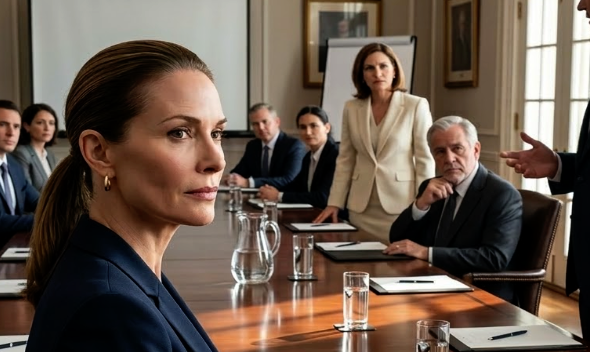
I arrived at the Quinnland estate five minutes early—a habit of discipline, not eagerness. The iron gates squeaked with the same expensive neglect I remembered. Inside, the formal dining room had been converted into a “war room.” There were nameplates, leather-bound agendas, and a projector screen.
I scanned the table for my place. I found it at the far end, near the kitchen door, away from the heat of the “strategic zone.” There was no nameplate. Just a blank white card and a cheap plastic pen.
“Yours is here, Ms. Quinnland,” an assistant whispered, gesturing to the armless wooden chair that looked like it had been pulled from the breakfast nook as an afterthought.
Across the room, Valora was radiant in a cream blazer, holding court with the family lawyer, Mr. Rudd. She didn’t look at me. A younger cousin’s child pointed at me and asked, “Who is she?”
“Oh, she used to live in Austin,” the mother replied, as if I were a ghost haunting my own lineage. “Not really involved in the business side.”
I sat down. My agenda was the only one in the room that wasn’t stapled. As the meeting began, I realized within minutes that this wasn’t a strategy session; it was an execution.
Valora stood, clicking through a slide deck that made my blood run cold. She was presenting a “New Legacy Plan.” My name appeared once, under a header labeled Inactive/Transferred Holdings. They were moving to consolidate the family assets—assets I had largely stabilized—into a new entity controlled entirely by Valora and Lucas.
“We’re grateful Theres could come to observe,” Valora said, her smile never reaching her eyes. “Even if she’s not directly involved anymore.”
The room offered a smattering of polite, pitying applause. I looked at my father. He was staring at his coffee, mumbling, “Don’t make this harder than it has to be, honey.”
It hit me then: they weren’t just ignoring me. They were erasing the paper trail of my existence. They had spent the last decade taking my anonymous gifts, and now they were using the legal structures I provided to lock me out of the very house I had kept standing. During the lunch break, I walked into my father’s study. I found a folder on the desk marked Wills & Trust – Final Revision. I flipped to the back. A document dated six weeks ago had me listed as a co-beneficiary. The new version, dated yesterday, had my name removed entirely.
They had deleted me from the future while I was still paying for their present.
I felt a strange, crystalline clarity. It wasn’t rage—rage is messy. This was a calculated realignment. I pulled out my phone and sent a single encrypted message to my team: “Trigger the ‘Cold Harbor’ protocol. Full revocation. Now.”
I walked back into the dining room. The air was thick with the smell of catered salmon and unearned confidence. Valora slid a leather folder toward me.
“We just need you to initial these acknowledgments, Theres,” she said smoothly. “It’s just a formality to clean up the titles. Since you’re not active in the tech space anyway, we’re absorbing the logistics modules into the main Quinnland fund.”
I opened the folder. They were trying to claim ownership of Blue Harbor’s proprietary software—the very code I had written. They had even hired my former assistant, Kayla, to present it as their “internal innovation.”
I looked at the pen. Then I looked at Valora.
“I won’t be signing that,” I said. The room went silent.
“Theres,” my father warned. “We discussed this. You’re being emotional.”
“I’m being a CEO,” I replied, standing up.
Valora signaled to a man in a navy jacket standing by the door—security I didn’t recognize. “Ms. Quinnland,” the man said, “I’ve been asked to escort you out. You’re no longer a party to these proceedings.”
I gathered my bag, moving with a deliberate slowness that seemed to agitate them. I looked at the table of relatives—the uncles whose mortgages I’d quietly covered, the cousins whose children’s tuitions I’d subsidized through “anonymous grants.”
“You didn’t just disinvite me,” I said, my voice echoing in the sudden vacuum of the room. “You declared me unnecessary. You should have checked the foundation before you tried to renovate the house.”
I walked out. No one stopped me. No one followed. I reached my car and opened my laptop. The “Cold Harbor” protocol was already live.
- Asset Freeze: The “Quinnland Mobility Fund”—which owned the family’s entire fleet of vehicles—was deactivated.
- Credit Revocation: The black cards distributed to the family members, tied to a Blue Harbor subsidiary, were cancelled.
- Infrastructure Blackout: The server hosting the family’s estate management and Lucas’s new business venture was taken offline. I owned the IP; they were merely tenants who had stopped paying rent.
Ten minutes later, as I pulled onto the freeway, the first call came. It was Valora. I let it go to voicemail.
Then my father. Then Lucas.
By the time I reached my apartment in Austin, my phone was a rhythmic pulse of panic. I sat on my balcony with a glass of wine, watching the sunset.
I checked the dashboard.
- Valora’s campaign account: Locked.
- Lucas’s payroll account: Insufficient Funds.
- Estate Utility Trust: Terminated.
The world they had stolen was built on a bridge I had provided. I simply stopped being the bridge. The following Monday, the headlines began to circulate in the industry trade journals: “Blue Harbor CEO Withdraws Support from Quinnland Holdings; Family Empire Faces Liquidity Crisis.”
For the first time, my name was printed in the bold, black ink of reality. Not as a daughter, not as an observer, but as the owner of the $900 million firm that had been the invisible spine of the Quinnland family for a decade.
The emails changed tone. The demands became pleas. “Theres, we didn’t know,” Valora wrote. “We can talk about a new seat at the table.”
I replied with a single sentence: “I’m not looking for a seat at your table; I’ve already built my own.”
I spent the next month setting up the “Uninvited Foundation,” a venture capital fund specifically for founders who had been overlooked by their own families or industries. I donated $10 million to the cause—money that would have gone to the Quinnland trust had they not tried to erase me.
My father sent one final message, a short, handwritten note delivered to my office: “You were right. We were blind. Please come home.”
I read it twice, then placed it in the shredder. Home wasn’t a squeaky iron gate or a dining room where I had no name. Home was the empire I had built in the dark, and for the first time in my life, I was finally living in the light. As I stood on the stage of a global leadership summit a few months later, I looked out at a sea of faces—people waiting to hear how a “ghost” became a titan.
“Legacy isn’t what people give you,” I told them. “It’s what you refuse to let them take. They told me I was unnecessary. So, I became essential.”
The Quinnlands eventually sold the estate to cover their debts. I heard Valora is working in middle management now, and Lucas is back to pitching “disruptive” ideas to people who actually check the references.
As for me? I still take my coffee in the morning sun. But now, when the quiet settles, it doesn’t feel like a secret. It feels like a victory.