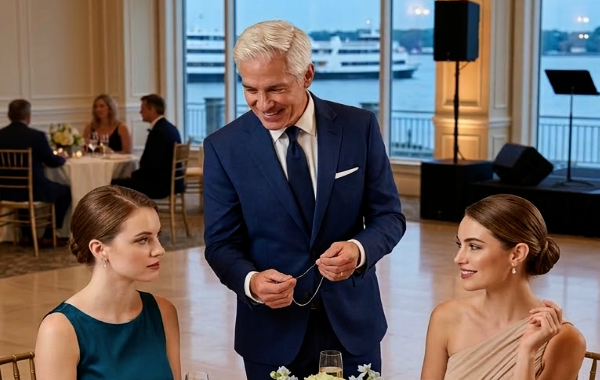
The Skyline Terrace Ballroom was less a venue and more a stage for a high-stakes performance. As I stepped through the glass doors, the atmosphere was thick—not just with the expensive scent of hydrangeas and vintage champagne, but with the suffocating weight of a decade’s worth of unspoken resentment. The golden light spilling from the Puget Sound sunset didn’t offer warmth; it merely highlighted the dust motes dancing in a room where every smile was a transaction and every gesture was a calculated move in a social chess game.
My parents, Grady and Noella Kelm, were the grandmasters of this arena. They moved through the crowd with the practiced fluidity of seasoned politicians. To the onlookers—Seattle’s elite, local business moguls, and family “friends”—they were the epitome of the American Dream: successful, poised, and devoted. But as I watched them from the periphery, I saw the mechanics of their charm. I saw the way Grady’s eyes never quite reached his smile, and how Noella’s laughter always carried a sharp, metallic edge. The evening began with a masterclass in psychological erasure. When the Master of Ceremonies took the stage, the hierarchy was established before the first course was served. My sister, Sirene, was heralded as a paragon of the family legacy. The applause for her “tireless dedication” to the family business was thunderous, fueled by my father’s enthusiastic standing ovation.
When my turn came, the contrast was a physical blow. I wasn’t “Arina, the honor graduate”; I was “their youngest daughter, fresh from her degree.” No name. No standing ovation. My parents remained seated, their polite, perfunctory claps sounding like dry leaves skittering across pavement. This was the first move: a public declaration that my achievements were incidental, a footnote to the family’s true narrative. As we moved to dinner, the “quiet declarations of rank” became inescapable. In the geography of a ballroom, distance from the head table is a measurement of worth. My place card was tucked beside the double doors leading to the kitchen. Every few minutes, the swinging doors released a blast of humid heat and the discordant clatter of industrial dishwashing.
While Sirene sat at the epicenter of power, bathed in soft candlelight and surrounded by editors and influencers, I sat in the “service zone.” It was a strategic positioning designed to make me feel like an interloper at my own celebration.
Sirene, ever the dutiful lieutenant in our parents’ campaign, stopped by my table not to congratulate me, but to mark her territory. Her whisper—“This is your last time at the center of anything”—wasn’t just a taunt; it was a prophecy she and my parents had been working to fulfill for years. The betrayal deepened during the main course. I noticed a local magazine editor—a man I had spent months talking to about my environmental engineering capstone—leaning in toward my father. Between them lay the latest issue of the magazine.
When I caught a glimpse of the page, the air left my lungs. My diagrams, my data on the river cleanup, and my months of field research were all there, printed in high-gloss ink. But the byline didn’t carry my name. It credited Sirene. My father had leveraged his business connections to swap the credit, effectively stealing the intellectual fruit of my labor to bolster the “golden child’s” resume.
When I attempted to gently correct the record with a nearby guest, the gaslighting began. My mother’s interjection—a fabricated story about me nearly being expelled—was a tactical strike. By painting me as a “leech” and an academic failure, she ensured that any claim I made to the engineering project would be viewed as the desperate lies of a jealous sister. The “Family Tribute” video was the final piece of the narrative architecture. It was a digital guillotine. In a meticulously edited sequence of photos, I was systematically removed from the family history.
The Holiday Erasure: Group shots from Aspen and Paris where I had been cropped out, leaving only the “perfect trio.”
The Graduation Theft: My high school graduation photo—the one where I held the diploma I earned through sleepless nights—had been manipulated. On the giant screen, it appeared that Sirene was holding the scroll, her arm draped around our parents in a victory lap for a degree she never earned.
The psychological intent was clear: if you are not in the pictures, you do not exist. If you do not exist, you have no rights, no voice, and no claim to the truth.
As the champagne was poured, my father rose for the “Grand Toast.” His speech was a masterpiece of passive-aggression. He spoke of the “tens of thousands” they had spent on my education, casting himself as the long-suffering benefactor of an ungrateful child.
In reality, my education was paved with merit-based scholarships, Pell grants, and forty-hour work weeks at a local diner. The “debt” he spoke of was a phantom, a lie constructed to make my eventual “failure” seem like a betrayal of their generosity.
“Sometimes people spend more on the story than the reality.” — Arina
The climax of the evening occurred with surgical precision. Through a recorded conversation captured by my friend Hollis, I learned the terrifying extent of their desperation. They didn’t just want to embarrass me; they wanted to incapacitate me. The “powder” my father slipped into my glass was intended to make me appear drunk, hysterical, or “faint,” providing the final proof that I was the unstable “leech” they claimed I was.
But years of living in a house of mirrors had sharpened my instincts. I didn’t just see the move; I anticipated the reaction.
The swap was a moment of poetic justice. By handing the glass to Sirene—the sister who had spent the night basking in the glory of my stolen work—I allowed the family’s own weapon to find its true mark. When Sirene collapsed, it wasn’t just a physical fall; it was the collapse of the entire Kelm artifice. The resolution was not found in a shouting match, but in the cold, hard light of evidence. When I took control of the AV booth, the “Kelm Narrative” met its end.
The Video Evidence: The ballroom saw, in high definition, their “heroic” father drugging his own daughter’s drink.
The Financial Evidence: Aunt Ranata’s documents proved that my education was my own achievement, exposing my father’s “financial sacrifice” as a total fabrication.
The social hierarchy of the room inverted instantly. The “leech” was the only person standing with integrity, while the “power couple” were revealed as nothing more than petty, dangerous conspirators. The legal and social fallout was total.
The Legal Charges: My parents faced charges of attempted poisoning and conspiracy. In the eyes of the law, “making a point” with a sedative is still a felony.
The Social Death: In a world built on “brand,” a video of a father drugging a glass is a terminal diagnosis. Their business partners fled, and their charity boards evaporated.
The Family Severance: My decision to leave the house keys, the pendant, and the legal relinquishment of the estate was the final act of surgery. I removed the Kelm name like a tumor.
Justice, I realized, is rarely a loud, cinematic moment. It is the quiet, profound silence of a door closing for the last time. As I stood on the ferry, watching the Seattle skyline—and the Skyline Terrace Ballroom—recede into the distance, the weight didn’t just lift; it dissolved.
I had entered that party as an extra in their show, a “leech” on their legacy. I left as the author of my own life. They had tried to poison my glass and my reputation, but in the end, the only thing they poisoned was their own future. The “Old Money” and the “Old Power” were gone, replaced by the simple, unadorned truth of a woman who finally knew her own worth.