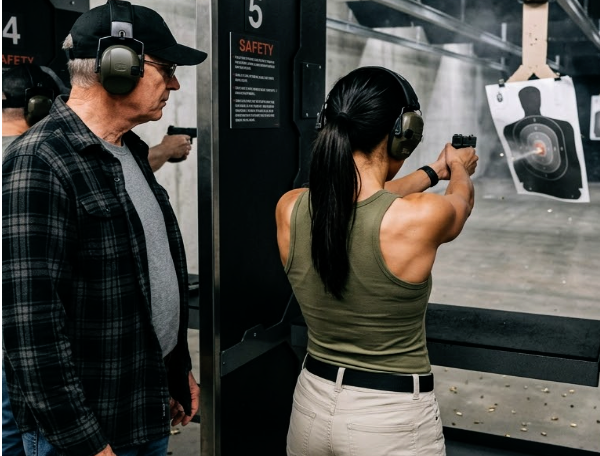
The scent of cordite and burnt CLP always felt more like home to me than the cloying fragrance of Jo Malone candles that permeated my mother’s estate in McLean. On that humid Tuesday before the wedding, the outdoor shooting range in Northern Virginia was a symphony of mechanical clicks and the rhythmic thud-thud-thud of high-caliber rounds hitting dirt berms. My brother, Liam, stood in the adjacent bay, decked out in five-thousand dollars’ worth of “tactical” gear that had never seen a day of actual field use. He looked like an action figure still in its blister pack.
“Just try to hit the paper, sis,” he shouted over his shoulder, his voice dripping with that particular brand of condescension reserved for men who inherit everything and earn nothing. “This isn’t for girls. The recoil on a .45 will jump right out of those dainty hands. Maybe stick to the snacks in the clubhouse?”
His friends, a collection of trust-fund analysts and lobbyists who thought “adversity” was a delayed flight to Saint-Tropez, erupted in a chorus of snickering. I didn’t respond. Silence is a weapon I learned to sharpen a long time ago. I simply adjusted my grip on the Glock 17—a tool I had carried through three deployments—and felt the familiar weight settle into the marrow of my bones. I didn’t need the fancy optics Liam had mounted on his custom Sig Sauer. I needed breath control, sight alignment, and the icy clarity that comes when you stop seeing the world as a series of obstacles and start seeing it as a series of targets.
In the span of six seconds, I emptied the magazine. Fifteen rounds. One ragged hole in the center of the “X” ring, tight enough to be covered by a silver dollar.
The range owner, a grizzled Master Sergeant who had spent thirty years in the sandbox and knew the difference between a hobbyist and a professional, stopped the entire line. The “Cease Fire” whistle blew with a piercing finality. He walked straight past Liam, who was still fumbling with his safety, and approached me. He didn’t look at my face first; he looked at my stance, then the target, then back at me.
“Ma’am,” he said, his voice a low gravelly rumble that commanded instant respect. “I haven’t seen a grouping like that since the SF guys came through last spring. Where did you learn to shoot like a ghost?”
The smug jokes in Liam’s bay died a sudden, violent death. The silence that followed was heavy with the realization that they had been mocking a predator while pretending to be lions. I didn’t look at Liam. I didn’t have to. I just cleared my weapon, locked the slide back, and walked toward the exit. If the shooting range was a reminder of who I was, my mother’s house was a factory designed to manufacture who she wanted me to be. Eleanor Wittman viewed the world through the lens of a social strategist. To her, people were not individuals; they were assets to be leveraged or liabilities to be liquidated. As the wedding of her “golden boy” Liam approached, I was firmly categorized as the latter.
“You’re not family, Haley. You’re a guest worker,” she said on the morning of the rehearsal. She said it with a practiced, porcelain smile—the kind she used when firing a gardener or negotiating a divorce settlement. She shoved a starched white apron into my hands, the fabric stiff and smelling of industrial bleach. “Since you’ve spent so much time in the mud and dirt, I figured you wouldn’t mind helping the catering staff. We wouldn’t want you feeling out of place among the actual guests.”
The room, filled with Liam’s friends and Eleanor’s bridge club, erupted in laughter. It was a cruel, performative mirage. My mother had already begun the process of my physical and social erasure. She had moved my belongings into a cramped room beside the storage closet, claiming the “real” guest rooms were reserved for people of “importance.” My West Point graduation photo, which my father had once hung with such pride in the study, had been replaced by a landscape painting of a Tuscan vineyard. To the world, I was no longer a Colonel in the United States Army or a strategic advisor at the Pentagon. I was “Haley, who has some administrative job in Washington.”
My name is Haley Wittman. I am 37 years old, and in the halls of the Department of Defense, my arrival is greeted with the sharp snap of “Attention on Deck.” I have navigated the labyrinthine politics of the Green Zone and negotiated treaties in rooms where the air was thick with the threat of assassination. But inside the zip code of 22101, I was merely the daughter who made my mother uncomfortable because I refused to be a decorative accessory to her vanity.
I took the apron. I folded it once, my movements precise and economical. I didn’t argue. I didn’t weep. I simply walked into the kitchen and dropped it into the trash can, right on top of a pile of discarded lemon peels and coffee grounds. That wasn’t a gesture of petulance; it was the moment I stopped treating my mother like a parent and started treating her like an adversary. Before the sun began to bleed across the Potomac the next morning, I drove to Arlington National Cemetery. The air was crisp, tasting of dew and old stone. My father, Colonel Marcus Wittman, lay beneath a simple white marker, a stark contrast to the sprawling, gilded estate Eleanor maintained with such ferocity.
He had been my compass. While my mother taught me how to hide my flaws, my father taught me how to use them as armor. I remembered a rainy afternoon when I was twelve, crying because I hadn’t been invited to a birthday party. He had sat me down in his study, the smell of pipe tobacco and old leather surrounding us like a shield.
“Haley,” he had said, his voice steady as a heartbeat, “your mother notices the brightest stars because she wants to own their light. But the brightest stars eventually burn out. Be the one that guides people in the dark. Be the North Star. You don’t need an audience to be essential.”
I thought about that lesson when my West Point acceptance letter arrived. My mother had tossed it onto the kitchen table like a grocery circular, sighing about the “unfeminine” life I was choosing. My father, however, had winked at me, and later that night, he snuck me into the city for chili dogs at a dive bar. He knew that one quiet, authentic celebration mattered more than a hundred loud, hollow ones.
That memory had sustained me through the grueling “Beast” summer at the Academy, through the bone-chilling nights in the Hindu Kush, and through that devastating Christmas call from a combat zone. I had been covered in the dust of a country that wanted to kill me, and Eleanor had looked at my face via Skype and asked if I was “using the right moisturizer,” before handing the phone to Liam so he could brag about the leather interior of his new BMW.
My work carried weight in rooms where the fate of nations was decided, yet a white apron in a McLean kitchen could still sting like a lash. But as I stood over my father’s grave, a challenge coin pressed into my palm, the sting faded into a cold, clinical focus. The turning point came in the form of Ava Russo, the woman Liam was supposed to marry. To the rest of the family, Ava was a “delightful girl from a good family” who would look perfect in the wedding photos. But when she asked me to meet her for coffee three days before the ceremony, she didn’t look like a blushing bride. She looked like a woman who had seen the bottom of a dark well and realized there was no ladder.
We met at a non-descript cafe in Alexandria. The second I sat down, Ava didn’t offer a platitude. She leaned in, her eyes sharp and searching.
“I know who you are, Ma’am,” she said. My breath hitched. She didn’t say “Haley.” She said Ma’am. “I served under your command in Kandahar. I was a corporal in the 10th Mountain Division. You were the one who authorized the air support when my unit was pinned down in that orchard. You pulled us out of an ambush that should have killed us all.”
I looked at her, truly looked at her, and saw the soldier beneath the silk blouse. “Why didn’t you say anything to Liam?”
Ava gave a hollow laugh. “Because Liam doesn’t listen to women who have more scars than he does. And because your mother spent the last six months telling me you were a ‘troubled soul’ who couldn’t handle the pressure of the real world. She’s not just erasing you, Haley. She’s trying to dismantle you.”
Ava wasn’t just there to reminisce. She handed me an encrypted thumb drive and a contact card for Dr. Maya Singh, a retired intelligence strategist. “Your mother is making moves, Haley. Financial moves. She’s using Liam’s wedding as a smokescreen to settle the estate.”
The meeting with Maya Singh was a masterclass in clinical deconstruction. We sat in a library filled with first editions and the hum of high-end encryption hardware.
“This isn’t family drama, Colonel,” Maya said, her voice devoid of sentiment. “It’s information warfare. Your mother is employing a classic ‘Scorched Earth’ protocol. She’s isolating you, delegitimizing your character, and now, she’s moving for the kill.”
The “kill” arrived during a private dinner at the Inn at Little Washington. My mother had invited me under the guise of an “olive branch.” Between the second course of truffled risotto and the third course of braised short ribs, she slid a neat, navy-blue folder across the table.
“It’s a small family matter, darling,” she said, her voice like honey poured over glass. “Just some paperwork for Liam’s future. It ensures the estate stays within the family lineage. You know how difficult these things get with taxes.”
I opened the folder. My training in logistics and contract law kicked in instantly. The language was dense, intentionally obfuscated by legalese, but the core of it was clear: Relinquish all claims. Transfer of title. Irrevocable power of attorney.
She wasn’t asking for my help. She was trying to trick me into signing away the house my father had specifically left to me in a private codicil she didn’t know I possessed. The house was more than real estate; it was my father’s legacy, the only place where his history wasn’t being rewritten by her hand. “I’ll have my lawyer review it,” I said, closing the folder with a soft thud.
The mask slipped. Eleanor’s smile didn’t just fade; it evaporated. “Don’t be difficult, Haley. We’re family. Liam needs this foundation. You have your… military pension. You don’t need this house. Don’t be a bitter, selfish girl.”
I looked at her—not as a daughter seeking approval, but as an operative assessing a threat. For the first time, I felt no shame. No longing for her love. Only the cold, invigorating certainty of a mission.
“The dinner is lovely, Mother,” I said, standing up. “We’ll talk at the wedding.”
The retaliation was swift. Within twenty-four hours, Maya alerted me to a post on a local high-society blog. It was a “human interest” piece, anonymous but clearly sourced from Eleanor. It painted a picture of a “decorated but unstable veteran” who was struggling to reintegrate into civilian life. It mentioned “concerning outbursts” and “emotional volatility.”
Worst of all, they had used a photo. It was a combat shot from seven years ago, taken after a seventy-two-hour mission in Kunar Province. I was covered in dirt, my eyes bloodshot from lack of sleep, grieving the loss of two men in my command. The article framed my exhaustion as a breakdown, my grief as instability.
I sat in the dark of my tiny room next to the storage closet, the blue light of the laptop screen illuminating the tears I refused to let fall. She had taken my most painful, sacred moment of service and turned it into a weapon of character assassination.
“Colonel,” Maya’s voice came over the secure line. “Do not react emotionally. That is what she wants. She wants a scene. She wants you to prove her right.”
“I’m not going to give her a scene, Maya,” I whispered. “I’m going to give her the truth.” The day of the wedding was a masterpiece of suburban opulence. The estate was draped in thousands of white roses, their scent so thick it felt like walking through a fog of perfume. A string quartet played Vivaldi. Waiters in white gloves glided through the crowd with trays of vintage Bollinger.
Eleanor was in her element. She wore a dress of champagne silk that probably cost more than a mid-sized sedan. She moved through the crowd like a queen, accepting compliments on the “perfect union” she had orchestrated.
Whenever someone asked about me, I heard her practiced response: “Oh, Haley? She’s here. She’s basically a low-rank grunt helping out behind the scenes. It’s good for her to have a routine, you know? The military… well, it takes a toll on the mind.”
I stayed in the shadows, wearing a simple black dress, the hidden recorder in my clutch a silent witness. Ava had been a ghost all morning, sequestered in the bridal suite. Liam was at the bar, already three scotches deep, laughing loudly at a joke he didn’t quite understand.
As the ceremony began, the guests took their seats on the manicured lawn. The sun was setting, casting long, golden shadows across the grass. My mother took her seat in the front row, her chin lifted, her face a portrait of maternal triumph.
Liam stood at the altar, looking nervous and small. Then, the music shifted. The heavy doors of the estate opened, and Ava Russo stepped out. She didn’t look like a victim. She looked like a soldier in white lace.
She walked down the aisle with a gait that was too steady, too disciplined for a nervous bride. When she reached the altar, she didn’t look at Liam. She looked at the guests. She looked at Eleanor. And then, she looked at me.
The officiant began the standard opening, but Ava held up a hand. A hush fell over the three hundred guests. Even the wind seemed to die down.
“Before we begin,” Ava said, her voice amplified by the microphone and carrying to the very back of the estate, “I think it’s important that we acknowledge the truth of this family. Because a marriage built on a lie is just another kind of prison.”
I saw my mother stiffen. She started to stand, a polite “Ava, darling, perhaps later—” forming on her lips.
But Ava wasn’t looking at her. She turned to the crowd. “Most of you know Haley Wittman as a ‘guest worker’ or a ‘troubled soul.’ But I know her as the woman who saved my life in a valley ten thousand miles from here. I know her as a Colonel who holds the Distinguished Service Cross. And I know her as the woman whose inheritance is currently being stolen by the people sitting in the front row.”
A collective gasp rippled through the audience.
“I have the recordings,” Ava continued, her voice cold and unwavering. “I have the legal documents Eleanor tried to force her to sign. And I have the proof that the smear campaign launched against a decorated officer was funded by the very woman who calls herself her mother.”
The silence that followed was absolute. It was the silence of a target being hit with surgical precision. My mother’s perfect night didn’t just crack; it shattered into a thousand jagged pieces of champagne silk and white roses.
I stepped out from the shadows of the storage closet wing and walked toward the altar. For the first time in thirty-seven years, I didn’t care about the bright stars or the darkness. I was exactly where I was meant to be.
The war was over. And for the first time, I wasn’t just a soldier. I was home.