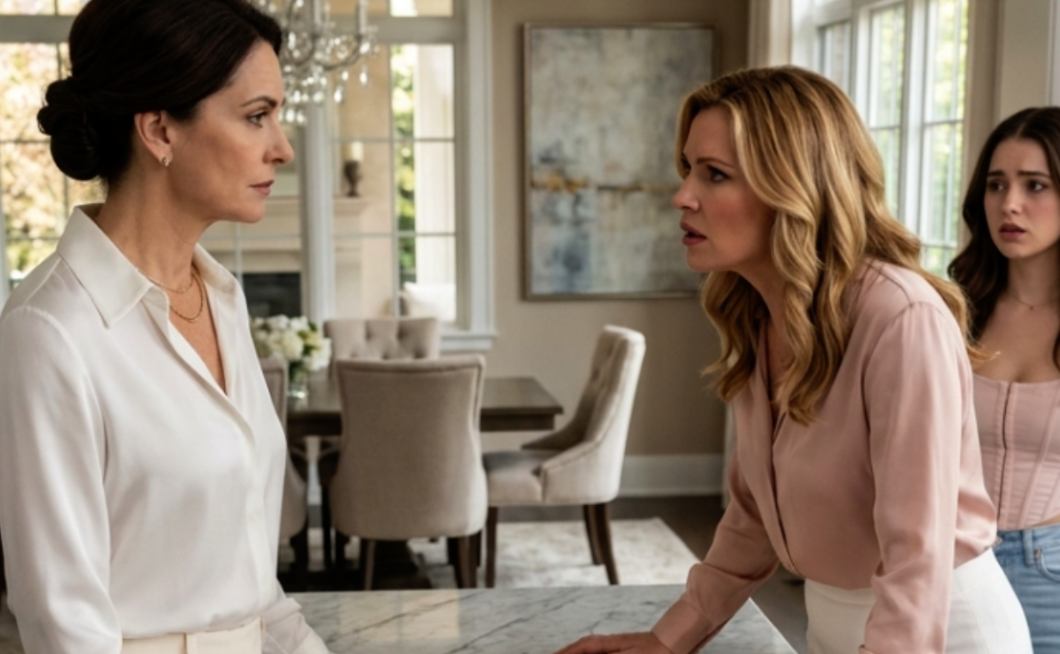
The vivid red cocktail struck my silk blouse a fraction of a second before I could even pick up my silver fork to cut into my birthday dinner.
For one suspended, suffocating moment, the entire table froze in a tableau of deliberate inaction.
The heavy crystal glass had, only a moment prior, rested in the impeccably manicured hand of my nineteen-year-old niece, Kinsley. It was a cosmopolitan, chilled to such a biting degree that I could feel the individual ice cubes slide like jagged stones down my chest before they struck the white porcelain plate in front of me with a sharp, echoing clatter. The crimson liquid immediately began its aggressive conquest across the front of my bodice, seeping deeply into my lap and permanently staining the soft, powder-blue silk. I had saved for two months for this specific garment, choosing to wear it only because my mother, Barbara, had rigidly insisted we were going somewhere “exceedingly nice” to commemorate my thirty-fourth birthday.
The opulent steakhouse around us descended into that particular brand of hushed stillness unique to desperately expensive rooms—the kind of silence where something distinctly ugly occurs, and every wealthy patron actively pretends they haven’t witnessed it. A uniformed waiter paused mid-stride near the mahogany wine station. A well-dressed couple at the adjacent table angled their shoulders, mastering the art of looking without appearing to look. From the dimly lit alcove near the brass-trimmed bar, the low, melancholic trill of a jazz piano drifted over, punctuated by a woman’s uncomfortable, careful laugh.
Kinsley loomed over me. Her perfect, salon-crafted curls cascaded over one shoulder, and the empty, dripping glass dangled loosely from her fingers. Her glossed mouth twisted into a subtle, knowing smirk—an expression far too practiced and venomous for a young woman who had supposedly just committed a clumsy mistake.
“Oops,” she murmured, the word utterly devoid of weight.
At the head of the long table sat my mother. Barbara held a stemmed glass of imported Pinot Grigio, her posture impossibly rigid.
She did not scold her granddaughter. She did not offer me a napkin. She did not inquire if the freezing alcohol had ruined my evening.
Instead, she cast a long, disdainful look at the spreading red stain and exhaled a heavy, beleaguered sigh, as though my silk blouse had maliciously conspired to embarrass her in public.
“Bethany,” my mother said, her voice dropping to a harsh whisper, “please do not make a scene.”
That was the precise moment the evening lost its chaos and achieved a terrifying clarity. It was not painful. It was simply, undeniably clear.
I shifted my gaze to my older sister, Madison, seated across from me. She was draped in a cream-colored designer dress, an obscenely heavy diamond pendant resting against her collarbone—the sort of jewelry that looked as though it required an armed guard. Beside her sat her husband, DeAndre, clad in a bespoke charcoal-grey suit, his manicured fingers idly tracing the rim of his scotch glass. He did not look appalled by his daughter’s behavior. He looked thoroughly entertained.
Kinsley gracefully slid back into the leather booth beside her mother, already tapping away at the illuminated screen of her smartphone, dismissing my existence entirely.
“She’s fine,” Madison declared, waving a dismissive hand adorned with platinum rings. “It was just a splash of a drink. Don’t be dramatic.”
“She threw it directly at my chest, Madison.”
My sister rolled her eyes toward the chandelier. “You always take absolutely everything so personally. It’s exhausting.”
“It is my birthday.”
“And DeAndre is paying an absolute fortune for this private reservation,” my mother interjected sharply, her eyes narrowing. “So the very least you can do, Bethany, is be gracious to your hosts.”
There it was. Suspended in the aromatic air of the steakhouse, the entire sociological hierarchy of my family had been distilled into a single, venomous sentence.
DeAndre mattered because they operated under the grand illusion that he was funding this luxurious charade. Madison mattered because she had successfully attached herself to him. Kinsley mattered because her youth, beauty, and arrogance perfectly reflected their meticulously curated, polished facade.
And I? I mattered only on the strict condition that I remained small, silent, and compliant enough not to disturb the aesthetic of their picture.
In their reductive vocabulary, I was merely “an accountant.” I was deemed a chronically practical woman who drove a practical Japanese sedan, inhabited a practical condominium, wore practical block heels, and possessed absolutely no glittering social life to showcase in their holiday newsletters. It was entirely irrelevant to them that my actual professional title was Senior Forensic Auditor and Estate Liquidator. It did not matter that my daily routine consisted of tracing cleverly hidden offshore assets, meticulously reconstructing the ledgers of collapsed shell companies, and untangling the labyrinthine finances of arrogant individuals who possessed vastly more money than common sense.
To Barbara, I was merely the dreary daughter who balanced spreadsheets. Madison, conversely, was the triumphant daughter who had married into prestige.
Slowly, I picked up my heavy linen napkin and pressed it against my chest. The cranberry stain deepened into a dark, bruised purple beneath my fingers. My skin reeked of cheap vodka, synthetic fruit, and profound humiliation.
“Are you truly not going to say a single word to her?” I asked my mother, my voice dangerously calm.
Barbara’s mouth tightened into a bloodless line. “Kinsley is young. She is under a lot of academic pressure.”
“She is nineteen years old. She is an adult.”
“She was expressing her frustration,” Barbara countered, lifting her chin. “You walked into a five-star establishment looking as though you were headed to a budget review in a municipal basement.”
DeAndre chuckled softly into his scotch. Kinsley didn’t even bother to look up from her text messages.
I sat back and truly looked at the four people surrounding that expensive mahogany table. I looked at their clothes, their jewelry, their confident postures. They were wrapped in luxury they could not afford, utterly convinced that I was the one who owed them an apology.
That was the catalyst. It wasn’t the ruined silk. It wasn’t Kinsley’s cruel smirk. It was their collective, unyielding expectation that I would absorb their abuse to keep their fragile reality comfortable.
For thirty-four years, I had flawlessly executed that role.
But for the past twenty-four months, I had committed a sin far graver than mere compliance. I had actively financed their delusion.
The arrangement had begun two years prior. Madison had appeared at my condo on a Tuesday evening, wearing oversized designer sunglasses despite the torrential rain outside. Her manicured hands trembled as she sat on my velvet sofa, spinning a desperate tale about DeAndre’s tech firm undergoing a “temporary restructuring.” Their primary accounts, she claimed, were locked behind administrative tape. She needed capital for absolute necessities: groceries, gasoline, school supplies for Kinsley. She wept beautifully, tears carefully avoiding her mascara.
Because of my background in forensic auditing, I knew immediately that her narrative was deeply flawed. Corporate account freezes do not function in the manner she described. However, I also intimately understood my sister’s crippling pride; she would never have knocked on my door unless she was staring down the barrel of genuine ruin. A tender, foolish remnant of my childhood self still yearned to be the supportive sister, the one who caught her before she hit the ground.
So, I had made Madison an authorized secondary user on a corporate expense account tied to my primary liquidation firm, Zenith.
“For absolute essentials only,” I had warned her, looking her dead in the eye. “Food and transportation.”
She had hugged me with bruising force, swearing on her life that every cent would be meticulously repaid within weeks.
The “essentials” began modestly enough with whole-foods groceries. But the perimeter of her needs rapidly expanded. Soon, the ledger reflected charges for eucalyptus steam spa appointments, imported Italian heels, spontaneous weekend getaways to boutique hotels, five-star tasting menus, exorbitant country club maintenance fees, and, eventually, a private personal stylist for Kinsley.
I had cataloged every single infraction.
September 14: $450 – La Mer Cosmetics. October 2: $1,200 – The Peninsula Hotel. November 18: $850 – Neiman Marcus.
I knew the timestamps, the merchant identification codes, the exact geographic locations of their deceit. I had permitted the bleeding to continue for one specific reason: as an auditor, you are trained never to interrupt a pattern of fraud before it becomes substantial enough to construct an undeniable, ironclad case.
But sitting in that steakhouse, smelling the vodka evaporating off my skin, I realized the pattern was unequivocally complete.
I folded my stained napkin, placed it gently over my ruined plate, and stood up.
The booth fell instantly silent. Madison blinked up at me, her brow furrowing. “Where on earth are you going?”
“Home.”
Barbara scoffed. “Do not be so terribly dramatic, Bethany. Sit down.”
I looked at my mother, then allowed my gaze to drift to Madison, and finally to Kinsley. “Thank you for the lovely birthday dinner,” I said, my voice completely devoid of inflection. “Do enjoy the rest of your evening.”
DeAndre leaned back against the leather upholstery, flashing a lazy, mocking grin. “Need me to spot you a twenty for the valet, Bethany?”
I smiled back at him. It was not a sweet smile. It was the smile of a predator.
“No,” I replied softly. “I believe I have covered more than enough tonight.”
He didn’t understand. But he would.
I walked out of the steakhouse with my spine perfectly straight, the damp silk freezing against my ribs. The hostess at the mahogany podium visibly widened her eyes and took a cautious step backward, sensing the static electricity radiating from me. Outside, the brutal October wind of downtown Chicago cut through the streets. Neon lights fractured across the wet pavement.
I did not start my car immediately. Instead, I sat in the driver’s seat of my practical sedan on the second level of the concrete parking garage, turned the heater to maximum, and retrieved my encrypted work tablet from my leather tote.
My mother’s call came through before the operating system even finished loading. I silenced it, watching the screen until the voicemail notification appeared. I routed the audio through my car’s speakers.
Barbara’s sharp, patrician voice filled the small cabin.
“Bethany, I certainly hope you are driving straight home to reflect on your behavior. You have completely ruined the mood of the evening. Madison is nearly in tears, and Kinsley feels viciously attacked. You must understand that DeAndre works incredibly hard to provide this level of luxury for our family, and the least you could do is display a modicum of gratitude. Do not attempt to contact us until you are fully prepared to issue a formal apology.”
I stared through the windshield at the blank concrete wall.
DeAndre works incredibly hard to provide.
I let out a harsh, breathless laugh. DeAndre had not drawn a legitimate paycheck in exactly eight months. His position as a regional tech executive had been quietly terminated following a catastrophic product launch and hushed allegations of budget misappropriation. Yet, he continued to leave his suburban driveway every morning in a tailored suit, briefcase in hand, because Madison required the illusion of success to breathe. He spent his days sitting in upscale, Wi-Fi-enabled coffee lounges, endlessly refreshing his inbox and applying for C-suite roles he was profoundly unqualified for.
I knew this with absolute certainty because I had personally audited the corporate entity that absorbed his former employer’s liquid assets. I knew his negotiated severance package had dried up sixteen weeks ago.
I opened my firm’s secure financial portal. The dashboard materialized in crisp, unfeeling columns of blue and white. I navigated smoothly to the card management sector and located my sister’s name under the authorized secondary users list.
I clicked the silver settings gear. A crimson prompt hovered on the screen: Revoke Access.
My finger lingered over the touchpad. I paused not out of hesitation, but because some executions demand a moment of reverence. Then, I pressed confirm.
Madison’s name vanished into the digital ether. The heavy black metal card resting in her designer purse was now nothing more than an inert piece of decorative aluminum. I pictured the steakhouse waiter approaching their table, leaning down to whisper the humiliating reality of a declined card.
Next, I opened the GPS fleet management application. A digital map of the greater Chicago metropolitan area populated the screen. I keyed in a specific Vehicle Identification Number—one I had memorized because I had personally signed the financing documentation under Zenith Liquidations. A glowing blue beacon appeared directly over the steakhouse’s valet lot.
It was Kinsley’s pristine Mercedes SUV.
She treated that vehicle like royalty. She drove it to her university lectures, to elite brunches, and to charity luncheons she despised, purely because the hood ornament announced her perceived socioeconomic status before she ever had to speak. She genuinely believed her father had purchased it as an early graduation gift.
He hadn’t. No legitimate financial institution would underwrite a loan in his name; his credit score was a smoldering crater. He had come to my office, practically weeping, begging for a temporary corporate lease through my LLC. He had promised strict monthly reimbursements. He paid for six months, then sporadically, and then ceased altogether.
Legally, unequivocally, the Mercedes belonged to me.
I dialed Mike, a seasoned recovery vendor I employed for hostile estate liquidations.
“Mike. I need a priority asset recovery executed tomorrow morning.”
“Give me the details,” he grunted. I fed him the VIN, the suburban address, and the corporate file number.
“Do you want my guys to knock and announce?” Mike asked.
“Absolutely not. Clean pickup. Six in the morning. Tow it directly to the secured impound. Under no circumstances are you to engage with the residents.”
Mike paused. “Sounds personal. Family situation?”
“It’s a business asset,” I replied coldly.
“Say no more.”
When I arrived home, I peeled off the ruined blouse and dropped it directly into the kitchen trash can.
At exactly 6:42 AM the following morning, my phone began to vibrate violently against my nightstand. First Kinsley. Then Madison. Then Barbara. A barrage of digital panic. I calmly brewed a pot of dark roast coffee before interacting with any of it.
I tapped Kinsley’s voicemail. “My car is gone!” she shrieked, her voice breathless and hysterical. “Someone stole it right out of the driveway! I know you did something, you psycho! Call me back!”
Deleted.
Madison’s text messages were frantic bursts of lowercase desperation: why is my card declining? i am at the spa with the girls. they are holding my coat. this is humiliating. turn it back on right now. bethany this isn’t funny.
I took a slow sip of my coffee. By 7:30 AM, heavy, rhythmic pounding echoed through my front door.
I checked the security monitor. Madison was pacing the porch in a wrinkled cashmere coat and massive sunglasses. DeAndre stood rigidly beside her, attempting to project an aura of masculine authority. Barbara anchored the rear, arms crossed, lips pursed into a venomous line.
I unlocked the deadbolt and pulled the door open, mug in hand.
“What is psychologically wrong with you?” Madison hissed, shoving past me into the foyer. “My card was declined in front of half the tennis club! And Kinsley’s vehicle has been stolen!”
DeAndre stepped inside, pointing a thick finger at my face. “You crossed a serious legal boundary this time, Bethany.”
I took a sip of coffee. “Did I?”
“You orchestrated the theft of my daughter’s car.”
“I recovered an asset belonging to my liquidation firm.”
Madison whipped around. “What is she talking about, DeAndre?”
I gestured toward the kitchen. “Please. Come in.”
They trailed me into my fiercely practical kitchen. Barbara’s eyes immediately swept over the laminate countertops and basic white cabinetry with her customary disdain. But my kitchen was fully paid for; it belonged entirely to me. That fact alone made it a cathedral compared to the house of cards they inhabited.
I set my mug down, unlocked my fireproof pantry safe, and withdrew two thick manila folders. I dropped the first one onto the counter. Smack.
“The vehicle title,” I announced.
DeAndre’s jaw tightened. “This is absurd.”
I slid the heavy parchment toward Madison. “Read the name of the registered owner.”
Madison’s eyes darted down the page. Her lips moved silently as she read: Zenith Liquidations LLC.
“My company,” I clarified. “DeAndre begged me to finance that car because his credit was radioactive. He promised to make the payments. He defaulted over a year ago.”
Madison turned her head with agonizing slowness to look at her husband. “You told me you paid for it in cash.”
DeAndre swallowed hard. He said absolutely nothing.
I opened the second folder, fanning out a densely packed spreadsheet of financial transactions alongside the original corporate card agreement. “And here is the ledger for your ’emergency grocery’ card. You used my corporate funds for luxury resorts, designer handbags, and a private stylist. You used my money to fund the very dinner where you sat and watched your daughter humiliate me.”
Barbara slammed her hand down on the documents, attempting to physically obscure the truth. “Enough of this nonsense!”
I met my mother’s furious gaze. “You haven’t even looked at the numbers.”
“I don’t need to look at your pathetic little spreadsheets! I know exactly what this is. It’s jealousy. You have always harbored a bitter resentment toward your sister because she managed to marry well while you sit alone in this bleak apartment!”
“Madison married a man who hasn’t received a paycheck since last October.”
Madison gasped. DeAndre closed his eyes as if bracing for an impact. Barbara, however, refused to look at him. Looking at him would mean acknowledging the collapse of her religion.
“You are acting like an arrogant child,” Barbara snapped, her voice trembling with rage. “Freezing accounts and stealing cars because you cannot stomach the success of others.”
“Real success,” I replied, “does not require my signature as a guarantor.”
My mother’s posture shifted. She drew herself up to her full height, summoning the ultimate weapon she had wielded over my head since childhood—the invisible, heavy chain of the family estate.
“Tread very carefully, Bethany,” she warned, her voice dropping to a lethal octave. “I am the primary beneficiary of your grandfather’s trust. I control the totality of this family’s wealth. If you do not reverse these actions immediately, I will telephone Arthur Mitchell this very morning and have you permanently excised from the estate. You will receive no distributions, no property, no family support. You will be left with absolutely nothing but your little calculators.”
Madison’s face brightened. DeAndre visibly exhaled, relieved that the matriarch was stepping in to crush the rebellion.
I looked at my mother for a long, quiet moment. Then, I smiled.
“When was the last time you actually spoke with Arthur?”
The kitchen went so completely silent I could hear the hum of the refrigerator compressor kicking on.
Barbara blinked, a fraction of her supreme confidence faltering. “What exactly does that mean?”
“It means,” I said, gathering the folders, “that we should probably go pay him a visit.”
Forty-five minutes later, the four of us stood in the opulent reception area of Arthur Mitchell’s downtown law firm. Arthur had served as my late grandfather’s estate attorney for over four decades. His office was a masterclass in intimidating old money: dark mahogany wainscoting, intricate Persian rugs, and towering shelves of leather-bound statutes.
Barbara stormed past the receptionist and threw open the heavy oak door to Arthur’s private office.
“Barbara,” Arthur said, mildly surprised, carefully removing his reading glasses. “This is highly irregular.”
“I require emergency addendums drafted immediately,” she commanded, planting her hands on his desk. “Bethany is to be completely disinherited. Every cent of future capital is to be routed to Madison.”
Arthur’s gaze shifted from Barbara’s furious face to me. I calmly took a seat in a wingback leather chair near the window, placing my folders in my lap.
“Bethany has proven herself to be dangerously unstable,” Madison chimed in, her voice shrill. “She unlawfully repossessed my daughter’s vehicle and illegally froze my credit card.”
“Your card?” Arthur asked, his eyebrow arching perfectly.
Madison swallowed. “My… emergency card.”
Barbara slammed her hand against the wood again. “Do your job, Arthur!”
Arthur looked at my mother with a profound, crushing sense of pity. “Please sit down, Barbara.”
“I will absolutely not sit down!”
“I strongly advise that you do.”
For the first time that morning, Barbara hesitated. Slowly, she lowered herself into the chair opposite me.
Arthur stood, keyed a code into the massive wall safe concealed behind a bookshelf, and extracted a sprawling, thick binder secured with blue legal ribbon. He dropped it onto the center of his desk with a heavy, authoritative thud.
“What is that?” Barbara demanded.
“This,” Arthur replied, “is the master file for the Mitchell Family Trust.”
“I receive the quarterly statements. I am perfectly aware of what my father left.”
“You receive an allowance,” Arthur corrected gently. “A very generous allowance. But it is an allowance nonetheless.”
Madison let out a brittle laugh. “What are you talking about?”
Arthur opened the heavy cover. “Ten years ago, shortly before his passing, your grandfather ordered a private, independent audit of the family’s assets. That audit revealed a sustained, egregious pattern of financial mismanagement and frivolous spending. Consequently, he restructured the entire estate. He transferred all primary capital, commercial real estate, corporate voting shares, and major investment portfolios into an irrevocable trust.”
Barbara’s complexion shifted from pale to ashen. “He would have informed me.”
“He did inform you,” Arthur stated evenly. “You simply chose to ignore the stipulations you found disagreeable.”
DeAndre began to edge subtly toward the door.
“The trustee of the estate is not Barbara,” Arthur continued. “It never was.”
“Then who the hell is it?” Madison demanded.
Arthur turned his head and looked directly at me. He didn’t build suspense. He simply delivered the facts.
“Bethany.”
The air was sucked out of the room. My mother stared at me as if I had suddenly transformed into a terrifying, unfamiliar species. Madison’s jaw went slack.
“Bethany Caldwell is the sole acting trustee and executor,” Arthur read from the preamble. “She retains absolute authority over the estate’s real property, liquidity, and asset distribution. That explicitly includes the deed to the suburban residence currently occupied by Madison and DeAndre Caldwell.”
Madison gripped the arms of her chair. “That is my house.”
“No,” I said, my voice echoing in the quiet room. “It isn’t.”
She whipped around, her eyes wild. “You knew? For how long?”
“Since the day Grandpa signed the final ink.”
“You let me believe I was in control of this family!” Barbara shrieked, her voice cracking.
“I didn’t force you to believe anything,” I replied calmly. “You deluded yourself because it allowed you to keep spending the trust’s money as if you possessed ownership.”
DeAndre was sweating profusely now. The moisture gleamed on his forehead. His eyes darted frantically around the room.
Arthur closed the binder. “As it stands, Barbara, there is no legal mechanism by which you can remove Bethany.”
Barbara sat frozen. Then, a desperate light flickered in her eyes. She tore open her designer handbag, rummaged wildly, and pulled out a single, sharply folded piece of legal paper. She slammed it triumphantly onto Arthur’s desk.
“My father signed this addendum privately before he died!” she declared. “It grants me absolute override authority in the event that the designated trustee acts with malice.”
DeAndre choked on his breath. “Barbara, don’t—”
She ignored him. “Read it, Arthur! It’s notarized.”
Arthur picked up the document. His eyes scanned the text, lingering on the signature block, and finally resting on the embossed notary stamp. His expression hardened into granite. He looked up at DeAndre.
My mother, tragically misinterpreting Arthur’s silence as defeat, smiled coldly. “You see? He planned for her treachery.”
I stood up and extended my hand. “May I review it?”
Arthur handed the paper to me.
As a forensic auditor, my entire career was built on detecting anomalies. The discrepancies on this document screamed at me. First, the paper weight was entirely wrong—it was standard commercial stock, completely lacking the heavy cotton weave my grandfather demanded for legal filings. Second, the signature was unnaturally uniform. My grandfather possessed a heavy, aggressive stroke that dug deeply into the page on the first letter and trailed off thinly. This was a slow, careful tracing.
But the final nail was the notary stamp.
Kevin Laram.
I recognized the name immediately. He was a disgraced real estate attorney whose license had been permanently revoked by the state board over a year prior due to an escrow embezzlement scandal I had investigated. He possessed zero legal authority to notarize anything, let alone on the date supposedly stamped on this document.
I lowered the paper and locked eyes with my brother-in-law. His face was a mask of pure terror.
“This document is a forgery,” I stated.
Barbara lunged forward. “You are a liar!”
“I am not lying,” I said softly. “But the man sitting next to you certainly is.”
Madison turned to her husband, her voice dropping to a horrified whisper. “DeAndre… what did you do?”
He couldn’t speak. He was hyperventilating.
I placed the forged document gently back onto the desk and tapped the center of the page. “How much, DeAndre?”
He blinked, tears of panic brimming in his eyes.
“The fraudulent loan,” I pressed, my tone razor-sharp. “How much collateral did you extract against a house you do not legally own using this forged override?”
Madison grabbed the lapels of his expensive, unpaid-for suit. “What loan?! DeAndre, tell me!”
DeAndre’s broad shoulders collapsed inward, shrinking him to a fraction of his size.
“Eight hundred thousand dollars,” he whispered.
The figure dropped into the silence of the room like an anvil. Madison recoiled from him as if he were actively on fire. Barbara buried her face in her trembling hands.
The grand, majestic illusion was dead. The family that had walked into the steakhouse ready to mock my practical life now stood shattered around a single piece of fraudulent paper.
I did not feel a rush of euphoric triumph. I merely felt the profound, settling peace of a perfectly balanced ledger.
Arthur immediately contacted the bank’s internal fraud division. I opened my laptop on his desk and executed a complete, hard freeze on every single account linked to the estate.
Over the next six months, the consequences manifested exactly as gravity does: silently, inevitably, and with crushing force.
There were no screaming matches. There were only certified letters from collection agencies, abruptly canceled country club memberships, denied tuition drafts for Kinsley’s university, and the humiliating foreclosure of the Oakbrook estate. The trust legally permitted a brief transition period to ensure they were not left homeless, but the era of limitless luxury was permanently terminated.
Madison was forced to relocate to a modest, two-bedroom rental apartment. She eventually secured entry-level employment managing schedules for a local nonprofit. DeAndre narrowly avoided federal prosecution by entering into a crippling restitution agreement with the bank, effectively destroying any chance he had of returning to the corporate sector.
My mother’s allowance was strictly maintained, but I implemented direct-payment controls. Her housing, medical care, and utilities were paid straight from the trust. She received no liquid cash. She lost her leverage.
On the night of my thirty-fifth birthday, I did not visit an overpriced steakhouse.
Instead, I invited three close colleagues to my condo. We ordered an excessive amount of spicy Thai takeout, drank inexpensive red wine out of mismatched glass tumblers, and laughed until we were breathless. Nobody mocked my profession. Nobody demanded I finance their delusions. Nobody spilled a drop of liquor on my clothes.
Long after my guests had departed, I stood alone in my quiet, thoroughly practical kitchen. I opened the pantry safe and looked at the two manila folders resting inside.
I did not keep them to stroke my own ego. I kept them as empirical evidence. Because sometimes, evidence isn’t collected for a judge or a jury. Sometimes, it is kept to remind the version of yourself who was conditioned to endure abuse that she never has to be quiet again.
I had finally learned the ultimate truth about wealth: money does not reveal a person’s character when they are earning it. It reveals their character when they believe someone else will forever foot the bill.
And the moment I stopped paying, the absolute truth was the only currency left.