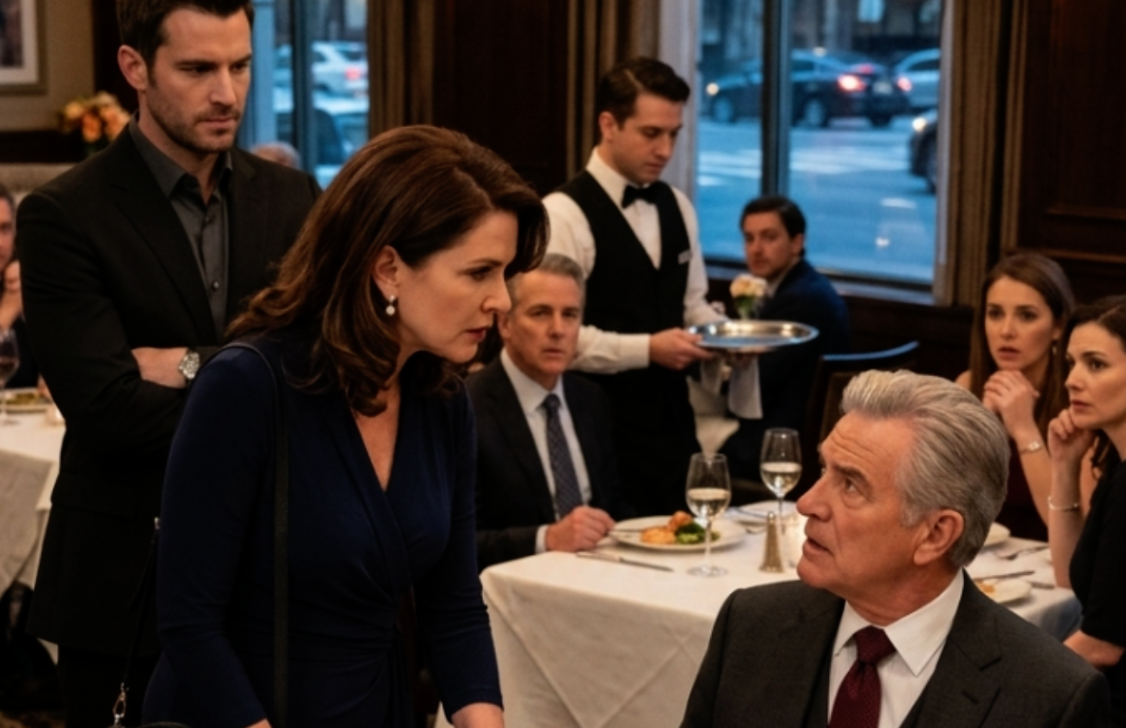
The scent of Alton’s cologne cut through the ambient candle smoke, a sharp, familiar spice that momentarily paralyzed my lungs. He leaned close, his mouth hovering just inches from my ear, his suit jacket brushing my shoulder. “You’re paying, right?” he whispered.
For a fractured second, I thought the bustling noise of the restaurant had deceived me. I was Dovy Boatright, and I had walked through the heavy glass doors of that establishment believing, against all the hard-earned wisdom of the past three years, that my family might finally want me back.
The hostess had greeted me with a blinding, manufactured smile, ushering me toward the back of the room as if she had been strictly instructed to watch out for a woman in a navy coat clutching a weathered leather purse. I had spent the entirety of the previous night perched on the edge of my mattress, staring at the glowing screen of my phone, replaying the voicemail from my estranged husband. His voice had been gentle, almost tender. Come to dinner, Dovy. It’s time we made things right. Hope is a terrifying and resilient thing; it requires so little oxygen to reignite. I had dressed with meticulous care. I wore a dark blue dress, low heels polished with a paper towel, and the pearl earrings I had not touched since my daughter’s college graduation.
But the room corrected my fragile optimism before a single word of welcome was spoken.
Twenty-five faces pivoted toward me as I approached the long, banquet-style table positioned beneath warm brass lamps and framed black-and-white photographs of rain-slicked city streets. There were cousins I had not seen in a decade, neighbors from our old suburban street, and acquaintances from church. They were already seated, already eating, already surrounded by the gleaming artillery of fine dining: crystal glassware, pristine white china, and heavy silver forks. Lobster tails rested on platters under a rich glaze of butter. Slices of perfectly seared steak were arranged like art. Near the head of the table stood a bottle of wine with a heavy gold label—a bottle that, to a woman who had recently learned to count her grocery money to the penny, screamed of an expense greater than a monthly car payment.
At the far end of the room, my thirty-one-year-old son, Dwight, leaned against the patterned wallpaper. He had his father’s height and his father’s infuriating habit of clenching his jaw to avoid engagement. He refused to meet my eyes. Three seats away sat my daughter, Kendra, wearing a champagne-colored dress and a diamond ring that caught the low light every time she reached for her water glass.
She was engaged. My daughter was getting married, and I was discovering this profound truth in a room full of people who had known long before I did.
“What is all this?” I managed to ask. I was still smiling, a biological reflex where the body maintains its polite conditioning long after the heart has flatlined.
Alton approached me with that familiar, easy saunter he always deployed when he wanted unearned forgiveness. He looked remarkably well, his hair transitioned to a distinguished silver, his face arranged into a mask of warmth that I instantly recognized as fraudulent. “It’s Kendra’s engagement dinner,” he announced smoothly. “We wanted you here for it.”
We. The pronoun landed like a physical blow. We planned. We invited. We decided. Not I. Not your mother. I looked at Kendra, desperately waiting for her to stand up, to rush over, to offer the apologies only a daughter can give. Instead, she lowered her gaze to her plate.
That was the exact moment Alton leaned in and asked me to foot the bill.
There was no “hello.” No “I missed you.” No inquiries about how I had survived the crushing weight of medical debt, the terrifying solitary recovery, or the hollow echo of an empty house. I had not been invited as a mother, a wife, or even a friend. I had been summoned as a remembered bank account.
Something deep within my chest went utterly and completely quiet. It was not the quiet of a broken spirit, but the heavy, pressurized silence that precedes a violent storm. I looked past Alton. Dwight was still staring at the carpet. Kendra’s fingers trembled around the stem of her wine glass. The extended family members were engaged in the theatrical performance of pretending not to watch me.
I smiled. Then, I raised my hand and signaled the nearest waiter.
He was young, perhaps twenty-five, with kind, observant eyes. I spoke two sentences to him, keeping my voice so low that not a single person at that sprawling table could hear the transaction. The waiter’s eyes flicked to Alton, then to the extravagant spread of food, and finally back to me. A flicker of profound understanding crossed his features. “Yes, ma’am,” he murmured.
For fifteen agonizing minutes, I sat in the empty chair they had designated for me—a seat purposely placed away from the warmth of the inner circle, positioned perfectly so the entire room could watch me submit to my role. I let them perform their pantomime of a happy family. Alton gave a saccharine toast about family finding its way back. Cousin Tessa dabbed at dry eyes. Dwight laughed too loudly at a joke. I politely asked Kendra about her wedding date, making brief, merciful conversation with her nervous fiancé, Marcus, who clearly had no idea of the cruel undercurrents of the evening. Alton kept shooting impatient glances toward the kitchen, waiting for the leather folio to arrive so I could fulfill my financial duty.
When the servers returned, they did not bring dessert. They brought stacks of white takeout boxes.
Quietly, with ruthless professional efficiency, the waitstaff began clearing the table. Half-eaten lobster tails, pristine steaks, roasted vegetables, and untouched bread rolls were swiftly packed into catering containers. Conversations at the table sputtered and died. Forks were lowered. Alton’s manufactured smile fought a desperate, losing battle against rising panic.
“What’s going on?” Alton demanded, his voice cracking.
The young waiter stood tall at the head of the table. “Dinner has been paid in full,” he announced clearly. “At Mrs. Boatright’s request, all remaining food is being packed and delivered tonight to the community shelter on Jefferson Avenue.”
The silence that followed was absolute. The gold-labeled wine was re-corked and whisked away. The confidence drained from Alton’s face, leaving behind a pathetic, hollow confusion.
“You paid?” he whispered.
“Yes,” I replied, my voice steady. “I paid for dinner. And I decided where it should go.”
Dwight finally pushed off the wall. “Mom, that’s not—”
“Don’t use that word only when you want something,” I snapped, cutting him down. Nobody dared to breathe. I saw Kendra’s eyes fill with tears, but I did not rush to comfort her. Some truths cannot be softened without turning them into lies. I stood up, retrieved my purse, and looked directly at Alton. “You invited me to a table I was never meant to belong to. Tonight, I decided not to sit there hungry.”
I walked out of the restaurant and into the cool, damp night air. I stood by my car, waiting for the familiar, crushing weight of grief to arrive. Instead, an incredible, buoyant lightness washed over me. I had finally put down a burden I had been carrying for years.
To understand the absolute necessity of that restaurant departure, you must understand the woman I used to be, and the brutal process that stripped her away. The first fracture in my old life occurred in a sterile doctor’s office with beige walls. The physician had used careful, measured terminology: Stage two. Treatable. Options. But the only thing I truly comprehended was that the ground had vanished beneath my feet.
Alton had driven me home that afternoon, holding my hand at every red light, promising, “We’ll handle it together, Dovy. Like always.” We had been married for thirty years. We had built a life, raised children, and weathered ordinary storms. I believed him implicitly.
But then the medical bills began to arrive. They came in thick envelopes, burying our kitchen table under a mountain of financial dread. Insurance was grossly insufficient. Alton’s voice lost its warmth, turning flat and exhausted. Every conversation mutated into an anxious debate about money, co-pays, and cheaper alternatives. As the brutal chemotherapy treatments drained my strength, leaving me too weak to cook or clean, Alton began retreating. He worked late. He took hushed phone calls in the garage.
One evening, I woke up with a metallic taste in my mouth, my head wrapped in a scarf, and shuffled down the hallway. The garage door was slightly ajar. I heard Alton’s voice, strained and desperate. “I don’t know how much longer I can do this. She’s becoming too much to carry.”
I convinced myself he meant the financial burden. I had to. But the rot had already spread to my children. Dwight became distant and overly polite, a chilling shift from his usual vibrant self. Kendra’s phone calls dwindled, replaced by a revolving door of flimsy excuses about busy work schedules and bad timing.
Then, one Thursday after a grueling infusion, I came home to find Dwight’s bedroom entirely empty. The furniture was stripped, the posters gone, leaving only pale rectangles on the walls. Two days later, Alton confronted me in the kitchen. He didn’t even have the courage to sit down.
“I think I need some space,” he declared, refusing to meet my eyes. “Not a divorce. Time to think.” He packed two suitcases and moved into his sister’s house, where Dwight had already relocated. He left me without a scene, without a fight, without the dignity of a definitive ending. He offered me silence and expected me to be grateful for the reprieve.
I finished my cancer treatments utterly alone. I drove myself to the clinic, gripping the steering wheel with shaking hands, waiting in sterile lobbies staring at a phone that never rang. When the oncologist finally declared me in remission, I sat in my empty driveway and wept, not from joy, but from the crushing realization that there was no one left to celebrate with.
Without Alton’s income, the house swiftly fell to the bank. I sold it just ahead of foreclosure, settling the debts and moving my drastically reduced life into a cramped, one-bedroom apartment with paper-thin walls. On my birthday, I called my children. I left voicemails. I sent text messages that were read and ignored. That night, I mourned the death of the family I had imagined, finally accepting that they were gone.
Financial reality, however, is immune to heartbreak. I needed an income. As an older woman with a glaring medical gap on her resume, my options were bleak. It was on a Sunday morning, glancing at a church bulletin board, that I saw the handwritten index card: Live-in caregiver needed. Must be patient. Must be dependable.
I had become an expert in patience. I called the number and met Birdie Loftton.
Miss Birdie was eighty-one, a fiercely independent widow with a tongue sharp enough to slice glass. She lived in a neat, white-sided house surrounded by neglected flower beds. During my interview, she looked me up and down and bluntly stated that caregivers never lasted with her. I promised her I wouldn’t be the one to leave.
The first few weeks were a relentless gauntlet of psychological tests. She deliberately hid money to see if I would steal it. She feigned losing her wedding ring to watch me panic and search the entire house, only to find it tucked inside a teacup. She complained about the temperature of her tea and the volume of the television, waiting for me to snap. I never did. I had survived a husband abandoning me to cancer; a cranky octogenarian was a mild breeze by comparison.
Eventually, the tests ceased. The sharp edges softened. Miss Birdie began to share stories of her late husband, Otis, and the quiet grief of never having children. She had a niece, Patrice, who only called twice a year, perfectly timed around tax season. “Funny how affection keeps a calendar,” Miss Birdie had noted bitterly.
By the third month, she demanded I move out of my bleak apartment and into her guest room. I became her constant companion. I learned the exact shade of her favorite morning mug and the precise route to her preferred pharmacy. We built a quiet, functional, fiercely loyal life together.
When Patrice finally decided to visit, she treated me like a parasitic infection. She pulled her aunt aside, hissing about the danger of having a “paid stranger” living in the house. Miss Birdie silenced her instantly. “Dovy is here every day. She doesn’t ask me for a thing. You’re family, yet here we are measuring who shows up.”
When Miss Birdie’s health inevitably failed, I was the one holding her hand on the hospital floor as we waited for the ambulance. I was the one who sat by her bedside for nine days, listening to the rhythmic beep of the monitors as her breathing slowed and finally stopped. I was the one who stayed.
Three days after her funeral, Miss Birdie’s attorney summoned me to his meticulously clean office. With a calm, measured voice, he informed me that Birdie Loftton had named me the primary beneficiary of her entire estate. The house, her savings, a rental property—everything was left to me. In her letter of intent, she had written a single, profound justification: Dovy never asked me for anything. She stayed.
The will entering probate became a matter of public record. That was how Alton finally remembered I existed.
Dwight had stumbled upon the probate filing while looking up a property issue online. He saw my name listed alongside a house, a rental property, and substantial savings. He immediately called his father. Alton’s first question wasn’t about my health or my well-being; his first question was, “How much?”
Suddenly, the wife who had been “too much to carry” possessed something of immense value. Greed is a spectacular motivator. Alton and Dwight orchestrated the elaborate engagement dinner trap, hoping to use Kendra’s milestone to guilt me back into the fold, assuming I was still desperate enough for their affection to pay for their meals and, eventually, share my newfound wealth.
When their restaurant ambush failed spectacularly, Alton resorted to the law. A week later, a process server arrived at my kitchen door with divorce papers. Hidden within the petition was Alton’s brazen claim to a portion of Miss Birdie’s estate. He argued that because we were still technically married when the inheritance was disbursed, it was marital property. Three years of absolute silence, and his opening communication was a demand for my money.
I did not break down. Instead, I hired Attorney Marion Ransom, a woman with a voice like shattering glass and zero tolerance for nonsense. I handed over boxes of meticulously kept care logs, pharmacy receipts, and bank statements proving that my life with Miss Birdie was entirely disconnected from the husband who had deserted me.
But the assault didn’t end with Alton. Dwight, ever resourceful in his entitlement, reached out to Patrice. United by unearned greed, Patrice hired her own probate attorney to contest the will, citing a minor clerical correction on a witness affidavit as proof of “undue influence.” They tried to paint me as a predatory caregiver manipulating a vulnerable old woman.
We all converged in a sterile, fluorescent-lit courtroom. Alton sat with his lawyer, refusing to make eye contact. Dwight fidgeted. Patrice sat rigid in a cream suit. Kendra, to my surprise, arrived alone and sat behind me, a silent pillar of unexpected support.
The judge dismantled Alton’s claim with ruthless efficiency. “There is no factual basis to classify the Loftton inheritance as marital property,” she declared, noting the years of physical and financial separation. Alton’s petition was denied on the spot.
Patrice’s challenge fared no better. Attorney Ransom called the drafting attorney to the stand, who confirmed Miss Birdie’s absolute mental clarity. Then, Ransom introduced the two handwritten letters Miss Birdie had left in her file. The judge read the words aloud to the breathless room: If anyone says Dovy talked me into this, they are lying… Dovy never asked. That is why I am choosing her.
The will contest was dismissed. The estate was officially mine. I looked back at Alton, Dwight, and Patrice—not with fury, but with the profound, detached clarity of a survivor surveying the wreckage of a storm she had safely escaped.
On the warm, sunlit steps of the courthouse, Kendra approached me. She was trembling, stripped of her usual defenses. She confessed that she had known about the dinner trap and had lacked the courage to warn me. She didn’t ask for immediate absolution; she simply asked for a chance to know me again, separate from the toxic machinery of her father and brother.
“I will always have room for you,” I told her honestly, letting the tears fall. “But the door for everybody else closed the night they sat me at a table I was never invited to.”
Time moved forward, carrying the weight of healing rather than the burden of waiting. I ignored Alton’s manipulative voicemails pleading for reconciliation. I responded to Dwight’s text messages with a firm, uncompromising boundary: Not yet. I was no longer in the business of rescuing the men who had willingly let me drown.
I poured my energy into Miss Birdie’s house. I repaired the rental property, planted vibrant marigolds along the walkway, and set up a recurring monthly donation to the Jefferson Avenue shelter. Kendra became a frequent visitor, helping me paint the porch railings in the late summer heat. We rebuilt our relationship slowly, brick by honest brick.
One evening, I prepared dinner in Miss Birdie’s dining room. I set the table using the good china. There were exactly three place settings: one for me, one for Kendra, and one for her fiancé, Marcus. I stood back and looked at the space. For my entire adult life, the concept of empty chairs had terrified me. Empty rooms represented abandonment; empty promises represented heartbreak.
But looking at my small, fiercely protected table, the space didn’t feel lonely. It felt clean.
When Kendra knocked, she waited respectfully for me to open the door, a small courtesy that spoke volumes about the new boundaries of our lives. She stepped inside, bringing the golden evening light with her.
I used to believe that family was the table you were born into, the structure you were obligated to endure, the place you begged to return to even when they forgot to set a place for you. I know better now. Family is not the table itself. Family is the people who notice when you are standing in the doorway without a chair. Family is the people who make room for you without calculating the financial or emotional cost.
And sometimes, when the people who left you to starve finally invite you back, only to eagerly slide the bill across the tablecloth, the most triumphant thing you can do is pay it, send the feast to those who actually need it, and walk out into the night with your dignity completely intact. I was never truly invited to their table. So, I built my own.