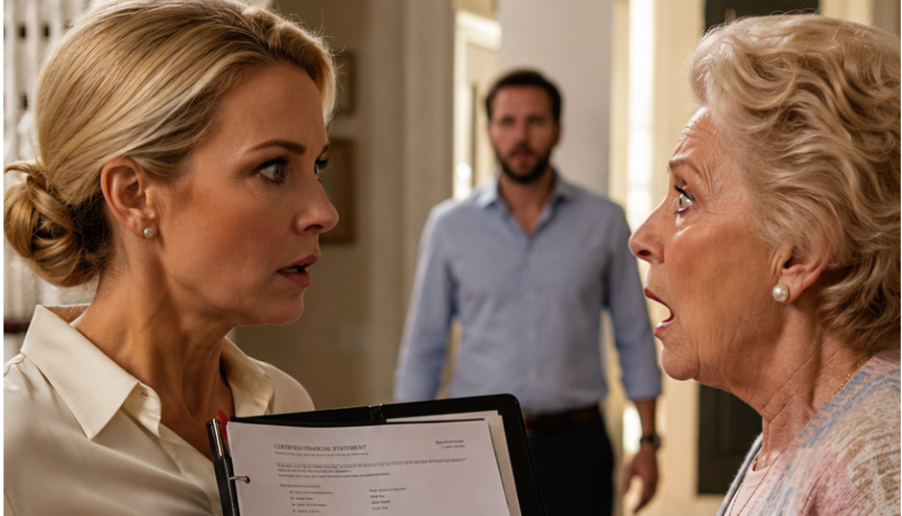
The night my mother-in-law instructed me to vacate her property, the ceiling fan above the dining room table revolved in slow, mechanical circles. It methodically distributed the scent of lemon-marinated chicken and lemon-scented furniture polish throughout an estate I had been quietly, single-handedly financing to keep upright.
It was a temperate spring evening within the type of suburban subdivision where uniform mailboxes stood like sentinels and the homeowners association dispatched cheerful, passive-aggressive notices regarding delayed refuse bins and excessive lawn height. Maryanne favored that neighborhood. She derived immense satisfaction from the manicured stone entryway, the meticulously sculpted shrubbery, and the leisurely pace of passing vehicles—slow enough for occupants to catalog who possessed company and who remained isolated. She frequently observed that the residence possessed “good bones,” a phrase she reserved for assets funded exclusively by external capital.
On this evening, she occupied the head of the table, illuminated by the brushed-gold light fixture I had personally selected and paid for. Ethan sat adjacent to me, his elbows pinned tightly to his flanks, his gaze fixed on his plate. I sat directly opposite the expansive kitchen island we had reconstructed the previous year—a renovation Maryanne routinely displayed to women from her congregation as though she had personally wielded the hammer and authorized the disbursements.
With deliberate grace, she folded her linen napkin, placed it beside her plate, and offered a smile so entirely devoid of malice that the weight of her words required several seconds to register.
“You’ll need to move out, Alyssa.”
I assumed I had misheard her. “I’m sorry?”
Her expression remained unaltered. “Lauren and Cal are prepared to establish a family, and they require the space. You are remarkably capable, Alyssa. You will undoubtedly land on your feet.”
The phrasing was precise. It was not an instruction issued to us—to Ethan and myself. It was not an invitation to collectively reorganize the household. It was addressed exclusively to me. I was being treated as a transient boarder, an auxiliary utility, a temporary appliance that had exceeded its depreciation schedule.
I turned to my husband, waiting for the inevitable correction, the dismissive laugh, the immediate defense: Mom, what are you talking about?
Instead, Ethan raised his water glass, took a measured sip, and maintained absolute silence.
That silence operated with a cold, surgical finality that no verbal altercation could ever achieve. There exist moments within a marriage where every concealed fracture becomes visible simultaneously—not through dramatic revelation, but cleanly, like an object beneath a shroud finally outlined by a stark light.
Maryanne leaned forward, adopting her soft, Sunday-luncheon cadence. “It need not become unpleasant,” she murmured. “This arrangement is temporary. Lauren has reached a specific junction in her life. She and Cal require room. Surely you comprehend that?”
I was thirty-two years old. I had been married to Ethan for six years. I did not oppose the concept of children; I merely harbored a profound reluctance to introduce a child into an existence sustained by structural strain, ambiguous trajectories, and the immense gravity of his mother’s expectations. I had communicated this stance clearly on multiple occasions. To Maryanne, this reluctance implied that my seat at the family table was vacant, my claim non-existent.
Lauren, her eldest daughter, had occupied the center of every familial orbit since the inception of my relationship with them. Lauren consistently received the prime allocation of resources, the gentler judgment, the grander narratives. When Lauren changed vocations three times within a twenty-four-month period, Maryanne characterized her as “discovering her path.” When Ethan lost his employment, Maryanne described him as being “under immense pressure.” When I executed late-night operations, discharged liabilities, and maintained the fiscal equilibrium of the household, she categorized me as “highly independent.”
“Independent” was her preferred nomenclature for women she intended to inconvenience.
I surveyed the dining room: the cream-colored placemats, the substantial glassware from Crate & Barrel, the dining chairs Ethan had once kissed my cheek for purchasing because they made the environment appear as though “grown-up people lived here.” Every physical asset before us had passed through my credit accounts, my wire transfers, my financial ledgers.
What Maryanne did not comprehend—and what Ethan had evidently neglected to disclose—was that I had been contributing $6,600 monthly to sustain that domestic infrastructure. This sum encompassed mortgage shortfalls, utility bills, insurance premiums, digital subscriptions, security monitoring, the kitchen modernization loan, the hardwood floor restoration, the beige sectional sofa she frequented for afternoon rests, the laundry appliances, and the professional landscaping service she boasted about whenever the hydrangeas bloomed.
I had absorbed these expenses without fanfare because I believed partnership precluded ledger-keeping. Maryanne, however, mistook my silence for emptiness. Ethan mistook it for permission.
I heard my voice respond, entirely even: “If that is your decision, I shall begin making arrangements.”
Maryanne relaxed immediately, as though I had accepted a minor logistical delay rather than complete erasure. “Excellent,” she noted. “I anticipated you would be reasonable.”
“Reasonable” was another foundational family term. It signified absorbing a profound blow without disrupting the dinner service.
I returned her smile, stood up, and assisted in clearing the table. That specific compliance startled me in retrospect—not that I maintained emotional control, but how automatically my body executed domestic labor within that house. Clear the dinnerware. Sanitize the surfaces. Preserve the leftovers. Protect the domestic atmosphere. Maintain the fiction.
Later that evening, I folded laundry upstairs with steady hands while Ethan showered. I paired socks, secured the buttons of a dress shirt he had not worn in months, and arranged my pajamas on the mattress while listening to water run through plumbing lines I paid to maintain. When he emerged, he observed me with the cautious apprehension of a man hoping a storm would dissipate by dawn.
“Alyssa,” he began, rubbing a towel through his damp hair, “Mom did not intend it to sound so—”
“She instructed me to vacate the premises.”
He sat heavily on the edge of the mattress. “Lauren and Cal require assistance for a brief duration.”
“And I do not?”
“That is an unfair interpretation.”
I looked at him—really looked at the damp hair, the slouched posture, the absolute readiness to advocate for another woman before verifying my psychological well-being. “What, precisely, are you articulating, Ethan?”
He opened his mouth, but he possessed no arguments that could survive daylight.
We occupied the same bed regardless. I lay awake, eyes fixed on the pale fan blades rotating above, and felt an internal detachment occur with absolute quiet. It was not fury, nor conventional heartbreak; it resembled the systematic shutdown of an empty commercial office building after close of business.
By 6:30 AM, my trajectory was set. I prepared coffee, toasted a bagel for Ethan, and kissed his cheek at the threshold. He departed with a distracted, appreciative murmur, maintaining the assumption that his lifestyle remained secure and that access was a permanent state of affairs.
The moment his vehicle cleared the driveway, I secured the deadbolt, inhaled deeply, and contacted a relocation firm. “I require a comprehensive packing and moving service today,” I informed the coordinator. “Everything included, same-day execution. I will authorize the emergency premium.”
I then opened my laptop and initiated a massive printing sequence: bank statements, digital receipts, loan instruments, utility ledger histories, screenshots of bank transfers, and electronic mail correspondence. I had always maintained fastidious records—a habit derived partly from my corporate background in operations consulting and partly from being the sole adult in the marriage who recognized the destructive potential of unmonitored automated payments. Ethan misplaced legal documentation with the frequency of cheap sunglasses; Maryanne categorized financial planning as “obsessive” until an air conditioning system failed and capital miraculously materialized.
Shortly after 8:00 AM, I transferred the expanding stack of documentation downstairs into a navy-blue accordion folder. I then conducted a room-by-room audit with a yellow legal pad, compiling an explicit inventory:
The list was extensive, yet insufficient to capture the true scope of my investments. Certain improvements could not be extracted by a moving crew: the restored oak flooring damaged by Maryanne’s pet, the custom kitchen backsplash, the commercial-grade water heater, the dining room light fixture. Those assets would remain. One cannot extract every ounce of historical labor from a structure, but one can cease donating it.
The relocation crew arrived before 10:00 AM in a commercial box truck. Three men entered—efficient, polite, entirely indifferent to the family mythology. The lead mover, Marcos, reviewed my legal pad.
“Everything itemized here,” I instructed him, indicating the stack of printed verifications on the counter. “I possess the purchase documentation if ownership is questioned.”
He glanced at the paper ledger and nodded, an expression indicating he had witnessed this specific scenario unfold across many zip codes.
By mid-morning, the acoustic profile of the house altered completely. The sound of drawers opening, heavy-duty tape tearing, closet hangers rattling, and heavy cardboard scraping across hardwood replaced the habitual quiet. It was the low, industrious thud of a life being translated into inventory.
I stood in the doorway of the living room, watching them encase the beige sectional Maryanne favored. I had purchased that specific piece during a holiday sale during our first year of occupancy; the previous sofa had sagged so severely that guests gravitated toward each other involuntarily. At the time, Maryanne had laughed, stating, “Well, if you insist on upgrading the environment, who am I to impede you?” She subsequently informed her weekly Bible study circle that Ethan had “surprised” her with luxury furniture.
That was the established ecosystem of the household: my capital arrived, Ethan received credit, Maryanne consumed, and Lauren joked.
I had met Ethan when I was twenty-six, a period when I still believed that basic human decency was self-evident. We wed after two years of courtship, initially renting a modest one-bedroom apartment above a commercial dry cleaner. It possessed thin walls and a narrow balcony where we consumed coffee on Saturday mornings, formulating plans for an uncomplicated future. Ethan was humorous then—lighthearted, preparing breakfast in his lounge shorts, referring to me as “Ace” due to my operational competence.
The marriage did not collapse catastrophically; it deflected slowly under a succession of minor retreats.
The primary shift occurred when Maryanne’s husband passed away following a protracted illness. He had refinanced the property multiple times to cover medical deficits, leaving behind a dignified-looking fiscal catastrophe rather than security. Concurrently, Ethan’s corporate division downsized, eliminating his position. He assured me the setback was temporary—we would economize, assist his mother, and regroup.
“She should not endure the loss of her home immediately following Dad’s passing,” he had pleaded in our kitchen, his hand on my waist with the earnestness that had once signaled safety. “We relocate there for six months, perhaps a year. I secure stable employment, we provide financial breathing room for Mom, and then we establish our independent residence.”
It sounded altruistic, logical, and family-oriented.
Instead, I entered a four-bedroom house at the terminus of a cul-de-sac and transformed into the load-bearing pillar holding the roof up. Working in operations consulting, primarily from a home office, I possessed sufficient contracts and discipline to guarantee a high, consistent revenue stream. It was not ostentatious capital, but rather the revenue generated by resolving corporate problems before they developed teeth. I engineered efficiency systems for external enterprises while inadvertently becoming the unpaid infrastructure of my own marriage.
Because Ethan’s pride could not tolerate the reality that his wife was carrying the financial burden, we constructed a compromise: liabilities were drawn from a joint checking account, which my individual corporate transfers consistently replenished. On paper—and within his internal narrative—the estate belonged to both of us.
I concurred because I loved him, because grief had made Maryanne brittle, and because I naively believed that temporary concessions remained temporary if honesty prevailed. Instead, the arrangement solidified like concrete. Ethan secured occasional freelance work, then part-time work, then a succession of positions that never materialized into the careers he promised. Maryanne ceased discussing the twelve-month timeline. Lauren began referring to the property as “Mom’s place” with the proprietary inflection of an heir marking an asset with ink.
At Thanksgiving, Maryanne would present a commercial cake and announce to extended relatives, “We are all collaborating to make this work,” before squeezing Ethan’s shoulder as though he had engineered the entire recovery. At church functions, she characterized her son as “a marvelous provider.” I would stand by the catering tables, balancing a paper plate, while neighborhood women admired the kitchen renovation photographs on Maryanne’s phone.
“Your son executed all of this?” a woman inquired on one occasion.
Maryanne smiled modestly. “Well, Ethan made it happen.”
In reality, I had authorized the contractor payments three days late because the masonry supplier had fouled the logistics, requiring half of my Friday to resolve between corporate client calls. Ethan had not even selected the grout color. But I understood the hierarchy: Lauren was celebrated for her desires, Ethan was excused for his deficits, Maryanne was canonized for her endurance, and my function was to make reality possible without ever appearing central to its execution.
The inquiries regarding childbearing operated under the same sugar-coated malice. During one holiday, while I was prepping dinner, Maryanne remarked, “Lauren is already analyzing local school districts. Astute girl. Certain women comprehend the risk of waiting too long.” At a birthday gathering, when I indicated Ethan and I were not rushing the timeline, Lauren laughed: “Well, someone in this family ought to utilize the surplus bedrooms.”
Ethan’s invariable post-mortem analysis was: “They intended no harm by it.”
That was his universal solvent. They intended no harm. As though a total lack of intent could prevent a bruise.
By the time the moving crew began dismantling the dining chairs, I arrived at a conclusion that would have humiliated me a year prior: I had remained because I mistakenly believed that sustained utility would eventually generate love.
It never does.
At 1:15 PM, my phone illuminated.
Maryanne: We shall discuss timelines this evening. There is no requirement for haste.
I looked up at Marcos as the sectional sofa cleared the threshold. I typed a single response:
Alyssa: Okay.
At 2:00 PM, Ethan entered through the mudroom. I heard the automated garage door, followed by his footsteps, and then the profound silence of a man encountering a reality he assumed could never manifest.
“Alyssa?”
I was in the primary bedroom, sealing a container of seasonal wardrobe items. He stopped at the door frame. “What is the meaning of this?”
I pressed the packaging tape down firmly. “I am vacating the property.”
He produced a short, incredulous laugh. “You are exhibiting unnecessary drama.”
I turned to face him. “No, Ethan. I am being precise.”
He looked down the corridor, registering the voices downstairs, the movement of crates, the metallic clatter of empty closet rods. “Mom indicated you had ample time.”
The phrasing remained consistent: Mom indicated. Not How are you? Not We must resolve this. Simply the latest directive from management.
I set the tape gun on the bare mattress. “Do you possess any self-awareness regarding how you sound right now?”
He rubbed his face. “Lauren and Cal require the structural accommodation, Alyssa. This is not a permanent relocation.”
I maintained eye contact. “Describe the logistics, Ethan. Your sister and her spouse occupy the property, establish a family, and your wife… what? Relocates to an extended-stay motel with a canvas tote bag?”
“That is an unfair characterization.”
“No,” I stated. “It is the literal trajectory.”
He followed me downstairs as the movers navigated the dining table through the front entryway. “Wait,” he injected, panic finally altering his pitch. “Why are they removing the furniture?”
“Because I purchased it.”
He stared blankly. “What do you mean, you purchased it?”
The question was delivered with such pure, unadulterated ignorance that it borders on the absurd. I accessed my financial application and displayed the screen directly before him: endless successions of ledger entries, supplier names, capital improvements, construction clearings, and the monthly bulk transfers into the joint account. The capital moved exclusively in one direction.
His expression shifted gradually, as though comprehension had to traverse an immense distance to reach his face. “You financed all of this?”
I offered a tired smile. “You never bothered to inquire.”
The front door opened before he could formulate a response. Maryanne entered, carrying a designer tote and a pharmacy package, maintaining her pleasant, managerial countenance. She advanced three steps into the foyer before registering the living room—or rather, the complete structural absence of it. The rug was gone, the lighting was removed, and the sofa was currently being secured in the truck. Only rectangles of dust remained on the wood floor.
Her smile faltered. “What is occurring here?”
Ethan looked between us, silent, apparently realizing that no one would provide him with a script.
I stepped forward. “I am vacating the premises today.”
Maryanne blinked. “That is entirely unnecessary. We indicated you had a transitional window.”
“We?”
She drew herself up. “Do not behave childishly, Alyssa.” Behind her, a mover carried the coffee table. She turned abruptly, her handbag slipping from her shoulder. “Excuse me. Return that item immediately.”
The mover looked past her to me. I nodded: “Continue to the truck.” He complied.
Maryanne’s voice lost its soft veneer, sharpening to a register I had rarely heard deployed in the presence of external witnesses. “You lack the authority to remove property belonging to this estate.”
I placed the navy accordion folder on the bare floor, unfastened the latch, and extracted the primary ledger. “The assets belong to me,” I replied. “Receipts, bank clearings, dates, contract signatures. Shall we initiate the review with the common areas or the kitchen infrastructure?”
Her mouth remained slightly parted. Ethan stepped closer, staring at the documentation as if hoping the itemized rows would alter their values. I had organized the files with color-coded indexing tabs:A woman of Maryanne’s disposition respected administrative documentation only when it protected her position; she dismissed it as cold when it applied leverage against her. She had once remarked, regarding a zoning permit issue, “Paperwork is irrelevant so long as individuals comprehend their position within the social structure.” She was currently learning a alternative lesson.
Lauren arrived ten minutes later, holding an iced beverage, her sunglasses perched on her head. She entered the empty foyer, surveyed the environment, and let out a nervous laugh. “Is this a practical joke?”
I met her gaze. “No. The property is yours.”
She frowned. “Then why is it empty?”
That was the exact juncture where reality settled upon them. The residence was not being transferred in its premium, subsidized condition; it was being returned to its actual fiscal baseline. And that baseline was entirely devoid of their comfort.
I departed before the final components were secured. I did not want my final memory of that environment to be the sound of Maryanne’s voice echoing off uncarpeted drywall. I checked into a commercial hotel near the highway intersection—a sterile corporate establishment featuring neutral carpeting, citrus-infused water in the lobby, and monochromatic prints of local geography that commanded no attention. The room smelled of industrial linen spray.
I deposited my luggage, secured the lock, removed my shoes, and stood stationary in the center of the space for a full minute. The silence was absolute. It was not a tragic silence, but simply the complete absence of external footsteps, human voices demanding my attention from lower floors, or a mother-in-law sighing because the household supplies required replenishment.
I sat on the mattress and organized my files across the white comforter like a tactical map. One electronic mail message stood out, which I affixed to the front of the file. It was an email from Maryanne to their historical tax preparer:
“Route the window replacements and kitchen capitalization under Alyssa’s identity. It optimizes the tax classification, and frankly, it represents her equitable share of the housing costs until Lauren requires the space.”
I reviewed that line three times. Until Lauren requires the space. My entire six-year marital utility distilled into seven words.
The following morning, I contacted my accountant, Nina. “Detail the scenario exclusively in metrics,” she instructed. I summarized two years of direct transfers, operational expenses, capital investments, and accounts registered in my name.
She exhaled slowly through the line. “Alyssa, you were not contributing to a household. You were underwriting an institution.”
Next, I retained Deborah, a family law attorney recommended for her capacity to decouple emotional narratives from statutory facts. “I require a determination regarding my explicit assets,” I informed her, “what liabilities I can immediately cease funding without legal exposure, and what documentation is required to prevent historical revisionism.”
“That,” Deborah responded, “is the correct operational approach.”
I spent the remainder of the day modifying authorizations. The high-speed internet account in my name was terminated. The security contract was canceled. The streaming services and premium service memberships vanished from the household infrastructure. The master gardener invoicing me directly was notified that financial responsibility had ceased. I did not execute these changes out of malice; I merely ceased pretending that an estate I had been ordered to leave possessed an ongoing right to my revenue.
I then transmitted a single paragraph via electronic mail to Ethan and Maryanne:
Effective immediately, I have terminated financial support for the residence located at 114 Bentwood Court. Any ongoing operational costs, debt service, or maintenance fees must be assumed by the property titleholders or current occupants. Legal counsel is currently reviewing the documentation of my historical capital contributions.
No hyperbole. No emotional adjectives. Just consequences delivered in complete sentences.
By midday, Ethan had initiated six voice calls and a succession of digital messages:
I deactivated the notification signal and fetched coffee from the lobby. The surrounding world continued its neutral trajectory, entirely unconcerned with my domestic divorce.
By the second day, the structural degradation of their lifestyle began. The termination of the internet account disrupted Maryanne’s media consumption and voice-activated automation. The security apparatus went dark. The lawn care service bypassed the address. The grocery delivery account failed due to an invalid card clearing mechanism. The premium television packages ceased broadcasting. The minor cushions of convenience that had insulated their daily existence deactivated sequentially.
Then the primary overhead liabilities arrived: the mortgage shortfall notification, the county property tax installment, the insurance escrow deficit, and the kitchen loan amortization schedule. These were the documents people routinely disregard only when an external actor is quietly absorbing them.
Ethan arrived at the hotel lobby that evening, appearing unkempt, his attire wrinkled—the classic presentation of an individual who had spent twenty-four hours being upbraided by family members he could no longer satisfy.
“You are publicly humiliating my family,” he stated quietly, approaching my table.
I adjusted my coffee cup. “Am I?”
“My sister is distraught. Mom cannot comprehend the mechanics of what is occurring.”
I looked at him. “That is ironic, Ethan. I failed to comprehend the mechanics when your mother ordered my eviction while you sat there like an unengaged restaurant patron waiting for the bill.”
He winced slightly. “The removal of the services, the legal communication… you are punishing everyone.”
“No,” I corrected softly. “I am withdrawing from a contract I never ratified as a permanent obligation.”
He reached toward me, then retracted his hand. “Return to the house. We can negotiate adjustments.”
“To what end?” I inquired.
“We can formulate a plan. Mom did not intend—”
I raised my palm. “Do not complete that sentence.”
He remained silent. I extracted a legal-sized envelope from my satchel and propelled it across the surface. He extracted the contents with unsteady fingers: an itemized accounting of my equity inputs, a formal demand for document preservation, and an explicit notification that any attempt to encase, transfer, or encumber the property would face immediate litigation.
“You have retained formal counsel,” he observed, his eyes scanning the brief. “You engineered this outcome.”
I stood up to depart. “No, Ethan. Your family liquidated the alternative.”
That evening, I reviewed a voice message from Maryanne. Her tone had completely abandoned its polished veneer.
“Alyssa, this has exceeded acceptable boundaries. You are fracturing this family over a basic misunderstanding. If you possessed any integrity, you would cease this performance and resolve the logistical complications you have generated.”
I terminated the playback. It was the same paradigm: the complications I had generated. Not the initial directive to clear my room. Not the years of silent financial exploitation. Not the assumption that my marriage could be dismantled like temporary staging to accommodate Lauren’s family planning. The offense was my refusal to continue funding the illusion.
By the third day, the narrative shifted from anger to anxiety. Maryanne’s electronic messages grew terse: Can we communicate? This does not require litigation. What are your explicit demands?
Ethan’s messages shifted toward baseline administrative data: What is the cost of the digital access? Which account services the structural insurance? Did you personally clear the carpentry loan? There are forms of ignorance that occur via oversight, and forms that are maintained willfully because knowledge demands reciprocal obligation. He had existed in the latter state for the duration of our cohabitation.
I answered exactly once, providing a cold breakdown:
I added a final line: That is the numerical reality of your temporary house, Ethan.
He responded six hours later: I was unaware.
I replied: You chose to remain so.
Two days later, he requested a final meeting at the hotel. Maryanne remained outside in her vehicle, parked near the entry canopy, her arms crossed tightly, her sunglasses deployed despite the overcast sky. She appeared significantly smaller—stripped of the unearned authority that comes from absolute compliance.
Ethan sat opposite me inside. “Mom indicates that if you return, we can implement structural adjustments. You would not be required to vacate immediately.”
I looked at him, feeling a sense of clinical detachment. “Let me analyze the parameters of this offer, Ethan. Your mother ordered my eviction from a property I was keeping solvent so your sister could take residency, and your current counter-proposal is that I may continue to finance my own displacement on a modified schedule?”
He looked down. “You formulate the description to sound malignant.”
“It sounds exactly like the ledger reads.” I looked at him with absolute clarity. “I loved you, Ethan.”
He raised his eyes. “I am aware.”
“No,” I clarified. “You lack the capacity to comprehend it. Because if you understood the nature of that commitment, you would recognize why this connection is permanently severed.”
He lost color then, recognizing that actions had finally yielded permanent status.
The following morning, Deborah contacted me with the results of her discovery phase. The window replacements, the kitchen modernizations, and the structural permits all carried my exclusive signature and financial footprint. Furthermore, Maryanne’s written communications with her tax consultants established that my payments were explicitly classified as covering equity interest. It did not grant me total deed ownership, but it generated a massive cloud over the title. They could not execute a transfer, a sale, or a refinancing structure without resolving my civil claims.
The formal legal notice paralyzed their plans. Lauren and Cal’s dream of occupying the large suburban house evaporated the moment the actual $6,340 monthly overhead became visible; they could not even sustain their current apartment without familial intervention. The image of their domestic expansion dissolved under simple arithmetic. Maryanne had never possessed a strategy; she possessed a fantasy subsidized by my operational efficiency.
The dissolution of the marriage was administrative. No dramatic scenes occurred within the courthouse; it was merely a succession of asset disclosures, statutory filings, and signatures.
During the final phase, Maryanne requested a singular private conversation. We met at a standard commercial diner off the interstate highway. She arrived wearing a luxury coat and pearls, attempting to utilize traditional social markers as leverage. She did not order sustenance. She spent the duration stirring a cup of coffee she never consumed.
“I believe this matter has been inflated beyond necessity,” she observed.
“It became exactly as large as your presumption, Maryanne.”
Her mouth narrowed into a thin line. “You were always excessively sensitive.”
“No,” I corrected her. “I was simply useful.”
She looked out the window at the passing highway traffic, silent for a prolonged interval. “I never directed Ethan to pursue a divorce.”
“You merely removed the foundation that prevented it.”
When the property was eventually liquidated to satisfy the outstanding liabilities, it occurred without public announcement or familial gatherings. My portion of the equity was deposited directly into my bank account—not as poetic justice, but as verified numbers on a closing settlement statement. It was sufficient to recoup my investments, secure a new residence, and validate the ultimate operational lesson: individuals will utilize whatever elevated nomenclature—family, duty, sacrifice, love—to make extraction appear noble. But when the structure is contested, reality exists solely in what survives in writing.
Lauren and Cal relocated to a small rental unit. Maryanne ceased her social hosting duties; rumors from mutual acquaintances indicated that her silver vehicle was rarely seen within the old subdivision. Ethan transmitted a final text message several months later: I did not anticipate this conclusion.
I replied with the final line of our shared history: Neither did I. You chose not to look. Then I blocked the number permanently.
My current residence is a modest two-bedroom apartment on the second floor of a brick building featuring a small balcony that receives direct morning sunlight. On my first evening, I sat on my own rug, consuming food from a real plate, having surpassed the point where I felt the need to perform grief. The environment contained exclusively what I authorized. The beige sectional sofa fit perfectly against the walls. The dining table sat under a different light fixture, and when I passed it, I found myself running my hand along the polished surface—a reminder of how novel true ownership feels after years of being told that basic boundaries are excessive.
I cultivate herbs on the window sill. I purchase luxury linens without monitoring their usage. I discharge my utility liabilities with a sense of genuine satisfaction. On Sundays, I consume coffee on the balcony in absolute autonomy.
What surprised me was not the occasional presence of grief—grief is a logical consequence of structural change. I had lost not only a husband but the specific version of myself that believed one more cycle of patience would convert systemic disrespect into gratitude. What surprised me was how light my own competence felt when it was no longer being extracted as a structural obligation.
In the old house, every action occurred before a demanding audience. In my current existence, a bill is merely a liability to be cleared. A clean kitchen at night is an act of consideration for my future self, not an unpaid effort to maintain a structure for people prepared to deny I am load-bearing.
Sometimes people ask if I regret not fighting with greater intensity before departing. I always provide the identical response:
I did fight. I simply ceased fighting for the wrong side.
The night Maryanne instructed me to leave, she assumed she was removing an impediment to her family’s comfort. What she actually severed was the final illusion retaining my presence. She did not discard me; she executed my release from a corporate assignment I had mistaken for a marriage.
And the structure I inhabit now does not require external validation. It stands entirely on its own foundation—quiet, paid for, and finally mine.