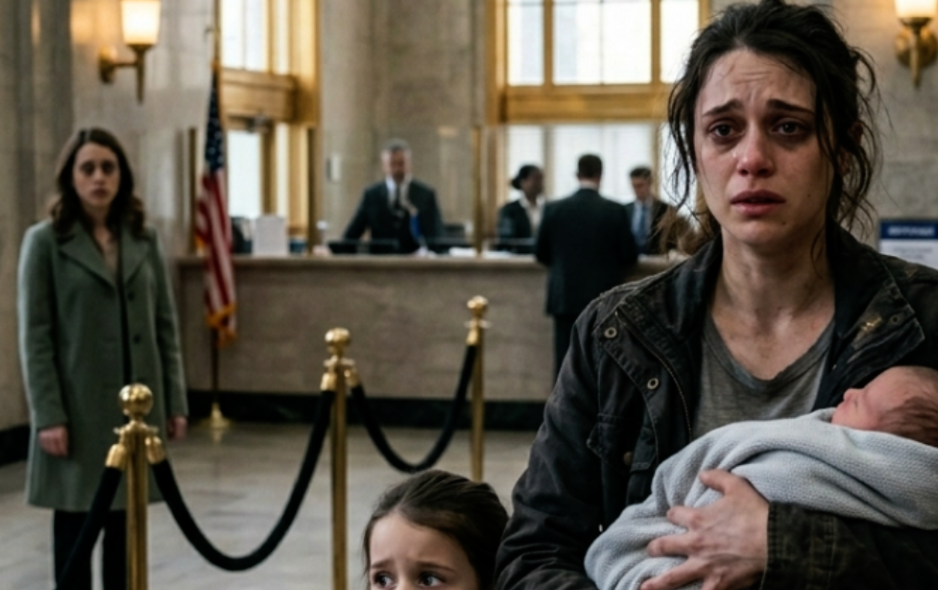
By the time Clara Velasquez pushed open the heavy, brass-framed doors of Ironcrest National Bank, the bitter March wind had stolen the remaining warmth from her body. Her hands were so profoundly numb that she could barely feel the hard, metallic edge of the card wedged between her fingers.
The card itself was an anachronism, a strange object capable of drawing stares in a modern financial institution. It possessed none of the glossy, lightweight flexibility of contemporary plastic, nor did it bear the embossed logos or holographic security strips of modern banking networks. Instead, it was dense and heavy, darkened by decades of oxidation to the dull, muted color of old pennies left forgotten in a jar. A faint, intricate crest was etched into its face, and the surname Velasquez was engraved so lightly across the bottom that the lettering appeared almost entirely worn away by time. Clara had discovered it only that morning, buried deep within the frayed bottom seam of her purse while frantically digging for stray bus fare and loose cough drops. For a long, silent moment in the dim light of dawn, she had simply stared at it in confusion, unable to recall the last time she had laid eyes on it. Then, like a sudden shift in the wind, she remembered her grandfather’s voice—low, patient, and resonant with the quiet gravity that used to fill the space of his narrow kitchen.
“If life ever corners you so hard you can’t see a door, mija,” he had said, his eyes locking onto hers with unmistakable intensity, “take this to Ironcrest.”
He had spoken those words only once. A single time in a lifespan of ordinary conversations. Then, with a casual flick of his wrist, he had slid the heavy piece of copper across the scarred wooden table and returned to stirring black coffee into chipped ceramic mugs. He had treated the statement as something entirely mundane, no more dramatic or consequential than explaining where the spare house key was hidden beneath the porch.
At twenty-one, Clara had dismissed the exchange as one of her grandfather’s peculiar, old-world eccentricities—akin to his habit of meticulously rolling his sleeves before washing dishes or neatly folding his cash into the exact same worn leather wallet he had carried since before her birth. She had accepted the card merely because he asked her to, tucked it safely inside a blank envelope, and subsequently allowed years of rent notices, grueling work shifts, the joys and anxieties of motherhood, overdue utility bills, and the daily mechanics of sheer survival to bury it beneath the weight of everything else.
Now, she stood frozen in a bank lobby constructed of polished white marble and immense, intimidating silence. She was acutely aware of her own appearance: her coat was threadbare, its zipper broken and held together by a single safety pin; her shoes were thoroughly damp from the slush on the sidewalks; and her hair was hastily tied back in a knot that had unraveled sometime before dawn. Her daughter, Lucia, pressed tightly against her left side, adopting the rigid, defensive stillness of a child who had learned far too quickly that it was safer not to take up space in the world. Beneath Clara’s right arm, two-year-old Mateo was fever-warm, his tiny body trembling as he coughed into her shoulder with a thin, hollow, rattling sound that had haunted her through the last three sleepless nights.
The vast lobby smelled faintly of expensive lemon oil polish and sophisticated perfume. Behind the long, uninterrupted teller counters, bank employees moved with the smooth, measured tranquility of individuals whose mornings never began with the agonizing choice between purchasing breakfast or medicine. Wealthy men in tailored wool coats stood in loose lines, quietly checking market updates on their phones. A woman with a sleek, professional blowout and a camel-colored leather handbag glanced at Clara once, paused, glanced again, and subtly adjusted her grip on her purse, pulling it a fraction closer to her body.
Clara felt a familiar, suffocating urge to turn around and run.
She had surrendered to that urge a dozen times over the past three weeks. She had done it at the elementary school office when Lucia needed yet another extension on her lunch fees. She had done it at the church pantry when the queue spilled out into the frozen asphalt parking lot and she spotted two women from her old neighborhood. She had done it at the county assistance building when the harsh fluorescent lights, the endless rows of plastic chairs, and the dehumanizing bureaucracy made her feel less like a human being than a file destined to be misplaced. By then, shame had materialized into a physical entity within her. It lived constantly in her throat, weighed down her shoulders, and manifested in the defensive way she apologized to people before they had even spoken a word of refusal.
But then Mateo coughed again, harder this time, his fragile frame jerking violently against her chest with the effort to breathe.
The sound anchored her. She stayed.
A security guard stationed near the grand entrance noticed her first. He was a broad-shouldered, middle-aged man possessing tired, remarkably kind eyes and a polished nameplate that read Derrick. He did not approach her with the aggressive posture of someone confronting a trespasser; instead, he walked over with the quiet, deliberate pace of someone who had witnessed desperation before and understood exactly how not to embarrass it.
“Morning, ma’am,” he said, his voice dropped to a respectful murmur. “Can I help you find someone?”
Clara swallowed hard, her mouth feeling as dry as dust. “I don’t know,” she admitted honestly, her voice trembling. “I hope so.” She extended her hand, offering the card. “It belonged to my grandfather. He told me if I ever needed help—real help—I should bring it here. I just… I need to know if it still means anything.”
Derrick looked down at the dark copper, and for a fleeting second, his professional veneer shifted. It was not an expression of alarm, but rather one of sudden recognition, or perhaps the uneasy awareness that he was looking at something the front-desk training manuals had never anticipated. He did not touch the metal immediately.
“Let me walk you over to the counter,” he said softly.
The nearest teller station was occupied by a young woman adorned with small pearl earrings and the practiced, unshakeable smile of an employee trained to maintain pleasant neutrality under any circumstance. Her name tag read Angela. She assessed the situation in rapid successions: first Clara’s faded coat, then the two children, and finally Derrick, whose silent, protective presence indicated that this was not a standard transaction.
“This customer needs assistance with a legacy card,” Derrick announced.
Angela blinked, her smile faltering slightly. “A what?”
Clara slid the heavy copper card across the polished marble counter. Angela picked it up between two fingers, visibly startling at its unexpected weight.
“I’ve never seen one like this,” Angela murmured, turning it over.
“That makes two of us,” Clara replied, her tone flat and devoid of bitterness. She simply no longer possessed the surplus energy required for bitterness before breakfast.
Angela scrutinized the faint crest on the back, and her entire demeanor altered. She glanced toward an older, more senior teller working two stations down. “Janice?”
The older woman walked over, took one look at the object resting in Angela’s palm, and instantly straightened her posture. “Where did you obtain this?” she asked, her eyes fixing onto Clara.
“It belonged to my grandfather,” Clara said, repeating the name like a shield. “Esteban Velasquez.”
An unreadable expression crossed Janice’s face—a mixture of profound surprise and deep-seated memory. She lowered her voice to a commanding whisper. “Please insert it into the auxiliary reader.”
Angela hesitated, her fingers hovering over her keyboard. “The legacy reader?”
“That is precisely what it is there for.”
Positioned beside the modern terminal was a small, obsolete piece of machinery, almost entirely obscured by a neat display of retirement brochures. It looked like a relic from a previous era of banking—brushed industrial steel with a narrow, manual slot and a faded, physical keypad. Angela carefully slid the copper card into the opening.
For one agonizing second, nothing happened. The world remained exactly as it was.
Then, the monitor flickered violently. A soft, low electronic tone sounded from somewhere beneath the heavy desk. A new, completely different interface opened on the screen. Angela frowned, quickly typing in her administrative access code, and then froze so utterly that Clara genuinely feared the machine had delivered a physical shock to her.
Janice leaned over her shoulder, her eyes widening. The two tellers stared at the display in absolute silence. Slowly, the color drained completely from Angela’s face.
“What is it?” Clara asked, her own voice dropping to a whisper. “Is there a problem?”
Neither employee answered her. The shift in the atmosphere of the room traveled faster than any spoken word. The rhythmic clicking of keyboards down the line stopped. A gentleman waiting behind them lowered his phone. Someone muttered an impatient question. Derrick took half a step closer to the counter, his jaw tightening as he monitored the room.
On Angela’s monitor, rendered in numbers far too large and impossible to belong to any reality Clara had ever known, sat a balance that resembled a catastrophic printing error:
$$\$142,600,000.00$$
Then, a rapid sequence of further digits populated after the decimal point, updating the balance in real-time.
Angela let out a sound that was half-breath, half-gasp. Janice reached across her terminal, slammed her hand against the privacy shield to obscure the monitor from public view, and whispered sharply.
“Call Ms. Caldwell. Immediately.”
The clients in the lobby had not overheard the specific figures, but they could read the sudden, stark terror of shock. They observed the way the bank staff instantly stood straighter, the way an executive manager emerged from a locked office within seconds, and the way the teller serving a wealthy businessman in a navy suit froze mid-sentence to look down the row at Clara.
Clara felt the sound of her own blood roaring in her ears. “There’s a mistake,” she said, her hands flying to her mouth. “There has to be a mistake.”
No one contradicted her, yet no one agreed. Derrick looked at her, then down at Lucia, whose small fingers had buried themselves deep into the frayed hem of her mother’s coat, and then back to the hidden screen.
“Let’s get you somewhere private, ma’am,” he said gently.
The branch manager arrived, dressed in a charcoal suit and a silk tie, his eyes sharp with the intense discretion of a professional who understood that a single misstep could end his career. He introduced himself as Mr. Hanley and addressed Clara with an immediate, profound respect that made her skin crawl with unreality.
“Ms. Velasquez, if you will please accompany us, a senior representative from our Legacy Accounts division is already on her way downstairs.”
Clara almost laughed—not out of amusement, but because her exhausted body no longer knew how to process shock. Legacy Accounts. The phrase sounded like something reserved for old money, for dynastic families with oil portraits in their libraries and sprawling summer estates, not for a woman who had spent the previous night trying to keep her children warm in the drafty corner of a church warming center that closed its doors precisely at six in the morning.
She nodded silently, her capacity for speech deserting her.
Derrick escorted them to a private, wood-paneled elevator. Lucia remained so close that Clara could feel the rhythmic trembling of her daughter’s fear through her sleeve. Mateo coughed twice on the ride up, then went completely limp, resting his heavy, feverish head against Clara’s collarbone.
When the elevator doors slid open, they stepped into an entirely different world. The upper floor did not resemble a bank; it felt like a private museum curated by individuals who valued quiet far more than display. There was dark, unpolished wood, thick wool carpeting that swallowed the sound of their footsteps, framed black-and-white archival photographs, and antique clocks ticking with absolute precision. Tall windows overlooked the gray city below, where the March wind chased dirty patches of snow along the gutters. The receptionist stood up the exact moment Clara appeared.
“Ms. Caldwell is expecting you.”
Margaret Caldwell was a woman in her late fifties, her dark hair threaded neatly with silver, possessing the composed, unshakeable countenance of an executive who had spent decades delivering life-altering news without ever losing her equilibrium. She wore a tailored navy suit and reading glasses on a delicate silver chain. There was an intentional, formidable edge to her presence—until her eyes fell upon the children.
Then, something in her face visibly softened.
“Before we address any paperwork,” Margaret said, her voice warm and authoritative, “would your children like something warm to eat?”
Clara opened her mouth to decline out of pure reflex—out of the deeply ingrained humiliation that compelled her to avoid taking up space or accepting charity—but Lucia spoke first.
“Is hot chocolate okay?” the girl asked, her voice so small it wounded Clara to hear it.
Margaret smiled beautifully. “Hot chocolate is more than okay, sweetheart.”
Within ten minutes, a silver tray appeared carried by an assistant. It held thick toast, scrambled eggs, fresh fruit, hot chocolate for Lucia, warm milk for Mateo, and black coffee for Clara in a heavy porcelain mug that felt impossibly solid in her hands. Clara had not sat in a chair that properly cushioned her body in months. She had not watched her children eat without meticulously counting every bite in weeks. Only after Lucia’s tense shoulders finally dropped and Mateo’s rattling cough subsided did Margaret place the old copper card onto the table.
“Ms. Velasquez,” Margaret began, “I am going to ask you a series of specific questions to verify your identity. After that, I will explain exactly why you were instructed to bring this card to us.”
Clara nodded, her hands beginning to tremble again despite the warmth of the coffee.
Margaret did not ask for account numbers or passwords. Instead, she asked for Clara’s full legal name, her exact date of birth, her maternal grandmother’s maiden name, the name of the specific street where her grandfather had lived his entire life, and the private nickname he used for her when she was a little girl. They were questions that no scammer or identity thief could ever answer. They were questions that belonged exclusively to small kitchens, family funerals, quiet birthdays, and old, repeated stories. Clara answered them one by one, each memory bringing the physical presence of Esteban Velasquez back into the room with striking clarity.
She saw his narrow kitchen in the small brick bungalow on the south side of the city. The faded yellow curtains. The tin of ground cinnamon that always sat to the left of the stove. The antique radio he kept tuned to baseball games even when he claimed he didn’t care who won. She remembered the way he would rhythmically rub the pad of his thumb over the handle of his coffee mug while deep in thought, and the deep, rough calluses on his palms from a lifetime spent repairing things that other people had discarded.
Her grandfather had never looked rich. He had looked useful. Solid. He was the sort of man neighbors called at two in the morning when a furnace failed or a porch step gave way. He had worn the exact same brown canvas jacket for fifteen consecutive winters. He drove a dented pickup truck, meticulously cut coupons, and saved used rubber bands in a glass jar. If he possessed wealth, Clara had never seen a single trace of it.
When the interrogation concluded, Margaret stood up and retrieved a small biometric scanner from a drawer. “This was explicitly specified in the original trust documents,” she explained. “Your grandfather was a very precise man.”
Clara let out a short, disbelieving laugh. “That sounds exactly like him.”
She pressed her thumb against the glass pane. The scanner blinked red, processed for a second, and then glowed a steady, vibrant green.
Margaret exhaled slowly, as though she too felt the immense weight of the moment. “Thank you, Ms. Velasquez. I can now officially confirm that your grandfather established an entity known as the Velasquez Contingency Trust.”
Clara stared at her. “My grandfather had a trust?”
“Yes.”
“That’s impossible. He didn’t have money.”
“It was created over forty years ago,” Margaret said, folding her hands over the file. “It was unusually structured, completely inactive by design, and was never intended to function like a conventional inheritance. It was built entirely around a single, specific contingency.”
Clara looked down at Mateo, who had finally fallen into a deep sleep against her chest, and then at Lucia, who was consuming her toast with the careful concentration of a child trying to be perfectly behaved in a place she felt she didn’t belong.
“What kind of contingency?” Clara whispered.
Margaret held her gaze with absolute seriousness. “Financial destitution.”
The words struck Clara with unexpected force. It was not because they were inaccurate, but because hearing her reality articulated in a polished office by an executive in a tailored suit made it feel permanent. Destitution was a bureaucratic word—the kind of word used in caseworkers’ reports, court documents, and state assistance applications. It was a term that transformed an individual’s struggle into a sterile legal category.
Margaret’s voice grew incredibly gentle. “Your grandfather’s legal instructions were explicit. The trust assets were to remain completely sealed unless a direct descendant presented the copper card in person, and our mandatory verification process confirmed that the individual possessed no secure housing, no significant liquid assets, and no reliable financial support from any outside source.”
Clara felt a strange sensation of detachment, as if she were floating outside her own exhausted body. She thought of the stained canvas cots in the church basement. She thought of the county motel voucher that had expired after forty-eight hours. She remembered the property manager taping the final notice to vacate directly onto her apartment door, the words PAST DUE stamped in bold red ink. She remembered selling her unreliable car for a fraction of its value because she was behind on insurance and could no longer afford the gas. The watery canned soup dinners. The endless bus transfers. The terrifying way she had begun waking up every single hour of the night, not because of external noise, but because fear itself had become an internal alarm clock she could not turn off.
“And you verified all of that?” Clara asked, her voice cracking.
“The moment the card was inserted into the legacy reader,” Margaret nodded. “The system automatically initiates a secure contingency audit using public records, banking data, historical asset searches, and regional shelter intake databases. I am deeply sorry to state this to you so plainly, Ms. Velasquez, but according to the legal terms of the trust, the condition of destitution has been fully met.”
Clara looked out the grand window at the city. All at once, the agonizing trajectory of the past three weeks rose up behind her eyes.
She had tried so desperately to keep up after the diner cut her shifts. She had tried even harder when Mateo contracted the respiratory illness and she was forced to miss two residential cleaning jobs in the same week. She had sold her grandmother’s small gold earrings. Then her microwave. Then the television. She had stretched their groceries beyond any reasonable limit, watering down the milk and skipping her own meals so that Lucia could take the remaining leftovers to school. She had called distant cousins who expressed sympathy but noted their own apartments were already overcrowded. A former coworker had allowed them to sleep on her living room couch for four nights, until the woman’s boyfriend made it clear he would not tolerate children in his space. After that came the shelter lines.
The worst element of poverty, Clara realized in that quiet room, was not the physical hunger. It was the continuous, degrading negotiation of one’s own dignity.
It was pretending to your children that sleeping in a vehicle or a church was a grand adventure when they asked why they couldn’t wear clean clothes. It was praying they wouldn’t notice your hands shaking as you did mental arithmetic at the grocery counter. It was memorizing the locations of every public restroom downtown like a hidden geography of survival. It was forcing a polite smile for people who looked straight through you, because allowing yourself to feel anger would consume the tiny shred of energy you required simply to make it to tomorrow.
And through all of those horrific weeks, the old copper card had been resting quietly in the seam of her purse.
Tears spilled over her lower lashes, and she pressed her palm against her mouth. “I forgot,” she whispered. “I forgot I even had it.”
Margaret did not ask her to explain or apologize.
Lucia, alarmed by the sudden fracture in her mother’s voice, slipped down from her leather chair and placed a small, warm hand on Clara’s arm. “Mom? Are you okay?”
Clara pulled herself together with an immense physical effort. “I’m okay, baby. I’m okay.”
It was a lie, of course. She had not been okay for a long time. But for the very first time in months, her desperation did not feel like the definitive end of her story.
Margaret opened a heavy leather folder and turned a single sheet of paper toward Clara. “Your grandfather’s trust assets, including over forty years of compounded investment growth and associated corporate holdings, currently total exactly one hundred forty-two million, six hundred thousand dollars.”
Clara stared at the document, the numbers blurring. To her, numbers had always represented immediate, concrete anxieties: rent, utilities, gas, laundry money, a balance of thirty-seven dollars to last until Friday, or the outstanding debt at the pediatric clinic. They had never represented this—an abstract sequence of digits that required multiple commas just to be readable.
“There’s a mistake,” she insisted automatically. “My grandfather fixed residential furnaces. He argued with grocery cashiers over the price of bruised apples. He owned the same static-heavy television for twenty-five years.”
Margaret’s mouth curved into a look of genuine affection. “Yes,” she said softly. “We are well aware of that.”
“How?”
“We know because he explicitly told us to expect exactly this reaction from you.” Margaret turned the page, revealing a document written in a firm, old-fashioned cursive script that Clara recognized instantly. Esteban’s handwriting always leaned aggressively forward, as if the words were in a hurry to be useful.
If she looks at you like you’ve insulted both of her grandmothers, that means you found the right girl.
A broken laugh escaped Clara’s throat, transforming into a sob.
“Your grandfather established an early, private investment position in an engineering and technology firm during its infancy,” Margaret explained, letting the emotion in the room settle. “He deliberately chose never to liquidate the vast majority of his shares. He lived an exceptionally modest life by personal choice, maintaining his old home and habits. According to his journals, his primary rationale was not secrecy for its own sake. He strongly believed that unearned wealth without proper life perspective fundamentally ruins people. He did not want this trust to be accessed in comfort—only in absolute necessity.”
Clara pressed her fingertips against the edge of the mahogany table, trying to ground herself in reality. “Why me?”
“You are his direct descendant, Clara. But there is a final component to his instructions.” Margaret pointed toward a small, flush-mounted door in the wood-paneled wall. “There is a recorded video message waiting for you.”
The adjoining room was small, dark, and remarkably quiet, featuring soft recessed lighting, a digital screen mounted on the wall, and a single row of comfortable chairs. It felt far more like a sanctuary or a chapel than a corporate office. Clara sat down heavily, Mateo still breathing softly in her lap, while Lucia curled tightly against her side. Margaret remained standing near the back, a quiet, unobtrusive sentinel.
When the screen flickered to life, Esteban Velasquez appeared. He was wearing his favorite faded denim button-down shirt, sitting at the exact yellow laminate kitchen table Clara knew by heart. The familiar yellow curtains hung behind him, and his chipped white coffee mug sat precisely at his right elbow. He looked older than she remembered, yet his eyes possessed an incredible, vital intensity.
For one impossible second, the reality of his death vanished entirely.
“Clara,” he said, his voice carrying the deep, gravelly timbre that had always made her feel safe when she was a child. “If you are watching this recording, it means one of two things has occurred. Either the world has been far harder on you than I prayed it would be, or you have become far stronger than I ever hoped you would need to be.”
Clara wept silently, the tears cascading down her face as Lucia gripped her hand with surprising strength.
Esteban leaned forward, looking directly into the camera lens. “I understand exactly what it signifies if this trust has been unsealed. It means you walked into that bank with no easy pride left in your pockets. It means life took a woman who would rather work herself to the bone than ask for a handout, and placed her in a position where asking became a matter of pure survival for her children. So, before I tell you anything about the money, I want you to hear me clearly: there is no shame in where you are standing. The only shame belongs to a world that allows a mother to stand terrified in a bank while her children are cold and hungry.”
He paused, taking a slow sip from his mug, his expression deeply reflective.
“When I was nineteen years old,” he continued, “I slept beneath the industrial loading docks on the north side for five weeks during a winter far colder than this one. I used discarded cardboard boxes for insulation and my own pride for a blanket, and I can tell you that neither one kept the frost out of my joints. I was hungry enough to consider stealing and far too proud to beg, so I learned which bakeries threw out their day-old bread at closing and which transit officers would allow you to remain inside a bus station until dawn if you kept your head down and your hands completely visible. I tell you this because whatever comfortable stories I allowed the rest of the family to believe over the years, the truth is entirely simple: everything I eventually built came after I knew exactly what it felt like to have no address.”
He smiled faintly, a brief, private expression. “I encountered great wealth the exact same way I encountered starvation: by pure accident and strange timing. A young engineer asked me to repair some heavy machinery in a warehouse when his business was failing. He didn’t have the cash to pay me for my labor, so he offered me equity shares and a lot of grand promises instead. Decades later, those promises materialized into far more money than any single human being genuinely deserves.”
His face hardened slightly, the lines around his mouth deepening. “But I never forgot the taste of being absolutely nobody to the people walking past me. I remembered how cold your bones get when society decides you aren’t worth the price of a heated room. So, I made a definitive choice. This wealth would never exist to spoil my children or turn my grandchildren into soft, entitled strangers. It would wait. It would watch. And one day, if a child of my blood stood close enough to the edge of desperation to truly understand the immense weight of an unlocked door, the money would finally go exactly where it belonged.”
The digital screen shifted, displaying a series of legal charters, architectural blueprints, and a corporate title: The Esteban Velasquez Foundation for Housing Dignity.
“The wealth is not entirely yours for personal luxury, Clara,” Esteban explained. “A generous portion has been allocated to guarantee your absolute safety. Enough so that no child of yours will ever have to wonder where they will sleep at night again. But the true, larger purpose of the inheritance is this foundation. Emergency shelters. Transitional housing complexes. Pro-bono legal aid for evictions. Medical outreach vans. Places designed to catch people before they break completely. You are not being rewarded for your suffering, mija. You are being entrusted with memory.”
Clara shook her head, terrified. “I can’t do that,” she whispered to the screen. “I don’t know how.”
On the recording, as if he had anticipated her exact objection across the gulf of time, Esteban smiled. “If your immediate thought is that you are completely unqualified, then you are precisely the person who belongs at that table. I do not want a polished, boardroom soul managing this money. I do not want an executive who uses the stories of the poor to decorate political speeches or impress donors at fundraisers. I want a leader who knows the visceral difference between real assistance and systemic humiliation. I want someone who remembers that a mountain of bureaucratic paperwork can feel like a punishment when your child is burning with a fever. I want someone who understands that human safety begins with a solid lock, a clean blanket, a place to store your shoes without fear of theft, and a single human being who says to you, with no suspicion in their voice: you are welcome here.”
He extended his hands toward the camera, palms up. “If I did my job correctly, this foundation will restore a little of what poverty systematically steals from a person before their spirit is broken. Choice. Quiet. The simple dignity of planning past Friday afternoon. If you accept this responsibility, Clara, do it with immense care. Hire people who possess the courage to tell you the truth. Read every single contract twice. Be highly suspicious of anyone who is too eager to help you spend the principal quickly. And never, ever forget what conditions unlocked this door. Not blood. Not entitlement. Need.”
His voice thinned with a sudden, rare emotion. “I am deeply sorry that life forced you to use that card. I prayed you never would. But since you did, listen to me: you are not at the end of your road. You are standing at the door. Open it.”
The screen went black.
The first action Clara took with the wealth had nothing to do with purchasing real estate, modern vehicles, or an expensive wardrobe. She took her son directly to the hospital.
Margaret Caldwell coordinated the logistics with an institutional speed that Clara could scarcely comprehend. A premier pediatric clinic affiliated with the city’s finest research hospital cleared an examination room immediately. Derrick, who had remained upstairs simply to ensure the family’s well-being, insisted on carrying their single, battered duffel bag down to a waiting black SUV.
At the clinic, Mateo was diagnosed with a severe respiratory infection that had progressed to a dangerous stage due to prolonged exposure to damp conditions and a lack of continuous rest. He required immediate intravenous medications, observation, and controlled warmth. The attending pediatrician, a busy woman wearing bright purple sneakers beneath her white coat, addressed Clara with a crisp, professional kindness.
“You got him here in time,” the doctor said, reviewing the chart. “That is what matters.”
Those specific words—you got him here—remained with Clara far longer than the medical diagnosis. For weeks, she had been trapped in a terrifying psychological spiral where it felt as though absolutely nothing she did mattered. No amount of phone calls, agonizing forms, or frantic movement from one temporary shelter to another could alter their trajectory. To hear a professional state that her actions had mattered was to receive a profound, essential validation: she had not failed as a mother.
That afternoon, the bank authorized an immediate release of emergency living funds while the grand architecture of the trust was legally transferred. There were dozens of signatures required, a mountain of legal documents that seemed to accumulate on every surface, but Margaret navigated the complexity like an expert captain. She carefully delineated the personal trust allocation from the massive foundation endowment, explaining the fiduciary protections and temporary structural restrictions designed to prevent financial opportunists from circling them.
“You do not need to master all of these technical details today,” Margaret assured her gently. “You only need to internalize one fact: you are completely safe tonight.”
Safe. The word felt incredibly foreign, like a language Clara had once spoken fluently but had entirely forgotten through disuse.
Margaret booked them into a spacious suite at a quiet hotel two blocks from the medical center. It was not an ostentatious place with crystal chandeliers or velvet furniture, but it was immaculate, warm, and featured windows that sealed perfectly against the howling winter wind. Clara stopped dead in the entryway, simply staring at the space. Lucia walked directly into the bathroom, turned the brass faucet handle, and watched steam rise from the hot water as if witnessing an act of genuine sorcery.
“Can we really use all of it, Mom?” she whispered.
“All of what, sweetie?”
“The hot water.”
Clara had to turn her face toward the wall to hide her tears. “Yes, baby. Every single drop.”
In the weeks that followed, a small army of individuals began materializing around Clara, drawn by the scent of immense wealth and institutional change. There were wealth managers with practiced, blinding smiles, philanthropic consultants who spoke about “community impact metrics” as if human misery were a marketing strategy, and ambitious real estate developers who suggested naming rights for buildings before a single foundation stone had been laid. They were men and women who used phrases like scalable compassion and legacy footprints without ever uttering the word shame—though Clara could tell within thirty seconds that none of them had ever experienced it.
During an especially grueling three-hour meeting filled with glossy slide presentations, Margaret noticed the look of suffocating exhaustion returning to Clara’s face. She quietly slid a yellow legal pad across the mahogany table. Written in Margaret’s precise handwriting were five words:
You are allowed to say no.
Clara preserved that piece of paper for the rest of her life.
Initially, her survival instinct urged her to flee. She wanted to take the personal portion of the trust, vanish into a quiet, ordinary life in a different state, buy Lucia a beautiful bed with a carved headboard, enroll Mateo in a high-quality preschool, and disappear. She wanted groceries without the agonizing mental math, laundry without the terror of quarters running out, and the simple luxury of purchasing medicine the moment a sneeze occurred. That path would have been entirely understandable. Perhaps even intelligent.
But every time she closed her eyes to envision that quiet life, she saw the concrete floor of the church warming center at dawn. She saw the faces of the mothers waking their children in the dark before the volunteers arrived to stack the metal chairs. She saw the intake desk where she had been turned away into a freezing rainstorm because her paperwork lacked a specific state seal. She saw her daughter pretending she wasn’t thirsty so her baby brother could have the remaining liquid in the carton.
She heard her grandfather’s voice echoing in the silence: You are being entrusted with memory.
So, she remained at the table.
She rented a modest, three-bedroom house in a quiet, working-class neighborhood with mature trees and narrow concrete sidewalks. She stocked the kitchen with simple staples: oatmeal, black beans, fresh apples, brown rice, and the specific brand of soft sandwich bread Lucia preferred for her school lunches. She bought a reliable, pre-owned all-wheel-drive vehicle, two heavy winter coats without tears, and work shoes that kept the dampness out.
Then, she assumed control of the foundation.
The inaugural board meeting of the Esteban Velasquez Foundation for Housing Dignity was held in a glass-walled conference room downtown. The trust had long maintained a dormant corporate skeleton, managed quietly by legacy attorneys whose sole responsibility had been to preserve the capital and wait. They had expected, Clara assumed, a polished, middle-aged heir with an elite education who would step into the presidency with predictable philanthropic platitudes. Instead, they were confronted by a thirty-one-year-old mother who had spent the previous month memorizing which fast-food establishments would permit a family to sit inside the longest on the purchase of a single cup of coffee.
The board chairman, a courteous man of advanced years named Robert Fenwick, opened the proceedings with a solemn, practiced reverence. “Ms. Velasquez, we are profoundly honored to finally execute your grandfather’s grand vision. We have prepared several sophisticated options for our initial public rollout.”
He slid a heavy, glossy marketing deck toward her. It was filled with beautiful architectural renderings, proposed corporate logos, public relations strategies, and a detailed plan for a high-end charity gala to be held in six months.
Clara looked at the first two pages, then quietly closed the binder. “How many emergency family shelter beds are physically available in this city tonight within a ten-mile radius of this building?”
Robert blinked, completely caught off guard. “I beg your pardon?”
“Tonight,” Clara repeated, her voice calm and level. “How many mothers with cold children can walk up to a facility after 8:00 PM right now and receive a room with a solid door that locks from the inside?”
A heavy silence descended upon the room. A consultant frantically flipped through an appendix of documents she had clearly not expected to reference.
“Exact, real-time figures for tonight are somewhat difficult to—”
“How many?” Clara insisted.
“Likely fewer than fifty,” another board member admitted reluctantly. “Depending on current overflow capacity.”
“Are any of those fifty equipped with cribs?” Clara asked. “Do any of them allow a mother to keep her teenage son with her, or do they force her to separate from him at the door? Do any of them accept an individual who has lost their government identification during a forced eviction notice?”
No one answered her.
“We can immediately commission a comprehensive, six-month regional needs assessment—” Robert began, clearing his throat nervously.
“I was the needs assessment,” Clara said.
The room went completely still. The performance of corporate philanthropy vanished from the space.
“I do not want a charity gala,” Clara stated, her eyes locking onto every board member individually. “Not this year, and perhaps never. I do not want a branding campaign before we have physical beds. I refuse to fund a foundation that functions primarily to make wealthy donors feel noble while desperate parents are shivering in parking lots with numb hands. I want immediate emergency family shelter capacity, twenty-four-hour medical intake, direct transportation vouchers, immediate legal representation in eviction courts, and caseworkers who answer phone calls at three o’clock in the morning.”
A prominent consultant offered a cautious, placating smile. “Ms. Velasquez, that intensive level of direct operational service would require an incredibly substantial, highly non-traditional operational infrastructure.”
Clara met her gaze without blinking. “Then I suggest you begin building one today.”
The work was neither rapid nor elegant. Wealth can eliminate financial friction, but it cannot instantly dissolve municipal bureaucracy, zoning restrictions, contractor delays, or political turf wars. Clara adapted with astonishing speed, learning to scrutinize line-item budgets with the exact same ruthless precision she had once applied to grocery labels. She discovered which administrators became deliberately vague when pressed for direct answers and which ones spoke with transparency because they had nothing to obscure. She learned to bring Margaret Caldwell to every single high-stakes meeting, utilizing the older woman’s icy corporate silence to do half the negotiation work.
The first physical property the foundation acquired was an abandoned, fifty-year-old motor lodge situated on the industrial periphery of downtown. It was a depressing sight: low brick structures, a cracked asphalt parking lot cratered with potholes, and a flickering neon vacancy sign that had been dead for a decade. The local city council viewed it as an irredeemable eyesore.
Clara looked at the property and saw thirty-two individual doors.
She stood in the center of the weed-choked courtyard on a freezing April morning, surrounded by architects, municipal building inspectors, and a senior contractor who continuously addressed her as “ma’am” with the distinct condescension men utilize when they are testing a woman’s financial resolve.
“Are you absolutely certain this is the optimal use of your capital, Ms. Velasquez?” the contractor asked, tapping his clipboard against his thigh. “Rebuilding an old structure like this is incredibly inefficient compared to a new build.”
“It is completely efficient if you have two shivering children in the back of a car and nowhere to put them by nightfall,” Clara replied coldly.
The man paused, studied her face for a long, quiet moment, and then nodded once with genuine respect. He never used that patronizing tone with her again.
The motor lodge was completely gutted and systematically transformed. Toxic mold was remediated, ancient plumbing was entirely replaced, and modern security systems were integrated throughout the perimeter. The old, cracked concrete swimming pool was filled in and converted into a beautifully landscaped, fenced playground equipped with shade sails, sturdy benches, and rubberized safety flooring.
One entire wing was dedicated to transitional housing, allowing families to reside securely for up to six months while stabilizing their lives. The opposite wing was reserved for immediate, emergency placement. The central front office was transformed into a round-the-clock intake clinic and legal support center. A large storage facility was repurposed into a bright laundry room featuring rows of commercial washers and completely free detergent—because Clara knew with absolute certainty how terrifyingly impossible maintaining clean clothing felt once stable housing disappeared.
[Table: Velasquez Foundation Emergency Shelter Specifications]
One well-meaning board member suggested purchasing expensive, tasteful abstract art to hang in the main reception lobby to create a professional atmosphere. Clara rejected the proposal immediately. She demanded instead a massive, deeply stocked winter coat closet, a universal device charging station, and a large basket filled with unopened, high-quality toothbrushes and hygiene supplies.
When the foundation finally opened the doors of its inaugural facility, there was an absolute absence of ribbon-cutting ceremonies, local political spectacles, or glamorous promotional films. There was simply fresh coffee brewing in large cardboard urns, store-bought muffins arranged on folding tables, and a large sheet cake that one of the newly hired caseworkers had proudly brought from a local bakery because she firmly believed that every new beginning deserved sugar.
Derrick arrived on his day off, wearing a clean flannel shirt and a warm smile, helping to direct the incoming social work vehicles to the correct entryways. Margaret stood quietly near the back of the room, holding a paper cup of coffee, her eyes never leaving Clara as she confidently greeted municipal health officials, local clergy, street outreach teams, and a group of neighborhood grandmothers who had materialized with car trunks completely filled with donated children’s socks.
A local investigative reporter approached Clara during the afternoon, pointing a microphone toward her. “Ms. Velasquez, what does it feel like to transition from experiencing literal homelessness to becoming one of the city’s most powerful philanthropists in less than twelve calendar months?”
Clara looked past the reporter to the neat line of strollers parked inside the warm entryway, watching a mother carefully unwrap her toddler from a wet blanket.
“It feels like I am the only person in this room who knows exactly who this building was built for,” Clara said.
The quote was printed on the front page of the city newspaper the following morning. It was the first time the public learned that the reclusive head of the massive Velasquez Trust had personally survived the shelter system. The media narrative moved with terrifying speed; society loves financial miracles and clean trajectories from profound suffering to immense triumph. What society inherently dislikes is the messy, uncomfortable reality of the middle—the endless bureaucratic forms, the rattling coughs that linger for months, the unanswered housing calls, and the pervasive, exhausting fear that becomes the very climate of a family’s existence.
Clara adamantly refused to let the narrative remain clean or comfortable.
Whenever she was invited to speak at public forums or city council hearings, she spoke with brutal specificity about eviction courts. She spoke about mothers losing their hourly employment because a child became ill, and subsequently losing their shelter because they missed a single week’s rent. She exposed systems designed for administrative convenience rather than human survival.
“The structural crisis is not merely that individuals lose their physical housing,” she stated before a packed city council chamber, her voice echoing off the limestone walls. “The tragedy is that once they lose it, our social systems compel them to prove they are worthy of basic human dignity over and over again. We treat poverty as a moral failing rather than an economic emergency.”
Several veteran councilmen, who had expected a standard speech of gratitude for municipal partnerships, shifted uncomfortably in their leather chairs. They looked down at their briefs, unable to meet her eyes. But one senior councilwoman, a notoriously tough politician who had spent thirty years in public service, slowly set her pen down and listened with rapt attention until Clara stepped away from the microphone.
By the arrival of late autumn, the foundation had successfully funded over five hundred emergency hotel placements for families turned away from overcapacity state facilities, established a mobile legal clinic that operated directly outside landlord-tenant court, and launched an unrestricted childcare subsidy fund for parents attempting to re-enter the workforce. Clara continuously insisted on allocating significant capital to small things that traditional philanthropy dismissed as micro-expenses: transit passes, secure steel lockboxes for personal birth certificates, replacement eyeglasses, school uniforms, and prescription co-pays.
“Families do not collapse because of one grand, dramatic catastrophe,” she reminded the board during a budget review. “Most of the time, they fall apart thirty dollars at a time.”
She also implemented an operational mandate that baffled the financial stewards but profoundly moved the frontline social workers: at every single Velasquez facility, the intake process was legally barred from utilizing suspicion as a baseline tool. There were to be no intrusive interrogations regarding why a family had lost their home, no judgmental glances at their worldly belongings, and no clipped, bureaucratic tones implying personal blame. The intake script began with three specific phrases:
On a torrential, freezing evening in late October, Clara was leaving the motor lodge site after a grueling four-hour meeting regarding winter overflow capacity when she spotted a woman standing in the main lobby. The woman was adopting the exact physical posture Clara had held months earlier at Ironcrest National Bank: standing completely rigid, her shoulders pulled tight, attempting to hold her remaining dignity together through sheer force of absolute will.
The woman’s jeans were thoroughly soaked to the knee from the freezing rain. Her young son, who appeared to be roughly six years old, had fallen fast asleep while sitting completely upright in a plastic chair, his faded backpack still strapped tightly to his small shoulders. Beside him, his older sister clutched a brown paper fast-food sack as if it contained something immensely fragile and priceless.
The on-site intake worker, a remarkably patient former school secretary named Denise, was crouched down to the children’s eye level, her hands resting gently on her knees.
“We have a beautiful private room completely ready for you, ma’am,” Denise was saying, her voice soft and reassuring. “There is hot chicken soup waiting in the kitchen, and we have plenty of dry clothes and warm socks if you need them.”
The mother stared at her, her eyes wide with deep-seated confusion. “That’s… that is everything? There are no more forms?”
Denise smiled warmly. “That is more than enough for tonight.”
Clara stood frozen near the exit, watching the scene unfold from the shadows of the hallway. She stayed there far longer than she intended, her breath catching in her throat. Then, she quietly walked out into the freezing downpour, reached her vehicle, and began to cry with such sudden, overwhelming force that she had to brace both hands against the steering wheel to stabilize herself.
Her tears were not born of sorrow. They were born of the overwhelming realization that she had just witnessed the exact reality her grandfather had envisioned long before she had ever believed it possible: a system that did not compel a human being to become completely invisible before deciding to see them.
At home, her life had settled into a beautiful, quiet rhythm. Lucia was growing into a confident, vibrant young girl who no longer flinched or hesitated when acquaintances asked her for her home address; she had recently joined the school choir and filled the house with practice scales. Mateo, his lungs completely healed and strong, had developed a fierce, stubborn attachment to toy trucks and peanut butter crackers. Clara was undergoing the slow, beautiful process of retraining her own mind to believe that tomorrow would actually arrive without a catastrophe. She had purchased an old wooden dining table at a yard sale and spent an entire Saturday painting it white while her children drew elaborate chalk gardens on the concrete patio outside. She had planted a small plot of tomatoes in the yard. She finally, fully unpacked their old duffel bag three months after moving in—belatedly realizing that a part of her mind had still been expecting an eviction notice to arrive.
Healing, she discovered, was not a sudden event; it was the slow, deliberate retraining of an animal that had spent too long caught in a trap.
There were, inevitably, moments of profound frustration. Distant, estranged relatives emerged from the woodwork with detailed, fabricated stories regarding what Esteban “would have truly wanted” done with the wealth. An old acquaintance called her out of nowhere to state he had always believed in her potential, wondering if the foundation had any open executive consulting positions with high salaries. Clara handled every single one of them with the exact, razor-sharp courtesy her grandfather had mastered.
“The foundation’s doors are permanently open to absolutely anyone who wishes to serve the community,” she informed a persistent cousin who was primarily interested in board titles and travel stipends. “However, they are significantly less open to individuals who only discovered our phone number after the newspaper article was published.”
Margaret Caldwell had nearly choked on her coffee with delight when she overheard that exchange.
By the arrival of December, the foundation had officially processed its two-hundredth family. Not every single story concluded with a seamless transformation. Some families required only three nights of shelter and a transit voucher to reach relatives in a different state. Others required months of intensive legal intervention, psychiatric care, employment training, and deep trauma counseling. A few families vanished into the night before dawn, because a lifetime of housing instability teaches the mind never to trust safety too quickly. Clara never romanticized the work; she understood far too well that access to capital was not the same thing as the holistic transformation of a life. A heated room helps immensely, as does a solid lock and a soft towel, but psychological trust does not automatically bloom simply because someone hands you a key card.
Yet, the numbers were undeniable. And the moments beneath the numbers were monumental.
On the first truly catastrophic freezing night of the winter season, Clara issued an executive directive to the staff to expand intake hours indefinitely, completely ignoring the protests of the budget team who warned it would strain their seasonal payroll metrics. She understood with absolute clarity what occurred on the streets after dark when the city buses ran less frequently and the municipal shelters filled to maximum capacity. Let the board grumble about metrics at the next meeting; she would handle them.
That night, a young mother arrived with two small children, clutching a single plastic grocery bag tied in a tight knot around her family’s medications. She stood frozen in the doorway of the warm lobby, wet, heavy snow melting off her shoulders, her eyes darting frantically across the room with the precise, hyper-vigilant terror of a person bracing for rejection. Her young son possessed the pale, completely exhausted gray countenance that children wear when they have been forced to be brave far longer than any child should ever have to be. Her little girl’s pink canvas sneakers were entirely soaked through to the socks.
Clara happened to be present in the lobby, having stayed late to personally review the winter blanket inventory. She saw the young woman enter, and for a fraction of a second, the current year vanished entirely. She saw herself standing in the marble lobby of Ironcrest National Bank, clutching a worn copper card and the final, broken threads of her sanity.
She crossed the tile floor before any of the intake staff could move. The young mother instantly stiffened, pulling her children a fraction closer, bracing her body for the inevitable sequence of bureaucratic questions.
Clara stopped precisely three feet away, ensuring she did not crowd the family’s physical space. She looked at the mother with absolute clarity.
“Hi,” she said, her voice dropping to a warm, quiet register. “My name is Clara.”
The woman swallowed hard, her knuckles white around the plastic bag. “I… I called the main number earlier this afternoon. The lady on the phone said that maybe if I got here before nine, there might be—”
“There is,” Clara interrupted gently.
The woman blinked, her breath catching. “There is?”
“We have a beautiful, warm room completely ready for you and the kids,” Clara said, gesturing toward the interior hallway. “Come all the way inside. You are absolutely freezing.”
The two children stepped forward first, their small faces hitting the wall of radiant heat emanating from the building. The change in their expressions was instantaneous—it was like watching winter flowers suddenly remember the existence of sunlight. One staff member immediately materialized carrying thick, dry towels; another moved quickly toward the kitchen to fetch hot cocoa. Denise stepped forward from the desk, holding her intake clipboard lowered at her side like an discarded shield.
The mother looked around the beautiful, clean space, her eyes moving across the coat closet and the play area, clearly waiting for the hidden catch to reveal itself.
“There isn’t one,” Clara said softly, reading the thought directly off the woman’s face. Her voice was entirely devoid of drama; it did not need it. Some sentences carry the entire weight of the world within themselves. “We are going to get you checked in. We are going to get some hot food into these children. And we will figure out absolutely everything regarding tomorrow in the morning.”
The woman’s lower lip began to tremble violently. “I don’t possess all of my legal paperwork,” she admitted, her voice dropping to a terrified whisper. “I lost our birth certificates when the sheriff arrived to execute the eviction notice—”
“That is completely okay,” Clara assured her. “We can help you order new ones next week.”
“My son has a terrible cough,” the mother continued, her defenses fracturing. “It’s been getting worse for three days.”
“We have an excellent pediatrician who will be in our clinic room at eight o’clock tomorrow morning.”
“I only have enough baby formula left in this bag to last until midnight.”
“Our pantry is completely full of formula,” Clara said. “Take as much as you need.”
The young woman shook her head slowly, a final, desperate physical defense against the overwhelming weight of relief. It was a psychological mechanism Clara understood perfectly: if you deny the existence of a good thing fast enough, it cannot break your heart when it vanishes.
Then, the little girl in the soaked pink sneakers looked up, tugged tightly on her mother’s damp jeans, and asked the one question that no bureaucratic system ever accounts for: “Mommy? Can we stay here? For real?”
Clara looked at the child’s wet shoes, then at the boy’s exhausted face, and finally at the mother whose pride was hanging together by threads so fine they were invisible to anyone without experience. And because she understood exactly what it cost a human spirit to hear those words too late in life, she delivered the answer as quickly as humanly possible.
“Yes,” Clara said, dropping down to her knees to bring her eyes directly level with the little girl’s. “You can stay as long as you need to. You’re safe now.”
The mother covered her face with both hands and began to weep. It was not a loud, theatrical display of grief; it was simply the silent, exhausted, disbelieving tears of a human being whose muscles had finally, after months of terror, received absolute permission to relax.
Around them, the house of dignity continued to move with its quiet, ordinary grace. A tea kettle began to whistle softly in the kitchen down the hall. A volunteer rhythmically folded clean wool blankets in the open supply room. Somewhere in the residential wing, a child laughed at a television program. The wet snow continued to tap softly against the glass windows. The front desk telephone rang, its sound low and controlled, and was instantly answered.
Clara stood up slowly, looking across the bright lobby at the coat closet, the rows of neatly organized cubbies, the charging cables, and the clean tile beneath their feet. They were all the tiny, beautiful details that individuals who have never lost a home take for granted every single day.
Her grandfather had been entirely right. Human safety did not begin with the accumulation of massive wealth. It began with the simple, radical act of being met without a single shred of suspicion.
Months earlier, Clara Velasquez had walked through the grand doors of Ironcrest National Bank carrying an old copper card and the final, desperate scraps of hope she possessed. She had entered believing she was begging for a few dollars—just enough for medicine, a motel room, or forty-eight more hours to delay the end of the world. Instead, she had been handed an inheritance far stranger, heavier, and more beautiful than money. Not luxury. Not rescue alone.
Responsibility. Memory. A structural way to transform one family’s private financial miracle into a permanent, unshakeable sanctuary for absolutely everyone who came after them.
And every single time a terrified parent crossed one of her thresholds with children clinging to their coats, every time she witnessed the first startled silence of absolute relief, she understood with perfect clarity why Esteban Velasquez had hidden his fortune behind the wall of hardship rather than bloodline. He had not wanted an heir who merely understood how to spend a fortune. He had demanded an heir who would never, for the rest of her life, forget exactly what a locked door, a hot meal, and a gentle voice are truly worth.
So, when the next family emerged from the dark and walked in from the cold, Clara crossed the lobby to meet them the exact same way.
Not as numbers. Not as a metric.
As people.
She extended her hand, smiled without a single trace of judgment, and gave them the only sentence that mattered:
“You’re safe now.”