The heavy iron strap hinges screamed as the reinforced oak door slammed shut, sending a fine shower of ancient mortar dust raining down from the cellar’s stone archway. Then came the sound that would echo in my memory for the rest of my life: the definitive, metallic clack of the deadbolt sliding securely into place. It was the cold, unyielding sound of a prison cell, entirely foreign to the wine cellar of a historic family estate.
For one suspended, breathless second, the world plunged into absolute darkness. The stairwell bulb snapped off, and the damp underbelly of my house swallowed me and my eight-year-old son, Leo, whole.
Leo let out a thin, sharp cry of pure terror, his small hands immediately grabbing a fistful of my cashmere sweater. “Mom?” he whispered, his voice trembling so violently it sliced straight through my chest.
I dropped to my knees on the cold limestone, reaching blindly through the blackness until my hands found his shoulders, pulling his rigid, shaking body against mine. “I’m right here,” I murmured, stroking his hair. “Don’t move. I’ve got you.”
My name is Natalie Bennett Caldwell. I was thirty-four years old, and until that precise moment, I had harbored the foolish illusion that there was a line my husband, Bradley, would never cross. I was fundamentally wrong.
Above us, muffled by twelve inches of solid oak and floorboards, Bradley’s erratic footsteps paced the main hallway. I recognized that frantic rhythm—the panicked pacing of a man pretending he was still in control. Historically, it signaled a disastrous investor call or a payroll crisis for his perpetually failing startup. Today, it signaled a profound betrayal.
“Bradley!” I shouted, my voice bouncing uselessly off the arched stone walls and cedar wine bins. “Open this door right now.”
His pacing abruptly stopped. When he finally spoke, his voice drifted through the small brass ventilation grate above the door, warped and ugly. “Give me the trust code, Natalie.”
For a moment, the sheer audacity of the demand paralyzed me. “What?”
“The family trust,” he snapped, his tone laced with venom. “The PIN. The access codes. I need them now. I need the property cleared as collateral by this afternoon. If you do what any decent wife would do, this ends in ten minutes.”
This was no spontaneous emotional outburst. This was a calculated strategy.
“You locked your own child in a cellar,” I said, enunciating every syllable. “Are you hearing yourself?”
“I’m done being shut out!” he yelled, striking the thick door. “I’m done being a charity case. Once I get the bridge loan, my company survives. Everything goes back to normal.”
There is no normal after this. Bradley was two million dollars in debt, having built an empire on tech buzzwords and empty promises rather than viable products. I had bailed him out, paid the household staff, and maintained the century-old estate—all from my own wealth. I was a commercial real estate appraiser specializing in historic properties; I understood solid foundations, and Bradley possessed none.
Then, a second set of footsteps tapped lightly across the floorboards above. Heels. Precise, unhurried, arrogant.
“Bradley,” a soft, polished voice purred through the vent. “You’re making this messy.”
It was Kelsey. His “business consultant.” The woman who had been smiling at me over my kitchen island while sending midnight texts to my husband.
“Hi, Natalie,” she chimed. “Honestly, you left us very few options. We tried getting you help for your little… episodes. The exhaustion, the emotional instability.”
My blood turned to ice as the puzzle pieces viciously snapped together. The brain fog I had suffered for three months. The expensive “wellness teas” Kelsey had so graciously prepared for me. The hasty prescription from Bradley’s hand-picked doctor.
“You drugged me,” I stated, the horror settling into my bones.
“Nothing dramatic,” Kelsey replied, adopting a nauseatingly sympathetic tone. “Just enough crushed sedatives to make your outbursts believable. Dr. Evans documented it all. When the police arrive, Bradley will explain you had a mental health spiral and locked yourself in. Who will they believe?”
They hadn’t just built a physical cage; they had built a psychological one. A trap designed to strip me of my credibility, my assets, and my freedom.
“Five minutes, Natalie,” Kelsey warned as their footsteps retreated. “After that, we stop being nice.”
Alone in the dark with my trembling son, I forced the panic down. I had purchased this 1920s limestone manor long before Bradley existed in my life. It had been a wreck, but as a historic appraiser, I knew how to read old houses. And this house hid a magnificent secret.
“Leo,” I whispered, kissing his forehead. “We are getting out. By using a door the bad guys don’t know exists.”
I guided him carefully through the pitch-black cellar, counting my paces across the geometric floor until I reached the deepest, coldest corner of the rear wall. The mortar lines here were slightly too precise. I slid my palm upward, counting the stone courses. At the fifth stone, I pressed flat.
Deep within the masonry, a concealed locking mechanism gave a low, metallic sigh. Steel shifted. Counterbalanced hinges rotated. A heavy section of the wall eased outward, spilling warm, amber light into the darkness.
Leo gasped in pure wonder.
I led him into a fully restored Prohibition-era speakeasy vault. It was a masterpiece of hidden architecture: rich mahogany paneling, a brass-railed bar, restored leather club chairs, and a completely independent climate control system. This was my sanctuary, a room Bradley never knew existed because he never cared to understand the mechanics of the things he claimed to own.
I wrapped Leo in a warm emergency blanket and seated him in a leather chair. Then, I crossed to the mirrored liquor cabinet, pressed a hidden latch, and woke the house’s nervous system.
The antique mirror transitioned instantly into a high-definition surveillance matrix. Sixteen camera feeds blinked to life. During the home’s renovation, I had installed discreet cameras in the crown moldings and library grilles to prevent contractor theft, wiring them to a secure cloud backup. I had never removed them.
Now, I watched the true nature of my family unfold in vibrant color.
In the kitchen, Bradley was nervously pouring bourbon. Kelsey was touching up her lipstick. Then, the front door feed showed the arrival of the vultures: my mother-in-law, Diane, carrying chilled champagne, followed by Bradley’s sister, Rebecca.
“Is it done?” Diane asked, her voice crystal clear over the hidden microphones. “Let her sit down there in the dark. It’ll teach her she’s not in charge.”
In the master bedroom feed, Rebecca’s husband, Jamal—a pawn shop owner with flexible morals—was violently emptying my closet. He yanked out the false back of my oak dresser and extracted my biometric lockbox. Inside sat my grandmother’s vintage platinum and diamond wedding necklace, estate stones, and crucial documents.
Jamal forced the lock with a pry tool. “This alone pays off the second mortgage,” Rebecca breathed, her eyes wide with greed. Jamal laughed, sweeping the priceless heirlooms into a canvas duffel bag.
In the dining room, a nervous notary named Greg arrived. Bradley spread forged transfer documents across the antique table, preparing to sign away my estate the moment the bank executive arrived. They were dangerously confident amateurs, convinced that ink on paper constituted a finished crime.
Within minutes, the dining room devolved into a sweaty, panicked mess. Bradley ripped off his tie. Diane fanned herself frantically. Upstairs, Jamal threw his heavy shoulder against the solid oak bedroom door, roaring accusations that Bradley had set him up.
But the final fracture required one more element. Weeks ago, reviewing flagged camera files, I had intercepted an audio clip of Kelsey on the phone. Now, I routed that specific audio file through the house’s invisible ceiling speakers.
A soft chime echoed through the sweltering estate. Then, Kelsey’s recorded voice dropped from the ceiling like a bomb:
“Bradley is such an easy mark. As soon as the bridge money hits, I’m wiring it offshore. He can take the fall for the forged property papers and the fake medical file. By the time he figures it out, I’ll be gone.”
The house froze. The color drained entirely from Kelsey’s face. Bradley stared at her, his jaw trembling in horrified realization.
“You were going to rob me?” Bradley choked out.
“It’s manipulated!” Kelsey shrieked, backing away. “She’s crazy!”
The fragile alliance instantly collapsed into feral infighting. Diane lunged at Kelsey, Kelsey screamed insults at Bradley’s failures, and Jamal continued trying to batter down the bedroom door.
Right in the middle of this beautiful, chaotic implosion, the doorbell rang. The “bank executive” had arrived.
Bradley hastily tucked in his sweat-drenched shirt, commanded Jamal—who had just smashed his way out of the bedroom—to hide the duffel bag behind the living room sofa, and opened the front door with a grotesque, plastered-on smile.
A tall, composed man in a dark suit stepped into the foyer.
From the safety of the hidden vault, I retrieved a thick manila folder from the wall safe. It contained copies of Bradley’s mirrored ledgers, offshore wire transfers, fake vendor invoices, and the surveillance footage. I had sent a duplicate to the proper authorities weeks ago.
I took Leo’s hand. “Time to go upstairs,” I said.
We ascended the narrow, original service stairs hidden behind the speakeasy wall, stopping just behind the library’s built-in oak shelving. I pressed the release latch. The heavy bookcase slid silently on its concealed tracks.
I stepped out into the library, holding Leo’s hand. I had smoothed my blazer and dusted off my son. I was not the hysterical, broken woman they expected. I was the master of the estate, stepping out of the very walls they thought they controlled.
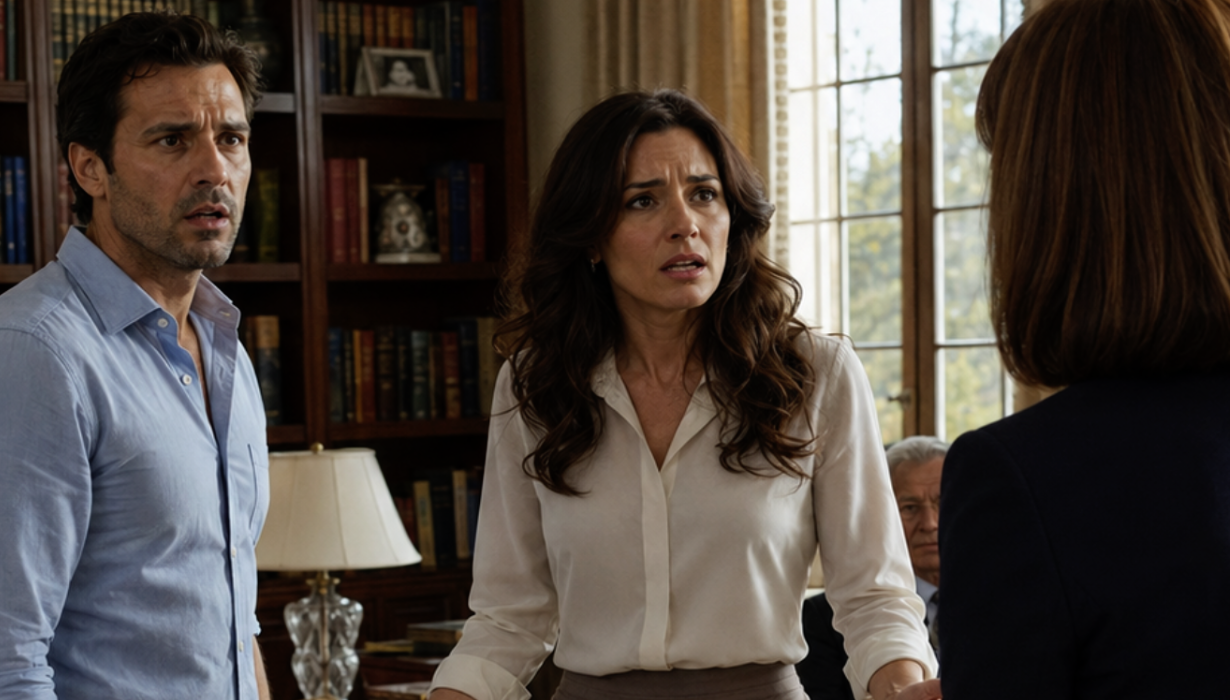
The shock on their faces was absolute. Diane let out a sharp gasp. Kelsey stumbled backward. Bradley looked as if he were staring at a ghost.
“How—” Bradley stammered.
“I live here, Bradley,” I said, my voice echoing with icy calm in the sweltering room. “Nothing in this house opens without my permission for long.”
Bradley desperately clung to his collapsing narrative. He turned to the man in the suit. “Sir, please. My wife is unwell. She’s having an episode. We had to secure her for her own safety—”
“Do not touch me,” I commanded, as Diane reached out to grab my arm with fake maternal concern. My tone sliced through the room. “Not in my house. Not while you are standing in the middle of a felony.”
I walked to the coffee table and dropped my manila file next to the forged blue folder.
“This estate is not Bradley’s to leverage,” I explained, looking directly at the executive. “Three months before my wedding, I transferred the title and associated investment holdings into an irrevocable trust. I am the managing trustee. The papers in that blue folder were forged by his mistress after they locked me in the cellar.”
Bradley collapsed onto the sofa, the oxygen leaving his lungs. “Your name was on the deed…”
“Nine years ago,” I replied. I had let him believe his own assumptions because he lacked the fundamental diligence to read the legal disclosures he signed.
The man in the suit calmly set down the forged documents. He reached into his jacket and produced a gold badge.
“My name is Special Agent Thomas Henderson,” he stated, his voice like iron. “Federal Bureau of Investigation. Financial Crimes.”
The silence that followed was total and devastating.
I had known about Bradley’s embezzlement for weeks. Instead of crying or confronting him, I had systematically compiled every piece of evidence—the shell accounts, the clumsy code words—and handed it to the FBI.
The front door swung wide, and local police officers flooded the foyer. Kelsey attempted to flee, slipping on her own forged paperwork and crashing to the floor before an officer hauled her up and cuffed her. Diane wailed, begging the officers to spare her son, chanting the eternal anthem of enablers: He just needed time. He’s a good man.
Bradley stood trembling in the center of the room. When the handcuffs clicked around his wrists, the illusion of the visionary founder evaporated, leaving only a terrified, pathetic man.
“Please,” Bradley begged, looking at me with wide, desperate eyes. “Don’t do this in front of Leo.”
“You already did,” I replied softly.
Before the police could march them out, I pointed to the living room sofa. “Officer, behind that sofa is a canvas bag containing my stolen vintage jewelry and heirlooms. My cameras recorded Jamal Carter forcing open my safe twenty minutes ago.”
Jamal was thrown to the floor, handcuffed, and dragged out cursing, his pawn-shop empire of stolen goods destined for a massive federal audit.
The driveway eventually cleared of flashing lights and police cruisers, leaving only Diane trembling on my front porch. She furiously smoothed her cashmere sweater, threatening to hire the best lawyers by mortgaging her luxury condo.
“That would be difficult,” I noted, leaning against the doorframe. “Bradley never bought you that condo. My corporation leased it. I canceled the lease, paid the termination penalty, and had the locks changed at noon today. Your belongings are in a storage unit.”
Diane stared at me, the social foundation of her life collapsing under the weight of reality. She sank onto the front steps and wept. I did not step over her; I stepped around her and quietly closed my heavy oak door.
The machinery of consequence operated with brutal efficiency. Bradley and Kelsey were denied bail, facing airtight federal fraud charges. Jamal’s pawn shop was raided. Diane and Rebecca ended up sharing a miserable, drafty apartment, relegated to low-wage shift work as their country-club friends abandoned them overnight.
I filed for divorce the very next morning. It was a clean, clinical severing. Justice, I had learned, does not require a dramatic performance; it requires absolute, unyielding follow-through.
The house, bruised by the chaos, slowly healed. I replaced the shattered doors and repainted the cellar stairwell. The speakeasy vault remained, but its purpose shifted. It was no longer a bunker of fear. We filled it with board games, blankets, and an old record player. To Leo, it became our private, magical library.
My historic appraisal business expanded rapidly. The wealthy suburbs gossip efficiently, and the underlying message was clear: Natalie Caldwell knows property, strategy, and exactly how to destroy anyone who attempts to corner her.
Months later, on a warm spring evening, Leo and I sat in the hidden vault, eating pizza on paper plates. The amber light caught the soft, relaxed lines of his face. The nightmares had stopped. The fear was gone.
“I like it better now,” Leo mumbled around a slice of pepperoni. “It doesn’t feel like hiding.”
“No, it doesn’t,” I agreed.
“Are they ever coming back?” he asked, circling the trauma the way children do before finally letting it go.
“No,” I promised him, smoothing his hair. “Because this house belongs to the people who protect it. And that means us.”
Later that night, after tucking him into bed, I returned to the vault alone. I ran my hand over the antique mahogany bar, reflecting on the long, quiet war I had won.
You can restore a century-old house to perfection and still mistakenly marry a fraud. You can understand load-bearing stone and still miss the fatal structural flaws in a smiling man. But the reverse is equally true: you can be deceived, cornered, and locked in the dark, yet still possess one hidden door.
Bradley and his family had mistaken my patience for weakness. They had mistaken my quiet competence for submission. They learned, far too late, that a woman who understands the exact value of everything she has built is the most dangerous person in the world to back into a corner.
I turned off the amber lights, walked upstairs, and finally climbed into a bed that belonged only to peace.
\