My name is Irene Ulette. I am thirty-two years old, and five years ago, my parents systematically excised me from their lives. The severing was not the result of a profound moral failure on my part, nor was it the tragic consequence of an insurmountable ideological divide. I was cut off because my older sister, Monica, told them I had dropped out of medical school.
She wove a tapestry of calculated fictions. She claimed I had quit out of sheer incompetence. She insisted I was lying to cover my tracks, that there was a volatile man involved, and that my subsequent silence was born of crippling shame. She fed them exactly enough venom to turn their affections entirely cold. In response, my parents fortified their emotional borders. They blocked my phone number. They sent my meticulously detailed emails straight to the trash. They absented themselves from my residency graduation and were conspicuously missing from my wedding. For half a decade, I operated under the assumption that I was an orphan in all but biology, sustained only by a single aunt who vehemently refused to let my existence be scrubbed from the family record.
Then, on a bitterly icy Thursday morning in January, the universe delivered a reckoning. My sister was rushed into the emergency room of the exact hospital where I serve as the chief of trauma surgery.
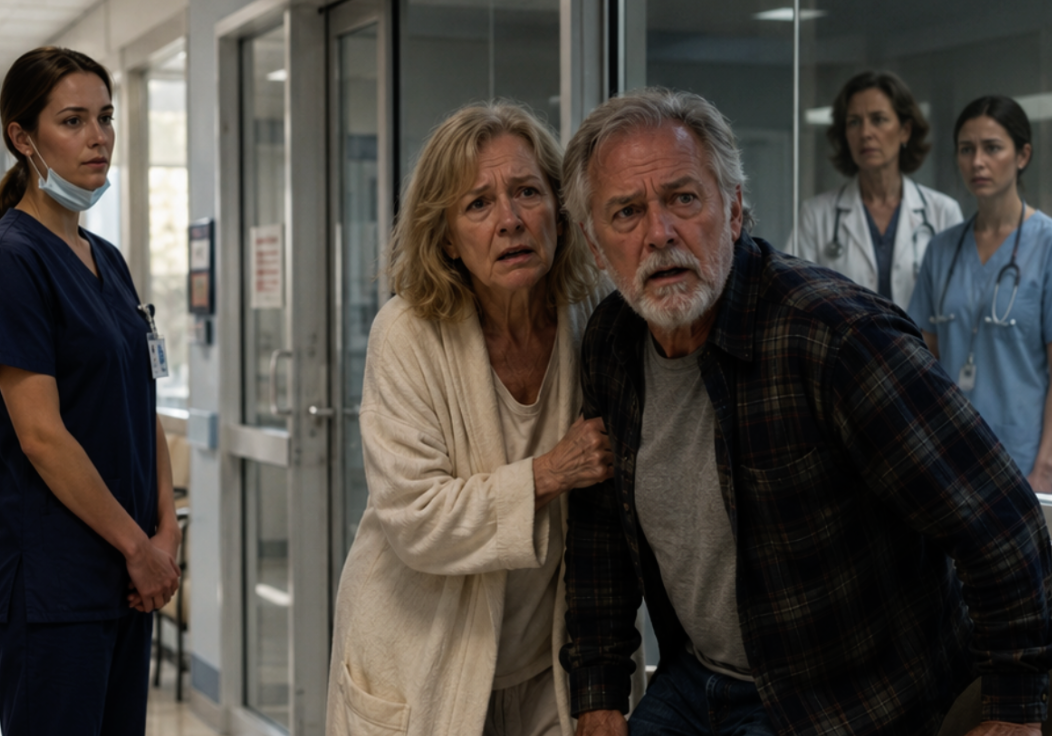
She was hemorrhaging internally after a catastrophic single-vehicle collision. The trauma team scrambled, immediately paging the attending surgeon on call. The heavy, sterile doors of the operating room hissed open. When my mother, frantic and unmoored in the waiting area, looked up and saw the name deeply embroidered over the white coat striding purposefully toward her bleeding daughter’s stretcher, she gripped my father’s arm with such terrifying force that it left dark bruises on his skin.
That was the precise moment the lie finally ran out of shadows to hide in.
To comprehend why that singular moment in the hospital corridor carried the weight of a tectonic shift, one must first understand the psychological architecture of the house I grew up in.
We lived in Hartford, Connecticut, occupying a narrow, impeccably maintained two-story colonial at the end of a suburban street where appearances were the primary currency. My father, Jerry Ulette, managed a manufacturing plant with a rigid, unyielding mindset. My mother, Diane, worked part-time as a bookkeeper but spent the vast majority of her waking life attempting to maintain a fragile peace in a household that understood nothing but hierarchy.
In that hierarchy, there were two daughters, and our roles were assigned early and permanently.
Monica, three years my senior, possessed a gravitational pull. From the moment she could articulate a sentence, she understood exactly how to make a room lean toward her. She was undeniably bright, relentlessly polished, and possessed a specific brand of performative humor that utterly charmed adults. She could command my grandmother’s crowded kitchen, effortlessly balancing a paper plate while making every aunt roar with laughter. I, conversely, would be relegated to the corner of the table, quietly peeling the paper label off a water bottle, perpetually wishing someone would ask me a question that required a nuanced answer rather than a simple nod.
Monica recognized a fundamental truth about our family dynamic long before I did: charm could successfully masquerade as character, provided the delivery was neat enough. She was a master of optical loyalty. She remembered the birthdays, penned the eloquent thank-you notes, and always made the highly visible phone calls to ask my mother if she needed anything from the grocery store. More dangerously, she was the daughter who possessed the uncanny ability to take an objective truth, pivot it just a fraction of an inch to the left, and manipulate it into something entirely self-serving.
I was simply the quiet one.
I was not rebellious, I was not difficult, and I generated no dramatic friction. I gravitated toward the empirical world. I loved biology. I sought comfort in order. I found profound solace in the absolute certainty that the human body made logical sense, even when the human mind—and the people around me—did not.
The distinction between being passively forgotten and never being fully seen in the first place is a harsh lesson to learn in childhood. While Monica was the undisputed star of community theater productions and the darling of the student council, I was the girl anchored at the far end of the Thanksgiving table, burying my face in an advanced science textbook so it would
That was the immutable pattern of the Ulette household. Monica was the main event; I was merely a footnote. I convinced myself that external achievement was a cleaner, safer substitute for parental affection. I committed myself to a singular, private religion: one day, I would construct a life so undeniable that they would be entirely incapable of dismissing me.
For one brief, glittering, and ultimately deceptive moment, it seemed I had achieved exactly that.
At eighteen, I received my acceptance letter to the highly competitive medical program at Oregon Health and Science University. When my father opened that envelope, he read the words slowly, as if tasting an unfamiliar delicacy. “That’s a real medical school,” he remarked, offering a rare, piercing look of genuine appraisal. “Maybe you’ll make something of yourself after all.” It was a sharp, ungenerous sentiment, but it was the closest approximation of pride I had ever extracted from him, and I inhaled it like oxygen.
The spotlight, for the first time in our collective history, had abruptly shifted.
Suddenly, Monica began calling me with alarming frequency. She feigned deep investment in my life, extracting the minutiae of my daily routines, my class schedules, and the names of my professors. I foolishly believed that the maturity of adulthood had finally leveled the playing field, that my tangible success had made me legible to my sister. In reality, I was unwittingly feeding a surveillance machine. I was handing her the exact raw materials—names, dates, vulnerabilities—that she would later weaponize to dismantle my reputation.
Medical school systematically stripped life down to its barest essentials: severe sleep deprivation, relentless anatomy exams, aggressive caffeine consumption, and a low-grade, permanent panic. But it also provided me with the first genuine connection of my life in the form of Sarah Mitchell.
Sarah was a former foster youth with an acid-sharp wit and a profound emotional intelligence that made family pretense seem utterly ridiculous. She became my roommate, my closest confidante, and my anchor. When, during our third year, she was abruptly diagnosed with aggressive, stage-four pancreatic cancer, the absolute devastation was compounded by her total lack of a support system. She had no family to rush to her bedside. She only had me.
I immediately went to the medical school dean, explained the harrowing circumstances, and filed formal paperwork for a temporary leave of absence to serve as Sarah’s primary caregiver. My academic spot was securely held; the paperwork was meticulous and fully approved.
In a moment of profound vulnerability, I called Monica and explained everything. I told her about Sarah’s diagnosis, the formal leave, and my planned return for the spring semester. Her voice dripped with practiced sympathy, promising absolute discretion.
Three days later, my father called me at the hospital. His voice was a flat, terrifying void.
“Your sister told us everything,” he stated, the words dropping like lead weights. “The dropping out. The lies. The boyfriend. All of it. Monica showed us the proof.”
The reality of the situation fractured around me. Despite my desperate pleas, despite my offers to send the official documentation from the dean, my parents refused to listen. They had been presented with a narrative that perfectly validated their lifelong biases. The call lasted exactly four minutes and twelve seconds.
That is precisely how long it took for my parents to erase twenty-four years of my existence. I did not disappear quietly into the Pacific Northwest ether. I fought with the ferocity of a woman drowning. I called fourteen times. I sent detailed, heavily documented emails outlining the truth. I mailed a handwritten letter via priority post. Every single attempt was met with a deafening silence, culminating in my letter being returned unopened, inscribed with “Return to Sender” in my own mother’s handwriting.
My aunt Ruth, the sole dissenting voice in the family, attempted an intervention, only to be firmly ordered by my father to stay out of a bed I had supposedly made for myself. On the sixth day, the horrifying epiphany solidified: I could spend the rest of my finite life battering my hands bloody against a permanently locked door, or I could turn around and construct a formidable door of my own.
When Sarah passed away that December, I arranged a stark, sparsely populated funeral. Returning to our quiet apartment, enveloped in the lingering scent of her hospital lotion, I found a yellow sticky note carefully hidden inside her battered anatomy textbook.
“Finish what you started, Irene. Become the doctor I know you are. And do not let anyone, especially your own blood, tell you who you are.”
I reenrolled. I graduated on time. No one from Hartford attended the ceremony, save for Aunt Ruth, who wept openly while clutching a bouquet of grocery store flowers. I matched into a grueling surgical residency back in Connecticut at Mercy Crest Medical Center, deliberately choosing proximity not out of a lingering desire for reconciliation, but out of a fierce need for unshakeable solidity.
It was there I met Dr. Margaret Thornton, a brilliant, emotionally stoic mentor who taught me how to command authority without unnecessary apology. It was also there I met Nathan Caldwell, a civil rights attorney who listened to the sprawling, ugly history of my family’s betrayal and offered only four words of absolute validation: “You deserved better.” We married in a small, joyful backyard ceremony. The invitation I stubbornly mailed to my parents was, predictably, returned unopened.
For years, Monica meticulously maintained the sprawling estate of her deception. To sustain her fiction, she cultivated an elaborate taxonomy of lies tailored to her audience:
She even went so far as to make anonymous, fraudulent inquiries to hospital administration regarding my medical licensure, desperately hunting for any scrap of professional failure to legitimize her personal fiction.
By the age of thirty-two, however, her desperate machinations were entirely irrelevant to my reality. I was the Chief of Trauma Surgery at Mercy Crest. I had a husband I adored, a deeply fulfilling career, and a quiet, beautiful life.
Then came the page at 3:07 AM on that freezing January Thursday.
When Monica was wheeled into the trauma bay, crushed and bleeding out, the ethical dilemma was instantaneous, but the medical imperative superseded it. I was the most experienced surgeon in the building. I disclosed the familial conflict to my team, documented it rigorously, and scrubbed in.
To understand the magnitude of that night, one must examine the stark contrast between medical reality and familial delusion. The operating room permits no fictionsWhen the final suture was placed and Monica was stabilized, I stripped off my bloody gloves. I walked into the hushed, fluorescent waiting room, still wearing my surgical scrubs, my security badge prominently displaying Dr. Irene Ulette, Chief of Trauma Surgery.
My father’s reaction was a study in structural collapse. He saw my face, read the badge, and the rigid certainties of the past five years instantly dissolved into a gray, horrifying confusion. My mother gasped, a sound of pure, unadulterated shock.
“We thought you dropped out,” she wept, her voice cracking under the weight of a half-decade of misplaced grief.
“None of that was true,” I replied, my voice steady, devoid of malice but stripped of all comfort. “Not one word. I sent emails. I attached paperwork. I called fourteen times. You returned my letter unopened.”
My father, reverting to muscle memory, attempted to shut down the conversation, claiming it was neither the time nor the place. I looked directly at the man who had exiled me and delivered the final, undeniable truth: “I know where your daughter is. I just spent three hours and forty minutes keeping her alive. The truth did not become inconvenient just because you aggressively ignored it for five years.”
The aftermath was neither cinematic nor entirely clean. Healing rarely is.
When Monica awoke in the ICU and beheld the reality of my badge and my presence, the facade she had spent her adult life fortifying crumbled completely. She eventually confessed the ugly, simple truth: she destroyed my reputation because my tangible success threatened the fragile ecosystem where she was the undisputed star.
I demanded absolute, structural accountability. I forced Monica to send a detailed, strictly factual email to forty-seven family members, explicitly retracting every lie, confirming my academic success, and admitting her malicious interference. The social currency she had hoarded for a lifetime evaporated overnight. The family did not excommunicate her; they simply stopped believing a single word she said. For Monica, that was a punishment far more devastating than anger.
My parents, faced with the undeniable wreckage of their own complicity, entered intensive family counseling. My mother had to confront the reality that her desperate need to “keep the peace” was merely a cowardly endorsement of injustice. My father had to dismantle his monumental pride, accepting that while Monica laid the bricks of the lie, his own stubborn arrogance had poured the concrete foundation.
A month later, at the hospital’s annual gala, I was awarded Physician of the Year. Standing at the podium, looking out over the sea of medical professionals who had chosen me, I saw my parents sitting quietly in the very back row. They were not there to claim my victory; they were there, finally, to witness it.
The most profound shift occurred on a quiet, snowy Sunday morning in February. The doorbell rang, and my parents stood on my porch, looking uncertain, holding a carton of orange juice and a tin of shortbread cookies. There was no grand, sweeping monologue. There was only my father, stepping into my kitchen, looking around the life I had built from the ashes of their rejection, and asking, “Can I help with anything?”
I pointed to the cabinet. “You can set the table.”
He carefully extracted the plates. He looked at me, his eyes heavy with the terrifying weight of ordinary repair, and asked, “Four?”
“Four.”
Forgiveness, I have learned, is not an act of collective amnesia. It is not pretending the house never burned to the ground. Forgiveness is standing in the ashes, possessing the full, searing memory of the fire, and slowly deciding whether you are willing to let the arsonists help carry the lumber for the rebuild.
My name is Dr. Irene Ulette. I am a surgeon, a wife, and a woman who learned the hard way that truth is an immovable object. And slowly, carefully, one plate at a time, I am learning how to let them be my parents again. Not because they demanded it, but because I finally hold the keys to the door.