The upscale Napa wine bar smelled heavily of aged oak, overpriced Pinot Noir, and suffocating deception. I sat across from my husband, Reed, whose hands were folded on the table like a man in deep, earnest prayer. His voice was soft, carrying a tender cadence that masked the venom of his words. He was urging me, for what felt like the hundredth time, to sell Ashford Vineyard. He offered me eight-and-a-half million reasons to walk away from my late father’s legacy, painting a picture of a carefree life on the coast, untethered from the relentless demands of harvest seasons and payrolls.
Across the table, my half-brother Sterling watched me with the sharp, unblinking focus of a predator. Sterling had burned through his own five-hundred-thousand-dollar inheritance in less than two years, a victim of bad investments and a catastrophic cryptocurrency crash. Now, he was desperate, broke, and eager for me to liquidate the estate so he could beg for a cut. Despite their coordinated pressure, I refused. Ashford Vineyard was not just rolling hills and ancient vines; it was the physical manifestation of my father’s love, built from the ground up after my mother’s death.
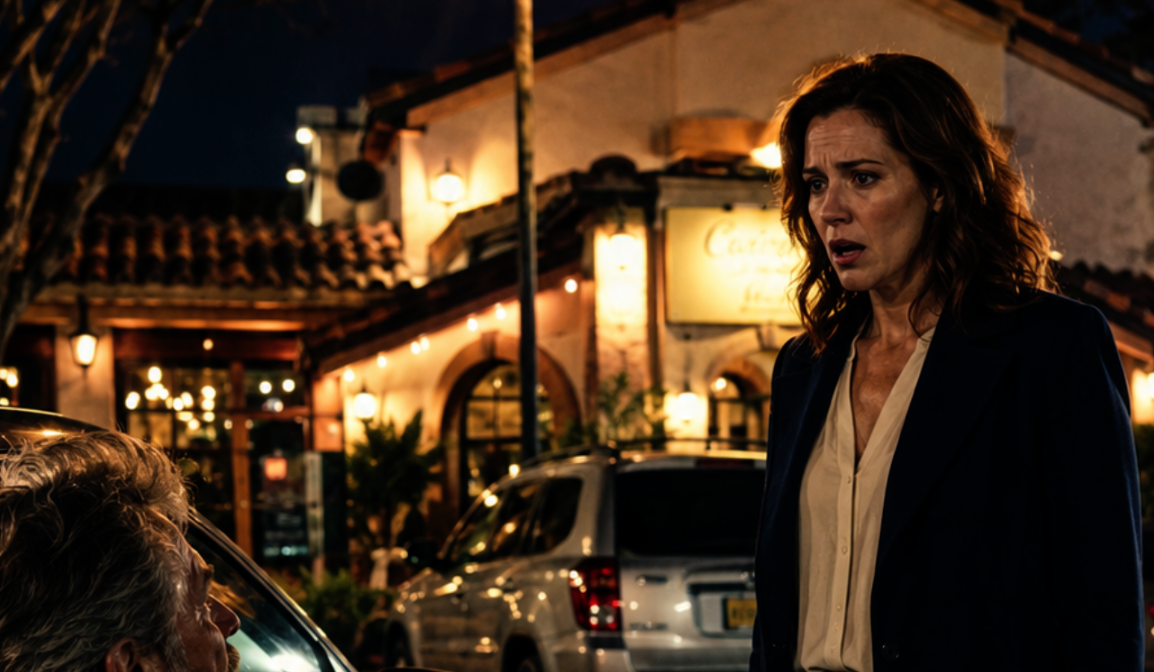
Suffocating under their unified front, I abruptly excused myself to get some air. The October night outside was sharp and cool, carrying the faint scent of eucalyptus. I navigated the poorly lit parking lot toward my dusty blue Subaru, seeking the sanctuary of the shadows. But the shadows were already occupied. A tall, weathered man in a faded denim jacket stepped into the dim yellow glow of a flickering street lamp. He raised his hands defensively, his face lined with deep creases of exhaustion and regret. He introduced himself as Eddie.
He didn’t demand my purse or my keys. Instead, he placed a small, polished walnut box onto the hood of my car and delivered a warning that effectively ended my life as I knew it. “Your husband is planning to kill you,” he whispered, his voice trembling with a terrifying certainty. He instructed me to open the box only when I was completely alone, to trust no one, and then he vanished back into the night, leaving me to grapple with the impossible.
Paranoia gripped me like a vice during the dark, winding drive back to the estate. I constantly checked my rearview mirror, imagining black sedans tailing me through the endless vineyards. Once inside my white Victorian home, I bolted the doors, turned on every single light to banish the creeping shadows, and finally opened the walnut box.
Inside the velvet-lined compartment lay a gold wedding band—Reed’s ring, engraved with our initials—a micro SD card, and a tightly folded letter written in cramped, desperate handwriting. The letter was a full confession from Eddie Caruso, who revealed himself to be Reed’s estranged, recovering alcoholic father. Eddie had been quietly working as an invisible handyman on the vineyard, desperately hoping to slowly rebuild a relationship with his son. Instead, he had become the silent witness to a monster.
The letter detailed a horrific night in September 2022. Eddie had hidden behind the oak barrels in the wine cellar and watched as Reed and Sterling brutally beat a young vineyard worker named Daniel Reyes to death with a crowbar. Daniel, a father to a two-year-old girl, had begged for his life, but Reed had struck him down without mercy. For two long years, Eddie had secretly collected audio recordings and videos, paralyzed by the fear of condemning his own son to life in prison. But his final discovery forced his hand: Reed had finalized a plot to murder me in a staged car accident to inherit the vineyard, collect three million dollars in life insurance, and sell the estate to a Russian operative named Nikolai Soalof.
Trembling uncontrollably, I plugged the SD card into my laptop. The grainy videos confirmed every sickening word. I watched my husband casually discuss cutting my Subaru’s brake lines on Highway 29, scheduling my execution for the very next night. In a separate video, Eddie provided crucial instructions: I had to enter the wine cellar at exactly 11:47 p.m., exploiting a three-minute blind spot in the security camera feed.
Racing against the clock, I descended into the freezing, damp cellar. Following Eddie’s exact directions, I located a dusty bottle of 1996 Chateau Margaux in row seven and twisted it three times. A heavy, mechanical grinding echoed through the room as a solid stone wall slid open, revealing a dark, prohibition-era tunnel.
The tunnel smelled sharply of chemical solvents and damp earth. It opened into a massive, vaulted underground chamber that housed an industrial offset printing press. Beside the gleaming machinery sat towering pallets of specialized cotton-linen paper and shrink-wrapped bundles of fake one-hundred-dollar bills. A meticulously kept ledger on a metal desk detailed the horrifying scope of the operation: forty-seven million dollars in counterfeit currency produced for Nikolai Soalof over the past thirty-six months, with an impending two-hundred-million-dollar shipment scheduled to leave the Oakland Port in just four days.
I was frantically photographing the ledger when the muffled sound of approaching footsteps echoed through the chamber. Panic surged through my veins. I dragged a heavy wooden crate beneath a rusted air duct, hoisted myself up, and squeezed into the cramped, icy metal shaft just as Reed and Sterling entered the room below.
Pressing myself flat, terrified that the erratic hammering of my heart would give me away, I listened to my husband finalize my death sentence. Reed coolly explained to Sterling that since I stubbornly refused to sell the land, I had to be eliminated, exactly as they had eliminated Daniel Reyes. He planned to invite me for a conciliatory drive the following evening, ensuring my brakes would completely fail at a steep drop-off on Highway 29. After my funeral, he would sell the property, pocket millions, and flee to a non-extradition country with Marlo, his lawyer and secret lover.
Once they vacated the chamber, I crawled out of the duct, fled the cellar, and barricaded myself in my bedroom. I immediately dialed the number Eddie had provided for FBI Agent Sawyer Reed. Her voice was a steady anchor in the swirling chaos of my nightmare. Eddie had contacted the FBI weeks prior, but they desperately needed an inside witness to definitively tie Reed to the operation.
The next morning, I drove to the FBI field office in San Francisco. Agent Reed and her tech specialist, Logan, secured the SD card, confirming they had enough evidence to indict. But as the day unfolded, the true depth of the betrayal surrounding me was laid bare.
My half-sister, Quinn, reached out in a panic and was intercepted by federal agents. In an interrogation room, she broke down in tears, confessing that she owed Reed a massive, fraudulent loan. Reed had ruthlessly blackmailed her with threats of federal prison, forcing her to spy on my every move for the past two years. Recognizing she was both a victim and an accomplice, Quinn signed a federal cooperation agreement to testify against him.
The revelations grew even more devastating. During a secure video call with my father’s original estate attorney in New York, I learned that my father’s true will had originally left forty percent of the vineyard to St. Jude Children’s Research Hospital, honoring the memory of my late stepmother. Marlo, Reed’s calculating lawyer and lover, had deliberately forged the probate documents to leave the entire estate to me. The motive was purely logistical: a charitable beneficiary like St. Jude would have immediately mandated a rigorous financial and physical audit of the vineyard—an audit that would have instantly exposed the massive counterfeiting press hidden beneath the tasting room.
Furthermore, the FBI uncovered the final piece of the corrupt puzzle: Detective Warren Hayes, Marlo’s husband, was the very officer who had investigated Daniel Reyes’s death. Hayes had hastily ruled the brutal murder a simple workplace accident. Financial forensics revealed that Hayes had received eighty-seven thousand dollars in offshore bribes from Soalof’s shell companies. The true leverage, however, was his teenage daughter, whose serious federal drug charges had miraculously vanished from the police evidence locker, courtesy of Soalof’s dark influence.
We meticulously set the trap. At eight o’clock that evening, I walked back down into the wine cellar, wired with a hidden micro-transmitter and a panic button strapped to my wrist. Outside the estate, twelve heavily armed FBI agents waited silently in the darkness. Deep inside the hidden tunnel, Eddie waited in the shadows.
Reed, Sterling, and Marlo descended the stairs together, carrying the fraudulent sale documents they desperately needed me to sign before executing my “accident.” I picked up the pen, my hands shaking violently, but I didn’t sign the paper. Instead, I looked Reed directly in the eye and asked him why he murdered Daniel Reyes.
The cellar froze. I revealed that I knew everything—the counterfeit money, Soalof, and the severed brake lines on my car. Reed’s charming facade instantly shattered. He reached into his tailored jacket and pulled out a Glock 19, aiming it squarely at my chest. But before his finger could tighten on the trigger, the secret stone wall ground open. Eddie stepped into the light, leveling a double-barreled shotgun directly at his own son.
“Put the gun down,” Eddie commanded, his voice heavy with years of profound regret and unyielding resolve.
Before Reed could fully process his estranged father’s sudden appearance, the cellar exploded with blinding light and deafening sound. FBI agents swarmed the room from every entrance, red laser sights locking onto the three conspirators. Recognizing he was vastly outgunned, Reed dropped his weapon and fell to his knees. Agents swiftly cuffed Reed, Sterling, and Marlo, dragging them up the stairs. Eddie lowered his shotgun and wrapped his arms around me as I finally allowed myself to shatter.
But the nightmare wasn’t over. As Reed was forcefully loaded into an armored transport van in the driveway, the ground beneath our feet violently shook. A massive fireball erupted from the wine cellar, shooting fifty feet into the night sky. The concussive shockwave knocked us flat against the gravel. Nikolai Soalof had triggered a remote detonator, obliterating the underground chamber, the printing press, and all the physical evidence of his counterfeiting empire.
Terrified by the sheer force of the blast and the reality of his situation, Sterling completely broke. Sobbing uncontrollably in his handcuffs, he screamed out Soalof’s exact location: Oakland Port, Dock 47. A two-hundred-million-dollar counterfeit shipment was actively being loaded onto a Russian cargo ship, scheduled to depart international waters at 10:30 p.m.
A massive convoy of FBI vehicles and Coast Guard cutters mobilized instantly. I rode in the back of Agent Reed’s speeding SUV as we tore down the highway toward the bay. We arrived at Dock 47 to find Soalof standing arrogantly beneath a suspended shipping container, surrounded by heavily armed mercenaries. As fifty federal agents surrounded the dock and sniper helicopters illuminated the area from above, Soalof realized he was cornered and calmly surrendered.
However, his fanatical second-in-command raised a C4 detonator, ready to blow the entire dock and everyone on it to pieces. A single, sharp crack echoed from a sniper rifle in the helicopter above. The mercenary’s hand was instantly shattered, sending the detonator tumbling harmlessly into the dark waters of the bay. Soalof and his men were arrested, and agents secured two thousand boxes packed tightly with shrink-wrapped, counterfeit hundred-dollar bills.
Five agonizing months later, the federal courthouse in San Francisco was filled to absolute capacity. I stood at the podium, delivering my victim impact statement while Daniel Reyes’s grieving widow and young daughter watched from the front row. I looked directly at the man who had promised to love and protect me, demanding unyielding justice for the lives he had so callously destroyed.
Judge Patricia Novak delivered the sentences with a cold, righteous finality. Reed Clark and Nikolai Soalof received life in federal prison without the possibility of parole. Sterling was sentenced to thirty years, Marlo to twenty-five, and the corrupt Detective Warren Hayes to eighteen. Quinn, due to her vital cooperation, received a reduced sentence of six years. Furthermore, the judge ordered that the two hundred million dollars in seized counterfeit currency, along with the millions generated from the vineyard’s valuation, be legally liquidated and turned over to St. Jude Children’s Research Hospital, finally honoring my father’s true, uncorrupted will.Rebirth and Redemption
A month later, the probate court officially validated my father’s original will. During an emotional video call with St. Jude’s director of development, I learned that my father’s legacy would fully fund a state-of-the-art Pediatric Cancer Research Center. Even more profoundly, a dedicated memorial fund had been established in Daniel Reyes’s name, having already raised over two million dollars to provide life-saving treatments for children battling cancer. Daniel’s widow expressed her deep gratitude, finding solace in the fact that her husband’s immense courage and ultimate sacrifice were actively saving innocent lives.
By December of 2025, Ashford Vineyard had been magnificently reborn. The smoking, hollowed crater of the old wine cellar was replaced by a beautiful, expansive two-story structure featuring a Prohibition History Archive and a modern, secure wine vault. We constructed the “Daniel’s Legacy Tasting Room,” a bright, welcoming space with towering glass walls and exposed wood, dominated by a smiling, joyful photograph of Daniel Reyes. Outside the tasting room, we planted a young coastal redwood tree in his memory, a living, breathing monument to his bravery that would stand for centuries.
Eddie, now proudly eleven years sober, stood beside me on the sweeping porch of the main house on Christmas Eve. He poured us two generous glasses of the 1996 Chateau Margaux—the very bottle that had unlocked the terrible truth, which the FBI had returned to us upon the closure of the case. We raised our glasses, toasting to Daniel, to my father, to justice, and to the beauty of second chances.
Betrayal within a family is a devastating wound that cuts far deeper than any blade wielded by a stranger. It is a toxic poison that tempts you toward the dark path of revenge, an urge that burns fiercely when the ones you trusted most choose unfettered greed over unconditional love. But pursuing that vengeance would have only destroyed whatever fragments were left of my soul. Instead, I chose the path of justice. I chose to rebuild. Forgiveness does not mean forgetting the horrific actions of the past; it means fiercely refusing to let that resentment consume your future. My husband tried to violently steal my life and my father’s legacy, but he could never steal my resilience. As I stood there, watching the warm Christmas lights glow against the crisp winter sky and the young redwood gently swaying in the breeze, I finally knew with absolute certainty that the darkness had passed.