Mom’s text arrived at precisely 9:47 a.m. on a brisk Tuesday morning, exactly three weeks before the Thanksgiving holiday.
Thanksgiving is strictly off-limits. Rachel’s future mother-in-law is the Chief of Medicine at Presbyterian. You would completely embarrass her.
I stared at the glowing screen of my phone for a long, quiet moment. I was standing in the heart of my research lab at the Columbia Medical Center, having just finished examining a fresh batch of fragile tissue samples under the high-resolution electron microscope. All around me, the steady, rhythmic hum of scientific progress filled the sterile air. My dedicated team of twelve researchers worked meticulously, analyzing the dense packets of data from our latest clinical trial. The breakthrough we had finally achieved in regenerative cardiology was not merely an incremental step; it was a paradigm shift that was going to fundamentally alter how the global medical community treated severe heart disease. The New England Journal of Medicine had already aggressively fast-tracked our comprehensive paper for publication in their upcoming January issue.
I typed back a single, unbothered word. Okay.
Almost immediately, my phone vibrated with a frantic message from my older sister, Rachel.
Thank God you’re being reasonable for once. Dr. Catherine Morrison is a huge deal. She runs the entire cardiac department at Presbyterian—she is David’s mother. I cannot have you there asking stupid questions about medicine or whatever.
I slowly lifted my gaze from the aluminum device to the heavy, framed credentials dominating the wall of my office. They told a vivid story my family had willfully chosen to ignore: a Doctor of Medicine from Johns Hopkins University, a Ph.D. in molecular biology from Stanford, board certification in the complex field of cardiology, seven grueling years of residency and fellowship, and fourteen expansive papers published in the world’s most prestigious, peer-reviewed medical journals.
I understand, I replied simply.
David and I are getting officially engaged at Thanksgiving. His mother is making the grand announcement. This is my moment, Sarah. I need absolutely everything to be perfect.
Congratulations.
Just stay home, watch football or something. Mom and Dad entirely agree it’s better this way.
I set the phone face down on the stainless steel counter and returned my total focus to the microscope. Through the complex array of specialized lenses, I could observe the thriving cardiac cells we had managed to regenerate using our novel, highly controversial stem cell protocol. These were cells that, according to every established medical textbook printed in the last century, simply should not exist. They were actively growing in glass petri dishes because my remarkable team had deciphered a biological puzzle that the rest of the scientific community had declared impossible.
My lead research assistant, Kevin, approached quietly, clutching a digital tablet to his chest. “Dr. Chin, the conference organizers just officially confirmed your presentation slot. November 26th, 2:00 p.m. in the Grand Ballroom. They are expecting an audience of over two thousand attendees.”
It was the American College of Cardiology’s annual research symposium, unequivocally the most prestigious, fiercely competitive gathering in our field. I had been formally invited to present our breakthrough findings on cardiac tissue regeneration. The distinguished keynote speaker, prominently listed on all the promotional materials, was none other than Dr. Catherine Morrison, Chief of Cardiac Medicine at Presbyterian Hospital, presenting on the future of interventional cardiology.
“Thank you, Kevin,” I murmured, my eyes still fixed on the cells. “Make sure the presentation slides reflect the absolute latest data from the Phase 2 trial results.”
“Already done,” he smiled brightly. “Dr. Morrison’s team actually cited your work extensively in their recent paper on minimally invasive procedures.”
“I saw that.”
“Have you met her?”
“Not yet.”
I had not bothered to mention to Kevin that the esteemed Dr. Catherine Morrison was on the verge of becoming my sister’s mother-in-law. Nor had I shared that my own family remained entirely oblivious to the fact that I was a doctor, let alone a pioneering researcher whose work was currently reshaping the very foundations of cardiac medicine. They had ceased asking about the realities of my life years ago, comfortable in the simple, uncompromising hierarchy they had artificially constructed. Rachel was the undisputed golden child; I was the complicated, difficult one.
Rachel had effortlessly glided down the expected, socially acceptable path. She earned a popular, undemanding college degree in communications and secured a lucrative job in pharmaceutical sales that required a vibrant, outgoing personality but minimal technical expertise. At thirty-one, she had dated a carefully curated succession of appropriate men boasting solid, wealthy careers and even better social connections. David Morrison was unequivocally her crowning achievement. At thirty-four, he was a high-powered investment banker at Goldman Sachs, commanding an $800,000 annual salary. He carried a distinguished family legacy at Princeton. His mother ran the cardiac medicine department at one of the nation’s preeminent hospitals, and his father was a senior partner at a formidable white-shoe law firm. The Morrison name functioned as a master key, effortlessly unlocking doors across Manhattan’s most elite and exclusive circles.
I, conversely, had taken an entirely different, far more demanding route. At eighteen, I had been accepted into Johns Hopkins for pre-med with a full, merit-based scholarship. When I mentioned medical school, my mother’s voice had wavered with palpable uncertainty. “That’s so many years, Sarah. What if you want to get married?”
I had gone anyway. The journey encompassed four relentless years of medical school, three exhausting years of internal medicine residency, and four rigorous years of cardiology fellowship. Alongside the crushing clinical demands, I continuously published research that eventually captured the focused attention of the National Institutes of Health. Now, at thirty-three, I served as an attending physician and the Director of Regenerative Cardiac Research at Columbia Medical Center. I was leading a brilliant team that had just successfully completed a clinical trial proving we could regenerate heavily damaged heart tissue using meticulously modified stem cells.
My parents had attended absolutely none of it. They were absent for my medical school graduation, absent for my residency completion, and absent for the prestigious awards ceremony where I accepted the Young Investigator Award from the American Heart Association. We saw the brief announcement in the university alumni magazine. My father had remarked once, “Very impressive, dear. Though we aren’t quite sure what it all means.”
Rachel had been far more direct. “You’re a doctor? Like, a real doctor?” She had sounded almost deeply offended by the revelation. “When did this happen?”
“Seven years ago when I finished residency.”
“And you never mentioned it.”
I had mentioned it dozens of times. They had simply never absorbed the information, far too singularly focused on Rachel’s latest wealthy boyfriend or her minor promotion to senior sales representative. Three years ago, I had purchased a historic brownstone on the Upper West Side for $4.2 million, paid in cash from my NIH grants, lucrative speaking fees, and specialized consulting work. I had mentioned the home at Christmas dinner. “That’s nice, dear,” my mother had deflected. “Rachel, tell us more about the condo David is looking at in Tribeca.”
I had stopped sharing entirely after that. My thriving practice at Columbia generated a very comfortable income—a clinical salary, compounded by deep research funding and consulting fees, pushing my annual earnings well over $700,000. But the vast financial reward was entirely beside the point. The point was the grueling, transformative work. The point was the fragile patients whose lives were forever changed because my team had achieved the impossible. Just last month, a sixty-three-year-old man suffering from severe, end-stage heart failure had walked comfortably out of the hospital after undergoing our experimental treatment. His critical ejection fraction had miraculously improved from twenty-two percent to forty-eight percent. He could climb stairs again; he could play with his young grandchildren. He had his life back.
That exact same week, Rachel had called to breathlessly tell me about the massive engagement ring David was designing for her. “Three carats, Sarah. Flawless. His mother knows the exclusive jeweler personally.”
November 26th arrived with a crisp, biting cold that perfectly cleared the New York sky. The American College of Cardiology symposium was held at the sprawling New York Hilton Midtown, merely eighteen blocks from my brownstone. I dressed with deliberate, uncompromising care that morning. I chose a sharp, authoritative navy blue suit from Theory, paired it with a soft cream silk blouse, and wore my professional Manolo Blahnik heels. I pulled my dark hair back into a severe, elegant French twist and fastened the delicate jade earrings my grandmother had gifted me shortly before she passed away. “Don’t let anyone make you small, Sarah,” she had told me the day she gave them to me. “Especially not family.”
The expansive symposium officially commenced at 8:00 a.m. I arrived purposefully early, collecting my heavy presenter credentials and meticulously reviewing the dense daily schedule. Dr. Morrison’s highly anticipated keynote address was slated for 10:00 a.m., while my own presentation was scheduled for 2:00 p.m. The organizers had thoughtfully placed me in the Grand Ballroom—the exact same massive venue hosting the keynote, a rare honor explicitly reserved for the conference’s most paradigm-shifting presentations.
At precisely 9:30 a.m., I secured a seat in the very front row of the cavernous Grand Ballroom. All around me, the space rapidly filled with an impressive array of top-tier cardiologists from across the country—esteemed department chairs, veteran researchers, and influential clinical directors. The ambient energy in the room was distinctly electric.
My phone briefly buzzed in my pocket. It was Rachel.
Having the absolute best Thanksgiving prep day. Catherine took me to her exclusive club for lunch. So elegant. She’s wearing Chanel. Mom is dying of jealousy.
I quietly silenced the device and tucked it away in my leather bag. At exactly 10:00 a.m., the main lights dimmed, and the low roar of conversation instantly hushed. Dr. Harold Chin, the respected President of the American College of Cardiology, approached the polished wooden podium.
“It is my distinct and profound honor to introduce our keynote speaker this morning,” he began, his voice echoing through the grand space. “Dr. Catherine Morrison has stood boldly at the very forefront of interventional cardiology for over two decades. As the Chief of Cardiac Medicine at Presbyterian Hospital, she oversees a massive department of eighty-three physicians and has personally pioneered numerous vital techniques in minimally invasive cardiac procedures. Please, join me in warmly welcoming Dr. Catherine Morrison.”
The sophisticated audience erupted in thunderous applause. I joined them, watching attentively as a tall, striking woman in her late fifties strode confidently onto the brightly lit stage. Her silver hair was cut in an uncompromisingly precise bob, and she wore a meticulously tailored black suit. She possessed a natural, commanding presence that instantly demanded complete, unwavering attention.
“Thank you,” Dr. Morrison said, her voice ringing out clear, steady, and supremely confident. “Today, I want to discuss the complex future of cardiac medicine. Specifically, I want to highlight the truly extraordinary, unprecedented developments in regenerative cardiology that are actively transforming how we approach severe heart disease.”
She fluidly clicked to her very first slide—a detailed, high-resolution diagram of standard cardiac tissue structure. “For decades, the accepted dogma in our field dictated that damaged cardiac tissue was a permanent, irreversible condition. A heart attack indiscriminately destroyed essential cells, left behind rigid scars, and drastically reduced overall heart function forever. We managed the subsequent symptoms, but we ultimately could not heal the underlying foundational damage.” She paused, letting the heavy silence hang in the room. “That long-held belief was entirely wrong.”
She clicked to the next slide. An enormous, brilliant microscopic image of beautifully regenerated cardiac cells filled the massive screen. My cells. Pulled directly from my laboratory research.
“Over the past three intensive years, breakthrough research has definitively demonstrated that we can, in fact, successfully regenerate highly functional cardiac tissue. The long-term implications are absolutely staggering.” She looked directly, fiercely out at the captivated audience. “I am deeply honored to present this groundbreaking, transformative work to you today. It is research conducted by one of the unequivocally brightest, most innovative minds working in our field.”
My resting heart rate increased slightly as my name flashed onto the screen behind her.
“Dr. Sarah Chin, an attending physician and the brilliant Director of Regenerative Cardiac Research at Columbia Medical Center, has meticulously developed a highly novel protocol utilizing modified stem cells to successfully regenerate severely damaged myocardium. Her Phase 2 clinical trial results demonstrate an astonishing forty-three percent improvement in the ejection fraction among patients suffering from severe, end-stage heart failure.”
A low, highly impressed murmur rippled organically through the vast sea of doctors.
“Dr. Chin’s relentless work is quite literally saving human lives,” Catherine continued warmly. “I am exceedingly pleased to officially announce today that Presbyterian Hospital will be heavily collaborating with Columbia Medical Center to rapidly expand this vital research, with Dr. Chin actively leading a massive multi-center trial. I strongly, urgently encourage every single one of you to attend her full presentation at 2:00 p.m. In fact, I believe Dr. Chin is sitting with us here right now. Sarah, would you kindly stand?”
Every single eye in that massive room abruptly turned toward the front row. I drew a steadying breath, stood up slowly, and turned gracefully to face the enormous audience. Two thousand of my accomplished peers looked back at me. The resulting applause was utterly deafening.
When I concluded my own extensive presentation that afternoon, the audience erupted in a deeply sustained, two-minute standing ovation. As I gracefully exited the stage, Catherine Morrison was patiently waiting in the wings.
“Brilliant,” she said simply, her eyes shining with genuine professional respect. “Absolutely brilliant. I desperately want to schedule a formal meeting next week to properly discuss the multi-center trial. And furthermore, I am hosting a lovely Thanksgiving dinner tomorrow evening at my home in Westchester. It’s a relatively small, intimate gathering—just close family and a few highly esteemed colleagues. My son, David, is officially getting engaged to a lovely young woman named Rachel Anderson. I would absolutely love to have you join us. We could easily continue this fascinating scientific discussion in a much more relaxed, comfortable setting.”
I stared at her, the sudden, crushing weight of the monumental coincidence washing over me. Rachel Anderson. My sister.
“I’ll be there,” I heard myself say calmly.
Thanksgiving evening arrived bathed in the golden glow of suburban streetlights. I arrived at Catherine Morrison’s sprawling Westchester estate at exactly 6:00 p.m. It was a stunning, immaculate colonial property situated on five acres of pristine land.
Catherine materialized in the grand hallway wearing a stunning, tailored cream pantsuit. “Sarah! I am so incredibly glad you could make it,” she greeted me warmly, taking my arm. “Come meet absolutely everyone.”
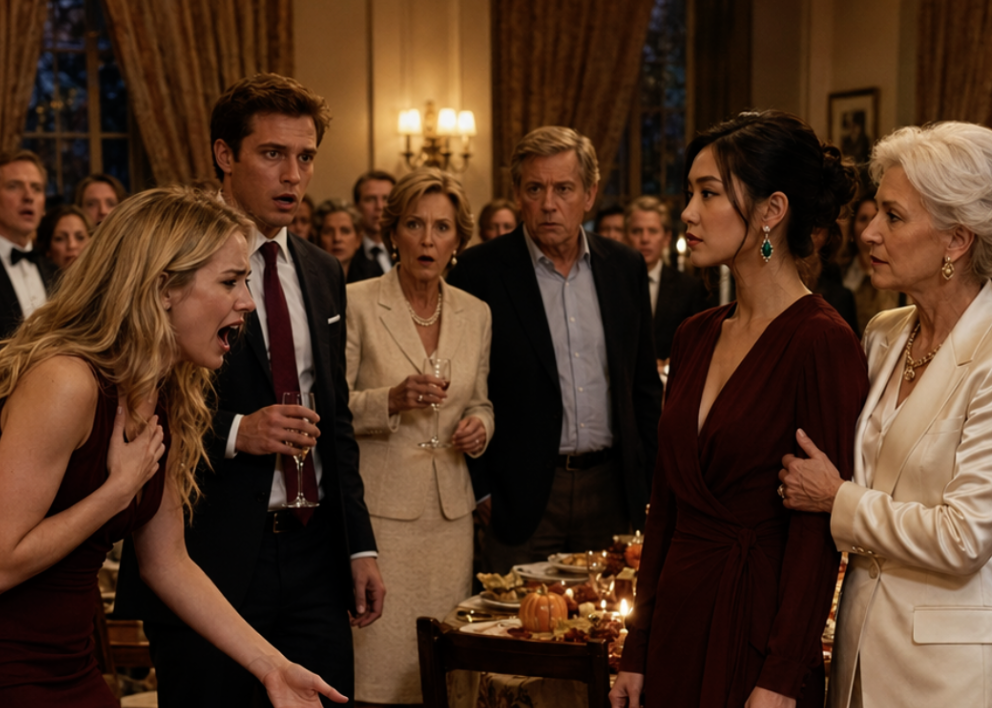
We entered a massive, lavishly decorated living room where approximately fifteen elegantly dressed people mingled. I spotted my family almost immediately. My mother and father stood awkwardly near the grand fireplace, while Rachel stood proudly across the expansive room in a tight red dress, her arm linked securely through David’s. None of them had noticed my quiet arrival yet.
“Everyone,” Catherine announced brightly, her clear voice easily cutting through the ambient chatter. “I would love to proudly introduce a very, very special guest this evening. This is Dr. Sarah Chin, the incredibly talented attending physician and Director of Regenerative Cardiac Research at Columbia Medical Center.”
The entire room naturally turned toward us. I quietly, intensely watched my family’s faces shift in rapid sequence. My father’s expression morphed instantly from polite confusion to startling recognition, and finally to absolute, paralyzing shock. My mother’s eyes widened comically, her delicate champagne flute freezing mid-air. Rachel went through a truly remarkable, painful transformation. Confusion. Recognition. Then, raw, unadulterated disbelief.
The expensive champagne glass violently slipped from Rachel’s trembling fingers. It shattered loudly against Catherine’s pristine hardwood floor, crystal fragments and golden liquid aggressively spreading across the polished wood.
The bustling room went completely, dead silent.
“Oh my god,” Rachel whispered horizontally. Then, louder, her voice high and distinctly panicked, “I’m so sorry. I’m so sorry. I will clean it up right now.”
“It’s perfectly fine,” Catherine said smoothly, gracefully gesturing to the hovering housekeeper. “Sarah, please, let me get you a fresh drink.”
As Catherine guided me steadily toward the opulent bar, David confidently approached us, extending his hand. “Dr. Chin, I’m David Morrison. My wonderful mother has been absolutely raving about your clinical research all day.”
Rachel suddenly appeared at his elbow, her face still shockingly pale. “This is… this is my sister.”
David’s handsome expression instantly went completely blank. “Your sister? Rachel specifically told me her sister worked in California, doing something minor with hospital administration.”
Catherine looked sharply between us, acute understanding dawning rapidly in her highly intelligent eyes. “Sarah is your sister? Rachel, my dear, you never once mentioned that your sister was a prominent physician.”
“We haven’t been particularly close,” I intervened quietly, offering a small drop of mercy to spare Rachel the complete, absolute humiliation of the moment. “My fault entirely. I’ve been heavily focused on my intensive research.”
“Well,” Catherine noted sharply, turning her gaze directly to my shrinking parents. “You must be so incredibly proud of her. She is currently completely revolutionizing cardiac medicine.”
My father opened his mouth, closed it, and opened it once again. “We… we are very proud.”
Later that evening, as the elite guests mingled over rich coffee and aged cognac, my mother finally cornered me in the quiet, shadowed hallway.
“Why didn’t you explicitly tell us?” she hissed, her carefully maintained composure permanently cracking. “Catherine Morrison thinks you are absolutely brilliant! Do you have any remote idea how incredibly foolish this makes us look tonight?”
“Tonight is deeply humiliating for you,” I said, my voice dangerously quiet and perfectly controlled, “because you are publicly discovering in front of wealthy strangers that you do not actually know your own daughter. I have sent you every single academic publication and major award announcement for the past seven years. You never responded. You never bothered to ask. That is a direct consequence of your actions, not my fault.”
Before she could mount a defense, Rachel abruptly appeared, her face flushed with angry tears, accusing me of intentionally ruining her perfect night.
“I have spent seven grueling years tirelessly building a difficult career,” I told my sister plainly, entirely emotionally detached from her manufactured drama. “I didn’t do any of it to embarrass you. I did it because I desperately wanted to save human lives. If you genuinely feel embarrassed tonight, that is entirely about your own deep-seated insecurity, not my hard-earned success.”
When I finally departed the sprawling estate, Catherine walked me quietly to my car, offering a sincere, deeply perceptive apology for inadvertently forcing the brutal confrontation. “Your research is going to save lives, Sarah,” she had told me softly under the cold moonlight. “Thousands of lives. That ultimately matters infinitely more than any petty family drama.”
I drove back to my peaceful brownstone in Manhattan, permanently silencing the relentless, vibrating barrage of frantic text messages and angry missed calls from my family. As I poured a quiet glass of wine and looked out over the glittering, endlessly complex city, my phone rang. It was Kevin, my dedicated research assistant.
“Dr. Chin! I am so sorry to call so incredibly late,” his voice was practically shaking with raw excitement. “The New England Journal of Medicine just posted our massive paper online ahead of the physical print! It already has over two hundred academic citations, and major media is eagerly picking it up. NPR desperately wants an exclusive interview tomorrow morning.”
I opened my sleek laptop. There it boldly sat on the glowing screen: Regeneration of Functional Cardiac Tissue Using Modified Stem Cell Protocol. Results from a Phase 2 Clinical Trial. Sarah Chin, MD, PhD, et al.
This was the grueling work that truly mattered. The profound work that would significantly outlast shattered champagne glasses, fragile egos, and painful family drama. I smiled, feeling the immense weight of the long, complicated day finally lift from my shoulders.
“Schedule the interview, Kevin,” I said warmly into the phone. “We have a lot of important work to do tomorrow.”