
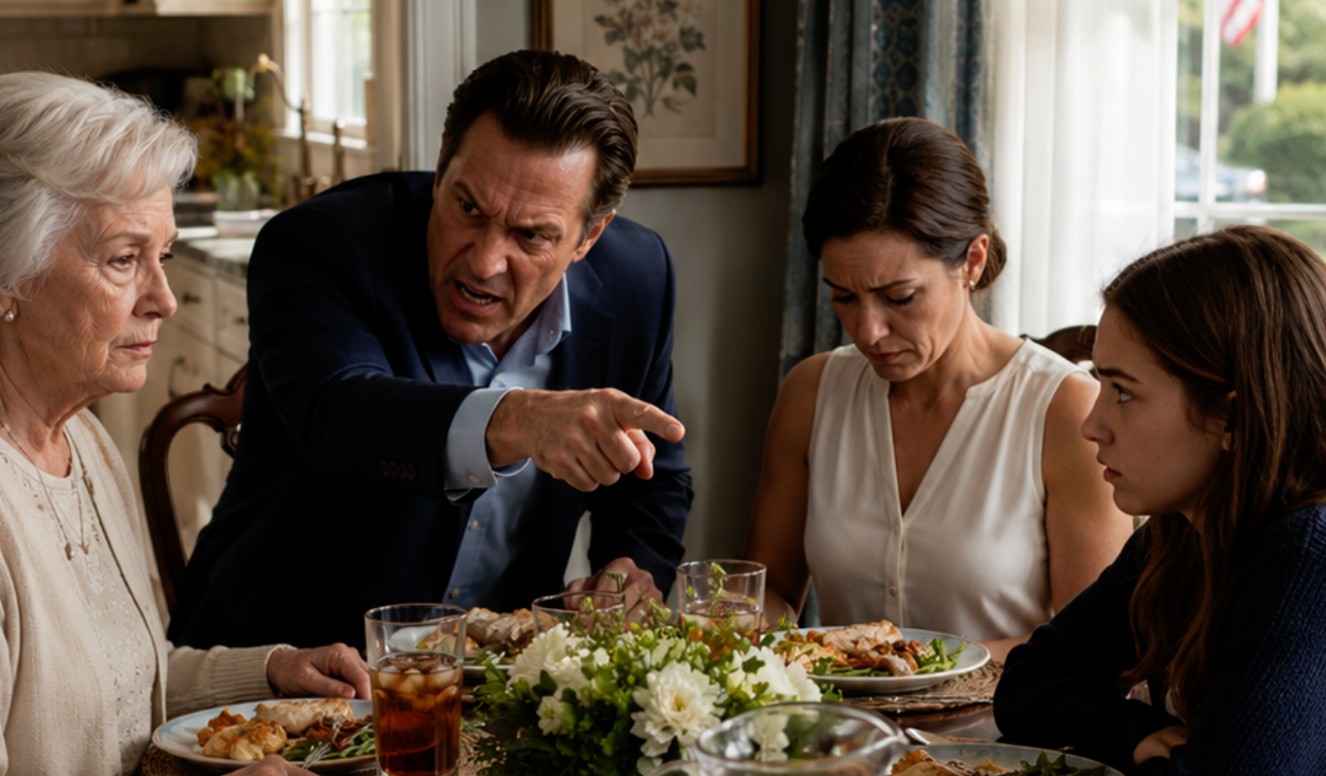
At Sunday dinner, my son Michael looked across the polished expanse of the dining table and delivered a sentence that would ultimately shatter the foundation of our family. “Your job is to watch my kids while I enjoy my life with my wife. It’s that simple. If you have a problem with it, the door is right there.”
The roast chicken I had painstakingly prepared all afternoon sat untouched on my plate, slowly growing cold. The dining room in their quiet, affluent New York suburb was suffocatingly warm and painfully ordinary. It was a tableau of domestic perfection: pristine china plates, pressed cloth napkins, a crystal pitcher of iced tea sweating beads of condensation onto the mahogany table. Through the front window, the porch light cast a golden glow over the small American flag Michael had left hanging since Memorial Day.
For a terrible, stretched second, nobody moved.
Jessica, my daughter-in-law, stared intently down at her salad, as if maintaining complete silence could somehow grant her immunity from the cruelty hanging in the air. Owen and Caleb, my eight-year-old twin grandsons, froze in innocent confusion, their forks suspended halfway to their mouths. But Clare, my sixteen-year-old granddaughter, looked straight at me. Her eyes held a deep, sorrowful understanding. She was the only one in that house who truly saw me.
I set my silver fork down with deliberate care. I slowly folded my linen napkin, smoothing the creases, placed it beside my plate, and stood up.
“Perfect,” I said, my voice remarkably steady. “I’m leaving. And you two can start paying your own bills. It’s that simple.”
Michael stopped chewing. The color drained from his face. Jessica’s fork slipped from her trembling fingers and struck the porcelain plate with a sharp, ringing note. It was not a loud sound, but in the echoing silence of that dining room, it landed with the finality of a tolling church bell.
“Mom,” Michael said, his voice dropping its authoritative edge, replaced by a sudden, thin softness. “Don’t be dramatic.”
Dramatic. That is the convenient label society affixes to older women the moment they finally decide to speak the unvarnished truth out loud.
I looked down at my son, a grown man cloaked in an expensive cashmere sweater I had painstakingly washed and folded by hand just two days earlier. His face was flushed with defensive irritation, but beneath that fragile mask of anger, I saw something entirely different. I saw fear. It was not the fear of losing his mother’s presence, nor the fear of fracturing our familial bond. It was the absolute, creeping terror that his unpaid domestic help was about to walk out the front door forever.
I turned my back on the pristine dining table and walked down the long, shadowed hallway toward the cramped back room they graciously referred to as my bedroom. Behind me, Michael’s heavy wooden chair scraped violently against the hardwood floor.
“Mom, wait,” he called out, his voice tinged with a desperation he tried to disguise. “It wasn’t a big deal.”
But it was a big deal. It was a cataclysmic revelation, far grander and more devastating than his narrow mind could possibly comprehend. By the time I reached the dreary storage room at the end of the hall, my suitcase was already completely packed. And by the time the morning sun breached the horizon, Michael would finally understand that I was not the only person leaving his house.
The true genesis of this story did not unfold at that tense dinner table. It began three months earlier, on a quiet Tuesday afternoon, while I was peacefully watering the fragrant basil behind my small, cream-colored house near Hudson, New York.
That house was not an architectural marvel. It possessed stubborn old windows that rattled in the winter wind, a wooden front porch that sagged slightly on the left side, and an ancient rocking chair that groaned a familiar complaint every time I settled into it. But it was entirely mine. My late husband and I had nurtured the dream of that house for decades. After he passed away, taking a profound piece of my soul with him, I purchased the home using a portion of his pension and the modest savings we had guarded like a flickering candle in a storm. I painted the kitchen a cheerful, pale yellow. I planted robust mint and sweet basil near the wooden back steps. I hung our faded wedding photograph in the central hallway, ensuring his smiling face was the first thing I saw every dawn. I had lived independently there for nearly a decade, and in all that time, I had never once felt abandoned by the world.
Then, Michael called.
“Mom, I need you.”
Those four simple words possessed a gravitational pull I could not resist. He wove a compelling narrative of domestic crisis. Jessica was utterly exhausted, pushed to the brink by the demands of modern motherhood. The energetic twins were simply too much to handle. Clare was retreating into teenage isolation. His corporate job demanded relentless travel. They were drowning, he insisted, their perfect suburban life taking on water faster than they could bail it out. They only required my assistance for a fleeting period—just until the chaotic waters of their lives receded, just until they could secure a proper, professional nanny, just until Jessica could regain her physical and emotional footing.
“Mom,” he murmured, lowering his vocal register to mimic the tone he used as a repentant little boy seeking absolution for a broken window, “I don’t know who else to call.”
I should have paused. I should have analyzed the logistics, interrogated the timeline, and asked the hard, practical questions. Instead, I heard the undeniable sound of my only son in distress, and my maternal heart provided an unconditional answer long before my logical mind had a chance to deliberate.
Within a matter of weeks, I had liquidated my sanctuary. I sold my beloved house swiftly, and significantly below its true market value, entirely because Michael stressed that speed was of the essence. He lectured me on the uncertainties of the real estate market, warning that maintaining an empty house would only hemorrhage money through property taxes and unavoidable repairs. He insisted that moving into their sprawling home made perfect logistical and financial sense. I could nurture my grandchildren, and he could oversee my modest finances.
“You shouldn’t be alone anyway,” he stated with a paternalistic sigh. “Not at your age.”
I was seventy-two. I was aging, certainly, but I was nowhere near ready to be buried. Yet, I allowed the condescension of that sentence to wash over me without protest, because mothers are deeply conditioned to swallow the small, stinging hurts inflicted by their children.
On the melancholic day I departed my house, I stood on the sagging porch, the cool metal of the house key heavy in my palm. The garden exhaled the rich, loamy scent of incoming rain and crushed mint leaves. My cherished rocking chair sat solitary by the window, too large to fit into Michael’s sleek SUV, so I abandoned it for the new owners, along with my terracotta porch planters and the intricate little side table my husband had built with his own hands. I comforted myself with a necessary delusion: I told myself I was not losing a cherished home; I was rejoining the vibrant heart of my family.
Michael and Jessica orchestrated a welcome that bordered on theatrical. There were blinding smiles, suffocating hugs, and the twins sprinting across the marble foyer screaming, “Grandma! Grandma!” Clare, however, merely kissed my cheek with a quiet reservation, her dark eyes harboring a profound, unspoken sadness I was not yet equipped to decipher.
They escorted me to my new quarters. It was situated at the absolute terminus of the hallway, concealed behind a door that stubbornly stuck in its frame. Prior to my arrival, this space had served as a purgatory for neglected items: tangled Christmas lights, obsolete electronics, cracked plastic storage bins, and the detritus of a family that consumed much and valued little. They had haphazardly cleared a narrow, precarious path leading to a solitary twin bed. The room boasted one diminutive dresser, a closet entirely choked with discarded wrapping paper, and a single, grime-caked window that offered a depressing view of the concrete alley behind the house.
Michael stood beside me, his hand giving my shoulder a reassuring squeeze. “It’s temporary, Mom,” he promised smoothly. “Just until we get organized.”
I forced a gentle smile. “It’s fine, sweetheart.”
That was the very first lie I uttered within those walls.
The initial week possessed a deceptive sweetness. I rose with the dawn to orchestrate breakfasts, meticulously packed nutritious lunches, laundered mountains of clothing, folded crisp towels, patiently guided the twins through complex homework assignments, and provided a captive audience for Clare whenever she felt brave enough to speak. Jessica impulsively hugged me in the gleaming kitchen one evening, sighing dramatically. “Eleanor, I honestly don’t know what we would do without you.” I tragically misconstrued her relief as genuine gratitude.
Michael returned each evening to a flawlessly clean house, sleeping children, and a hot, homemade dinner simmering on the stove. He would press a kiss to my forehead, a gesture resurrected from his youth. “Mom, you’re saving us,” he would say. I tragically misconstrued his convenience as genuine love.
By the commencement of the second week, polite requests had hardened into rigid expectations. Jessica ceased asking if I would be willing to pick up the children; she simply abandoned the printed school schedule on the marble island. Michael no longer inquired if I minded preparing dinner; he preemptively texted me his culinary cravings from his downtown office.
During the third week, they embarked on their inaugural “work trip.” Three grueling days at an important conference in Albany, they claimed. They departed with matching designer luggage and returned on Sunday night radiating a relaxed, sun-kissed glow, smelling faintly of expensive coastal wine and luxurious cocoa butter lotion. Jessica casually tossed me a generic box of chocolates likely acquired at an airport kiosk. “You’re an absolute lifesaver,” she declared, before marching upstairs and abandoning her soiled laundry directly in front of the washing machine.
Gradually, those expensive suitcases became permanent, looming fixtures near the front closet, perpetually packed and ready for deployment. Michael maintained the illusion of corporate necessity—conferences, crucial investor meetings, client dinners, complex contracts demanding his personal touch. But the subtle inconsistencies began to gnaw at the edges of my perception. I found luggage tags from exotic locales miles away from dreary Albany. I discovered crumpled restaurant receipts from upscale resort towns. I noted spa brochures carelessly shoved into the depths of Jessica’s designer purse. I even observed a stark, undeniable tan line on Michael’s wrist where his heavy luxury watch normally sat.
I did not want to know the truth. But a mother’s intuition operates independently of her denial; she feels the jagged edge of reality long before she allows herself to look at it.
My days devolved into a grueling marathon dictated entirely by the whims and needs of others. At five o’clock each morning, I stood in the silent kitchen, brewing coffee in Jessica’s complicated silver machine. I assembled lunches like an assembly line worker. At six-thirty, I roused the children, hunted for elusive missing socks, tied intricate knots in shoelaces, forged signatures on permission slips, and reminded the boys of their library obligations. Clare invariably descended the stairs last, moving like a pale ghost, her eyes radiating a bone-deep exhaustion.
Following the chaotic school drop-off, I transformed into a maid. I vigorously scrubbed sticky kitchen counters, sanitized sprawling bathrooms, and wrestled with endless piles of laundry. I knelt to sweep errant cereal from beneath the massive kitchen island. I meticulously ironed Michael’s dress shirts because he claimed the local dry cleaner was “an unnecessary and frivolous expense right now.” Most days, I consumed a meager lunch while standing rigidly at the kitchen sink. By mid-afternoon, the cycle repeated: school pickups, snacks, homework, dinner preparation, kitchen cleanup, and the arduous task of putting the twins to bed. Michael and Jessica treated the home as an upscale hotel, coming and going with breezy entitlement.
The fragile illusion shattered completely on a mundane afternoon. Jessica had carelessly left her unlocked phone resting on the living-room sofa while she dashed upstairs. The twins were occupied constructing a towering block fortress on the rug. Clare sat curled in an armchair, a heavy novel resting on her lap.
The phone screen illuminated, demanding attention. Without a conscious decision, my eyes darted to the glow. An Instagram notification dominated the display. Jessica had uploaded a new post. The image showed her standing on a gleaming white balcony overlooking impossibly turquoise water, a crystal glass of wine held aloft. Michael stood beside her, looking relaxed, tanned, and victorious. The geographic location tag proudly declared: Cancun. The accompanying caption read: A well-deserved rest.
The application indicated it had been posted two days prior—precisely when they were purportedly trapped in a windowless conference room in Albany.
My hands turned to ice as I carefully lifted the device. I scrolled through a damning archive of deceit. There were dozens of photographs. Jessica lounging on pristine white sands behind oversized sunglasses. Michael holding an imported beer beneath the shade of a swaying palm tree. Extravagant room service displays. Breathtaking tropical sunsets. Every single uploaded date perfectly aligned with a fictitious “work trip.”
I returned the phone to the exact indentation on the sofa cushion. Across the quiet room, Clare slowly closed her heavy book.
“Grandma,” she whispered, her voice trembling with a mixture of terror and resolve. “I need to show you something.”
We ascended the stairs to her bedroom, securing the door behind us. It was the sole sanctuary in that massive house that felt authentic: vibrant sketches taped haphazardly to the walls, thick stacks of literature bordering the window, and rebellious band posters commanding the space above her unmade bed. She unlocked her own phone and navigated to a hidden folder of screenshots.
“I’m so sorry,” she wept softly. “I should have told you earlier. I just didn’t know how to do it.”
At first, my brain rejected the visual data on the screen. Then, my eyes focused on the title of the group chat. The Mom Plan.
My stomach violently rebelled. The digital timestamps indicated the conversation began weeks before I had even agreed to sell my house.
I read the cruel, calculating words repeatedly. My eyes tracked across the screen, but the core of my being felt entirely detached, floating somewhere above the room. The chat log was extensive, filled with callous jokes about my traditional cooking, exasperated complaints regarding my “annoying old lady questions,” and detailed itineraries for luxurious vacations funded entirely by the thousands of dollars they saved by utilizing my free labor.
Then came the exchange that caused the floorboards to pitch beneath my feet.
Clare lowered her phone, her youthful face streaked with tears. “There’s more,” she confessed, her voice breaking. “They sold the beautiful furniture you left stored in the garage. The dresser, the little table, and the rocking chair. Mom listed it on Facebook Marketplace. They used the cash to go out for a fancy dinner downtown.”
My rocking chair. For a devastating moment, I could vividly hear the rhythmic creaking of the wood on my old porch. I could hallucinate my late husband sitting in it, sipping dark roast coffee, waving cheerfully at a passing neighbor. Sold. Discarded not out of desperate hunger or genuine necessity, but to fund a trivial evening of fine dining.
I moved to Clare’s window and gazed out at the manicured, deceptively peaceful street. A neighbor wrestled grocery bags from a minivan. A distant dog barked. A sprinkler rhythmically ticked across an emerald lawn. The exterior world remained stubbornly normal, while inside, the entire architecture of my life had been maliciously dismantled piece by piece.
For three agonizing months, I had labored under the delusion that I was saving my son. I had sacrificed my independence, slept in a miserable closet, and actively convinced myself I was fortunate to be of use. I had willingly disappeared into a life of indentured servitude. And the most horrifying truth was that every ounce of my suffering had been coldly premeditated.
“Grandma,” Clare pleaded, her voice barely a breath. “Please don’t be mad at me.”
I turned, bridging the gap between us, and enveloped her in my arms. She collapsed against my shoulder, sobbing with the unguarded vulnerability of a very young child. “I was so scared,” she cried into my shirt. “I thought if I exposed them, you’d run away, and then I’d be trapped here completely alone with them. You’re the only person in this massive house who ever asks me how I am and actually bothers to wait for the answer.”
In that profound moment of shared grief, clarity struck. I was not the sole invisible entity in this residence. Clare was a ghost here, too. Michael and Jessica utilized the photogenic twins for curated social media aesthetics, they deployed Clare as a polished prop for annual holiday cards, and they exploited me as an endless source of free domestic and financial capital. We were nothing more than convenient accessories in the fraudulent masterpiece of a life they broadcasted to the world.
I tightened my embrace, smoothing her hair. “I am leaving,” I promised fiercely. “But I swear to you, I am not leaving without you.”
That evening, shrouded in the silence of a sleeping house, I retreated to my dismal room and retrieved an ancient, leather-bound notebook. It was a repository of history; the first pages still held my husband’s favored chicken soup recipe and my mother’s legendary lemon cake. Finding a pristine page, I meticulously began to chronicle the betrayal. I recorded specific dates, verbatim promises, the exact timeline of the house sale, the missing funds, the vanished furniture, the fraudulent trips, and the terrifying push for power of attorney.
Digging through the hidden depths of my suitcase, I located a faded business card bound by a brittle rubber band: Arthur Vance. Attorney at Law. He was the fiercely intelligent lawyer who had meticulously drafted my husband’s will decades ago. Driven by desperate hope, I dialed the number.
Arthur was a revelation of calm competence. He listened patiently as I stumbled through the narrative, peeling back the layers of my own profound shame.
“Mrs. Ramirez,” Arthur stated, his voice a steady anchor in my turbulent sea. “What you have painstakingly described heavily implies financial elder exploitation, deliberate fraud, and systemic theft. You possess absolute rights, but we must navigate this with surgical precision. Individuals who plan with such cold calculation tend to panic and destroy evidence when cornered. Do not confront them. Do not sign a single document. Gather irrefutable proof quietly, and we will formulate a safe exit strategy.”
The following morning, I violated the sanctity of their master bedroom. Arthur demanded proof, and I intended to deliver it. Deep within Michael’s immaculately organized closet, hidden inside a nondescript storage box, I unearthed the bank statements. They bore my name. My life savings.
Michael had manipulated me into adding him as a “convenience signer” to facilitate automatic bill payments. The hemorrhage of my funds had commenced a mere fourteen days after my arrival. Withdrawals of $3,000, $5,000, $2,500, labeled with vague, fictitious justifications: Family support. Home expense. Medical need. Almost thirty thousand dollars of my security had vanished into the ether of their luxurious lifestyle. My remaining balance sat at a precarious $16,200. I photographed every single page, my hands possessing a terrifying, icy stillness. I did not shed a single tear; my grief had rapidly crystallized into an unbreakable armor of purpose.
I transmitted the digital evidence to Arthur. His response was immediate and decisive: This is incontrovertible proof. You require a secure location immediately.
I reached out to Carol, a distant cousin I hadn’t seen since a gloomy funeral years prior. Over a tense meeting at a local coffee shop, I poured out the unedited, ugly truth. Carol simply reached across the table, grasping my hand with fierce loyalty. “You and Clare will stay with me,” she declared. “I have a modest guest room, but it possesses a door with a heavy lock and people inside who understand the meaning of respect.”
For the subsequent two weeks, I functioned as a highly skilled operative trapped behind enemy lines. I maintained the facade of the compliant, exhausted grandmother, continuing to launder, cook, and clean. Simultaneously, aided by Clare’s technological fluency, we breached Michael’s computer. We discovered terrifying spreadsheets detailing their debt, receipts for Jessica’s lavish jewelry, and a chilling document plainly titled Strategy, outlining a six-step process to drain my assets and ultimately abandon me in a state-run facility.
When Michael departed for a five-day “industry convention” in Miami with Jessica in tow, the moment had finally arrived. Arthur prepared a barrage of legal filings: injunctions to freeze the remaining accounts, civil complaints for fraud, reports directed to the district attorney, and an emergency protective petition ensuring Clare’s legal right to leave with me.
Saturday dawned brilliantly clear. We waited until Michael and Jessica returned. As they confidently dragged their luggage through the front door, shouting cheerful greetings, Clare and I simply picked up our bags and exited through the rear door. We walked to my old, reliable car—the vehicle Michael had endlessly pressured me to sell.
Before engaging the engine, I marched to the grand front door and slid a crisp white envelope underneath it.
Michael, By the time you read this, I am gone. I will no longer serve as your unpaid employee. I will not sign away my autonomy. My legal counsel will contact you regarding the substantial funds stolen from my accounts. Clare is with me under emergency legal protection. Do not attempt contact. Eleanor
The fallout was spectacular and legally ruinous for my son. Safely entrenched in Carol’s spare room, I ignored the barrage of desperate, threatening text messages Michael fired at my phone. Arthur executed the legal trap perfectly. My remaining funds were instantly frozen, preventing further theft.
Faced with the terrifying prospect of criminal prosecution and public disgrace, Jessica appeared on Carol’s porch, stripped of her makeup and arrogance, begging for leniency. She attempted to justify their actions as an act of financial desperation, a drowning couple grasping at any lifeline. But I had read the Strategy document; I knew the profound difference between a desperate mistake and a calculated assassination of a mother’s livelihood.
Eventually, Michael’s frantic legal team brokered a settlement. In exchange for my cooperation in a deferred prosecution arrangement—keeping Michael out of a prison cell—they immediately surrendered a certified check for $24,800, representing the stolen funds and the heartbreaking loss of my husband’s rocking chair.
With that recovered capital, Clare and I secured a modest, sunlit two-bedroom apartment in a respectable senior living complex. It lacked the grand marble foyers of Michael’s suburban mansion, but it possessed something infinitely more valuable: peace. The kitchen was narrow, but the windows faced the eastern sunrise.
I secured a gentle part-time position at a local floral shop, learning the delicate language of botany, while Clare flourished in her high school art program. She painted a breathtaking exhibition titled Invisible Women, capturing the overlooked, vital labor of women like me.
On my seventy-third birthday, standing on our small balcony in the crisp autumn air, I looked down at the terra-cotta pots lining the railing. I had planted fresh mint. Through the harsh winter, it would inevitably recede, appearing dead to the untrained eye. But the robust roots beneath the soil would survive the cold, waiting patiently to push green shoots through the dark earth when the sun returned.
I had spent my entire existence believing that maternal love required infinite endurance and total self-sacrifice. I had finally learned the hardest lesson of all: sometimes, the most profound act of love is having the courage to leave the table, walk through the door, and plant yourself in soil where you are finally allowed to grow.