
“Thanks for firing me,” I said, sliding my deactivated company badge across the polished mahogany of the boardroom table. “I couldn’t activate it myself.”
The silence that followed was absolute. It wasn’t the contemplative quiet of a routine strategy session; it was the suffocating, heavy vacuum of a room that had just collectively realized the floor had vanished beneath their feet.
Not a single person breathed. Not Brandon, who had spent the previous hour smiling at me with the unbearable smugness of a man who firmly believed he had just invented corporate strategy. Not Daniel, the CEO, whose authorizing signature currently glared from the projection screen behind him like a loaded weapon he had entirely forgotten he owned. And certainly not the general counsel, a man who had gone so completely ashen that the fluorescent lights above seemed to wince in sympathy.
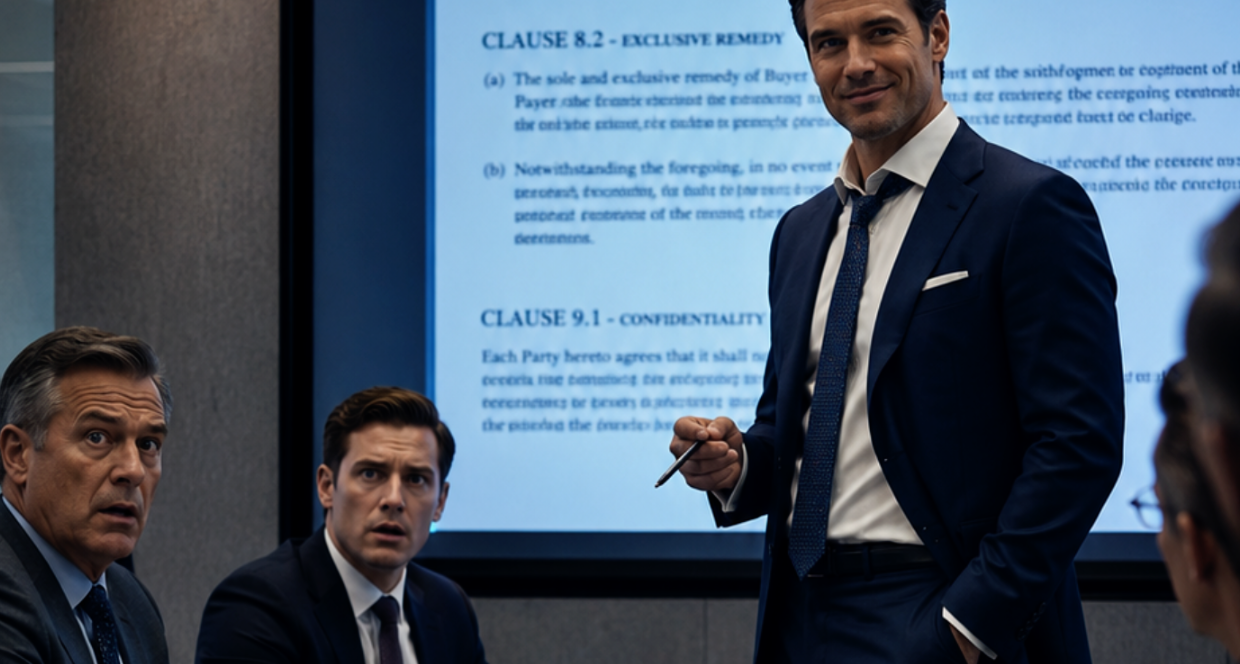
Illuminated on the wall, the boardroom monitor displayed a single, irrevocable line in pristine white text:
That was the precise fraction of a second when comprehension finally dawned on them. It hadn’t been when I casually strolled into the room after my laptop had been locked out by IT. It hadn’t been when Brandon had attempted to wave off my presence as a mere administrative glitch. It hadn’t even been when the activation clause first materialized on the monitor, prompting the legal team to begin reading it aloud in that specific, dry, meticulously careful cadence lawyers reserve for moments when profound power is about to violently change hands.
No. They only truly understood when I stood up, offered my plastic badge to the center of the table, and smiled pleasantly at the man who had tragically mistaken my deliberate silence for surrender. Brandon’s jaw unhinged, yet no sound emerged. For the first time in our brief, antagonistic acquaintance, he had found himself utterly devoid of words that someone else had drafted for him.
I exited the room without slamming the heavy oak door. A slammed door is an emotional indulgence; it is loud, messy, and desperate. Over eight years of surviving in this building, I had cultivated the profound understanding that the quietest, most imperceptible maneuvers were invariably the ones that inflicted the most devastating damage.
A mere four days earlier, I had still been the indispensable operative everyone summoned when the corporation was on the precipice of bleeding out in public view. Officially, my title was Senior Strategy Director—a designation polished enough to look formidable on a LinkedIn profile, yet ambiguous enough to obscure my actual function in board packets. In reality, I was the architect of survival. I intercepted and neutralized catastrophic disasters long before they could ever waft up to the executive floor.
I specialized in highly detailed, surgical interventions. For example, when an aggressive vice president accidentally emailed an unredacted acquisition deck to our primary market competitor, I orchestrated a complex narrative rewrite before the competitor’s server could even finish the download, brilliantly turning a fatal internal leak into a “calculated external misinformation test.” When the CFO attempted to creatively categorize a multi-million-dollar luxury African safari under the budget line for “leadership development,” I buried the discrepancy deep within the audit committee’s purview, successfully framing it as a misplaced algorithmic coding error rather than the blatant embezzlement it actually was. When Daniel, our fiercely arrogant CEO, promised one explicit dividend strategy to aggressive investors and a completely contradictory compensation package to our restless employees, I meticulously crafted the bridging language that made both disparate factions firmly believe they had simply misunderstood his towering intellect in their own favor.
I never lied. That was the exquisite irony of my position. I was far too skilled for crude falsehoods. Instead, I understood the complex topography of truth. I knew precisely where to apply heavy emphasis, where to introduce bureaucratic delay, where to innocently request extensive clarification, and where to expertly process a raging crisis into a tedious, unthreatening committee review. Men like Daniel absolutely relied upon people like me because our quiet competence transformed their impulsive recklessness into something resembling a visionary strategy.
Yet, they also harbored a latent, unspoken fear of us. They feared us because we were the keepers of the corporate memory. We remembered absolutely everything.
The inciting incident of my final week commenced on a Tuesday morning. A junior legal associate named Aaron appeared trembling in my doorway before the steam had even faded from my first cup of coffee. He looked as though someone had replaced his bloodstream with cold brew.
“Ma’am,” he stammered, his voice an octave too high. “We need your eyes on this. Immediately.”
He handed me a physical, printed email chain. The medium alone communicated the profound severity of the issue; nobody printed anything unless they desperately needed plausible deniability and distance from digital tracking logs. The header screamed: Confidential Memo: Preliminary Asset Divestiture Timeline. Below it lay absolute ruin. Someone had inadvertently blind-copied the entire external mergers and acquisitions partner list on a highly restricted legal contingency document that should have remained buried. If a single recipient forwarded that file, the resulting press leak would tank our stock by lunch and invite aggressive market speculation by dinner.
Aaron swallowed thickly, suggesting that Susan from Legal thought we needed to trigger formal disclosure obligations.
“Tell Susan to recall the email immediately,” I instructed, keeping my voice completely level. “Then initiate a hard scrub of all internal and external server pathways. I need the full recipient list cross-referenced with system audit logs. Bring me names, IP timestamps, open rates, forward attempts, and file download metrics. Map out whether any attached metadata pinged outside our controlled firewall environment.”
When he merely stared, paralyzed by the adrenaline, I added softly: “Right now, Aaron.”
I did not raise my voice. I almost never did. Panic possesses a distinct olfactory signature, and once a room senses it on you, they rapidly cease listening to your expertise and merely react to your fear. Absolute calm, however, makes panicked executives eagerly hand over their keys. By 9:30 a.m., the hemorrhage was fully contained. External access was definitively severed, recipient logs were secured, and the communications department was armed with an incredibly dull explanation regarding routine stress-testing of restricted document channels. Legal drafted a memo outlining why no formal disclosure was triggered.
The board of directors remained blissfully ignorant. That was invariably the sole metric of my success.
The facade finally cracked just after 10:00 a.m. that same morning. I had returned to my desk, picked up my abandoned coffee, and opened my digital calendar, only to discover a glaring absence. My standing Monday morning strategy sync with the CEO was gone. It had not been rescheduled. It had not been politely declined. It was simply erased.
For seven years, eleven months, and three weeks, that exact meeting had anchored my schedule like a high-stakes dental appointment. Every Monday at 8:00 a.m., Daniel and I would meticulously dissect investor anxieties, mitigate legal exposures, navigate executive behavioral issues, and quietly extinguish whatever reputational fires he had ignited over the weekend. Now, the time slot was a barren white rectangle.
Assuming a synchronization error, I refreshed the portal. The absence remained. I then checked Thursday’s critical pipeline alignment session. My name had been surgically extracted from the attendee list. The roster still prominently featured Brandon Vale—Daniel’s recently installed son-in-law, currently masquerading as the Executive Vice President of Strategic Transformation. Brandon possessed the kind of manufactured pedigree that allowed him to use hollow verbs like “unlock,” “synergize,” and “reimagine” to mask a profound lack of actual business acumen. His previous experience consisted of a failed app and a venture fund advisory role secured by family connections. He viewed experienced women like me not as vital assets, but as “legacy talent,” ripe for removal.
A quick diagnostic check of the system access logs confirmed my suspicions. While most of my administrative privileges appeared superficially intact, three highly sensitive restricted folders had been quietly downgraded from edit-access to view-only. Two approval queues I managed had been rerouted to other departments. An underlying backend console token had been explicitly revoked at the systems admin level while I was busy mitigating the morning’s memo leak.
This was a meticulously calculated maneuver. I sat perfectly still in my chair, experiencing not fear, but the cold, crystalline stillness of recognizing a predator moving in the dark. In corporate ecosystems, termination is rarely a sudden, dramatic guillotine; it is a slow, methodical starvation. First, your core meetings mysteriously vanish. Then, your unilateral approvals become “shared collaborative efforts.” Finally, Human Resources appears with soft eyes and a severance folder. They refer to it as a “structural reorganization.” I knew better.
An automated monitor alert buzzed on my phone: another backend permission had just been revoked by an internal admin. Without a single word, I packed my leather bag and departed the building before noon. The averted gazes and nervous shuffling of my colleagues in the hallway provided all the confirmation I required.
I navigated the midday downtown traffic with an eerie, detached serenity. The harsh June heat pressed aggressively against the windshield, but my hands remained perfectly steady on the wheel. Once home, I fed my cat, kicked off my heels, and bypassed the wine for a glass of ice water—absolute mental clarity was paramount. I then booted up an encrypted offline digital archive I hadn’t accessed in six long years.
After three methodical attempts, the complex password unlocked a digital vault containing old buyout frameworks, executive risk analyses, LLC agreements, and merger contingency plans. These documents were the relics of a deeply paranoid corporate era, a time when executive leadership had been so utterly terrified of hostile takeovers that they had eagerly signed anything the Legal department placed before them, provided it promised absolute structural protection.
I queried a single, specific text string: Trigger events.
A solitary folder materialized on the screen. Within it rested Clause 14.6, blinking against the dark interface like a dormant serpent. I allowed myself a genuine, unhurried smile.
Six years prior, during our second, highly volatile company merger, Daniel had become consumed by the paranoid delusion that the board of directors intended to oust him using familial loyalists and side agreements. He demanded absolute, unbreakable structural protection. Because I was the silent architect of the firm’s hidden scaffolding—the one who knew precisely which equity pools could be weaponized and who explicitly controlled the executive trusts—I was tasked with drafting the contingency framework.
I wrote the legal protections with devastating precision. Clause 14.6 was engineered for an exceedingly specific hypothetical scenario: If an employee tied to strategic control is terminated retroactively by an executive with familial ties to active leadership during a period of operational restructuring, dormant administrative rights over the LLC executive equity trust are immediately activated and completely transferred to the terminated employee.
At the time, Daniel had aggressively championed the clause, wholly convinced it would permanently prevent a board-backed nepotism purge against his inner circle. He never possessed the imagination to envision a future where his own arrogant son-in-law would become the weaponized relative. He did not fathom that I would become the primary target of that purge. Most dangerously, he fundamentally forgot that I possessed a flawless, unforgiving memory.
The anticipated phone call from Human Resources arrived the following morning at precisely 9:12 a.m. The medium was the message: a voice call leaves no auditable paper trail. Sandra from HR, her tone dripping with practiced, artificial corporate empathy, politely requested my presence in conference room 8C.
I arrived meticulously armored for the encounter: a sharp navy blazer, immaculate white blouse, tailored black trousers, and my hair tightly secured. Slipped securely into my interior pocket was a specific, heavy fountain pen. Three years earlier, during a bout of fraud paranoia, I had personally instituted a biometric ink-verification protocol for high-risk executive exits. The system rigorously logged ink composition, pressure profiles, timestamps, and document authentication to prevent coercion. Naturally, Daniel had signed off on the protocol without bothering to read the fine print.
Conference room 8C was a glass interrogation cube designed to feign transparency. Brandon stood by the window, attempting to project relaxed authority in his expensive sneakers, while Sandra sat at the table with a manila envelope.
“We’ll make this brief,” Brandon announced, dispensing with pleasantries. “Following a strategic review of our operational structure, we’ve decided your position has been dissolved. Effective immediately.”
“Retroactively,” Sandra interjected, adjusting the folder with nervous hands. “The paperwork was legally finalized yesterday.”
I absorbed the exact phrasing, ensuring the conditions were stated for the record. “You are terminating me. As part of a restructuring.”
Brandon nodded entirely too eagerly. “A broader operational alignment. It’s strictly business. Nothing personal.”
Sandra slid the thick severance package across the table, informing me that my badge and laptop access had already been electronically secured, and that I had precisely fifteen minutes to vacate the premises discreetly. Brandon watched me intently, clearly hungering for a crack in my composure—a raised voice, a visible tremor, any evidence that I was emotionally unstable and entirely worthy of disposal.
Instead, I smoothly extracted my fountain pen. I completely ignored the Non-Disclosure Agreement, the release forms, and the non-compete clauses. I flipped directly to the single acknowledgment document that legally verified I had been subjected to a retroactive involuntary termination due to operational restructuring, explicitly initiated by a family-linked executive.
I signed it in vivid blue ink. Slowly. Applying deliberate, scannable pressure to ensure the biometric timestamp registered perfectly in the security mainframe. Brandon looked profoundly disappointed by my lack of histrionics as I deliberately capped the pen, declined the security escort, and walked myself gracefully out of the building. My absolute composure wasn’t a manifestation of denial; it was the final stage of a six-year preparation.
By late afternoon, I was crouched in a dusty, sweltering storage unit across town, retrieving the original, physical copy of Clause 14.6 from a rusted lockbox hidden behind outdated crisis playbooks. The heavy paper bore the authentic notary stamps, initials, and dates from six years ago. To officially activate the trigger, I possessed all three mandatory elements: a retroactive termination, a family-linked executive instigator, and now, the timestamped, notarized proof of the original foundational agreement.
I drove the documents straight to Mitch Caldwell, a brilliantly cynical corporate attorney who operated out of a dismal office tucked behind a dry cleaner. Mitch meticulously verified the biometric signatures, confirmed the external Delaware registration, and generated a flawless, digitally certified validation packet featuring multiple redundancies.
“This isn’t a small grenade, Lisa,” Mitch muttered, his eyebrows climbing as he admired the ruthless efficiency of the paperwork. “This is a controlled building demolition.”
Returning home, I utilized an archaic, forgotten internal enterprise crisis-communications routing tool I had built myself years prior. I carefully configured the highly encrypted legal packet to bypass standard firewalls, routing it directly through the internal queues to forcefully project onto the main boardroom monitors. I scheduled the automated execution for exactly 1:00 p.m. the following Friday—precisely in the middle of the quarterly board meeting.
When Friday morning arrived, Brandon had already disseminated a pompous, company-wide memo detailing his grand “Operational Vision Refresh” and the systematic elimination of “legacy roles.” With that single email, he had eagerly provided the absolute final piece of documentary evidence required to seal his own fate.
At 12:37 p.m., I parked my car in my usual spot on level three. Utilizing my still-active physical keycard, I bypassed a highly confused lobby security guard and strode directly into boardroom 17B. The room was packed with the executive suite, external counsel, and the full board of directors. Brandon froze mid-sentence as I calmly took my customary seat across from the CFO.
“Lisa,” Brandon stammered, his practiced, arrogant smile severely faltering. “We must have missed something in the calendar update. We weren’t expecting you.”
“I’m still on the board invite list,” I replied evenly, folding my hands in my lap. “One p.m. As always.”
At exactly 1:00 p.m., the general counsel’s tablet chimed with a delicate ping. Then his associate’s laptop buzzed. Within seconds, Brandon’s meaningless presentation detailing “efficiency pods” and “strategic velocity” was forcefully overridden.
The massive projection screen flashed stark white, displaying the heavily encrypted legal queue in bold text: Equity Redistribution Protocol — Clause 14.6C. Activated. Involuntary Termination Event Verified.
The automated system scrolled relentlessly through the documentation for the entire room to witness: my full legal ID, the termination timestamp, the verified biometric signature, and finally, the damning text of the clause itself. Authority to redistribute equity, transfer trust assets, and assume controlling interest shall proceed per subsection 6A, non-reversible upon verified execution.
Daniel erupted from the head of the table, his face dark with fury, demanding the screen be turned off immediately. But the general counsel, completely drained of all color, refused to move.
“You are exposed, Daniel,” the counsel stated with a chilling, exhausted finality. “This clause explicitly dictates that any retroactive termination initiated by a family-linked executive transfers absolute administrative control of the executive equity trust directly to the terminated party. The authentication parameters have been irrevocably met.”
The CFO’s laptop chimed with a definitive backend portal notification. His face collapsed into his hands. “The equity admin portal just reindexed control,” he whispered, turning his screen toward the paralyzed board chair. “Ownership control: 72% executive holdings consolidated. She has absolute majority control.”
Daniel glared at me, his immense arrogance shattering into desperate, flailing rage. “This was not the deal! She was supposed to take the severance and go quietly!”
“It is exactly the documentation you signed,” the general counsel corrected softly, effectively severing Daniel’s remaining authority. “Do not threaten her. She is a controlling stakeholder with governance authority now.”
I stood up, the legs of my chair scraping loudly in the breathless, silent room. I retrieved my deactivated security badge from my purse and placed it deliberately in the center of the mahogany table, making sure Brandon could clearly read my name.
“Thanks for firing me,” I said, meeting Brandon’s terrified, hollow gaze. “I couldn’t activate it myself.”
I left the room, the monitor behind me permanently locked onto the unalterable confirmation of the ownership transfer.
The following Monday morning, I returned to the corporate headquarters through the grand glass front entrance, completely bypassing the parking garage. This time, the security guards did not hesitate or reach for their radios; they immediately stepped aside. Employees in the expansive lobby parted seamlessly, offering me the wide, physical space that true, undeniable power effortlessly commands.
I took the elevator up to the executive suite and walked into the hastily reorganized boardroom. The environment had been entirely reset. I bypassed my old, subordinate chair without a second glance. Without waiting for introductions, permission, or the inevitable, quiet apologies from the remaining terrified executives, I took the seat at the absolute head of the table.
I opened the thick packet in front of me, looking calmly at the men who had once treated my vast expertise as purely disposable. For the first time in eight years, when I spoke, no one treated my words like a cleanup operation. They treated them like an absolute directive. I owned the room.