“You brought a thief into this venue.”
My mother delivered the sentence with the casual detachment of someone observing a mild change in the weather. She did not say it as though my eight-year-old daughter, Lily, was crumpled on the cold marble floor of a Savannah ballroom, blood rapidly blooming across the pristine white of her flower-girl dress. She did not say it as though my younger brother, Austin, had just weaponized a heavy oak wedding menu board, swinging it into the side of my child’s head in front of two hundred horrified guests.
She said it as though I had simply worn the wrong shoes.
“You brought this embarrassment on our family,” she continued, her voice slicing through the heavy, stagnant air.
The jazz band remained frozen mid-song, their instruments suspended. The scent of champagne and imported roses mingled sickeningly with the sharp, coppery tang of my daughter’s blood. Above us, the crystal chandelier cast an indifferent, glittering light over the devastation. My father stood rigidly beside my mother in his immaculate black tuxedo, his arms folded across his chest, nodding in silent agreement. A few feet away, Austin stood breathing heavily, his face a grotesque mask of unjustified rage.
And my sweet Lily, the gentlest soul I had ever known, whimpered weakly against my chest. Her small fingers clutched my wrist, desperate to tether herself to a world that had suddenly turned violently cruel.
“Mom,” I whispered, staring up at the woman who had given birth to me, begging her humanity to surface. “Call an ambulance.”
Helen Caldwell did not move a single muscle.
It was my father who finally spoke, looking down at me with absolute disdain. “Take your girl and get out, Harper. You’ve ruined your brother’s night enough.”
In that precise fraction of a second, something deep within my soul went entirely, irreversibly silent. It was not a peaceful silence. It was the death of a desperate, thirty-two-year-old hope. The part of me that had spent a lifetime begging for their love simply stopped breathing on that marble floor.
Before that June night in 2026, I had been the kind of woman who apologized when someone else stepped on my foot. I was Harper Hayes, a graphic designer living a quiet, gentle life in Savannah with my husband, Ryan, and our daughter. I loved Spanish moss, quiet coffee shop mornings, and the simple safety of my chosen home.
I had built a peaceful life because I had never been freely given one. In the Caldwell household, peace was a currency you earned through grueling, perpetual utility.
When my brother Austin was born two years after me, the entire gravitational pull of our family shifted to orbit him. He was the golden son, the heir, the name-carrier. I, on the other hand, was designated as “the reliable one.” That was the Caldwell euphemism for the one who was easiest to take from.
When I was eighteen, I earned a scholarship to an out-of-state design program. I had worked exhausting bakery shifts, hoarding tips in a coffee tin to build my portfolio. But two weeks before I was meant to leave, my mother slid a glass of iced tea across the kitchen counter—her universal herald of bad news—and told me I needed to be realistic. Austin wanted to attend a private business academy in Atlanta, and they could not afford both.
“Don’t be selfish,” she had snapped when I protested.
That word became the collar around my neck. I stayed. I drove an old Honda to a local community college while my parents funded Austin’s extravagant dorm room. And the sacrifices never ceased. When Austin failed classes, maxed out credit cards, or borrowed money from dangerous people, the burden always fell to me. Over five agonizing years, I handed my brother twenty-five thousand four hundred dollars.
I only knew the exact figure because my husband, Ryan, had made me write it down.
Ryan saw through my family long before I had the courage to open my own eyes. He was patient, steady, and entirely devoid of the toxic pretense my parents thrived on. He noticed how my voice shrank after phone calls with my mother, and how I scratched my wrists raw from anxiety. When my parents left our modest backyard wedding early complaining of a headache, I cried in the bathroom. Ryan merely held me under the string lights and whispered, “The family we build will be better than the one you were given.”
When Lily was born, I believed becoming a mother would suddenly make me brave. But instead, I made the most profound mistake of my life: I kept bringing my daughter around my parents. I fed her into the viper’s nest because some naive, broken part of me believed that if they could just love her goodness, it would retroactively prove they had loved me.
Lily was deeply, naturally good. She saved ladybugs and cried over shelter dogs. She did not belong in the Caldwells’ orbit.
Austin’s descent into pure, unbearable arrogance accelerated when he met Amber Whitfield. The Whitfields possessed old Savannah money—the quiet, powerful kind that moved through charity boards and historic committees. Amber was beautiful, polished, and breathtakingly mean.
When their eighty-thousand-dollar wedding was planned at a historic estate, my mother inevitably called to demand financial help, citing the “standard” Amber’s family expected.
For the first time in my life, with Lily coloring quietly on the floor beside me, I said no.
My mother hung up on me. The punishment for my disobedience was three weeks of utter silence, followed by an invitation that explicitly excluded us from the family seating. We were assigned to Table 27, right next to the kitchen doors.
Ryan warned me they were going to use me. He offered to stay home. But Lily had already twirled in her white dress, dreaming of a princess wedding, and I could not bear to crush her joy.
The day of the wedding was suffocatingly hot. The estate was a Southern magazine archetype—white columns, sweeping porches, crystal chandeliers. Amber looked stunning in lace, but upon seeing us, her smile vanished. She openly criticized Lily’s white dress, and my mother swiftly ushered us to the back of the room, masking her exclusion as concern for our “comfort.”
We endured the slights. I stayed calm when my mother walked past us without a glance, and when Austin offered a toast pointedly thanking only the family members who “actually supported” the union.
An hour into the reception, Ryan received an urgent call regarding a massive logistics account he had been chasing for months. I urged him to take it in the courtyard. I told him we would be fine. I would spend the rest of my life replaying that moment, hating myself for not stopping him.
Ten minutes after Ryan stepped outside, the jazz music abruptly stopped.
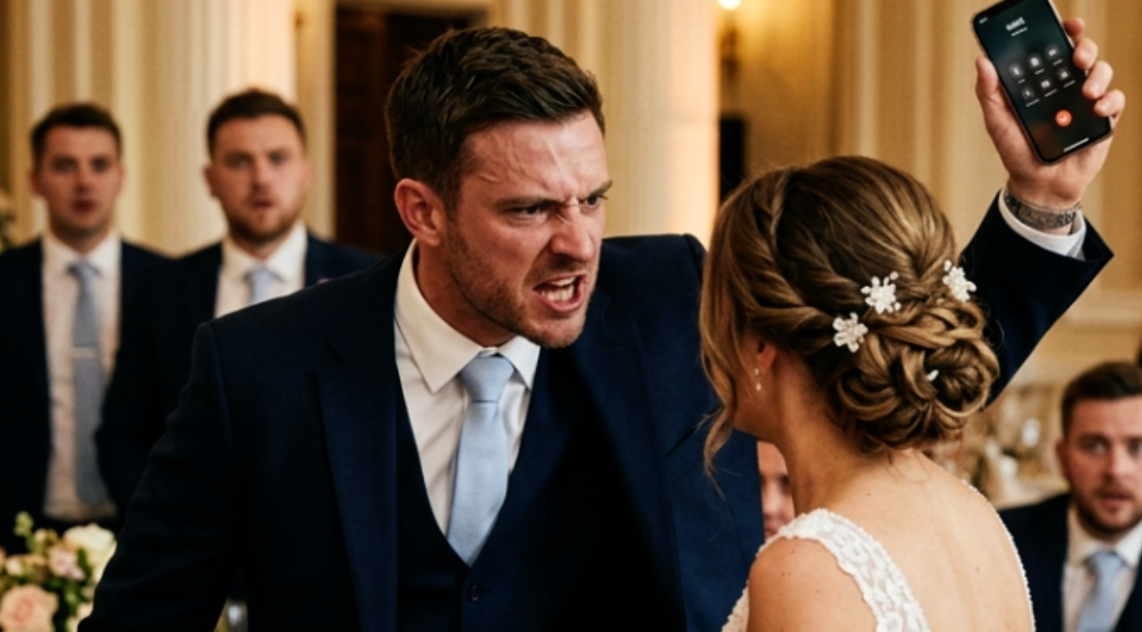
Austin stood near the bridal table, dramatically patting his pockets. He commandeered the microphone, his voice booming through the speakers, announcing that his new iPhone—containing sensitive vendor and banking information—had been stolen.
A ripple of extreme discomfort washed over the wealthy crowd. As guests patted their pockets, Austin marched straight toward Table 27. My parents and Amber’s family trailed behind him like a tribunal awaiting a confession.
“Your daughter was near the bridal table,” Austin accused, his mouth twisted in a vicious sneer.
My blood ran cold. “No, she wasn’t. She’s been beside me all night.”
“Don’t lie for her,” my mother hissed.
Before I could physically shield her, Austin lunged at Lily’s chair. He snatched her little denim jacket, shoved his hand deep into the right pocket, and miraculously extracted a titanium-colored phone.
The ballroom gasped.
Lily shook her head violently, tears instantly welling. “Mommy, I didn’t. I promise I didn’t.”
“I know,” I said, my voice fiercely steady. My daughter could barely remember her tablet password; she had no use for corporate documents.
I looked at Austin and saw the truth. Beneath his feigned panic was a cold, deliberate satisfaction. He had planted the phone. This was his grand stage. This was my punishment for refusing to pay for his lavish lifestyle, for marrying a man who saw through his facade, and for finally stepping out of line. He had chosen my innocent child as the prop to break me.
“Your trashy little thief tried to ruin my wedding,” he spat.
“Do not call her that,” I demanded.
Austin looked at his audience—Amber’s wealthy parents, the stunned guests—and saw his opportunity to play the righteous defender of order. He grabbed the heavy, solid oak menu board resting on a metal easel nearby.
He swung it with both hands. Not at me. At my eight-year-old daughter.
The sickening crack of wood against bone echoed through the silent room. Lily’s small body was thrown sideways, collapsing onto the unforgiving marble.
The silence broke with my own primal scream. I dropped to my knees, pressing my hand to her head, feeling the warm, terrifying rush of blood spilling through her blonde hair. I begged for an ambulance. I begged my mother for help.
Her response was the final blade severing my familial bonds: “You brought a thief into this venue.”
When Ryan burst through the side doors and saw the blood, the broken board, and my brother standing over us, his jaw locked in a terrifying restraint. He immediately called 911, his voice vibrating with lethal control.
When the paramedics arrived, Austin attempted to play it off. “It’s just a family misunderstanding. The kid stumbled.”
I stood up. My dress was stained crimson. My hands were soaked in my child’s blood. “My brother struck my eight-year-old daughter in the head with that solid oak menu board,” I commanded the room, my voice ringing with an authority I had never known. “I want every injury documented.”
Ryan walked beside Lily’s stretcher as they wheeled her out. I stayed behind. I knew that if I left, my family would weave a tapestry of lies before the police arrived.
When two Savannah officers entered, my father stepped forward with his practiced, rich-man cadence, attempting to dismiss the assault as a private dispute. I stepped directly in front of him, looking into the officer’s body camera. “I am the victim’s mother. I am pressing charges.”
My mother desperately interjected, claiming Lily had behavioral issues. It was a vile, desperate lie.
I turned my attention to the pale, sweating venue manager. “This estate has security cameras. There’s one above Table 27. I want the footage preserved immediately.”
My father snapped that I was not in charge.
“I am now,” I replied.
We marched to the security office—a bizarre funeral procession of officers, venue staff, my parents, the bride, and the groom. The manager pulled up camera four and rewound the footage.
The high-definition screen displayed undeniable reality. We watched as Austin approached our table while I was briefly distracted. We watched him glance over his shoulder, pull the titanium phone from his own tuxedo pocket, and deliberately slip it into Lily’s denim jacket. We even watched him smile.
The silence in the cramped office was absolute.
Then, Amber slapped him. The sound was as sharp as a gunshot.
“You framed a child?” she screamed, her voice trembling with sheer disgust. “An eight-year-old?”
Austin stammered, desperately trying to salvage his shattered image, whining that it wasn’t supposed to be recorded, that she had embarrassed him. Amber tore the engagement ring from her finger, hurled it at his chest, and declared he was no longer her husband. Within minutes, the Whitfields evacuated the venue, leaving the eighty-thousand-dollar fantasy to rot under the chandeliers.
The police officers turned to my brother. “Austin Caldwell, turn around. Put your hands behind your back.”
My mother physically fell to her knees in front of me, clutching my blood-stained dress. The woman who had just watched my child bleed out on the floor without blinking was now sobbing over the prospect of her son’s ruined reputation. She begged me to drop the charges.
“He should lose everything,” I told her, my voice eerily calm.
My father’s face flushed purple. “After everything this family has done for you—”
I laughed, a sharp, bitter sound that startled even me. “For me? You took my college money. You took my savings. You sat me at the back of his wedding and called it comfort. Then he planted a phone on my daughter and cracked her head open, and you told me to leave before the cake was cut.”
As they paraded Austin through the ballroom in handcuffs, past the staring, disgusted faces of the elite society he had worshipped, he shouted my name. He demanded I tell the police that this was family.
“No,” I said under the porch lights. “This is evidence.”
Later that night at the hospital, Ryan and I stood vigil over Lily. She had a severe concussion and a deep scalp laceration. When she woke up, pale and fragile, her first question shattered my heart. She asked if she was in trouble.
“No, baby,” I wept, holding her carefully. “You didn’t do anything wrong.”
The next morning, my parents arrived at our small blue house. They stood on the porch, demanding I drop the case, warning me that the family could not survive my “drama.” My father delivered his ultimate ultimatum: if I proceeded, I was no longer his daughter.
“That is the first honest thing you’ve ever given me,” I replied, and I closed the heavy door in their faces.
The social execution of the Caldwells was swift and absolute. The unedited truth moved through Savannah like wildfire. Austin lost his job within the month. The Whitfields severed all ties and unleashed their attorneys to recoup the wedding costs. My parents found the doors of high society permanently bolted shut against them.
Austin faced the courts. Without me to shield him, absorb his debts, or clean up his wreckage, he was finally subjected to the merciless weight of consequence.
Lily healed slowly. We found her a counselor who taught her words like “unsafe adult.” The night terrors eventually faded. Months later, she brought me a crayon drawing of our home. Underneath a massive yellow sun stood Ryan, Lily, and me. On the far edge of the paper, banished behind a thick black fence, were three faceless figures: Grandma, Grandpa, and Uncle Austin.
“That’s the people we don’t visit anymore,” she explained.
When I asked her how she felt about that, her answer was a single, beautiful word: “Safe.”
I used to believe that peace would arrive only when my family finally apologized. I thought it required a tearful reckoning where they realized my worth. I was wrong. Peace was the profound absence of their demands. Peace was a Thanksgiving dinner where Lily proudly announced she was thankful for mashed potatoes and “people who tell the truth.”
People are fond of repeating that blood is thicker than water, usually right as they are trying to hold your head under it. I had learned a different, vital truth. Love is not measured by the volume of abuse you are willing to endure. Family is not a title you get to keep after you sacrifice a child on the altar of your own ego.
And silence is not always a symptom of weakness. Sometimes, silence is simply the deep breath a woman takes before she stands up, washes the blood from her hands, and decides that the people who relied on her infinite forgiveness have finally, permanently, run out of it.
I chose Lily. I chose Ryan. I chose the quiet mornings and the crayon drawings. And if I had to stand in that opulent ballroom a thousand times over, surrounded by blazing chandeliers and cruel faces, I would make the exact same choice. I would choose my daughter every single time.