My name is Avery Miller. On the evening of my eighteenth birthday, the world outside possessed a deceptive beauty. The setting sun cast a long, silvery glow over our backyard fence, and the heavy summer air carried the comforting scents of warm concrete, freshly cut grass, and cooling sugar. I stood barefoot on the patio, gazing up at the fragile string lights I had spent the better part of the afternoon meticulously hanging. Some bulbs beamed with a fierce brightness, while others flickered weakly, almost as though they shared my quiet apprehension about whether this night was truly worth celebrating.
Arranged carefully on the patio table was a platter of forty-eight chocolate chip cookies, baked from scratch that morning. They were the kind of cookies that begged to be eaten—golden-edged and soft. Now, they sat untouched and cold. Beside them rested a vanilla cake I had funded with my babysitting savings. I had painstakingly mixed the batter, smoothed the icing, and written Happy 18th Avery in trembling blue gel frosting. The letters were slightly asymmetrical, yet they filled me with a quiet pride.
Then, the sliding glass door hissed open. My mother, Elise, stepped onto the patio. Her gaze bypassed the twinkling lights, the tower of cookies, and the carefully inscribed cake. Instead, she stared at her phone, her features arranged in the same exhausted mask she wore when confronted with unwashed dishes or taking out the trash.
“We canceled your birthday, Avery,” she announced. Her tone was devoid of malice, which somehow made it infinitely worse. It was entirely transactional. “Your sister is having a difficult day. Miranda needs absolute peace. We cannot have a crowd making noise.”
The words felt impossibly small compared to the devastation they wrought. I asked her to repeat herself, hoping I had misunderstood. With a heavy, burdened sigh, she reiterated that my friends had already been contacted and told not to come. She had casually used my own phone, left unattended on the kitchen counter, to lie to my friends about me being sick. There was no apology, no comforting touch, no promise to reschedule. Having delivered her administrative update, she simply turned back inside, sliding the glass door shut to trap the air conditioning.
Left alone in the twilight, I unspooled the unlit candles from their plastic sleeve and pressed them into the frosting. I leaned over them and blew out a breath, then another. I pretended they were burning, because pretending was the native language of my childhood. But with every breath, an invisible, silent fracture echoed in my chest. It was the precise moment the fragile architecture of my patience finally collapsed.
To fully comprehend the gravity of my departure that night, one must understand the unspoken laws governing the house in which I was raised. From the sidewalk, our life appeared flawlessly manicured. The lawn was aggressively maintained, the windows gleamed, and the seasonal decorations were always deployed with patriotic punctuality. Yet, within those pristine walls, a singular, irrefutable doctrine dictated our existence: Miranda mattered most.
Miranda, my senior by two years, was the undeniable center of our domestic solar system. Her moods, her desires, and her frequent crises were the gravitational forces around which my parents perpetually orbited. My earliest memory of this dynamic took root when I was merely five years old. I had drawn a vibrant family portrait—bestowing a yellow dress upon my mother, a blue shirt upon my father, pink shoes for Miranda, and a bright green bow for myself. I carried it home with the breathless reverence of a child carrying treasure.
Upon entering the kitchen, I found it consumed by a localized state of emergency. Miranda, then seven, had dropped a scoop of ice cream from her cone. My mother was on the floor, cradling her weeping eldest daughter, murmuring desperate consolations, while my father sprinted toward the freezer to procure a replacement scoop before the wailing escalated. I stood in the doorway, clutching my masterpiece, waiting for the crisis to abate. I waited for my mother’s eyes to meet mine, to acknowledge my colorful offering. After ten agonizing minutes of invisibility, I quietly laid the drawing on the counter and retreated. The following morning, I found it discarded in the trash, marred by the sticky remnants of melted ice cream. That stained piece of paper became the definitive metaphor for my upbringing.
“Sensitive” was the weaponized adjective my parents constantly deployed to shield Miranda from consequence. If she faced disappointment, delay, or the tragic necessity of sharing, the atmospheric pressure of the house plunged. Doors slammed, meals were rejected, and my parents scrambled to appease her with treats and concessions. Conversely, I was designated the “easy” child. When funds were insufficient for two extracurricular activities, Miranda danced while I remained home. I inherited her faded jeans and oversized coats with the stern reminder not to be wasteful, while Miranda’s wardrobe was constantly refreshed to ensure she fit in.
This inequity extended far beyond material goods; it consumed our parents’ emotional bandwidth. If I struggled academically, I was instructed to research the solution myself. When Miranda found a task tedious, my father would spend hours completing half her assignments to stave off her frustration. When I ran a fever, a glass of water was deposited by my bed. When Miranda suffered a headache, the house descended into an enforced, sepulchral silence, complete with drawn curtains and endless bowls of soup.
Invisibility was not a choice; it was a necessary survival mechanism. Complaining rendered me “difficult.” Asking for things was deemed “stressful.” At twelve, I dared to request a simple, blue bicycle for Christmas. On Christmas morning, the large shape beneath the tree was revealed to be a magnificent, gleaming red bicycle—gifted entirely to Miranda. When she immediately complained about the color, my father frantically promised to exchange or repaint it. Meanwhile, my mother handed me a meager box of art supplies. When my face betrayed a flicker of devastation, my father scolded my jealousy, insisting Miranda needed the exercise. I wasn’t jealous of the object; I was starved for the meticulous care and concern they so freely lavished upon her.
As the years accumulated, the grooves of this toxic pattern only deepened. I became a phantom in my own residence, quietly managing the household chores my mother was too exhausted by Miranda’s theatrical emotional displays to complete. I cooked, I cleaned, and I funded my own necessities through neighborhood babysitting. I earned impeccable grades, only to watch my mother dismiss my report cards to the refrigerator with a magnetic clip, while simultaneously treating the family to dinner to celebrate Miranda managing a mediocre ‘C’ in history.
Approaching my eighteenth birthday, I harbored a foolish, resilient kernel of hope. I believed the threshold of adulthood might finally force them to see me. I formally requested a simple backyard party—funded and executed entirely by myself. With grudging permission granted, I spent three weeks meticulously planning, cleaning, and preparing. Yet, the moment Miranda awoke with a sour mood and a fabricated migraine—aggravated by a boy’s unreturned text—the gears of my erasure began to turn.
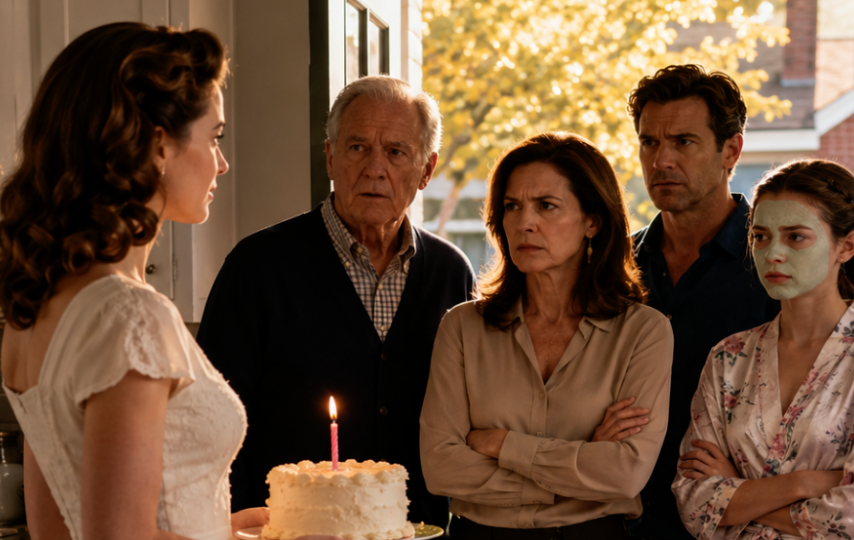
When I returned to the kitchen after carrying the rejected birthday cake inside, I found my family resuming their normal programming. Miranda, miraculously cured of her affliction, lounged in a silk robe, a green face mask applied, casually demanding a slice of the cake she had just effectively outlawed.
“No,” I stated, the syllable hanging in the air with the weight of an anvil. “This is my cake.”
The outrage was immediate. My mother pleaded with me not to “start,” desperate to preserve Miranda’s restored mood. My father angrily ordered me to surrender a cookie, labeling my refusal as selfish.
“Selfish?” My voice elevated, vibrating with eighteen years of suppressed grief. “I bought the flour. I baked them. I cleaned the house. I asked for one night. Everything is handed to Miranda, and I am perpetually told to understand.”
Miranda sneered, mocking my lack of friends—the very friends my mother had just turned away. As my parents flanked her like royal guards, my mother banished me to my room until I was prepared to apologize. But the power dynamic had fundamentally shifted. I stood my ground, finally unburdened by the desire for their approval.
Then, the doorbell rang.
It was Edward, my paternal grandfather. A towering, formidable man with piercing blue eyes, he rarely traveled from his home two hours away, but he had remembered my milestone. Stepping into the kitchen, his sharp gaze inventoried the scene: my white dress, the untouched cake, Miranda’s spa attire, and the barren, blinking backyard. When my father weakly claimed I was ill, Edward scoffed. He demanded an explanation, and when my parents stammered about prioritizing Miranda’s delicate sensibilities, his disgust was palpable.
“Avery, answer me honestly,” Edward commanded, his voice a low rumble. “Is this how it always is?”
I could have retreated to my default setting of protection and pacification. Instead, I envisioned the unlit candles and the lies sent from my phone. “Yes,” I confirmed. “This is how it always is.”
Without hesitation, he offered me an exit: a quiet home where my birthday would never be canceled. Over the shrill protests of my mother and the empty threats of my father, I ascended the stairs and packed my life into a single duffel bag. I left behind the hand-me-downs and the memories of silent crying. When my father warned that walking out the door meant forfeiting their support, I looked at him with chilling clarity.
“I’ve been on my own for years, Dad,” I replied. “You just didn’t notice.”
The profound silence of my first morning at Edward’s house felt entirely alien. I awoke expecting the familiar, frantic chorus of demands—requests to fix the coffee maker, to find the iron, to manage the morning chaos. Instead, there was only the gentle rustle of wind moving through the pine trees outside my window. The guest room, redolent of lavender and cedar, did not feel like a storage closet for a useful tool; it felt like a sanctuary for a welcomed human being.
When I descended to the kitchen, I found a plate of perfectly fried eggs, bacon, and buttered toast waiting for me. It was a minor, everyday gesture, yet it moved me to tears. No one had cooked for me in over six years. No one had paused to consider if Avery might be hungry.
My phone, however, remained a digital tether to the chaos I had fled. It illuminated endlessly with missed calls and manipulative texts. My mother accused me of ruining Miranda’s night; my father threatened me with “rules”; Miranda simply demanded a chauffeur for her morning commute. I ignored them all, spending the day peacefully weeding the garden alongside Edward.
When I finally answered my mother’s call later that afternoon, she demanded my return, casually dismissing my “tantrum” and offering superficial bribes. “We’re a family,” she insisted. “Everyone has to pitch in.”
“I pitched in for eighteen years,” I countered quietly. “I’m done.”
As the days progressed, the manipulation evolved. Anger shifted to guilt, manifesting in lies about our dog refusing to eat, or links to dresses my mother promised to buy me if I capitulated. But distance provided an impenetrable armor. I realized with absolute certainty that the dysfunction was never my fault. I was merely the structural beam holding up their decaying roof.
A week later, I sent a final, non-negotiable ultimatum:
Mom, Dad, I am safe. I am happy where I am. You keep asking me to come home. I am willing to discuss our future relationship, but I have one non-negotiable condition. Miranda is twenty years old. She is an adult. She needs to move out and learn to support herself. I cannot live in a house where her cruelty is tolerated and rewarded. If you want me back, she has to go.
The response was immediate and violent. Miranda drove to Edward’s house, practically vibrating with entitlement, demanding I return to do her laundry. When she physically grabbed my arm, her nails digging into my flesh, Edward intervened, his booming voice shattering her illusions. She fled, leaving me with four red crescent moons on my skin and the definitive proof of my family’s priorities.
Two days after the confrontation, an email arrived from my father:
…If you want to be part of this family, you need to apologize to your sister and accept your place here. If you cannot do that, perhaps it is best you stay with your grandfather until you grow up.
It was a masterpiece of blame-shifting, but that single phrase—accept your place—severed the final, frayed thread of my hope. They did not desire me; they missed the convenience of my subjugation. I typed a two-sentence reply, blocked their numbers, and felt an overwhelming, euphoric rush of liberation.
The subsequent year was an exercise in radical unlearning. I had to train my nervous system to stop anticipating unreasonable demands, to stop flinching at the buzz of a phone. But as I meticulously constructed a new, authentic life, the fragile ecosystem I had left behind catastrophically collapsed.
Through the inevitable grapevine of small-town gossip, Edward learned the details. My mother, no longer possessing a silent maid to maintain her illusions of domestic perfection, watched her home deteriorate into squalor, eventually abandoning her social engagements out of profound embarrassment. My father, stripped of his unpaid, highly competent assistant, missed critical deadlines and hemorrhaged his most lucrative consulting contracts.
Most predictably, Miranda became their sole, suffocating burden. Without me acting as a buffer and a chauffeur, she lost three consecutive jobs in four months due to her staggering arrogance and sheer laziness. My parents, bound by their vow to never let her experience discomfort, drained their finances to sustain her. Within eight months, the immaculate suburban house with the patriotic flag and the manicured lawn was sold. They were forced into a cramped, noisy two-bedroom apartment. Eventually, driven by financial ruin rather than sudden enlightenment, they forced Miranda to move out. The ship they had sacrificed me to keep afloat had finally sunk under its own weight.
Two years later, I sat in a sunlit coffee shop in Flagstaff, Arizona, the majestic, snow-capped San Francisco Peaks dominating the horizon. I was twenty years old, studying graphic design on a scholarship and working at the university library. I had genuine friends, a colorful wardrobe, and a portfolio that made me proud. My twentieth birthday had been celebrated loudly in a karaoke bar, surrounded by people who never asked me to shrink myself for their comfort.
As I sketched the mountains, my phone vibrated with an unknown number. When I answered, my mother’s thin, shaky voice filled my ear. She sounded ancient.
“You were right,” she wept, confessing that Miranda was gone and their lives were empty. “We need our daughter.”
Eighteen years ago, those words would have been my salvation. Now, they tasted like ash. I listened to the desperate subtext: We are lonely. We need a solution. They didn’t miss Avery; they missed the utility I provided.
“I have a life here,” I told her, my voice remarkably steady. “I have peace. I worked very hard for it. I’m not going to set it on fire to keep you warm.”
I ended the call over her frantic pleas and blocked the number permanently. Setting my phone aside, I looked down at my sketchbook. My coffee was warm, the mountains were brilliant, and the expansive world outside the window belonged entirely to me. I had lost a family, but sitting in that sun-drenched cafe, I realized I had finally recovered the one person who truly mattered.
Myself. And she was going to be magnificent.