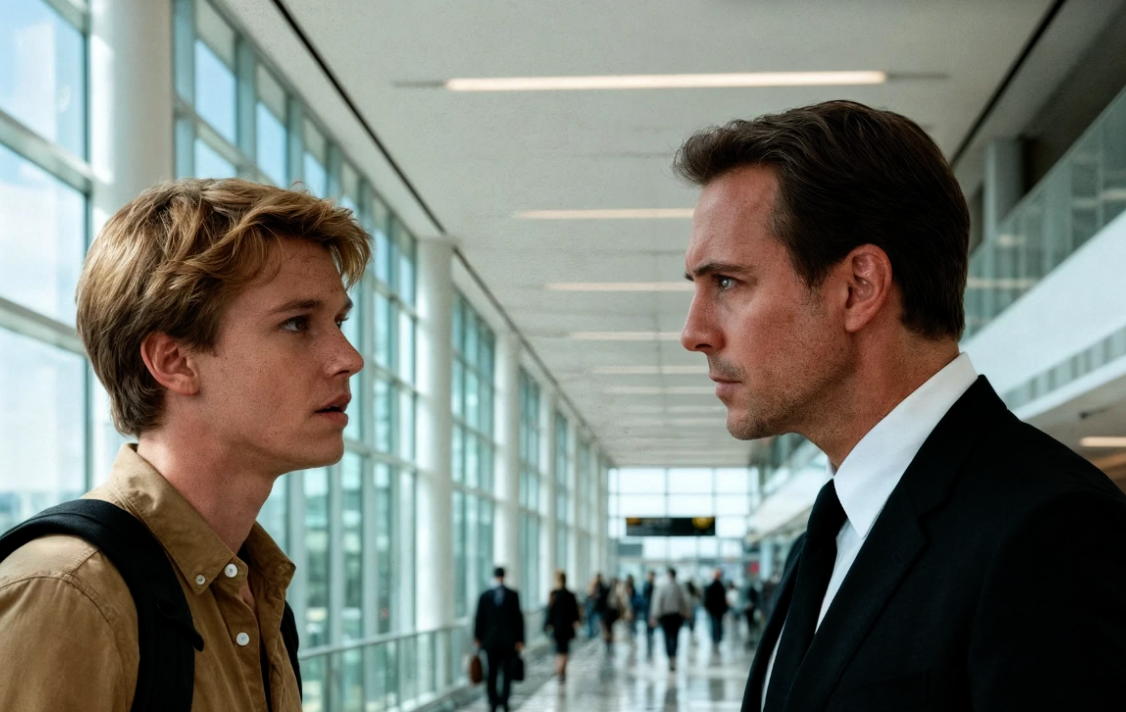
“Ethan,” Grandpa had said, his gray eyes as cold as steel in winter. “This is a private discussion.”
“I thought I could listen and learn,” I had replied, my voice cracking like the teenager I was.
Tyler laughed. “Learn what? How to spend money you’ll never have?”
“That’s enough, Tyler,” Grandpa said, though his tone suggested he approved. “Ethan, go find your mother. I’m sure she needs help with something.”
I slipped away, my face burning with shame, and found Dad in the garage, admiring Grandpa’s collection of vintage cars.
“Don’t let them get to you, son,” he said, putting an arm around my shoulders. “Men who measure everything in dollars often come up short where it truly matters.”
That was twelve years ago, and nothing had changed since. I became a chemistry teacher at a public high school in Oakland, spending my days trying to convince teenagers that understanding electron orbitals would matter in their lives someday. My starting salary was less than what Tyler spent on his monthly gym membership, but I loved it. I loved the moment when a struggling student finally understood a concept, the way their eyes lit up as if they had discovered fire.
The last time I saw Grandpa alive was six months before his death, at his eighty-sixth birthday party. He looked at me as if I were transparent when I wished him a happy birthday, then immediately turned away to discuss Tyler’s latest promotion at Barton Pierce. That night, I decided I was done trying. He had made his choice about who mattered in this family, and it wasn’t me.
And now, standing in his office for the reading of the will, I realized that nothing had changed, even after his death. The pecking order was carved in stone—or rather, in solid silver and stock portfolios. I was there out of obligation, nothing more.
The reading took place immediately after the funeral. The October rain had stopped, but the sky remained gray and heavy, matching the mood as we returned to Grandpa’s office. Mr. Dalton, the estate attorney, arranged his papers with the precision of a surgeon preparing for an operation. He had been Grandpa’s lawyer for thirty-two years, and his face showed nothing but professional detachment as he prepared to redistribute a fortune that could feed a small country.
“Before we begin,” Mr. Dalton said, adjusting his wire-rimmed glasses, “I must make it clear that Mr. Camden was very specific about his wishes. Every detail was discussed and finalized two weeks before his passing.”
Two weeks. When he knew he was dying but hadn’t thought to call me. Not that I had expected anything else.
Tyler cracked his knuckles, a habit he had carried since childhood whenever he was excited.
“Let’s get on with it, Dalton. Some of us have flights to catch.” He had already mentioned three times that he was flying to Singapore the next day for a major deal he couldn’t miss.
Mr. Dalton opened the first envelope, Tyler’s name embossed in gold.
“To my grandson, Tyler Alexander Camden, who has demonstrated the ambition and drive necessary to carry the Camden legacy forward in the business world. I leave my real estate holdings in Chicago, including Camden Tower on Michigan Avenue, the Harbor Gardens complex in the Gold Coast, and sixteen additional commercial properties with a total estimated value of twenty-seven million dollars.”
Tyler raised his fist as if he had just scored a touchdown.
“Yes! I knew it! I knew he recognized talent when he saw it.”
“In addition,” Mr. Dalton continued, “I leave him my collection of classic cars, including the 1962 Ferrari 275 GTB, the 1955 Mercedes-Benz 190 SL, and ten other vehicles stored at the Massachusetts estate.”
“The Ferrari!” Tyler practically shouted. “That thing is worth nine million by itself! Grandpa, you beautiful bastard!”
Aunt Marianne shot him a disapproving look, but she was smiling too.
Mr. Dalton cleared his throat and moved to the next envelope.
“To my granddaughter, Madison Rose Camden, whose social influence has brought a touch of modernity to our name. I leave my properties in Cape Cod, including the main estate on Bay Crest, valued at fourteen million dollars; the beach house on Ocean Drive, valued at seven million; and my private island, Harbor Key, off the coast of Oregon.”
Madison let out a scream so high-pitched I thought the crystal chandelier might shatter.
“Oh my God, Harbor Key! Do you understand what this means? I can host influencer retreats, exclusive events. This is going to change everything!”
She was already typing on her phone, no doubt drafting the announcement post for her followers.
“Furthermore,” Mr. Dalton continued, “she will receive my yacht fleet, including the Camden Star, the Harbor Dream, and the Midnight Crown.”
“Four yachts!” Madison gasped. “Four! I can’t… this is beyond.”
Her assistant was now filming her reaction, probably for some “from grief to gratitude” video. Uncle Leonard patted her shoulder proudly.
“Your grandfather knew you’d make good use of them, sweetheart.”
My mother tensed beside me, her hand searching for mine. I could feel the strain in her fingers. Dad remained perfectly still, his jaw tight, which meant he was holding back words.
“To my daughter, Elaine,” Mr. Dalton read, and Mom straightened slightly, “I leave the sum of one hundred and twenty thousand dollars and my collection of first editions, in the hope that she may find in them a wisdom I was never able to give her.”
One hundred and twenty thousand dollars. It sounded like a lot until you compared it to the millions flying around the room. The books were probably worth something, but the message was clear. She had made her choice, and this was the consequence.
“Thank you, Father,” Mom said softly, with more grace than he deserved.
“And finally,” Mr. Dalton said, pulling out a small crumpled envelope that looked as if it had been fished out of a trash can. “To my grandson, Ethan.”
The room fell silent. Even Madison stopped typing.
“To my grandson, Ethan James Hayes. I leave… this.”
Mr. Dalton handed me the envelope. It was literally wrinkled, as if someone had balled it up and then tried to smooth it out. My name was written on it in Grandpa’s handwriting, but the writing looked rushed, almost like an afterthought.
I opened it with trembling hands. Inside was a single plane ticket. First class, LAX to Marseille, with a connection to Saint-Tropez. The flight was for the next morning at 8:00 a.m. There was also a handwritten note on a torn piece of paper:
“First class. Don’t miss the flight.”
That was all.
The silence lasted barely three seconds before Tyler burst out laughing.
“Seriously? A plane ticket? One ticket!”
He literally fell back in his chair, clutching his stomach.
“My God, this is incredible. Ethan got a vacation. One little trip.”
Madison snatched the envelope from my hands before I could stop her.
“Let me see that. Oh my God, it’s true! It’s an actual ticket, not even open-ended. There’s a specific date: tomorrow.”
She dissolved into laughter.
“At least it’s first class. Grandpa really splurged on his favorite grandson’s only inheritance.”
“Maybe it’s a test,” Tyler said, wiping tears from his eyes. “Like, if you don’t go, you get nothing. But if you do go, you also get nothing. Just a pretty view of Saint-Tropez.”
“I bet there’s a hotel reservation,” Madison added. “One night somewhere average. Oh, Ethan, take pictures for us poor unfortunate souls who only inherited millions in property.”
My face burned. Every word was a slap, made worse by the fact that I couldn’t argue. It was exactly what it looked like: one final dismissal, a way to send me overseas during the estate distribution so I wouldn’t even be around to contest anything if I wanted to.
Aunt Marianne’s voice cut through the laughter.
“Father always had his reasons. Perhaps this was his way of telling Ethan to broaden his horizons, to see how successful people live before returning to his little teaching job.”
“That’s enough,” my father said in a dangerously calm voice. It was the tone he rarely used, but when he did, everyone listened. “You’ve had your fun. Message received: the carpenter’s son doesn’t deserve what the investment banker’s son deserves.”
“Oh, don’t be so sensitive, Frank,” Uncle Leonard said. “It isn’t personal.”
“Father simply recognized that some people are built for empires and others for, well, simpler things,” Dad replied. “Like teaching the next generation. Like building homes with real craftsmanship instead of glass towers that will be torn down in thirty years.”
The room erupted into arguments, but I no longer heard anything. I stared at the ticket in my hands.
Saint-Tropez, tomorrow.
No explanation, no context, no logic. Just a destination and an order:
“Don’t miss the flight.”
That evening, sitting in my childhood bedroom at my parents’ house, I turned the ticket over and over in my fingers. The room hadn’t changed much since high school. My periodic table poster was still on the wall, and my old textbooks lined the shelf above the desk. The window overlooked the backyard where Dad had built me a treehouse when I was seven, now weathered but still standing. Here, everything had permanence, history, meaning.
The ticket in my hands felt like an interruption, a glitch in the matrix of my ordinary life.
Dad knocked and came in without waiting for an answer, the way he always had. He was carrying two beers, already opened.
“Thought this might help,” he said, handing me one and sitting on the edge of the bed. The mattress groaned under his weight, a familiar sound that somehow made me feel both twelve and twenty-nine.
“You don’t have to go,” he said after a long sip. “Your grandfather played games with people his whole life—moving them around like chess pieces, testing them, manipulating them. Don’t let him play you from beyond the grave.”
“But what if it means something?” I asked, peeling the label from my bottle.
“And what if it doesn’t?” Dad replied. “What if it’s just one last power move, making you dance to his tune even after he’s gone? Monday morning, kids are counting on you. You have a life here, son. A good life.”
Before I could answer, Mom appeared in the doorway, holding a cup of tea. She had changed out of her funeral dress into her comfortable pajamas, the ones with tiny music notes that I’d given her three Christmases ago.
“I think you should go,” she said quietly, surprising both of us.
“Elaine, that man just humiliated our son in front of the entire family,” Dad protested.
“No,” she said, walking over and sitting on my other side. “He separated our son from the others. That’s different.”
She touched the ticket lightly, as if it might dissolve.
“Your grandfather was many things—cold, calculating, obsessed with control—but he was never frivolous. Never. Every gesture had a purpose, even when we couldn’t see it.”
“You’re defending him now?” Dad’s voice rose. “After all this?”
Mom shook her head.
“I’m not defending him. I’m trying to understand him. Frank, I need to tell you both something. Ten days before he died, he called me.”
We stared at her. Grandpa hadn’t called our house in years.
“He sounded different,” she continued. “Tired, but also, somehow, more present than he had been in decades. He said, ‘I’ve been watching Ethan. He’s different from the others. He has something they don’t.’ When I asked what he meant, he only said, ‘He’ll know when the time comes.’”
“Why didn’t you tell me?” I asked.
“Because I thought it was just the rambling of a dying man trying to make peace with his conscience. But now, with this ticket, I’m wondering if there was more to it.”
Dad stood and paced to the window.
“This is insane. Are we really considering sending Ethan on a treasure hunt because Walter Camden decided to play one last cryptic game?”
“It’s only one day,” Mom said softly. “One flight. If nothing comes of it, at least Ethan will know. He won’t spend the rest of his life wondering.”
I looked at the ticket again. The flight number seemed to pulse on the paper.
“My students have a test on Monday.”
“I’ll proctor it,” Mom said immediately. “I remember enough chemistry to watch them take an exam.”
“This is crazy,” Dad muttered. But I heard defeat in his voice. He knew, as I did, that once she had decided something, it was decided.
“What if it’s dangerous?” he tried one last time.
“It’s Saint-Tropez, not Mogadishu,” Mom replied with a small smile. “The worst that happens is Ethan gets a beautiful view of the Mediterranean and comes home with a story.”
I stood on the villa terrace, watching the sun set over the Mediterranean, holding the foundation documents Victor had given me. Their weight was nothing like the crumpled envelope that had brought me here. These papers carried real responsibility, real meaning, the kind I never could have imagined.
My phone buzzed with a new message from Tyler:
“Hope you’re enjoying your little vacation. Don’t blow your whole teacher salary at the casino. We’re already dividing Grandpa’s wine cellar since you’re not here to claim your share. Oh wait, you don’t have one.”
I almost laughed at the irony. They were fighting over bottles of wine worth maybe sixty thousand dollars, while I stood at the helm of half a billion they would never even hear about.
Victor joined me on the terrace, setting down two glasses of wine that was probably indecently expensive.
“Your grandfather stood exactly here when he made his decision forty-five years ago. He told me this was where he realized his American life had become a prison he had built for himself, and that this was his way out.”
“He kept me at a distance to protect all of this,” I said, finally feeling understanding settle over me like the sea breeze.
“No,” Victor corrected, his tone gentle but firm. “He kept you at a distance to protect you from becoming like them. He once told me, ‘Ethan has his father’s hands and his mother’s heart. He builds, he teaches. Let him believe we forgot him. It will make him stronger. Hunger shapes character. Comfort destroys it.’”
I thought of my students in Oakland, especially the ones who stayed after school because they had nowhere else to go. Maria, who wanted to become a doctor but couldn’t afford SAT prep. James, whose parents worked three jobs and still couldn’t cover college application fees. Destiny, brilliant in chemistry but convinced she wasn’t smart enough for college because no one in her family had ever gone.
“I’ll do it,” I said, feeling as if I were breathing after holding my breath for years. “But on one condition: I keep teaching. I’ll spend my summers and breaks here managing the foundation, working on the projects, but I’m not leaving my students. They need me and, honestly, I need them. They keep me grounded.”
Victor smiled—the first real warm emotion I had seen from him.
“Your grandfather predicted you would say exactly that. He even wrote it down.”
He pulled out another document. Grandpa’s handwriting was neat:
“Ethan will want to keep teaching. Let him. A teacher turned philanthropist will change the world. A philanthropist who remains a teacher will save it.”
We spent the next two days going through everything. The scale of the foundation was dizzying. Schools in Laos where girls were learning to read for the first time in their family’s history. Hospitals in Ethiopia providing free surgeries for children with cleft palates. Water purification systems in Ecuador that had reduced infant mortality by sixty-five percent. Every project carried Grandpa’s notes, his attention to detail, his desperate attempt to balance the ledger of his life.
“He started after your mother married your father,” Victor revealed on the final morning. “He saw her choose love over money and realized he had gotten everything backward his entire life. But by then, Tyler had already been molded in his image, and Madison was following the same path. You were his last chance to get something right.”
The flight home was different. I was no longer the same person who had left LAX four days earlier.
At Sunday family dinner, Tyler couldn’t resist asking about my “cute little trip.”
“It was educational,” I said simply, serving myself salad while he bragged about his new Ferrari.
“Did Grandpa leave you anything over there? A nice watch? A timeshare, maybe?” Madison snickered, livestreaming our family dinner because everything was content to her.
“Just perspective,” I answered, catching my mother’s knowing smile from across the table.
My father squeezed my shoulder as I sat down, and I knew he understood too. Not the details, but the change in me. Money hadn’t changed me. Meaning had.
Eight months later, a new after-school program mysteriously received funding at my high school. State-of-the-art lab equipment appeared during spring break. Every student who wanted to take AP Chemistry suddenly had their exam fee covered by an anonymous donor. Maria got into medical school with a full scholarship from an unknown foundation. James’s college application fees were mysteriously waived. Destiny received a mentor who helped her understand that she was bright enough for Caltech.
My cousins never wondered why I looked content despite my tiny inheritance. They were too busy posting selfies on their yachts and arguing over property taxes on their inherited estates. Tyler was already mortgaging his assets for new acquisitions, building his grandfather’s empire higher and higher. Madison had turned Harbor Key into an exclusive influencer retreat charging twelve thousand dollars a weekend for “authentic experiences.”
Meanwhile, the Romano Foundation quietly built fourteen new schools in Bhutan. We funded a groundbreaking malaria program in Uganda. We provided clean water to fifty-five thousand people in Bolivia. Every project was rigorously monitored, meticulously documented, and completely anonymous.
I kept the crumpled envelope in the drawer of my desk at school, right beside the photos of my students. Sometimes I took it out and looked at it, remembering the humiliation of that will reading. My cousins had received exactly what they wanted, and it had made them smaller, greedier, hungrier. I had received exactly what I needed, and it had made me grow beyond anything I could have imagined.
The final page of Grandpa’s journal contained one last note:
“Ethan, they received what they could see. You received what they will never understand. The visible fortune was my success. You are my legacy. The money I earned will be spent and gone within a generation. The lives you change will echo forever.”
He was right.
Tyler has already lost three million dollars in bad investments, too proud to admit he isn’t the genius he believes himself to be. Madison is burning through her inheritance on private jets and luxury clothing, every purchase demanding something bigger to fill the emptiness.
But today, a girl in Laos, who learned to read in one of our schools, has just been accepted to university. A boy in Ghana, who had heart surgery in our hospital, has just run his first marathon. A village in Chile that gained access to clean water has not lost a single child to a waterborne disease in three years.
Some secrets are worth keeping. Some legacies are worth living. And sometimes, the smallest gift—a crumpled envelope with a plane ticket—can be worth more than all the visible wealth in the world.
My grandfather gave me something my cousins will never have: the chance to matter.
And that is the only inheritance that truly counts.