
The afternoon sun of March 2026 cast long, skeletal shadows across the master bedroom of the Miller estate. I stood before the mahogany-framed mirror for what felt like hours, adjusting the hem of a new but deliberately plain dress. It was a soft, discreet taupe — a color designed to blend into the wallpaper, symbolizing my role as the quiet anchor and support for a man whose star was rising. In this house, I had learned that my presence was a secondary requirement, a footnote to my husband’s emerging career. I was the “tolerated” daughter-in-law, a woman who had mastered the art of the polite smile and the restrained opinion.
Downstairs, the house buzzed with the electric energy of imminent success. Today, they were celebrating Mark’s promotion to CEO. In New York’s elite business circles, such a title was more than a job: it was a coronation. Extra tables had been crowded into the vast living room, covered with brand-new crimson tablecloths that looked like fresh wounds against the white marble floors. The air smelled of expensive cologne, aged Scotch, and the cold, delicate scent of lilies.
At the center of the storm stood Mark. He looked stunning in his tailored navy suit, holding a glass of vintage Bordeaux. He nodded at every congratulation, his laughter perfectly measured: not too loud to seem vulgar, not too soft to seem timid. I watched him from the shadow of the hallway and felt a painful emptiness. We were being celebrated, and yet I had never felt more alone.
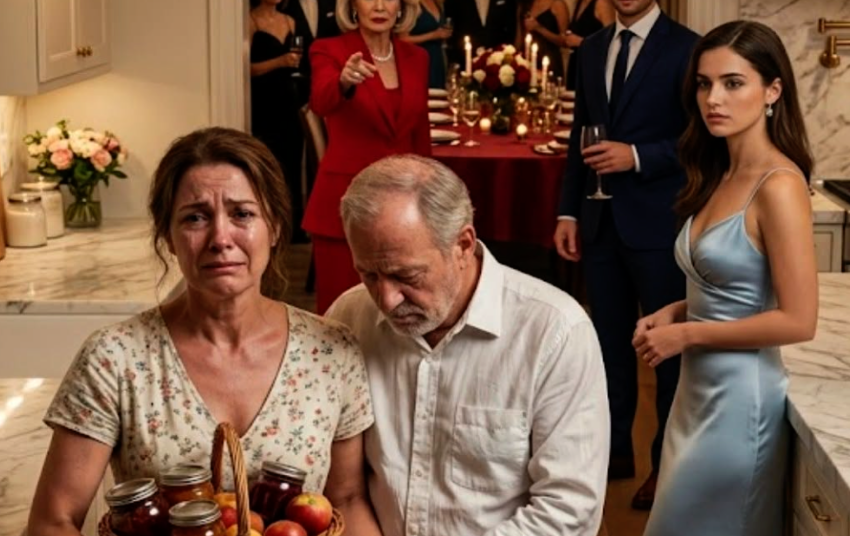
At five o’clock, the gate buzzed. I saw them through the window: my parents. In a sea of black SUVs and professional drivers, they stood at the edge of that world like two lost characters on the wrong stage. My father wore a shirt that had been ironed so many times the collar had begun to fray, but he had polished his shoes until they shone like mirrors. My mother, small and nervous, wore a light-colored dress from a local shop, her hair pinned up in a style that had gone out of fashion ten years earlier.
In her hands, she clutched a basket. It was a rustic woven basket, filled with the harvest from their modest garden: jars of homemade apricot jam, crisp apples, and dill-seasoned pickles my father grew behind the shed. To the guests inside, it was a quaint curiosity; to me, it was a basket holding the very soul of my childhood.
I hurried to meet them, my heart pounding against my ribs.
“Mom, Dad, you’re here,” I whispered, pulling them toward the door.
My father cleared his throat, straightening his posture to hide the embarrassment he felt before the tall columns and perfect lawns.
“We thought we’d come a little early,” my mother murmured. “In case there was work to do in the kitchen. We didn’t want to just be guests; we wanted to be useful.”
We had barely crossed the threshold when the air changed. Eleanor, my mother-in-law, appeared like a ghost of high society. Her gaze was a cold, clinical instrument. It swept over my father’s frayed collar, lingered with open disgust on the basket of pickles, and finally settled on me.
“Well, look who it is,” she remarked, her voice a sharp blade wrapped in velvet. “A little early, aren’t you? We don’t need ‘help’ from the guests, my dear. You’ve simply arrived early enough to get in the catering staff’s way.”
The party grew louder. The rooms became a cacophony of ambition. The “main” guests — Mark’s associates, venture capitalists, and members of old aristocratic families — occupied the central tables. They spoke the language of the wealthy: tax havens, summer homes in Provence, and volatility in the tech sector.
My parents sat in a corner, holding their glasses as if they were life preservers. Every time a waiter passed, they apologized for taking up space. That was when Eleanor came back toward us, her face wearing a mask of false concern.
“The main tables are filling up quickly,” she declared, her tone leaving no room for negotiation. “We reserved them for our long-time friends and Mark’s strategic partners. But look — there’s some room in the kitchen with the staff. Go on. You’ll be more comfortable away from the crowd.”
The words hit like a physical blow. The kitchen — a place of steam, grease, and the frantic movement of hired staff. That was where she had sent the people who raised me, who worked double shifts to pay for my education, and who came today with nothing but love and a basket of apples.
I turned to Mark. He stood just a few feet away, swirling his wine. He had heard every word. Our eyes met for a fraction of a second, and I saw cowardice there. He did not want a “scene.” He did not want his “important” colleagues to witness a domestic argument.
“Anna, don’t make a scene,” he breathed, leaning so close that I could smell the expensive wine on his breath. “There are so many people here. Let it go, just for today.”
My father, always the peacemaker, forced a heartbreaking smile.
“It’s nothing, sweetheart. The kitchen is fine. We don’t want to bother anyone.”
My mother said nothing, her eyes lowered as she followed him toward the swinging wooden door that separated the “guests” from the “servants.”
I remained in the center of the living room, surrounded by the laughter of people who did not know my name. Through the open kitchen door, I saw my father push his chair against the wall so he would not get in the servers’ way. I saw my mother staring at the cold tile floor.
And then it happened.
Eleanor walked into the kitchen and snapped:
“Sit closer to the wall! You’re blocking the dessert path!”
That was the moment the scale finally tipped.
I walked into the kitchen, and when Eleanor turned toward me with her triumphant, condescending smile, expecting me to apologize for my parents’ “awkwardness,” I did something she did not expect.
I laughed.
It was not a loud laugh. It was a soft, crystal-clear sound — the sound of a woman realizing that the cage she had been living in was made of paper, not gold.
“What’s the problem? We’re crowded!” Eleanor exclaimed, her voice carrying into the living room and silencing the guests.
I looked at Mark, who stood in the doorway with growing horror on his face. I looked at the “important” people watching this “drama” with amused detachment.
“Embarrass you?” I said to Mark, my voice perfectly steady. “You weren’t embarrassed when you saw my parents sent to the kitchen like trash. But now you’re embarrassed?”
I took my mother’s hand. It was rough, thin, and trembling. Then I took my father’s hand.
“Dad. Mom. We are not having dinner here tonight.”
“If you walk through that door,” Eleanor screamed, her face turning blotchy purple, “you don’t ever have to come back!”
I did not turn around. I simply smiled.
“I know. And I won’t be the one begging to return.”
The cool New York evening air felt like a blessing. We hailed a taxi, leaving behind the house with its red tablecloths and hollow celebrations. My parents were in shock.
“Sweetheart, people will talk,” my mother whispered. “They’ll say you’re ungrateful.”
“Let them talk,” I said.
I took out my phone. I did not call a friend. I called a number few people in New York knew — a direct line to the concierge of one of the most exclusive five-star hotels in downtown Manhattan.
When we arrived, the transformation was complete. The automatic glass doors opened, and a man in a tailored suit bowed.
“Ms. Miller, your VIP lounge is ready. Please follow me.”
My parents froze. The luxury here made Mark’s house look like a poor imitation. White linens, silverware, a panoramic view of the city.
“They know you?” my mother asked in amazement.
I simply smiled and pulled out their chairs.
“Tonight, order whatever you want. Don’t look at the prices. Just breathe.”
As the waiter poured the wine, my phone began to vibrate. It was not merely vibrating; it was screaming.
83 missed calls from Mark.
15 voicemails from Eleanor.
Dozens of messages from the family.
I placed the phone face down on the white tablecloth. The “daughter-in-law” had disappeared. In her place was the woman who understood the true mechanics of power.
While we sat in the quiet luxury of the restaurant, a storm was raging at the Miller house. The banquet had not simply ended; it had imploded.
Eleanor received the first call: a representative from the bank, cold and formal, informing her that the company’s main lines of credit were “under review for irregularities.”
Then came the second shock: Mark’s vice president called to say that three major investment partners had suddenly suspended contract negotiations.
Why?
“Orders from above.”
The panic in that living room must have been palpable. “Above” was a level of influence Eleanor and Mark could only dream of — a world where wealth was not merely earned but inherited and wielded like a scalpel.
Eleanor sat at the head of her empty table, staring at the cold lobster tails. She remembered a name mentioned by the banker — a name linked to the silent benefactors who had saved the family company from bankruptcy years earlier. She understood, with chilling clarity, that the “ordinary woman” she had insulted was the key to that door.
The next morning, the meeting took place in the hotel lobby. Eleanor and Mark arrived looking like ghosts. Eleanor’s arrogance had vanished, replaced by desperate, feverish humility. She no longer gave orders; she sat with her hands clasped, eyes fixed on the floor.
“I… I came to apologize,” she stammered.
My father, the man who had been sent to the kitchen, looked at her. He did not look at her with anger, but with deep, tired pity.
“We don’t need your apology for ourselves,” my mother said, her voice surprisingly strong. “We simply ask that in the future, you do not look down on anyone — especially not the people who love the woman you call family.”
Mark turned to me, his eyes pleading.
“Anna, come home. We can fix this. I’ll be on your side from now on.”
I looked at him and saw the truth. He was not choosing me because he loved me; he was choosing me because he was afraid of what I could take away from him.
“You can repair an action, Mark,” I said. “But you cannot change a lifelong habit. You didn’t stay silent because there were ‘too many people.’ You stayed silent because deep down, you agreed with her. You believed they did not belong at the main table.”
My father stood. He placed a hand on Mark’s shoulder.
“Being a husband,” my father said, “means choosing the right side when it is difficult, not only when it is convenient. If you had stood up in that kitchen, you would have had a family. But you chose the crowd. And now the crowd is all you have left.”
A few weeks later, we moved into a new apartment. It was not a mansion. There were no marble floors or catering staff. It was a place with large windows that let in the morning sun and a kitchen where there was always room for everyone around the table.
My parents lived with me for a while. I watched my father water the plants and my mother make soup, her movements slow and peaceful. The weight of “having to fit in” had disappeared. We were no longer characters in someone else’s play; we were the authors of our own.
Mark’s family company survived, but it was humiliated. The contracts were eventually restored, but its prestige had been stained. They had learned the most expensive lesson of all:
There are people you must never, ever offend — not because they are powerful, but because they are good.
Looking back on that night at the banquet, I realize the story was not about a promotion or a restaurant. It was about the three pillars of self-respect:
Dignity is non-negotiable.
If a relationship requires you to sacrifice the respect owed to your parents, it is not a relationship; it is a transaction.
Silence is a choice.
In the face of injustice, silence is not “keeping the peace”; it is complicity.
True power is quiet.
The loudest person in the room is rarely the most influential. Real influence comes from the integrity of one’s character.
A home does not need to be large. It does not need to be filled with CEOs and venture capitalists. What matters is that within its walls, there is room for everyone to sit with their head held high.
That final evening, I turned off my phone and listened to the rain against the window. I was no longer the “daughter-in-law.” I was a daughter who had honored her parents. And there, I found a wealth no CEO title could ever offer.