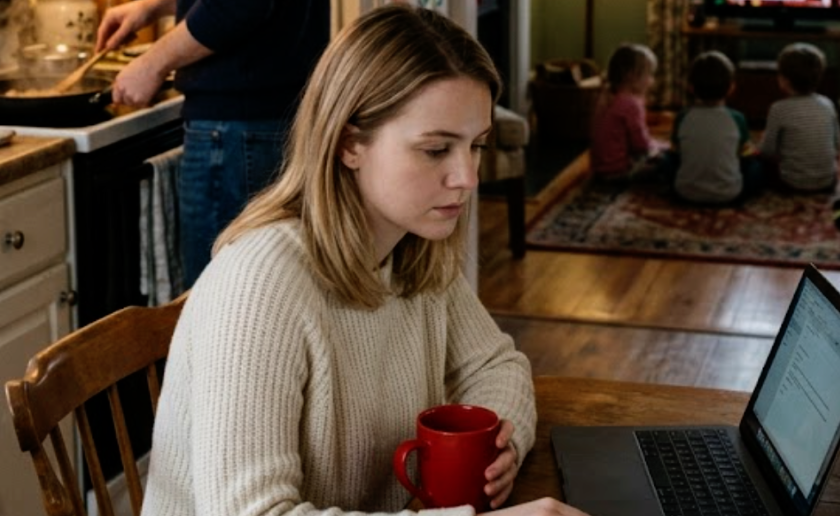
Two sleeping bags pulled from the hallway closet. That was the precise moment the foundation of my family fractured. They were the cheap kind, adorned with faded cartoon dinosaurs, smelling distinctly of basement damp and mothballs. My mother didn’t gently hand them to me; she tossed them. One landed at my six-year-old son’s feet. The other hit the floor beside my four-year-old daughter, who immediately picked it up and hugged it like a gift simply because she didn’t know any better.
My sister, Ashley, stood in the guest-room doorway, leaning against the frame, and laughed.
“Should have booked a hotel.”
I counted to three. I always count to three.
To truly understand what we walked into that night, you have to back up two hours. My husband, Ryan, and I had both taken the day off work, driving two and a half hours from Rochester to Maple Grove. We arrived on the porch laden with offerings: my son Owen in a Thanksgiving sweater he proudly picked out himself; my daughter Ellie clutching her beloved stuffed rabbit; an expensive, forty-six-dollar ivory linen tablecloth I had bought because my mother casually mentioned hers had a stain; and a pumpkin pie baked from scratch using my late father’s heavily guarded recipe.
When we walked in, Ashley’s family was already deeply settled. Their coats occupied every available hook by the door. My mother’s guest room was fully claimed by Ashley’s kids, Mackenzie and Jordan. Their shoes were neatly lined up by the bed, their suitcases were unzipped, and iPads were charging on the nightstand. They had been there since Tuesday.
Dinner went as it always did. Mom said grace, thanked God for family, and praised Ashley for her “courage” and resilience through a rough week—a rough week that had arguably lasted since her divorce in 2019. When the time came to put the exhausted children to bed, I assumed we would find space. Instead, my mother gave me her signature closed-door smile. The one that was warm on the surface but bolted heavily from the inside.
She told me Ashley’s kids couldn’t possibly be moved, praised my children as “troopers” who would view sleeping on the floor as an adventure, and tossed the flimsy dinosaur sleeping bags onto the living room carpet.
I counted the coats on the hooks: five. None of them ours. I counted the photos on the mantel: seven. I was in exactly one, blurred in the background holding a cake for someone else. I knelt down to eye level with my children.
“Pack your things, babies,” I whispered. “We’re going on a real adventure.”
Ryan didn’t ask a single question. He read my face and gathered our things. My mother stood in the doorway, the porch light illuminating her from behind, accusing me of being dramatic over “just one night.” I didn’t turn around.
It was never just one night.
By 11:07 p.m., we were on the highway. Driving away from a place you’ve spent your whole life trying to belong to doesn’t initially feel like freedom. It feels like cold, simple math. The kind you do in the dark at seventy miles an hour, adding up every dollar and every sacrifice, until you realize the total was never going to be enough because you were never the one they were counting.
Part II: The Invisible Ledger
The pumpkin pie was still between my feet, filling the car with the scent of brown butter and nutmeg. It smelled exactly like my father. He used to make that pie at six in the morning on Thanksgiving, fiercely refusing help from everyone except me, whom he let measure flour from a stepstool.
“The house doesn’t hold itself up, kid,” he used to say.
He wasn’t talking about the pie, and he wasn’t just talking about the physical building. He meant the furnace filters, the gutters, the mortgage checks he wrote by hand—the invisible, unglamorous work nobody throws a parade for. When he died of pancreatic cancer at fifty-seven, his final words to me in the hospice room were a directive: “Take care of the house, Lauren.”
He meant the people in it.
I was twenty-five then, working as a dental hygienist and making fifty-eight thousand dollars a year. Three weeks after his funeral, my mother called me over to look at the finances. She saved her crying for audiences; with me, she was strictly business. After Social Security and her part-time job, she was short roughly $1,200 a month on the newly refinanced mortgage.
When I tentatively asked about Ashley helping, my mother gave me a look of pure patience, as if I had asked a refrigerator to levitate. Ashley was going through a divorce; she was far too fragile. So, I volunteered. I set up the auto-pay. Ryan, who was only my boyfriend at the time, warned me with quiet clarity.
“You’re supposed to be her daughter, not her bank account.”
I filed that sentence away and ignored it. Over the next four years, the invisible ledger grew aggressively:
Month 6: Supplemental health insurance to bridge her to Medicare. $340 a month.
Month 14: An emergency furnace replacement in the dead of a Minnesota winter. $4,200 put entirely on my credit card.
Month 20: Gymnastics tuition for Ashley’s daughter. $280 a month, because Ashley couldn’t “swing it.”
Year 3: A roof replacement deposit. $3,500.
Meanwhile, Ryan and I indefinitely postponed our own kitchen renovations. I kept a spreadsheet on my phone, silently watching the numbers climb, constantly telling Ryan, “Just one more year.” It is the universal prayer of people paying for love on installment.
The family dynamic had been permanently cemented when I was nine years old. Dad had a cancer scare. Mom packed Ashley a bag and sent her to Aunt Ruth’s because Ashley “gets scared when things are uncertain” and “needs to be somewhere safe.” I was left to walk three blocks alone in the freezing dark to a neighbor’s house.
“You’re my strong one, Lauren. You can handle it,” my mother had declared.
That was the unbreakable family rule: Ashley gets rescued. Lauren handles it.
Ashley never had to be anything. She lost four jobs in four years, and Mom meticulously crafted an excuse for every single failure. I worked five days a week, scraping calculus off molars, driving a beat-up Honda, and budgeting my $3.40 daily lunches. When I paid $8,500 for Mom’s kitchen renovation and spent three days of my vacation grouting the backsplash until my knees ached, Ashley arrived, took a photo of the countertops for Instagram, and hashtagged it #blessed. My mother commented on the post, praising “her” beautiful home. No one mentioned me.
I had spent my entire adult life trying to earn a seat at a table that was never actually set for me.
Part III: The Cancellations
It was 1:30 a.m. when we finally pulled into our driveway in Rochester. Our house was small, and the cabinet handles stuck out too far, but every room had a real bed for every person who lived there. After tucking the kids in safely, I sat in my kitchen, opened my phone, and looked at the spreadsheet.
The bottom number stared back at me like a receipt for a meal I never ordered: $97,340. By morning, I knew exactly what I was going to do.
It was Black Friday. While the rest of America trampled each other for electronics, I sat at my kitchen table with a cup of coffee and methodically dismantled the invisible scaffolding holding up my mother’s life. I approached it the way I approached a dental cleaning: methodical, precise, and entirely unsentimental.
Cancellation 1: The Mortgage. $1,850 a month. Forty-eight payments completed totaling $88,800. I hit cancel, confirmed the prompt, and wiped the slate clean.
Cancellation 2: Supplemental Insurance. $340 a month. Thirty-six months of payments totaling $12,240. I called the provider and transferred the billing back to the policyholder.
Cancellation 3: The Roof Project. A brief text to Jim the contractor canceled the project and secured my $3,500 deposit refund.
Cancellation 4: Gymnastics Tuition. $280 a month. Twenty-six months of payments. I logged into the portal and deleted my Visa card.
Four cancellations. Total monthly financial bleed removed: $2,470. Total one-time funds recovered: $3,500.
Total lifetime investment in being invisible: $124,520.
I closed my laptop and placed my hands flat on the table. Grounded. Done.
Ryan slid a plate of pancakes in front of me. He didn’t ask if I was sure or if we should convene a committee to discuss it. He just looked at me and said one word: “Good.” It held the exact weight of a man who had been patiently waiting four years for me to finally choose myself.
Before I left the table, I took screenshots of every single transaction from the past four years and placed them in a folder named Proof. It wasn’t for social media, and it wasn’t for a courtroom. It was simply armor for the inevitable moment when someone would look me in the eye and tell me I hadn’t done enough.
Part IV: The Fallout
The system ran purely on fumes through the weekend. But by Monday, the ground in Maple Grove started to aggressively cave in. The phone calls began, and I let every single one ring through to voicemail.
My mother left a message on Sunday assuming a “glitch” with the bank. By Monday, her tone shifted to panic. She pleaded with me to call her, leaning heavily on her weaponized incompetence: “I don’t understand these things, you know that.” The reality was, she understood them perfectly well when Dad was alive. She understood them well enough to let me pay for four years without ever uttering a single thank-you.
Then, Ashley called Ryan. Not me, Ryan.
Mackenzie’s gymnastics payment had bounced, and Ashley, operating at her usual pitch of high irritation, wanted to know if I had “forgotten” to update my card. She didn’t say thank you for the past two years of tuition. She treated me like a broken vending machine, annoyed that her free ride had abruptly halted. Ryan calmly informed her that the issue was between her and her family, refusing to engage in the drama.
By Tuesday, the cracks were massive. Mom left a frantic voicemail about the mortgage company sending a letter and the tarp on the roof failing against the coming snow. Ashley texted me a 43-word manifesto of pure, distilled projection. She called me selfish for letting Mom lose her house, entirely blind to the sheer audacity of demanding I continue paying for a house she had never contributed a single dollar toward.
By Wednesday, the cascade reached its inevitable peak. The smiling controller had activated her entire network. Aunt Ruth, Uncle Terry, and Barb from church all left deeply concerned voicemails. Not one of them knew the financial truth, because Mom hadn’t admitted that her youngest daughter had been secretly funding her life. She simply told them I was being “distant” and had abandoned the family over a petty misunderstanding.
“She just doesn’t always know how to show it,” Barb pleaded in her voicemail. It is the universal alibi of people who never have to be on the receiving end of the damage.
By Wednesday evening, the call log on my phone hit 198. Not one person asked what had actually happened at Thanksgiving. Not one person asked why a mother of two packed up and left at 11:00 p.m. To ask the right questions would mean rearranging the sacred family myth—the myth where Diane was a saint, Ashley was fragile, and Lauren simply handled the burdens.
Mom’s final voicemail was desperate and sharp. “I cannot lose this house. Your father would be—” She stopped herself right before she said “ashamed of you.”
She was entirely wrong. My father, the man who wrote the checks by hand and taught me the value of invisible labor, would have looked at that $124,520 spreadsheet and felt profound shame. It just wouldn’t have been directed at me.
I finally picked up my phone and sent a single, definitive text: “I’ll meet you Saturday. Just us. Caribou Coffee. 10 a.m.”
Part V: The Confrontation
Saturday morning, I arrived at Caribou Coffee seventeen minutes early. Outside, the first real snow of the season was dusting the sidewalks, signaling a hard reset. Inside my bag was a manila folder containing fifty-three pages of highlighted bank statements.
I didn’t rehearse my speech. You cannot rehearse a conversation with someone who constantly rewrites the narrative while you are standing in it. I brought raw numbers instead. Numbers do not rearrange themselves to induce guilt; they simply exist.
Mom arrived in her formal church clothes, her makeup applied with the precision of a press release. It was armor cleverly disguised as elegance. She sat down, claiming she was “worried sick” about me.
I bought her a chamomile tea, sat down across from her, and placed the manila folder on the table.
“Mom, do you know what auto-pay is?”
Her hand hovered over the teacup. I opened the folder and systematically took her through it, page by undeniable page. The mortgage. The insurance. The emergency furnace. The kitchen renovation. The gymnastics tuition. The roof deposit.
“Total: $124,520. Over four years.”
Her fingers went entirely still. For a brief moment, the smiling controller faltered. She whispered that she didn’t know it was that much money.
“You didn’t ask,” I replied calmly.
She attempted one final defense, trying to shrink the reality by claiming I was overreacting to a single night with the sleeping bags. I didn’t raise my voice. I didn’t need to; the folder was doing all the screaming for me.
I told her it was never about one night. It was about every holiday where Ashley showed up empty-handed and got the crown, while I showed up loaded down with the financial and emotional weight of the family and got the floor. She had given Ashley the guest room, but she had given me the mortgage. That was her math, not mine.
“What do you want me to do?” she asked. It was the smallest, most vulnerable voice I had ever heard her use.
I laid out the boundaries of our new reality. I wasn’t going to let her lose Dad’s house, but I was absolutely done being invisible. She had two distinct options: Ashley could finally start contributing, or Mom could downsize the property. And if my family ever visited again, my children would get actual beds.
I stood up, leaving the massive folder on the table.
“Lauren,” she called out. I looked back. She seemed remarkably smaller than I remembered. “Thank you. For… for all of it.”
It had taken four arduous years and $124,520, but the very first thank-you finally arrived the precise moment I stopped paying.
Part VI: The Real Sleeping Bags
That evening, the snow stopped, leaving the backyard in Rochester looking breathtakingly crisp and clean. I walked out to the back porch carrying an Amazon box. Owen and Ellie followed me like I was carrying treasure.
I opened the cardboard and pulled out two brand-new, premium sleeping bags. They were rated for twenty degrees, lined with incredibly soft flannel, deep forest green on the outside, and patterned with little silver stars on the inside.
Owen unrolled his immediately on the porch and excitedly climbed inside.
“These don’t smell like Grandma’s basement.”
I laughed. It was a real, unburdened laugh, bubbling up from a place that had been suffocated by ledgers, numbers, and silence for far too long. Ellie asked if we were going camping. I promised her we absolutely would. Just the four of us. A real plan for the spring, complete with a campfire and marshmallows, completely free from the agonizing obligations of baking pies for people who wouldn’t taste them, or buying tablecloths for a table that had no seat for me.
Ryan brought out mugs of hot chocolate. We sat together in the cold, letting the kids meticulously count their marshmallows. Some counting is not a burden; sometimes, it is just joy wearing the coat of arithmetic.
The house in Maple Grove was objectively bigger. It had four bedrooms and a grand mantel full of photos where I barely existed. But sitting on my porch, watching my children safely cocooned in sleeping bags they actually wanted, I finally understood my father’s wisdom in its entirety.
The house doesn’t hold itself up, kid.
But neither do you.
There is a distinct point where relentless loyalty to your family crosses a line and becomes a profound betrayal of yourself. I found my answer on a Wednesday night in November, driving down the highway in the dark. I think most people who carry the invisible weight of their families already know their answer.
The only difference now is realizing that you are finally allowed to say it out loud.