The voice of my mother, Janice, materialized through the cellular receiver with a calculated, glacial precision. “Mother’s Day is only for the well-behaved kids. Your daughter can skip this year.” The articulation of those words did not merely inflict emotional distress; they manifested as a visceral, kinetic impact. I sat across the kitchen table from my eight-year-old daughter, Laya, whose innocent morning routine was abruptly shattered. The glass of juice she held froze in mid-air, a pendulum abruptly halted by the gravity of the room. Her wide, perceptive eyes locked onto mine, and the whisper that escaped her lips systematically dismantled the fragile architecture of my heart.
“Grandma doesn’t love me.”
That singular fraction of a second constituted an irrevocable paradigm shift. For the entirety of my conscious life, I had assumed the role of the compliant, well-behaved daughter. I was Hannah Romano: the localized reserve bank, the institutional guarantor of the family’s comfort. I funded my mother’s revolving credit lines, subsidized my brother’s vehicular liabilities, and sponsored my sister’s manufactured luxury vacations. I had continually metabolized their casual insults and bottomless entitlement under the misguided assumption that I was purchasing familial harmony.
However, witnessing that intergenerational poison spill directly onto my child stripped away the illusion. The “peace” I had been financing was an absolute fabrication. It was merely the maintenance of control. As I observed Laya’s trembling lower lip, a profound, crystalline resolution descended over my psyche. The cyclical weaponization of conditional love had reached its absolute terminus.
Love that demands a continuous ransom of compliance and capital is not love. It is extortion wrapped in the vocabulary of kinship.
For my entire adult existence, my personhood had been secondary to my utility. I was not recognized as Hannah Romano, the autonomous individual; I was the provider, the operational fixer, the silent treasury from which everyone felt entitled to withdraw.
This systemic exploitation did not manifest overnight. It was an insidious, incremental encroachment. It commenced upon my college graduation when I secured my first position as a junior analyst. I was immensely proud of my initial salary, and my mother, wielding a masterclass in emotional manipulation, suggested we consolidate our financial infrastructure. “Just in case of an emergency, darling,” she had purred, gently patting my hand. “It’s what families do. We support each other.”
I acquiesced. I harbored a desperate, naive longing for the idealized, supportive familial structures depicted in media. My hunger for her maternal validation was so acute I would have authorized any concession. Thus, the precedent was established, and the “emergencies” began to aggregate.
The escalation of their demands correlated perfectly with my professional trajectory. As I earned promotions and my income expanded—especially during the grueling sixty-hour work weeks following Laya’s birth and her father’s departure—my relatives ceased viewing my salary as my rightful compensation and began treating it as their communal asset.
To understand the pathology of this family dynamic, one must examine the specific methodologies of their financial extraction:
The resultant guilt was a suffocating miasma. She successfully engineered an environment where prioritizing my own child’s medical needs over my adult sister’s leisure felt like a moral failing. I capitulated. I prioritized an adult’s cosmetic vacation over my daughter’s dental health.
I was the branch office; they were the corporate headquarters. They demanded continuous capital injections but offered zero interpersonal dividends. They possessed encyclopedic memories for billing cycles but suffered collective amnesia regarding Laya’s birthdays and ballet recitals. The peace I purchased required me to remain in pieces.
The silence in my kitchen following the phone call was absolute, dense with the realization of my own complicity. I dropped my phone upon the granite counter and knelt to embrace Laya. Her small frame was rigid, vibrating with the effort to internalize a rejection she lacked the psychological framework to comprehend.
“She said she doesn’t want me,” Laya sobbed, the sound tearing through the quiet room—a profound, wounded resonance that shattered the final remnants of my familial loyalty.
A novel sensation flooded my nervous system. It was not the familiar, exhausting resentment I had harbored for years. This was an arctic, hyper-focused rage. I had spent a decade functioning as a shield for my abusers, inviting vipers into my sanctuary, only to act shocked when they struck my offspring.
After consoling Laya, setting her up with her favorite animated program and the promise of chocolate-chip pancakes, I returned to the kitchen. My phone vibrated with an Instagram notification. It was Chloe.
The digital tableau before me was an orchestration of deliberate cruelty. The uploaded video showcased Janice brandishing crystal champagne flutes, Chloe blowing performative kisses, and Derek gorging on artisanal pastries. The geotag confirmed their location: Lavenia, the city’s premier brunch establishment, a venue they exclusively patronized on my pre-authorized tab.
The caption read: “Happy Mother’s Day to the best mom in the world. So happy to celebrate with our real family.”
They were actively broadcasting my exclusion as a punitive measure. They assumed this public humiliation would erode my resolve. They calculated that the juxtaposition of their joyous solidarity against my isolated rejection would compel me to apologize, to grovel, to open my wallet in exchange for readmittance into the “real family.”
They had fundamentally miscalculated. The arctic clarity within me crystallized. This was not a humiliation; it was an emancipation proclamation.
“They just made the biggest mistake of their lives,” I whispered to the empty room.
I bypassed the social media applications and directly accessed my banking infrastructure. The interface, once a source of chronic, low-grade dread, now presented itself as the instrument of my liberation.
As I began preparing the pancake batter, the technological fallout commenced. Text messages flooded the lock screen. Chloe: “My card was just declined at the salon. Fix it.” Derek: “WTF? My gas card isn’t working.” Chloe: “Hannah, answer me. You’re embarrassing me.”
The silence of their panic was deafening. I ignored the barrage, focusing instead on the perfect golden-brown circumference of the pancakes. The telephone rang; a local number materialized on the display. I accepted the call, placing it on a low-volume speaker.
“Hello, Miss Hannah Romano. This is Michael Tran, the manager at Lavenia,” a polite, professionally strained voice stated. “I have your mother and her party here. We’re experiencing an anomaly with the card on file. She stated you were running late and would handle the settlement.”
Janice’s performance was holding steady; she was defaulting to the narrative of my incompetence to shield her own insolvency.
“I will not be joining them, Michael,” I articulated with uncompromising authority. “Furthermore, they are no longer authorized users on my financial accounts. My mother, Janice Romano, will be assuming full liability for her bill today.”
The profound silence radiating through the receiver spoke volumes. Michael, a consummate professional, grasped the sociodynamics of the situation instantly. “I understand completely, Miss Romano. I will manage the situation on this end.”
The ensuing barrage of calls from my mother was frantic, vibrating the phone against the granite countertop. I finally answered. The background noise consisted of Chloe’s audible weeping and the ambient murmur of a restaurant observing a public collapse.
“Hannah,” Janice’s voice trembled with a manufactured, cloying sweetness. “Something is dreadfully wrong with your card. You are embarrassing us, darling.”
“There is nothing wrong with my card, Mom. I am simply not subsidizing your lifestyle anymore. You, Derek, and Chloe have been permanently removed from my accounts.”
The facade instantly evaporated, replaced by a feral hiss. “How dare you? You will rectify this instantly. You are ruining Mother’s Day!”
“You achieved that an hour ago,” I countered, my tone devoid of inflection. “When you informed me my daughter was an undesirable.”
She devolved into chaotic threats, accusing me of utilizing my wealth as an instrument of control. I interrupted her flailing logic. “I do not feel powerful because I possess financial resources. I feel powerful because I have permanently revoked your access to them.”
I terminated the connection.
Despite the profound satisfaction of that boundary, I recognized that authentic closure required physical finality. I was not going to hide. I instructed Laya that I was running a brief errand, secured the premises, and drove to Lavenia.
Upon entering the establishment, the visual tableau was striking. The curated aesthetic of Chloe’s Instagram post had dissolved into pathetic reality. Janice was flushed and argumentative; Chloe was submerged in genuine, mascara-streaking grief; Derek appeared catatonic.
As I approached the host station, Janice lunged, her manicured fingers—a service I had funded—digging into my forearm. “Stop this right now. Go to Michael and unfreeze the card,” she commanded.
I met her gaze, gently prying her fingers from my flesh. “You do not retain the privileges of my resources after discarding my humanity,” I stated.
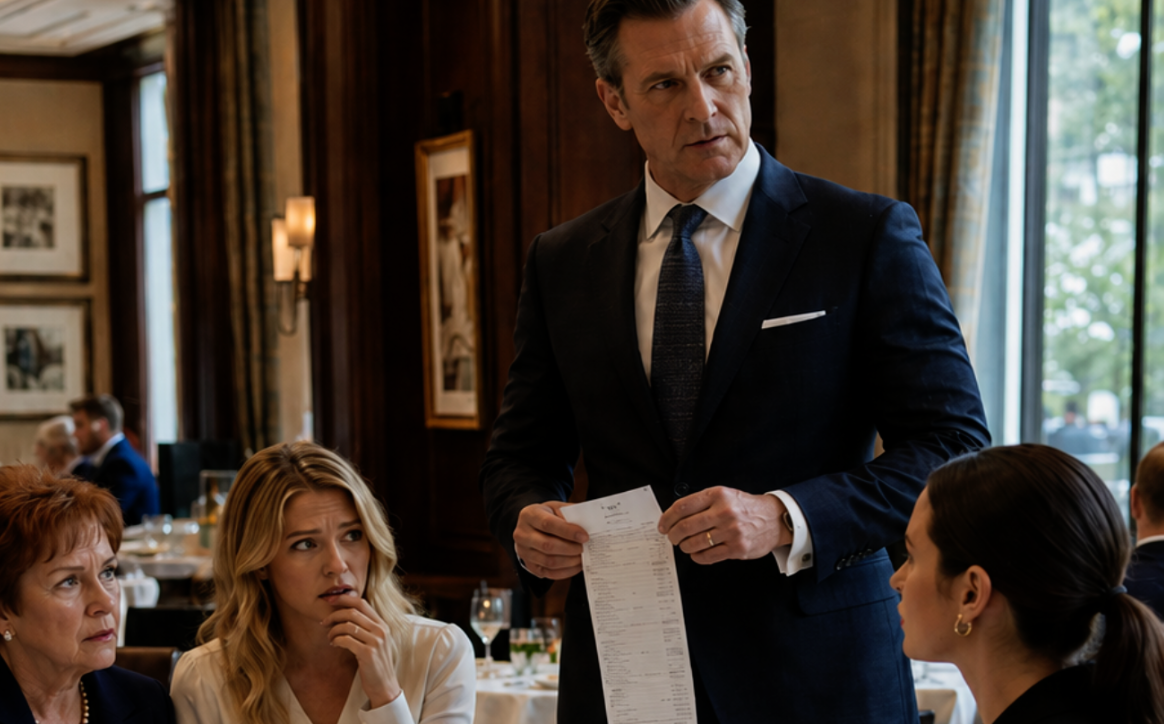
I approached Michael and requested an itemized ledger. The extravagant total—fueled by premium champagne and gratuitous appetizers ordered after my daughter’s exclusion—exceeded one thousand dollars. I retrieved my personal debit card.
“I will compensate the establishment solely for the omelette, the pastries, and the coffee—items totaling exactly ninety-four dollars. They must reconcile the remainder.”
Chloe wailed, “You’re making us look destitute!”
“You are destitute,” I replied with quiet devastation. “You have simply been living as parasites on my labor for so long that you forgot your own reality.”
I signed the receipt, pivoted on my heel, and exited the venue. The chimes of the restaurant door signaled the final curtain on my subjugation.
Returning to the absolute tranquility of my home, I observed Laya peacefully coloring at the kitchen table. The immediate confrontation had concluded, but the structural integrity of my new boundaries required comprehensive reinforcement. The financial cutoff was merely a symptom; the enmeshment was systemic.
I opened my laptop and initiated a meticulous, uncompromising purge of my personal infrastructure:
The hierarchy was dissolved. The treasury had locked its vaults.
The subsequent days were characterized by the predictable mechanics of a narcissistic smear campaign. My cellular device became a repository for vitriolic voicemails, desperate text messages, and hysterical declarations of my supposed mental instability.
My branch manager, Mr. Henderson, even contacted me to report that my family was causing a disturbance in the bank lobby, demanding access to my capital under the guise of an emergency intervention. I calmly instructed him to summon the authorities and refer any further communication to legal counsel. The sheer terror of accountability sent them fleeing before law enforcement arrived.
Extended family members forwarded their judgments, operating on the manipulated narratives Janice had distributed. The historical version of myself would have mounted a frantic, exhaustive defense campaign, desperately trying to correct the record.
The reconstructed Hannah Romano understood that defending oneself to an audience committed to intentional misunderstanding is a fool’s errand. I initiated a digital quarantine: I blocked their telecommunications, deactivated my social media interfaces, and embraced the profound, echoing silence.
Weeks synthesized into months. The absence of dread became my new baseline. My financial portfolios, unburdened by the weight of three adult dependents, began to compound exponentially. I initiated a substantial educational trust for Laya and accelerated my mortgage amortization.
One vibrant Saturday morning, Laya and I drove to the municipal botanical gardens. At nine-thirty in the morning, defying conventional dietary paradigms, we purchased massive chocolate ice cream cones. We located a serene bench overlooking a water feature.
Laya, her face smeared with chocolate, leaned against my shoulder. The anxious, hyper-vigilant posture she used to adopt around her grandmother had completely dissolved.
“Are they still mad, Mom?” she inquired softly.
I considered the intelligence I had passively absorbed through the grapevine: Janice had been forced into retail employment; Derek was utilizing public transportation; Chloe had been compelled to downsize her housing due to overwhelming insolvency. They were experiencing the friction of reality.
“Yes, they are likely still angry,” I responded with measured honesty. “But more importantly, they are learning. They are learning the mechanics of self-reliance.”
As I looked out over the meticulously cultivated garden, I recognized the profound fallacy that had governed my existence. I had historically conflated love with continuous, unreciprocated transaction. I had believed that tranquility required self-immolation.
The boundary I established on that specific Sunday was not an architecture of malice. It was the most profound, fundamental act of maternal protection I had ever executed. It was the bedrock upon which a new, sustainable ecosystem would thrive—a paradigm where affection did not require continuous taxation, and where my daughter could exist, unburdened by the mandate to be “well-behaved” merely to secure her right to be loved.