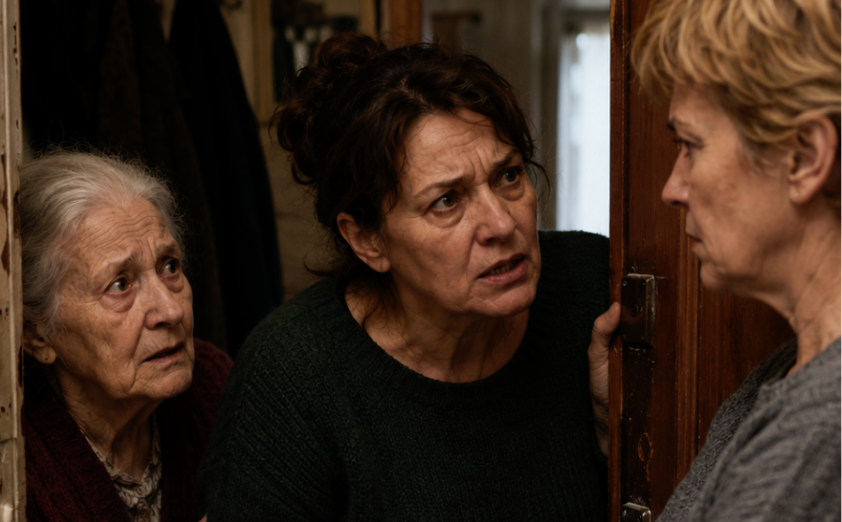
“Daughter, take me away from here, they’re locking me in!” my mother sobbed into the phone, and in the background someone snapped sharply, “Put the phone down.”
“Mom, where are you right now?” I asked, standing up so quickly that the cup on the table wobbled.
“At Kolya’s, in the room,” she whispered. “They took the key out. They say I’m in the way. I only wanted to go to the kitchen.”
“Give me the phone,” I heard the voice of my sister-in-law, Svetlana. “Valentina Sergeyevna, are you making a scene again?”
“Mom, don’t hang up,” I said. “I’ll be there in an hour.”
“No need,” Svetlana suddenly said loudly, now into the phone. “Elena, your mother is simply being capricious. We feed her, give her water, and she complains about us.”
I looked at the bag by the door, at my passport in the open drawer, at the phone trembling in my hand. If I went there alone now, they would once again say it was just family hysteria. Which meant I couldn’t go alone.
I was fifty-six years old, and I knew that tone far too well. That is how people speak when they have already decided that an elderly person is a thing that can be moved, shut away, fed on a schedule, and then call it care.
My mother, Valentina Sergeyevna, was seventy-nine. All her life she had been neat, quiet, and a little stubborn. She loved white curtains, her cups with blue rims, and her habit of going out into the courtyard after lunch.
After my father died, she lived alone until my brother Nikolai persuaded her to temporarily move in with him.
“Mom, it’s worrying for you to be alone,” he said. “We’ll be nearby. Sveta knows how to cook, there’s enough room, and your apartment can be rented out for now.”
I argued back then. I offered Mom to live with me, but she didn’t want to move far away from her neighborhood and her friends. Nikolai lived closer, smiled, brought groceries, and called himself a caring son.
At first, everything seemed calm. Mom called in the evenings and told me that Svetlana made soup and that her grandson Dima brought her tea. Then the calls became shorter. Then Mom began speaking in whispers.
Once she said that her pension now went into a “shared account” because it was more convenient that way. I came without warning and saw Mom’s bag lying in Svetlana’s wardrobe.
“So she doesn’t lose it,” my sister-in-law explained.
“And her passport?”
“In there too. Documents should be kept in one place.”
Mom was sitting on the sofa then, smoothing the edge of her headscarf. I asked her if everything was all right. She looked at Nikolai, then at Svetlana, and said:
“Everything is fine, Lenochka. Don’t worry.”
But I did worry.
Mom either couldn’t find her phone, or said they wouldn’t let her go outside alone, or asked me to bring her old cardigan and then suddenly refused the request. Nikolai insisted that she was mixing everything up, Svetlana said I was interfering with their family, and Dima stopped answering my messages altogether.
Today Mom had called herself. That meant she had the phone. And that meant she had managed to say the most important thing before they took it away.
I called the district police officer. I still had his number from a previous matter concerning Mom’s building. Not for a scandal. For procedure.
“Elena Viktorovna?” he recognized me. “What happened?”
“My mother called and said they’re locking her in a room. She’s living with her son. I’m going there. I need a witness and an official conversation.”
“Same address?”
“Yes.”
“I’ll come over.”
“Thank you.”
I put my passport, a copy of Mom’s apartment document, old utility bills, and a printout of bank deposits that I had managed to get earlier into my bag. I didn’t know exactly what would be needed. But I knew one thing: without papers, they would turn me once again into a nervous daughter who was “getting her mother worked up.”
On the way, I called Mom. Her phone was switched off. Then I called Nikolai.
“Lena, why did you put on this performance?” he said instead of greeting me.
“Where’s Mom?”
“At home. Sleeping.”
“She just called me crying.”
“She exaggerates everything.”
“Kolya, I’m coming.”
“No need. Sveta is tired. It’s our home, our rules.”
“Mom has rights too.”
He chuckled into the phone.
“What rights? We support her.”
“On her pension?”
He fell silent.
“Don’t start,” he said, now sharply. “Her pension is forty-two thousand six hundred rubles. Do you think you can support a person on that? We spend more on top of it.”
“Then you’ll show me the receipts.”
“Are you going to audit me?”
“No. We’ll talk in front of the district officer.”
“Have you lost your mind?”
“No, Kolya. I’m finally doing this the right way.”
He hung up.
The district officer was already standing by the entrance when I arrived. Calm, with a folder under his arm. I quickly explained: Mom was living with her son temporarily, complaining that she was being locked in and had no access to her documents.
“We won’t shout,” he said. “First we’ll find out where she is and whether she can leave.”
“I’m not planning to shout.”
“Good. Then ring the bell.”
I pressed the intercom button. Svetlana answered.
“Who is it?”
“It’s me. Open the door.”
“It’s inconvenient right now.”
“I’m with the district officer.”
The pause was so long that even in the stairwell you could hear the lamp above the door buzzing.
“One moment,” Svetlana said.
Nikolai opened the apartment door. His face was red, but he still forced a smile.
“Well, well,” he said. “My own sister came with the police.”
“With the district officer,” the man beside me corrected him calmly. “Is Valentina Sergeyevna home?”
“Of course she’s home. What, did we kidnap her?”
“Please show us where she is.”
Svetlana came out of the kitchen, wiping her hands on a towel.
“She’s resting. She shouldn’t be upset.”
“Who decided that?” I asked.
“We take care of her,” Svetlana snapped. “And you come here and lecture us.”
“Where is Mom?”
Nikolai stepped aside.
“Come in. Just no theatrics.”
We entered the hallway. The apartment smelled of fried onions and closed windows. Mom’s room was at the end of the corridor. The door was shut. A key was sticking out of the lock from the outside.
I stopped.
“Kolya.”
“What?” He shrugged. “So she won’t go out at night and fall.”
The district officer looked at the key.
“Did Valentina Sergeyevna herself ask you to lock the door?”
Svetlana answered quickly:
“She forgets things. We do it for safety.”
“I wasn’t asking you.”
Nikolai pulled out the key and opened the door.
Mom was sitting on the edge of the bed in her gray cardigan. There was no phone nearby. On the nightstand stood a cup of cold tea and a plate of cookies. When she saw me, her face crumpled like a child’s.
“Lenochka…”
I went to her and hugged her. She was warm, alive, trembling.
“I’m here.”
“They said I was ungrateful.”
“Later.”
The district officer asked gently:
“Valentina Sergeyevna, do you want to leave this room?”
“I do,” Mom said. “I wanted to go to the kitchen. Then outside. They said I ruin everything.”
Svetlana threw up her hands.
“See? She exaggerates everything. She wanted to go outside in house slippers.”
“I asked for my shoes,” Mom said. “They’re in your wardrobe.”
I turned to Svetlana.
“You have Mom’s shoes?”
“So they wouldn’t be lying around in the hallway.”
“And her phone?”
“It’s charging.”
“Where?”
Svetlana didn’t answer right away.
Nikolai irritably went into the kitchen and brought back Mom’s phone.
“Here. Nobody took anything.”
“Why was it switched off?”
“It died.”
Mom said quietly:
“I don’t know how to switch it off myself.”
Silence hung in the corridor. Svetlana sharply placed the towel on a chair.
“Elena, you’re deliberately making us look like monsters. We buy her groceries, cook, do laundry. By the way, eighteen thousand rubles a month goes only for her food.”
“Show the receipts,” the district officer said.
Svetlana looked at him as if he had asked for something unreasonable.
“What, are we supposed to write down every carrot?”
“If you are explaining a locked door with expenses, then it is better to confirm the expenses.”
Nikolai pressed his lips together.
“Nobody was keeping her here.”
I pointed at the door.
“The key was on the outside.”
“We locked it because she walked around all day and got in the way!” Svetlana snapped. “I have work, Dima has things to do, Nikolai has his shifts. She wants tea, then the window, then the courtyard. It’s impossible.”
Mom lowered her head.
“I asked quietly.”
“Quietly?” Svetlana smirked. “You called me from the room endlessly.”
I felt anger rising in me. But the district officer was standing beside me, and that helped me keep my voice steady.
“Mom, where is your passport?”
She looked at Svetlana.
“They have it.”
“Who?”
“Sveta said it was safer that way.”
Nikolai exhaled roughly.
“The passport is in the wardrobe. Nobody is hiding it.”
“Bring it,” I said.
“Don’t order me around.”
“Then please bring it,” the district officer said.
Nikolai went into the bedroom. He came back with Mom’s bag. Inside were her passport, pension certificate, bank card, and a thin notebook where Mom used to record purchases. The notebook was almost empty.
“You have the card too?” I asked.
“To pay for groceries,” Svetlana said. “She gave it herself.”
“Mom?”
Mom clutched the bag to herself.
“I gave it. Then they told me it was more convenient.”
“Was money withdrawn from the card?” the district officer asked.
Nikolai abruptly turned toward me.
“So that’s why you came? Because of money?”
“I came because Mom called and said she was being locked in. The money is part of the same order of things.”
Svetlana laughed.
“Order? We renovated her room. We spent seventy-five thousand rubles so she would be comfortable. Wallpaper, curtains, a mattress. And now we’re the bad ones?”
Mom raised her eyes.
“The mattress was old.”
Svetlana reddened.
“But the curtains are new!”
“I didn’t ask for them.”
I took a folder from my bag and placed it on Mom’s bed. I pulled out the printout of bank deposits and withdrawals.
“This is what I managed to get at Mom’s request. Her pension comes in, then almost all of it is withdrawn in cash. Mom doesn’t remember going to the ATM herself.”
Nikolai stepped toward me.
“You were digging through her accounts?”
“At her request.”
“Mom couldn’t have asked.”
“She could. And she did. Back when she said they weren’t giving her the card.”
Mom nodded.
“I asked Lena to look.”
Svetlana grabbed the back of the chair.
“Valentina Sergeyevna, aren’t you ashamed? We’ve been trying for your sake.”
“Sveta,” Mom said quietly, “I want to go home.”
Nikolai froze.
“What do you mean, home?”
“To my apartment.”
“It’s rented out.”
“Without my consent.”
“With yours!” he raised his voice. “You yourself said an empty apartment should bring in money.”
“I said we should think about it.”
I took out a copy of the rental agreement that Mom’s neighbor had sent me after seeing strangers at her door. Mom’s signature looked strange: large, uneven, not at all like her usual neat handwriting.
“This is the agreement for Mom’s apartment,” I said. “Kolya, who signed it?”
He turned pale.
“Mom did.”
“Mom, did you sign it?”
She stared at the page for a long time.
“I don’t remember this.”
Svetlana quickly cut in:
“She doesn’t remember many things.”
“But you remember everything,” I said. “Who receives the rent?”
Nikolai said nothing.
The district officer took the copy and looked at it carefully.
“Valentina Sergeyevna, do you want to leave now with your daughter?”
“I do.”
“Are you taking your documents with you?”
“Yes.”
“Card, phone, keys?”
Mom looked at Nikolai in confusion.
“I don’t have the keys.”
“I have the keys,” he said. “So the tenants don’t bother her.”
“What tenants, if Mom wants to go home?”
“You can’t just throw them out.”
“But you can just lock Mom up?”
He abruptly walked over to the window.
“Lena, you don’t understand. We have debts. Mom agreed to help. From her pension, from the apartment. We’re not strangers.”
“To help does not mean to hand over her passport, card, phone, and be locked behind a door.”
“You’ve always been so smart, haven’t you?” He turned to me. “You came all proper, with the district officer. But who sat with her every day? We did.”
“If you sat with her in such a way that she cries and begs to be taken away, that is not care.”
Svetlana flared up.
“Take her then! Just don’t call later saying you can’t manage.”
“I won’t.”
“And return the money for the renovation.”
“Show the receipts, and we’ll discuss it.”
She fell silent.
Mom stood up. Her legs were trembling, but she held the bag tightly. I helped her put on her coat. Svetlana watched as if I were taking away not an elderly woman, but a source of income.
“Mom,” Nikolai said more softly now, “what are you doing? We’re family. Lena has wound you up.”
“Kolya,” Mom spoke quietly but clearly, “I asked you to open the door. You said, ‘Sit there.’”
“I was busy.”
“And I was locked in.”
He looked away.
The district officer made a note in his notebook.
“I recommend that everyone stop arguing now. Valentina Sergeyevna is leaving voluntarily with her daughter. She has her documents, phone, and card with her. Settle the issue of the apartment and the money officially.”
“Officially,” Svetlana repeated with a smirk. “Of course.”
“Exactly,” I said. “From now on, only that way.”
Nikolai suddenly remembered the money.
“And who will pay for the groceries?”
“Show the receipts.”
“Why do you keep repeating that?”
“Because now there will be no more trust based on words alone.”
Mom suddenly took a small keyring out of her bag.
“These are not my keys.”
I looked. On the ring were keys to Nikolai’s apartment and a small key from a cabinet. There were no keys to Mom’s apartment.
“Where are Mom’s keys?”
Nikolai remained silent.
Svetlana said:
“The tenants have one set. We have one set. There’s no other way.”
“Then you will give me your set now,” I said.
“We won’t,” Nikolai answered.
The district officer looked at him.
“It would be better to hand them over. The owner has the right to demand access to her property.”
“Fine, take them,” Svetlana snapped. “But then deal with the tenants yourselves.”
She went into a room and came back with the keys. She threw them onto the cabinet. I picked them up and put them into Mom’s bag.
All this time, Mom stared at the floor. Then she said quietly:
“Lenochka, let’s go.”
We left the apartment. In the stairwell she stopped, as if afraid they would call us back.
No one called.
In the car, Mom held the bag on her lap and kept checking whether the passport was still there. I didn’t rush her. The district officer followed us to Mom’s building, because we needed to understand who was currently living in her apartment.
In the courtyard, Mom suddenly burst into tears.
“Am I a bad mother?”
“No.”
“Kolya is my son.”
“A son has no right to lock up his mother.”
“He wasn’t like this before.”
“Maybe. But today he is like this.”
She nodded and wiped her eyes with a handkerchief.
An unfamiliar man opened the door to Mom’s apartment. Behind him were boxes, someone else’s slippers, and a child’s bicycle. He was surprised when he saw Mom.
“Who are you?”
“The owner,” the district officer said. “Valentina Sergeyevna. We need to talk.”
The man immediately became cautious. He called his wife. They turned out to be ordinary people, neither scandalous nor rude. They said they had rented the apartment through Nikolai, paid him in cash, and thought everything had been agreed upon.
“We paid thirty thousand rubles,” the woman said. “We were told the mother knew.”
Mom closed her eyes.
“I didn’t know.”
The man looked at his wife, then at us.
“We don’t want problems. We need time to pack our things.”
“No one is throwing you out onto the street today,” I said. “But from now on, you will speak only with the owner.”
Mom suddenly straightened.
“With me.”
I looked at her and, for the first time that day, saw not a frightened woman in someone else’s room, but Valentina Sergeyevna, who once could put any school supply manager in their place.
“Do you have a contract?” she asked.
The woman brought the papers. Mom looked at the signature for a long time.
“That is not my hand,” she said.
The district officer made another note.
Nikolai was already calling me at that moment. I didn’t answer. Then Svetlana called. Then Nikolai again. The phone lay in my bag and buzzed like an angry fly.
We agreed with the tenants that they would move out calmly, without arguments, and that in the meantime they would not pay Nikolai. Mom received their number, and they received hers. Everything was said in front of the district officer.
When we stepped out onto the landing, Mom leaned against the wall.
“I want to go home. But strangers are there.”
“Soon they won’t be.”
“And today?”
“Today you’ll come to my place.”
She nodded.
At my home, I made up the bed for her in my room, put water, her phone, and her bag on the nightstand. She held on to her passport for a long time.
“Mom, put it beside you. It isn’t going anywhere.”
“I got used to having to ask.”
“You don’t have to anymore.”
She looked at me.
“Can I really keep my card myself?”
“You can. And you will.”
“And Kolya?”
“Kolya will now speak through documents.”
In the evening, I laid out everything we had taken on the table: passport, card, pension certificate, keys, a copy of the rental agreement, the account statement, and Mom’s empty expense notebook. Mom sat beside me and watched as if these were not papers, but pieces of her voice being returned to her.
“In the morning we’ll go to the bank,” I said. “We’ll close the old card and open a new one.”
“And the pension?”
“It will remain yours.”
“What if Kolya is offended?”
“Let him be offended without your money.”
For the first time, Mom chuckled softly.
“You’re like your father.”
“And you’re like yourself. You just forgot.”
She was silent for a long time. Then she said:
“I don’t want a terrible quarrel.”
“That’s not what this is about right now. This is about you being free, with your documents and keys.”
“Yes.”
“And about no one ever locking your door from the outside again.”
She flinched, but nodded.
In the morning, we went to the bank. Mom sat in front of the employee herself, handed over her passport herself, and said herself:
“I want a new card. Close the old one. Do not give anyone access.”
The employee looked at me, but I remained silent. This was Mom’s sentence. She had to say it herself.
“Of course, Valentina Sergeyevna.”
Mom signed. The signature came out uneven, but it was hers. She looked at the pen in her hand and suddenly said:
“I still can.”
“Of course you can,” the employee replied.
After the bank, we went to the district officer and left a statement. Mom spoke briefly, sometimes losing her thread, but each time returning to the main point: she had been locked in, her documents and card were not with her, and the apartment had been rented out without clear consent. I sat beside her and did not interrupt.
Nikolai came there himself. Apparently, someone had called him.
“Mom,” he said from the doorway, “why are you doing this?”
She squeezed her bag.
“So they won’t lock me in anymore.”
“Nobody locked you in!”
The district officer looked up.
“Nikolai, I saw the key on the outside.”
My brother reddened.
“That was for safety.”
“For safety, you ask consent,” Mom said.
He looked at her as if he were hearing her voice without Svetlana nearby for the first time.
“Mom, I only wanted what was best.”
“No, Kolya. You wanted what was convenient.”
Those words struck harder than any shout. Nikolai sat down on a chair and lowered his head.
“We really do have money problems.”
“Then you should have asked,” Mom said. “Not taken.”
“I’ll return it.”
“You’ll return what you withdrew from the card?”
He was silent.
“And the rent money?”
“Mom…”
“Kolya, I’m asking.”
“I’ll try.”
“No,” I said. “Now it’s not ‘I’ll try.’ The sums will be calculated, deadlines written down, signatures put in place.”
He looked at me angrily, but in front of the district officer he kept quiet.
Mom suddenly took the pen.
“I want to write that the keys to my apartment must be only with me and Lena.”
“We’ll write that down,” the district officer said.
Nikolai stood up.
“So now I’m not allowed to visit my mother?”
Mom looked at him for a long time.
“You may. When I invite you.”
He turned pale.
“Mom…”
“I love you, Kolya. But I will no longer live under lock and key.”
The office became quiet. It seemed to me that even the district officer stopped writing for a second.
After that, things did not move quickly, but they moved properly. The tenants moved out peacefully. Mom returned to her apartment after we changed the locks and removed the strangers’ boxes. I helped her hang the curtains, put the cups with blue rims back on the shelf, and return the expense notebook to the kitchen table.
“Will you write in it again?” I asked.
“I will,” Mom said. “Only now for myself.”
Svetlana called several times. I didn’t answer. Mom didn’t answer either. Nikolai sent a message: “I wanted to help.” Mom read it and placed the phone face down.
“Will you answer?” I asked.
“Later.”
“What does later mean?”
“When he learns to write the truth.”
Later, he came to Mom’s entrance. Alone, without Svetlana. I was at Mom’s because we were waiting for a repairman for the wardrobe. Nikolai stood on the stairs with a bag of apples.
“Mom, may I?”
Mom looked through the peephole, then at me.
“I’ll do it myself.”
She opened the door, but did not remove the chain.
“Hello, Kolya.”
“Mom, I brought apples.”
“Thank you. Leave them by the door.”
He swallowed.
“You won’t let me in?”
“Not today.”
“I’m your son.”
“A son comes to his mother, not to her card.”
He lowered his eyes.
“I understand.”
“Not yet. But you can start.”
“How?”
“Return the money you received for my apartment. And write to me how much you withdrew from the card.”
“Mom, it’s not that much.”
“Then it will be easy to write down.”
He stood there for another minute, then placed the bag by the door.
“I’ll come later.”
“When I invite you.”
He nodded and left.
Mom closed the door and pressed her palm against it. Not from weakness. Because for the first time, she had told her son “no” and remained standing.
“Was it hard?” I asked.
“Yes.”
“Doing the right thing is not always easy.”
“But the door opens from my side now.”
I hugged her.
That evening, we drank tea in her kitchen. The curtains hung evenly again, the cups stood in their places, and the phone lay beside Mom’s hand. Several times she picked it up, checked whether the sound was on, and put it back. She was getting used to it.
I placed Mom’s bag on the chair beside her and put the new keys on top. The thought was brief: care has no right to lock a door from the outside.
Then Mom opened her expense notebook and wrote on the first line: “The keys are with me.” Her apartment, pension, documents, and voice belonged to her again, while Nikolai and Svetlana lost the right to manage her fear under the guise of family help.