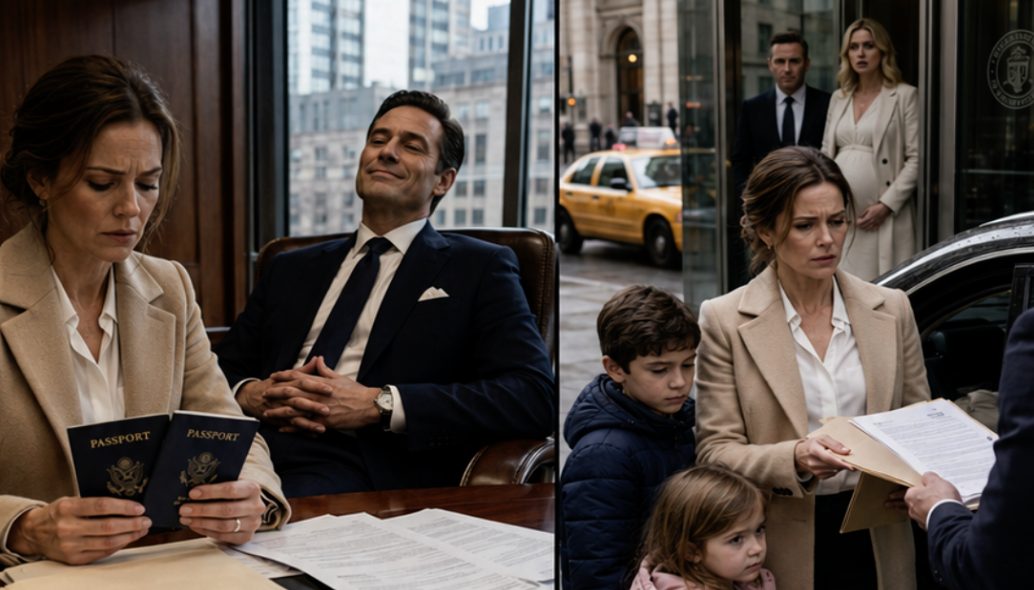
The mediator’s office smelled of stale coffee and the sterile, ringing emptiness of impending finality. When Hannah’s pen lifted from the divorce decree, the wall clock read exactly 9:00 A.M. She felt no tears, no dramatic surge of pain, nor the crippling devastation she had spent months imagining. There was only a profound, cellular silence—the quiet shedding of a ten-year marriage to Rowan, a man who had once promised her the entirety of his life.
Barely had the ink dried when the illusion of Rowan’s civility vanished. His phone chimed, playing a saccharine ringtone that Hannah recognized instantly. It was Allison. Without a sliver of hesitation or shame, Rowan answered, his voice melting into an unfamiliar, sickeningly sweet cadence. He assured his pregnant mistress that he would soon be at her ultrasound checkup, loudly boasting that his family would be there to welcome the new heir to their legacy.
Rowan scribbled his signature across the documents with raw contempt, pushing the paperwork back across the desk. He felt untouchable, standing upon the absolute certainty of his own narrative: the self-made king shedding the stagnant, burdensome housewife. He sneered, pointing out that the premarital condo, the cars, and the assets were safely his. If Hannah wished to take their two young children, Aiden and Chloe, she was welcome to them. Less hassle, he claimed. His sister, Megan, stood nearby, a loyal architect of his arrogance, echoing his cruelty by mocking Hannah’s prospects as a single mother.
Hannah did not argue. She simply stood, opened her purse, and placed the house keys onto the polished mahogany desk. The quiet click of metal against wood was the opening chord of her requiem for their marriage. When Megan demanded she return everything that wasn’t hers, Hannah silently withdrew two navy-blue passports.
“The visas have been ready since last week,” Hannah said, her voice completely devoid of the tremor they all expected to hear. “I am taking the children to study in London.”
As Rowan and his sister froze, paralyzed by the sheer audacity of her independence, a black Mercedes GLS glided to the curb outside. A sharply dressed driver stepped out, bowing slightly to Hannah. She gathered her children, looking at her ex-husband for the final time. “Rest assured,” she told him calmly, “from this moment on, the kids and I won’t interfere with your new life.”
In the back seat of the car, the driver handed Hannah a thick envelope. It contained the meticulous, irrefutable proof of Rowan’s financial deceit: photographs, bank transfers, and real estate documents linking marital funds to the luxury condo he had secretly purchased for Allison. The trap had been painstakingly set over months of quiet observation. As the car pulled away toward JFK Airport, Hannah watched the New York skyline blur. She stroked her son’s hair, listening to him ask if his father would visit. She said nothing. The old chapter was definitively closed, and an ocean of distance was about to be drawn between her family and the empire of lies Rowan had built.
While Hannah’s flight ascended into the June sky, Rowan’s family descended upon the Hope Reproductive Health Center. They functioned as a royal court awaiting a prince. Linda, Rowan’s mother, fawned over Allison, while Megan presented organic juices and blessed silver pendants, entirely erasing the memory of the woman who had just signed her life away in a mediator’s office an hour prior.
The ultrasound room was bathed in a bright, unforgiving light. Allison lay on the examination table, her face glowing with a smug, triumphant certainty. Rowan held her hand, his chest puffed with the pride of a patriarch. But as the doctor pressed the transducer to Allison’s abdomen, the atmosphere in the room slowly, terrifyingly warped. The doctor’s brow furrowed. He stopped speaking. The silence stretched until it became a physical weight.
Ignoring Rowan’s irritable demands for reassurance, the doctor summoned hospital security and the legal department. When he finally spoke, his words were clinical, absolute, and devastating.
The Discrepancy: Fetal measurements indicated that conception had occurred at least a full month earlier than Allison had claimed on her intake forms.
The Implication: The child was conceived long before Allison and Rowan had begun their exclusive, secret affair.
The Inevitability: A DNA test would be required, but the medical truth was already glaring from the monitor.
The room erupted into a suffocating chaos. Linda recoiled in horror; Megan transformed instantly from a fawning sister into an aggressive interrogator. Rowan, however, simply froze. The foundation of his hubris—the new family, the heir, the justification for destroying his marriage—crumbled into dust. Allison sobbed hysterically, stammering out weak denials that convinced no one.
Yet, the ultrasound was merely the first domino. As Rowan stood in the clinic corridor, reeling from the betrayal, his phone began a relentless, punishing symphony of ruin:
The Corporate Exodus: His CFO called to announce that three major partners had simultaneously terminated contracts worth over $10 million, triggering a catastrophic $1 million penalty.
The Frozen Assets: When Megan attempted to pay the hospital bill, every credit card was declined. A panicked call to the bank revealed a court-ordered emergency injunction. Hannah’s lawyer had successfully frozen every asset tied to Rowan’s name.
The Legal Siege: Steven, Hannah’s attorney, called to formally notify Rowan of a lawsuit for the concealment and deliberate dissipation of marital assets, backed by impenetrable evidence.
Rowan fled the hospital, racing to his corporate headquarters only to find his legacy in the hands of the IRS. Anonymous tips—accompanied by flawless, insider accounting ledgers that only Hannah could have compiled—had exposed his illicit transfers of corporate funds to fund Allison’s lifestyle. His company was immediately placed under audit, his accounting computers seized, and his reputation mortally wounded. In a single morning, Rowan had gone from a self-proclaimed king to a man buried beneath an avalanche of his own arrogance.
The rain in Chiswick was a gentle, persistent mist—a soft gray blanket entirely unlike the sharp, glass-and-steel edges of New York. Hannah sat in the warm, book-lined extension of her rented terrace house, watching her children thrive in a reality built on safety rather than performance.
Aiden’s shy transition had quickly melted into a passion for local football, returning home with grass-stained knees and a burgeoning English accent. Chloe had immersed herself in dance classes and playdates, drawing endless pictures of their new garden, always featuring a bright, yellow sun. They had crossed an ocean, and in doing so, they had found themselves.
Hannah’s own transformation was equally profound. The settlement from the divorce had been swift and absolute. The New York judge, presented with Hannah’s watertight documentation of Rowan’s financial fraud, had ordered massive punitive restitution. But for Hannah, the money was merely a tool; the true victory was her autonomy. She no longer had to endure the silent, suffocating weight of being unappreciated.
She found a quiet, deeply fulfilling purpose in translating Italian children’s books. Her first major project, Il Faro Solitario (The Lonely Lighthouse), became a mirror for her soul. As she translated the story of a solitary lighthouse keeper weathering storms, she realized she was no longer merely surviving; she was actively authoring her days. She wasn’t just translating words; she was translating her life from a narrative of victimhood into an epic of quiet strength.
Boundaries became her new architecture. When Linda, shattered by her son’s deceit and her own complicity, emailed a desperate, tearful apology, Hannah did not erupt in anger. She felt a detached, weary pity. She permitted supervised, monthly video calls between the children and their grandmother, prioritizing the emotional stability of Aiden and Chloe over any petty desire for revenge.
Eventually, a man named David entered her life. He was a documentary editor—kind, grounded, and entirely uninterested in playing the savior. He simply walked beside her, sharing quiet dinners and easy laughter. It was a companionship built on mutual respect, entirely devoid of the desperate, heavy theatrics that had defined her marriage’s final years. Hannah had successfully translated her existence into a language of peace.
The collapse of Rowan King Partners was not a slow decline; it was a spectacular, public execution. Clients fled en masse, terrified of the reputational contagion. Creditors called in massive lines of credit. Eventually, the board of directors—led by a cold, calculating Megan—voted Rowan out of his own firm. His bankruptcy proceedings were a public autopsy. The luxury cars, the penthouse, the designer furniture—all were liquidated to satisfy Hannah’s court judgment and the mounting corporate penalties.
Rowan was forced into a tiny, poorly insulated apartment in Queens. The walls were paper-thin, vibrating with the sounds of a life he once believed himself too important to live. Allison, stripped of the glamour and wealth she had banked on, transformed into a resentful, volatile presence. The baby, Leo, was born into a suffocating fog of unpaid medical bills and screaming arguments.
The final, absolute breaking point arrived via a white cardboard box: a DNA test.
When the results landed in Rowan’s inbox, they carried the clinical, zero-percent probability of his paternity. Confronted with the digital proof, Allison’s fragile facade shattered. She lashed out with exquisite cruelty, revealing the father was a musician named Mark. She mocked Rowan’s desperate desire for a “do-over family,” calling him a fool who bought into an illusion because he wanted a trophy to prove he wasn’t the villain.
Rowan kicked her out. As the door slammed shut, taking Allison and the crying infant with it, Rowan was swallowed by a silence more profound than any he had ever known. It was the silence of absolute ruin. He had traded a loyal wife, two beautiful children, and a thriving empire for an empty, echoing room.
He found employment through a temp agency, doing mindless data entry in a soulless, fluorescent-lit office. His brilliant financial mind, once utilized to structure multi-million-dollar buyouts, was now reduced to avoiding typos in endless spreadsheets.
One evening, a thick envelope arrived at his grim apartment. It was forwarded by Steven’s London office. There was no legal summons, no demand for money. It contained only a single sheet of paper—a photocopy of a drawing by Chloe. It depicted a bright sun, a green tree, and the family holding hands. At the bottom, in Aiden’s careful cursive, it read: Our house in London. And beneath it, in Chloe’s sprawling print: We are hap.
The misspelling undid him. A harsh, ugly sob tore through Rowan’s chest. The drawing was not a weapon; it was a devastating report from the front lines of the life he had forfeited. They were not just surviving without him; they were flourishing. The revenge he had feared—public shaming, screaming matches—would have been easier to endure. This quiet, unassailable happiness was the ultimate punishment. It was the absolute proof that he had broken his own life, and the world had beautifully, flawlessly moved on without him.
Two years after the divorce, the damp London air brought a ghost to Hannah’s doorstep. It was Allison.
She stood in the drizzle, stripped of her expensive gloss, pushing a travel-stained stroller. The arrogance was gone, replaced by a bone-deep exhaustion. She had tracked Hannah down through Linda, seeking not a confrontation, but a desperate need to clear her conscience before fleeing back to her family in Ohio.
Standing in Hannah’s warm, pristine kitchen, Allison offered a fractured, tearful apology. She confessed her foolishness, admitting she had thought she was winning a game against a weak housewife, only to realize Hannah was the sole person who truly understood the board. She revealed that Rowan was entirely destitute, having signed away all rights to the child, existing as a ghost in New York.
Hannah listened to the apology. The anger that had once been a banked fire within her had long since cooled into ash. Allison was no longer a villain; she was a cautionary tale, a living embodiment of consequence. Hannah accepted the apology—not as an act of intimate forgiveness, but as a statement of fact. As Allison walked away into the rain, Hannah closed her door. The haunting was over. Her peace remained entirely intact.
Across the Atlantic, Rowan’s life had narrowed to a tiny, humble axis. One evening, escaping the oppressive silence of his apartment, he wandered into a community center hosting a free financial literacy workshop for people starting over. Surrounded by single mothers escaping debt and men ruined by predatory loans, Rowan found himself stepping out of the shadows.
He began to help. He translated the complex, terrifying language of finance into simple, actionable steps for the desperate and the vulnerable. He taught an elderly widow how to manage her savings so she could sleep at night. He showed a young mother how to budget. He wasn’t Rowan King, the disgraced titan of finance. He was just Rowan, the quiet man in the back of the room who knew how spreadsheets worked.
The center eventually offered him a tiny stipend to become a part-time financial empowerment coach. It was a pittance compared to his former wealth, but it was clean. It was built on repairing lives rather than exploiting them. He found a fragile, quiet purpose. On Aiden’s birthday every year, he would make an anonymous donation to a children’s literacy charity in London—a secret message in a bottle, cast into an ocean he could no longer cross.
In her Chiswick garden, Hannah sat beside David, watching her children laugh under the fading golden sun. Her second translated novel had just been shortlisted for an award. She had not merely survived the storm; she had learned its profound lessons, building a shelter so sturdy that no external chaos could ever breach it again.
Their stories, once violently intertwined, had separated into two distinct rivers. One was a narrow, quiet stream winding through the shadowed canyons of regret, seeking a humble, solitary grace. The other was a wide, sun-dappled river, flowing powerfully and beautifully toward an open sea of authentic, undeniable joy. Both, finally and completely, had found their way.