When I finally found the strength to call my parents from the sterile, fluorescent-lit hospital chapel, my trembling hands were still stained with the gray, powdery ash from the accident scene. I had refused to wash them in the small sink in the corner of the room. Washing them felt like an erasure, an unforgivable concession to the nightmare that had just become my permanent reality.
My husband, Ethan Miller, and our two children—Lily, who had just turned seven, and Noah, who was four—had lost their lives that crisp, ordinary morning on Interstate 95, just outside Richmond. A commercial truck driver, pushed past his legal hours, had fallen asleep at the wheel, drifting across the median and striking their SUV with such catastrophic force that Ethan never even had the fraction of a second required to swerve.
I survived because I was not with them.
That single, jagged sentence kept cutting through my mind like a shard of broken glass. It sliced through my thoughts then, it still does today, and I am certain it always will. I was supposed to be in that passenger seat, but a last-minute work emergency had kept me home. I had kissed them in the driveway, told Ethan I loved him, and watched the taillights of our car fade down the street.
I called my father first. I sat on a hard wooden pew, staring at a stained-glass window that offered no comfort, and pressed the phone to my ear.
“Dad,” I whispered, my voice cracking, barely more than a breath. “There’s been an accident.”
Behind his voice, I heard the unmistakable sounds of a celebration. The rhythmic, cheerful pulse of a restaurant. Music playing softly from hidden speakers. The clinking of heavy silverware against porcelain plates. Laughter. I could hear my younger sister, Melissa, calling out something in the background about lighting the candles. The juxtaposition of my absolute devastation and the casual merriment of their evening was a physical blow.
“What happened?” he asked. His tone was perfectly level. Calm. Almost profoundly bored, as if I had called to tell him I was running late due to highway traffic.
“Ethan is gone.” My throat closed violently around the words, choking them off. I forced myself to swallow the bile and the terror. “Lily and Noah too.”
Silence. For a moment, the restaurant noise in the background seemed to swell, rushing in to fill the hollow void on the line.
Then, the phone rustled, and my mother came on the line.
“Claire? What do you mean, gone?”
“They died this morning,” I gasped, the reality of the words burning my tongue. “The funeral is Friday. Please. I need you. I need you both here.”
There was a muffled exchange, and my father took the phone back.
“Friday?” he asked, his voice entirely devoid of the panic or heartbreak a parent should feel when their child’s world has just ended.
“Yes.”
He exhaled slowly, a measured, irritated sigh. “Claire, Friday is your sister’s birthday dinner. The reservation at Le Petit has been booked for weeks. You know how hard it is to get a table there.”
I had thought, in my overwhelming shock, that grief had already emptied me completely. I had thought there was nothing left inside me to break. I was entirely wrong.
“Dad,” I said, my voice dropping into a dead, flat register. “My husband and my children are dead.”
“I understand,” he replied, utilizing the exact same mild, conversational tone he used when discussing the chance of rain on a golf weekend. “But today is your sister’s birthday, and we simply cannot cancel at the last minute. We can’t come.”
The call ended with a soft click before I could even draw the breath to beg.
I stood alone in that hospital chapel with the dead phone in my hand, the ash from the highway still clinging to my fingers, and the sound of the call ending echoing with a quiet, devastating finality. In that desolate moment, I understood something fundamental—a brutal truth I would spend the next six months trying desperately to unlearn: I had never been the daughter who mattered in that house.
I had always been the other one. The useful one. The low-maintenance one whose needs could always be managed, suppressed, or negotiated into something smaller and more convenient. I had simply not needed them badly enough before this morning to discover the absolute limit of their love.
At the funeral, the sky was a bruised, relentless gray. I stood anchored between three polished wooden coffins—one large, two unnaturally, unbearably small—while Ethan’s parents practically held me upright. His mother, Margaret, sobbed with such raw, visceral agony that her entire body shook against mine. Her grief was a tangible, living thing. His father, David, kept one heavy, warm hand firmly on my shoulder the entire time, gripping me as if he was terrified I would dissolve right into the church floor if he let go for even a single second.
My side of the church was a barren wasteland.
There were no parents to hold my other hand. No sister to lean on. No cousins, no aunts or uncles from the Harper family.
There was only my Aunt Ruth, my father’s estranged sister. She had driven six straight hours through the rain after hearing the news from a mutual neighbor, not even from my own family. She had appeared at the heavy wooden doors of the chapel just before the service began, her hands clasped tightly together, her face the ashen color of someone who had driven through a terrible nightmare only to arrive at an even deeper hell.
Three days after the funeral, while I was sitting in my silent, suffocating house, my phone buzzed with a text message from my mother.
Hope you’re managing. Melissa felt very hurt that you didn’t call her on her birthday.
I sat on my living room sofa and stared at the illuminated screen until the words blurred into meaningless shapes. I did not type a response. I did not throw the phone.
Instead, something deep inside of me went utterly quiet that day. It was not the quiet of emptiness, nor was it the quiet of defeat. It was quiet in the very specific, profound way of a decision being made so deep down in your soul that it barely makes a sound on its way to becoming irreversible and permanent.
For the next six months, I did not answer a single one of their calls.
They sent generic holiday photo cards. They added me to group text messages about trivial family gossip. They even mailed a heavy, cream-colored invitation to Melissa’s engagement party. I held that thick cardstock in my hands for a long time, tracing the embossed lettering, before slowly placing it into the bottom drawer of my desk—the place where I kept things I was not emotionally ready to throw into the trash, but could not bear to look at directly.
I spent those six agonizing months doing the grueling, invisible work that profound grief requires, work that is simultaneously enormous and soul-crushingly mundane. I spent days identifying personal belongings returned by the police in plastic bags. I spent weeks writing thank-you notes to neighbors who had dropped off casseroles I couldn’t eat. And I spent my Tuesday afternoons sitting in silence with Margaret on her back porch, drinking bitter tea, because we were the only two people on earth who missed Ethan, Lily, and Noah in the exact same specific, paralyzing way.
On a rainy Wednesday in October, I found Noah’s little green plastic stegosaurus hidden deep inside my left winter shoe. I pulled it out, sat down on the cold kitchen floor, and wept until I could not breathe. I did not get up from the tiles for a very long time.
But I also spent those months making calculated, necessary decisions.
Exactly six weeks after I buried my family, I sat in the polished, mahogany-paneled office of my attorney, Daniel Price. I completely rewrote my will and formally removed my parents as my emergency contacts. I systematically revoked every single medical, legal, and financial authorization that bore the name Richard or Helen Harper. I transferred my home, my life insurance, and my savings into an ironclad trust named after Ethan and the children. With the help of Ethan’s parents and Aunt Ruth, I officially created the Miller Memorial Road Safety Foundation, installing them on the board of directors.
And, most importantly, I filed a legally binding, formally notarized statement with my attorney. It explained, in cold, indisputable legal prose, exactly why no member of the Harper family was ever to receive control, authority, or financial benefit from anything tied to me, my late husband, or my deceased children.
My parents refused to attend the funeral of my husband and two minor children because it conflicted with my sister’s birthday dinner reservation.
That sentence, written so plainly, became part of the foundation’s permanent background documents.
And because journalists are thorough when a high-profile story warrants it, they found that document when the wrongful death settlement was finally finalized.
On a freezing, bitter Tuesday morning in January, my name suddenly dominated the local and regional news headlines.
WIDOW OF I-95 CRASH VICTIMS AWARDED $18.7 MILLION IN SETTLEMENT; ANNOUNCES CHILD SAFETY FOUNDATION.
And buried just beneath the bold print, tucked into the fourth paragraph of the lead article, was the sentence about the funeral and the birthday dinner.
By noon, my phone was ringing incessantly with calls from every member of my extended family.
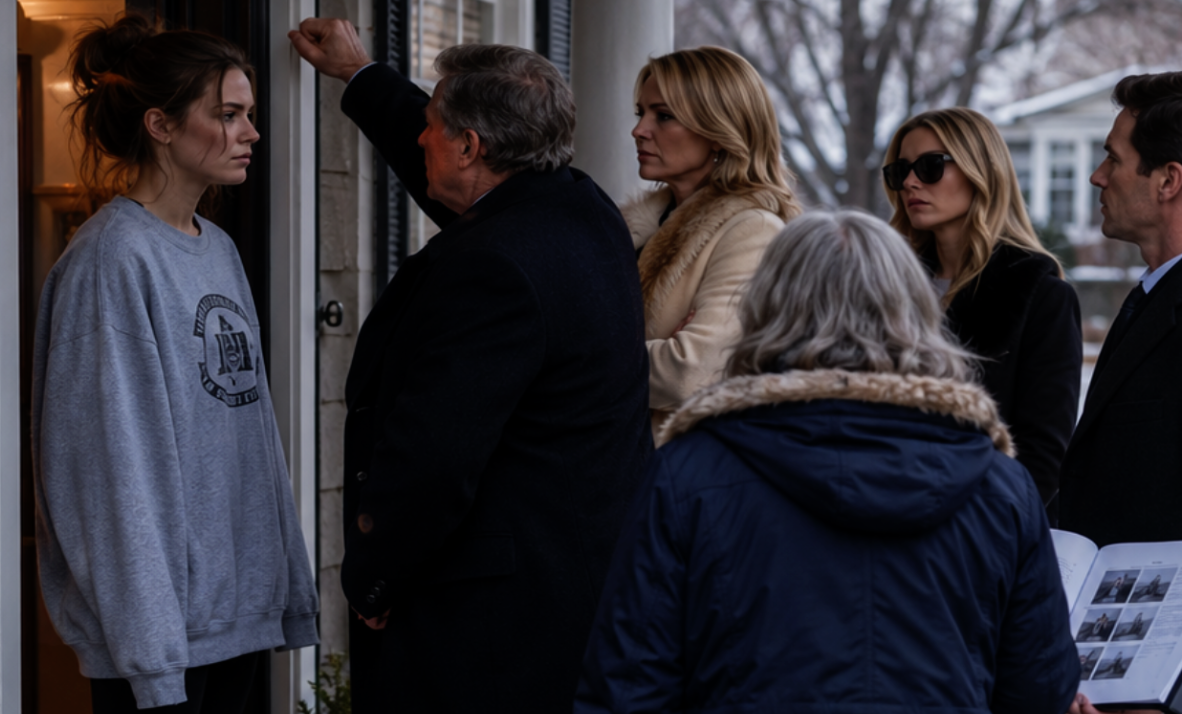
By evening, my father was standing outside my house in the freezing cold, his heavy fist pounding on the front door hard enough to rattle the delicate stained-glass window Ethan had installed three summers earlier.
“Claire!” he shouted, his voice muffled but aggressive through the thick wood. “Open this door right now! We need to talk!”
I stood in the dim hallway, barefoot on the hardwood, wearing Ethan’s faded, oversized college sweatshirt. The house smelled of cedar wood, cold coffee, and the heavy, specific silence of rooms where children used to run and make joyous noise. On the refrigerator behind me, Lily’s crayon drawings were still taped up, curling slightly at the edges. Noah had hidden his toy dinosaurs in my shoes every single week without ever explaining his reasoning or stopping the habit, and my closet was still full of them.
I did not move to turn the lock.
On the glowing screen of the doorbell camera, I could see my mother standing just behind him. She was wearing an expensive, immaculate cream-colored winter coat, her lips pressed into a hard, furious line. Melissa stood slightly behind her, wearing dark designer sunglasses despite the gray, fading winter afternoon, looking agitated.
“Claire,” my mother called out, her voice pitching up into a performative shrillness. “We saw the news. We need to talk about this as a family.”
Family. The word tasted like ash in my mouth.
My phone buzzed in my pocket. It was Aunt Ruth.
Don’t open the door. I’m ten minutes away. I called your attorney.
Daniel Price had warned me this might happen. He had warned me that the moment the settlement became public, the dynamics would shift. The trucking company had fought us tooth and nail, but the evidence was overwhelming and undeniable. Ethan had done absolutely nothing wrong. The truck driver had blatantly ignored required rest periods to meet corporate quotas. The logistics company had intentionally falsified their vehicle maintenance logs. The case settled just days before it was set to go to a jury trial, and the staggering financial amount became a matter of public record through the court filings.
I had not celebrated the victory.
No amount of zeros in a bank account could ever return Ethan’s warm, booming laugh. No check could buy back Lily’s adorable, lisping smile with her missing front tooth, or Noah’s endearing habit of whispering his deepest secrets into our golden retriever’s ear, convinced the dog was the only confidant he could fully trust.
But the money did give me one profound thing my family had never allowed me to have throughout my entire life.
Protection.
Outside, my father’s voice dropped into the calculated, measured tone he always deployed when he wanted to sound like the most reasonable man in the room.
“Claire, sweetheart, we’re not here to fight with you. We’re genuinely concerned about you.”
I reached out and pressed the speaker button on the camera interface.
“You were not concerned when I stood beside three coffins,” I said, my voice echoing metallic and cold through the outdoor speaker.
My mother’s face immediately tightened on the camera feed. “That is incredibly unfair of you, Claire. We were in shock. People handle trauma differently.”
“You explicitly told me that Melissa’s dinner reservation mattered more than my children’s funeral,” I countered, feeling no anger, only a vast, icy clarity.
Melissa angrily pulled off her sunglasses. Her eyes were perfectly dry. There was no trace of sorrow in her face, only deep indignation. “I didn’t know you were going to turn it into a massive public scandal!” she snapped sharply. “My bridesmaids are sending me these articles. Brandon’s parents saw it in the paper this morning! Do you have any earthly idea how humiliating this is for me right before my wedding?”
I turned my head slowly. Behind me, resting on the brick mantelpiece of the fireplace, sat three beautiful, tragic urns.
I looked at them for a long moment, drawing strength from the love they represented. Then I looked back at the camera screen.
“I’m not punishing anyone,” I said softly, but loud enough for the microphone to catch. “I’m just entirely done pretending that you didn’t make a choice.”
Aunt Ruth arrived just before my father could decide whether to escalate his shouting.
Her sensible blue Subaru pulled sharply into my driveway, stopping directly behind their luxury sedan and blocking them in completely. She stepped out into the freezing wind wearing faded jeans and a heavy navy wool coat, carrying the formidable expression of a woman who had spent sixty-two years being chronically underestimated by her brother and had grown entirely, permanently tired of it.
“Step away from that door, Richard,” Ruth commanded, her voice slicing through the winter air like a blade.
My father turned, his face flushing dark red with immediate anger. “Stay out of this, Ruth. This is private family business.”
“No,” she replied, not slowing her pace as she marched up the walkway. “This is trespassing on private property.”
My mother straightened her posture, pulling her cream coat tighter around herself. “How dare you speak to your own brother that way in public.”
Aunt Ruth stopped at the base of the porch steps and looked at my mother with an expression of pure, quiet disgust. “I drove alone through a torrential thunderstorm to help bury Claire’s husband and babies while you were eating a birthday cake. Do not ever presume to lecture me about manners, Helen.”
For the first time in my entire life, my father had absolutely no quick, cutting comeback.
He was not embarrassed because he felt any genuine regret for his actions. He was embarrassed solely because Ruth had said the words out loud, outside, with enough volume for Mrs. Alvarez across the street to hear from her front porch.
That had always been my family’s true, unyielding religion. Not love. Not loyalty. Not kindness.
Appearances.
If Melissa screamed at me when we were teenagers, I was told to apologize for upsetting her. If she intentionally ruined my high school graduation dress because she couldn’t stand not being the center of attention, I was instructed to be gracious and forgiving. My parents had never once asked whether something actually hurt me. They had only ever asked who might have seen it happen.
Funerals, I had learned, reveal the absolute truth of people.
So does a settlement of eighteen million dollars.
My father turned back toward the doorbell camera, trying to regain his composure. “Claire, listen to me. We are not here about the money.”
“Then what exactly took you six months to drive across town?” I asked.
He had no answer for that either. He simply stood there, his jaw working.
My mother stepped closer to the camera lens, trying to look maternal. “Nobody here said a single word about money, Claire.”
Aunt Ruth crossed her arms over her chest, unfazed by the cold. “You drove here today, unannounced, mere hours after seeing the settlement amount published in the morning paper.”
“We drove here because she is dangerously isolating herself!” my mother shot back defensively.
“No,” I said through the speaker. “I am protecting myself.”
Right then, Daniel Price arrived at the curb in his sleek black sedan. He walked up the driveway wearing a tailored charcoal overcoat, a thick manila folder tucked securely under his arm. He wore the exact same impenetrable expression he wore during hostile depositions—which was to say, he betrayed absolutely no emotion at all.
“Mr. and Mrs. Harper,” Daniel said smoothly, coming to a halt next to Aunt Ruth. “You have been formally notified in writing not to come to this property uninvited. You are currently trespassing.”
My father puffed up his chest. “She is my daughter. I have a right to see her.”
“She is a thirty-four-year-old adult,” Daniel replied, his voice a calm, legal drone. “Who has made her legal and personal wishes abundantly clear.”
“She is grieving, she is vulnerable, and she is being manipulated by her,” my mother spat, pointing a manicured finger directly at Aunt Ruth.
Daniel didn’t blink. He simply opened the folder. “Your daughter executed her estate documents with full mental capacity, in my office, in the presence of two independent witnesses and a state notary. She also provided a comprehensive written record of the estrangement, which included time-stamped messages sent in the days following the funeral.”
Melissa’s mouth fell open in genuine shock. “You kept screenshots?”
“Yes,” I said, my voice steady through the speaker. “Especially the one where Mom told me you were hurt that I missed your birthday call while I was picking out caskets.”
My mother went completely pale, the color draining from her face in an instant.
I noticed on the camera feed that Mrs. Alvarez across the street was now standing openly on her porch, her arms folded across her chest, watching the spectacle. Mrs. Alvarez was the woman who had brought me three consecutive weeks of warm casseroles after the funeral. She was the one who had quietly planted beautiful white lilies near my mailbox in the spring, simply because she knew Lily had loved being named after a flower.
My mother noticed her too, and her voice instantly dropped to an embarrassed, frantic whisper. “Claire. Please. Let’s not do this outside where the whole neighborhood can see.”
I reached out and unlocked the front door.
Everyone on the porch froze as the heavy wood swung inward.
I stepped out onto the freezing porch. I didn’t grab a coat. I stood there in Ethan’s oversized sweatshirt, my hands buried in the pockets.
For months, I had played this exact confrontation over and over in my head. In every imagined version of this moment, my hands were shaking. In every version, I either screamed myself hoarse or dissolved into a puddle of weeping panic.
But when I actually saw them standing there in the cold light of day, stripped of their power over me, they looked so much smaller than my memory had made them out to be. They looked pathetic.
“You want privacy now?” I asked, my voice carrying clearly across the frost-covered lawn. “You should have offered me dignity back in June.”
My mother’s eyes immediately filled with tears on command—the precise, practiced, glistening tears of a woman who had learned decades ago exactly which emotional displays yielded the best results. “I lost them too, Claire. They were my grandchildren.”
“No,” I said, cutting her off without raising my voice. “You lost the social role of the grieving grandmother the exact moment you actively chose not to attend their funeral.”
Her tears stopped instantly, drying up as if a faucet had been turned off.
Melissa scoffed, crossing her arms. “That is just cruel, Claire.”
I turned my gaze slowly to my sister. “Cruel was asking me why I didn’t call to wish you a happy birthday while the bodies of my children were being lowered into the earth.”
Melissa flinched, stepping back slightly, but I knew it was only because Daniel and Ruth were standing right there to witness her shame.
My father pointed an angry, trembling finger at me. “You are tearing this family apart. You are destroying us over a grudge.”
I looked past his pointing finger, past my mother’s pale face, out to the bare, towering maple tree in the center of the front yard. That was the tree where the thick rope from Lily’s tire swing had hung, swaying in the breeze, until I could no longer stand to sit in the window and watch it move without her in it. I had taken the swing down a month after the accident. But the heavy iron hook was still embedded deep in the bark—a small, rusted piece of metal, the only thing remaining of the joy that used to live there.
“This family was already broken long before the accident,” I said softly, returning my eyes to my father. “I just finally stopped standing in the middle, cutting my hands to shreds trying to hold the broken pieces together for you.”
My mother took a hesitant step forward and whispered, “What do you want from us, Claire?”
For a fleeting second, it sounded almost like a real, genuine question. Almost. But it came six months too late, and it was entirely surrounded by the wrong context—the money, the public embarrassment, the wedding—to be anything other than a calculated negotiation strategy.
“I wanted you at the funeral,” I said, my voice dropping to a harsh whisper. “I wanted you to hold my hand when I buried the man I loved. I wanted you to stand there and cry with me over Lily’s pink casket and Noah’s blue one. I wanted my parents.”
The porch went completely, utterly quiet. The only sound was the bitter winter wind moving dead, dry leaves across the concrete steps.
“Now,” I said, locking eyes with my father. “I want you to leave my property.”
My father’s jaw hardened, the muscles ticking beneath his skin. “You’ll regret this, Claire. You are going to end up completely alone.”
Daniel Price immediately lifted his smartphone, his thumb hovering over the screen. “Please repeat that threat clearly for the recording, Mr. Harper.”
My father glared at the attorney with pure venom. Then, realizing he had lost, he turned away in disgust.
My mother hesitated at the bottom of the steps. For one fragile, suspended second, looking at her face, I thought she might actually say something real. I thought she might break through her own vanity and offer an apology that wasn’t a social performance—the actual words from the deeply buried place where a mother understands exactly how profoundly she has failed her child.
Instead, she adjusted her expensive collar and said, “Melissa’s wedding is in April. I truly hope you don’t plan to make things worse for her by parading this feud around.”
The last, microscopic thread tethering me to them snapped. It happened so quietly I almost missed it.
“I won’t be there,” I said.
Melissa laughed, a short, bitter sound. “Good. Nobody wants that kind of depressing energy at my wedding anyway.”
Aunt Ruth stepped forward, putting herself between me and my sister. “Then it sounds like absolutely everyone has exactly what they want.”
“Leave now,” Daniel instructed, gesturing toward their blocked-in car. Ruth walked back to her Subaru and reversed out of the driveway, giving them just enough room to escape.
They got into their luxury sedan, backed hastily out of my driveway, and drove away down the suburban street. They looked exactly like people leaving a high-end restaurant after complaining about a disappointing meal. There was no final, dramatic speech. No lingering look of regret. Just a car shifting into reverse, the crunch of tires on frosty asphalt, and then an impossibly quiet street.
I stood on the porch and realized, for the first time in six months, I was breathing normally. The tight, suffocating band that had been wrapped around my chest since the hospital chapel was finally gone.
Ruth walked up the driveway and gently touched my shoulder. “Are you okay, sweetheart?”
I looked at the heavy front door, at the frost-covered porch, at the white lilies dormant by the mailbox, and finally at the rusted iron hook buried in the maple tree.
“No,” I said, pulling Ethan’s sweatshirt tighter around me. “But I am free.”
The headlines about the settlement changed everything, but not in the cynical way people assumed when they read about the millions of dollars.
The money didn’t change who my family was; it only served as a glaring spotlight, illuminating what had always been there hiding in the dark. My parents did not panic that Tuesday because they realized they had hurt me. They panicked strictly because the entire world could finally see that they had.
In the long, quiet months that followed that confrontation, I slowly began to move forward in pieces.
The Miller Memorial Road Safety Foundation held its very first public fundraiser in early May. Ethan’s parents stood at the podium and spoke eloquently about commercial truck safety regulations and the dangerous legislative gaps that allowed exhausted drivers to falsify their rest logs.
When it was my turn, I spoke for four minutes exactly. My voice shook violently when I had to say Lily and Noah’s names into the microphone, but I forced myself to say them loudly and clearly.
Afterward, local reporters cornered me, asking invasive questions about my family estrangement whenever they could slip them in.
I gave them the exact same, impenetrable answer every single time.
“My only focus is honoring my husband and my children.”
It was the absolute truth. It was also the cleanest, most dignified way to permanently close a door.
Melissa’s lavish wedding took place in April, exactly as planned, without me.
Aunt Ruth heard through the family grapevine that my mother, ever dedicated to appearances, had insisted on placing an empty chair near the front of the venue, complete with a mournful little bouquet, to signal to the guests how heartbroken they were over my “unreasonable absence.” I did not ask to see the photograph that someone eventually texted to Ruth. I did not need to see it to know exactly how it looked.
On the one-year anniversary of the accident, I woke in the dark and drove out to the cemetery just as the sun was rising. I brought a bouquet of bright yellow tulips for Ethan, white daisies for Lily, and a small, die-cast red toy fire truck for Noah, because I knew he would have desperately wanted something to play with, even out there in the quiet grass.
I sat down on the cold morning dew between their headstones. I talked to them out loud. I told them all about the foundation’s recent legislative victories. I told them about Margaret finally learning to smile at a memory rather than immediately breaking down. I told them about Aunt Ruth taking me on a road trip up to the coast of Maine, simply because I had mentioned once in passing that I had never seen the ocean in the winter.
And then, as the sun crested the horizon, I told them the deepest truth.
I miss you every single minute of every single day, I whispered to the cold stone. But I am still here.
The morning wind moved softly through the high branches of the cemetery trees.
There was no answer. Of course there was no answer. There was just the pale morning light, the biting cold air, and my bare hand resting firmly on the names carved deeply into the granite—the names that were theirs, and always would be.
Yet, for the very first time since the day of the funeral, I did not feel abandoned.
Sitting there in the grass, I felt entirely accompanied by the people who had actually, genuinely loved me. The ones whose love had never come tethered to impossible conditions, or social calculations, or an emotional billing system that constantly compared the heavy cost of my grief against the minor inconvenience of changing a restaurant reservation.
Ethan had always told me that my family had conditioned me to apologize for bleeding after they were the ones who had handed me the knife. He had always said it so gently, holding my face in his hands, saying the hard things he knew I needed to hear but never wanting them to land like harsh accusations.
He had been right. It had taken losing him completely to finally understand exactly how right he was.
I stood up from the wet grass, brushed off my knees, and walked slowly back to my car in the bright, piercing January light.
The living have to keep going.
That is the entire, brutal instruction of survival, and the whole overwhelming difficulty of it. You just keep going. You carry the weight of them with you every step of the way, and you finally stop letting broken people tell you that your immense grief should make itself smaller just so their superficial comfort can be larger.
I drove home.
I made a pot of coffee.
I kept living.