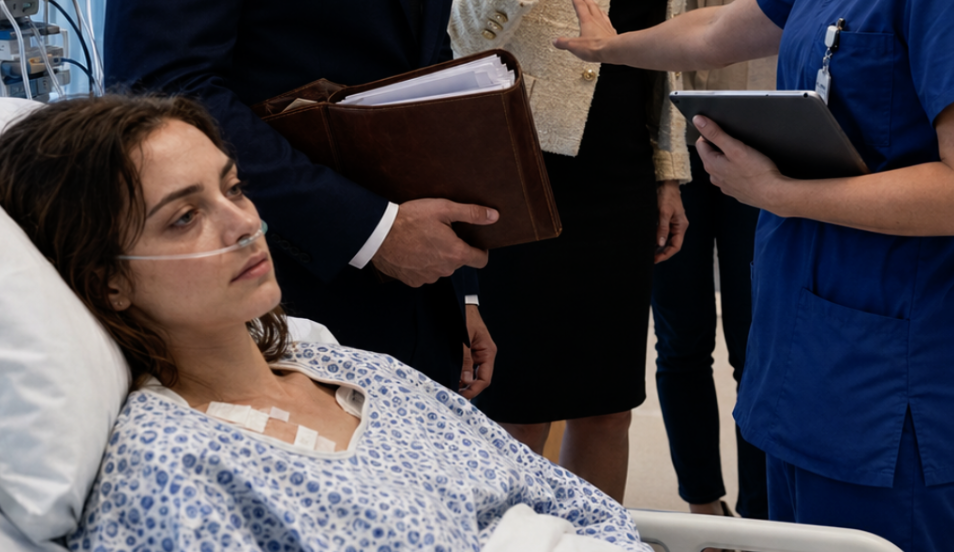
The fluorescent lights above my hospital bed buzzed with that thin, electric whine unique to places of healing, the kind of sound that makes you wonder if every bit of human fear eventually rises into the ceiling to vibrate through the panels long after the patients leave. A nurse adjusted the IV pole beside me, the clear plastic bag trembling as her sleeve brushed it. Down the hall, a monitor chimed, and someone coughed behind a curtain. My phone, however, was warm in my palm, emitting a different kind of tension.
“Your sister is very upset right now,” my mother said through the speaker, her voice flat, irritated, and entirely devoid of the comfort I so desperately needed. “This is not the time to be dramatic.”
I stared up at the tiled ceiling, counting the tiny holes in the acoustic panels. I counted them because if I didn’t, I would start screaming. It was a trick I had used since childhood—count the tiles, count the cracks, count anything to keep my own feelings from spilling out into a room already reserved exclusively for my younger sister, Emma.
My name is Marissa Collins. Ten minutes before I was scheduled to be wheeled into open-heart surgery, my mother was furious with me because my sister had cried over a couch. It wasn’t a tragedy or a diagnosis that had triggered this family crisis. It was a beige, oversized, expensive sectional in Emma’s newly renovated living room in Raleigh. A week prior, exhausted by months of cardiac tests, night sweats, and the profound loneliness of managing a terrifying illness my family refused to take seriously, I had casually replied to a photo of the room. I simply noted that the couch looked a little big for the space. No insult, no attack. Just a tired observation. Emma didn’t reply; she called our mother.
By the next morning, my entire family had agreed I had “lashed out.” And now, lying under fluorescent lights with a cannula beneath my nose and a surgical consent bracelet on my wrist, my mother was telling me that Emma’s hurt feelings could not wait.
“Mom,” I said quietly, my throat dry. “They’re going to wheel me in soon. I just wanted to hear your voice before they start.”
There was a dismissive pause. In the background, I heard Emma’s breathy, wounded voice. Then, my mother returned sharper. “She’s crying because you criticized her living room. Can this wait? You’re an adult. You’ll be fine. I have to deal with your sister right now.”
The line went dead. There was no “I love you,” no “You’ve got this.” Just a beep, a blank screen, and my own reflection staring back at me. The nurse beside me paused her work. “Family on the way?” she asked gently.
“No,” I replied, my voice sounding weightless and unfamiliar. “No one right now.”
In that moment, looking at the phone in my hand, I experienced a profound, pre-surgical clarity. My surgery was critical, yet my sister’s living room feelings ranked higher. This realization didn’t make me cry, nor did it make me angry in the old, frantic way. It simply sharpened every edge of the room. I had spent thirty-five years performing the same family dance: minimizing myself so Emma’s emotions could take up all the oxygen. But as surgeons prepare to open your chest, you learn which fears matter and which losses have already happened. I realized the person I kept waiting for had been absent so long that her absence was the baseline.
I took a slow breath, scrolled down my contacts, and called Daniel Price, my lawyer.
“My surgery starts in a few minutes,” I told him, my voice steady. “If I wake up, meet me in the ICU tomorrow. Bring everything.”
“Understood,” Daniel replied, the weight of a professional, validating pause holding the line. “I’ll be there.”
The surgery lasted six hours. When I woke up, rising through layers of what felt like cold water, the ICU was filled with the rhythmic hissing and beeping of life-preserving machines. A nurse leaned over, her eyes crinkling above her mask, and told me the surgery had gone very well. They had successfully removed the mass pressing near my heart. I had survived.
Relief should have washed over me, but instead, what surfaced was that same sharp clarity. I reached for my phone, its bright teal case absurd in the sterile room. There were no missed calls. No messages from my mother, my father, or Emma. Not even a generic pity text. I opened my messages and typed a short text to Daniel: I’m awake. He replied instantly that he was on his way.
To understand why a lawyer was my first call from an ICU bed, you have to understand the insidious nature of my family’s neglect. We looked completely normal from the outside. But my mother, Patricia, managed our emotional lives to serve her own comfort, and my father, Raymond, retreated into absence to avoid conflict. Emma, born premature and fragile, was mythologized from day one. Her discomfort was always treated as a five-alarm fire.
Conversely, my pain was always labeled “dramatic.” When I had a 103-degree fever at age ten, Mom made me wait forty minutes because she was helping Emma pick out a party outfit. When my cardiologist first used the word tumor, my mother told me not to tell Emma because she was already stressed about her home renovation. By the time my chest was cut open, I had been thoroughly trained to doubt the validity of my own emergencies.
Daniel arrived in the ICU that afternoon with a leather folder and a calm demeanor. Three months prior, he had drafted my medical directives—temporary documents I had carried around like a secret, holding out a foolish hope that my mother would miraculously step up when the surgery date arrived. She hadn’t.
“Are you certain?” Daniel asked as he laid out the crisp, flagged pages on my tray table.
Memories of dismissal rushed through me: my father deferring to my mother, Emma crying because my illness “triggered her,” my mother hanging up the phone as the operating room doors opened.
“Yes,” I said. “For once, I’m acting because someone else didn’t.”
I signed away my mother’s medical and financial authority. I designated Daniel as my proxy. Each signature felt less like rebellion and more like moving furniture in a house where I had been bumping my shins in the dark for years. Just as I finished, my phone buzzed. It was Mom.
“Why didn’t you tell me the surgery was today?” she demanded.
“I did. I called you from pre-op.”
“Well, I thought you were exaggerating,” she replied, as casually as if we were discussing the weather. “When are you getting discharged? Emma and I might come by later this week.”
“You don’t need to,” I said. “I’ve handled everything. My medical decisions, my financial decisions, my emergency contacts. You’re no longer responsible for my care.”
Silence hummed on the line before she snapped, accusing me of punishing her. I told her I was simply protecting myself, recalling the sound of the dead phone line while she debated throw pillows.
My mother arrived at the ICU the next afternoon like a storm front, Emma trailing behind her in soft pink and cream linen. Through the glass window of my room, I watched Mom march up to the nurses’ station, only to be politely informed that she was listed as a visitor, not family, and had no medical access. The flush of humiliation rose in her cheeks.
She pushed into my room, glaring at Daniel, who stood quietly by the window. “What did you do?” she demanded.
“I made sure the person responsible for my life answers when I call,” I replied smoothly.
She immediately resorted to her favorite weapon, calling me dramatic, arguing that Emma had been in tears over the sofa. The irony was palpable—I was in an ICU bed with a freshly stitched chest, and we were still talking about a sectional. After sixteen minutes of tense, fruitless argument, during which Daniel calmly deflected her demands with clinical facts, she warned me I would regret cutting out family. I looked at my bandages and told her I would only regret ignoring reality.
Recovery was a slow, grueling process of humiliation and pain. When I was finally discharged, my best friend Lena drove me back to my apartment. On Daniel’s advice, I had the locks changed before I even arrived home. “Boundaries only work when they meet hardware,” he had told me.
Two days later, my doorbell camera buzzed. My mother and Emma stood in the hallway, holding a foil-covered casserole. Mom tried her old key. When the deadbolt didn’t budge, she glared into the camera lens and demanded I open the door.
I pressed the microphone icon from my bed. “I’m resting. I’m not having visitors today.”
She accused me of cruelty, but I held firm. They eventually left the casserole on the floor and walked away. The family group chat exploded with my mother’s indignation, but I simply typed a firm message reiterating my legal boundaries and muted the conversation. Every denial of their entitlement felt like a brick being laid in a new, sturdy wall protecting my life.
In October, my father visited me alone. He didn’t bring guilt or excuses; he simply sat in my living room and apologized. “I should have come to the hospital,” he admitted, looking older and deeply uncomfortable. “I’ve spent a long time letting your mother decide what counts as urgent. It was easier.”
“It was easier for you because the cost landed on me,” I pointed out.
To my surprise, he nodded. He didn’t ask me to undo the paperwork, and he didn’t demand absolution. It was the most honest conversation we had ever had, and while it didn’t magically heal the past, it established a fragile, genuine respect between us.
The real test of my new boundaries came in November. Emma’s renovation costs had spiraled, and Mom called to demand I loan Emma fourteen thousand dollars to pay her contractor. When I refused, citing my massive out-of-pocket medical expenses, Mom deployed her ultimate weapon: Emma was eight weeks pregnant.
I thought of myself in the hospital, bandaged and exhausted, while my mother prioritized upholstery over my survival. “If something happens because Emma chose built-ins she couldn’t afford, that will not be my medical emergency,” I said, and hung up. I shook afterward, terrified by the lingering ghost of my conditioning, but Daniel reminded me that truthful boundaries often precede comfortable ones.
Tragically, in January, Emma miscarried. Dad called to deliver the news. The loss bypassed all our petty grievances; this was a true tragedy. I told Dad to ask Emma if she wanted me at the hospital. He called back twenty minutes later to say she had declined. I sent white tulips to the hospital, which were promptly returned to my apartment marked “recipient refused.” I put them in a vase on my kitchen table and grieved the loss of my unborn niece alone, in a space where no one could accuse me of performing my sadness incorrectly.
Months passed before the ice began to thaw. Dad started calling me every Sunday, even accompanying me to a cardiology follow-up, where he silently wept when the doctor gave me a clean bill of health. In May, I finally agreed to attend his birthday dinner at Emma’s house.
The oversized beige couch dominated the room. Dinner was tense but polite until dessert, when Mom loudly suggested we stop this “paperwork nonsense.”
Dad set down his fork. “Patricia,” he said quietly, but with absolute authority. “Leave it.”
The room froze. For the first time in my life, my father hadn’t retreated. He stood his ground against her, and the air in the room fundamentally shifted.
Later that evening, Emma found me in the hallway. She confessed that Mom had twisted the story of the tulips, convincing Emma I had only sent them to look generous. “I was bleeding and devastated and angry,” Emma whispered. “I wanted someone to blame.”
She then asked, hesitantly, about my surgery. She admitted she had ignored my medical updates because she was too afraid of having to step up and be a supportive sister. When she asked to see my scar, I pulled my collar aside to reveal the raised, pink line.
Emma gasped softly. “It was real,” she whispered, tears filling her eyes. “I made it about my couch.” For the first time, she offered an apology that wasn’t wrapped in excuses. I didn’t rush to comfort her—she needed to feel the weight of it—but I told her I heard her. It was a beginning.
Healing is not a montage; it is a series of quiet, deliberate choices. A year after my surgery, I ran my first mile. Lena cheered, and Daniel handed me water. Our relationship had slowly evolved from professional reliance to a deep, steady romance. He never overstepped, and he never confused being needed with being entitled. We moved at a pace dictated by trust, a stark contrast to the frantic emotional trespassing of my family.
Two years post-surgery, Emma gave birth to a daughter, Grace. She texted me at four in the morning, inviting me to the hospital. When I arrived, Mom stiffened, but Emma bypassed her entirely, placing the tiny, sleeping infant into my arms.
“I don’t want her to grow up like us,” Emma whispered to me, ignoring our mother’s indignant gasp. “I don’t want her to think love is attention you have to compete for.”
I looked down at my beautiful niece, innocent of the heavy inheritances we adults carry, and promised, “Then we do it differently.”
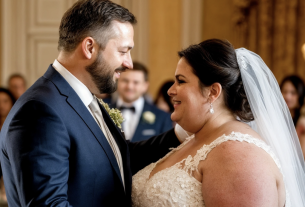
Four years after the surgery, Daniel and I were married in a small garden in Asheville. My father walked me down the aisle, whispering, “I’m here.” My mother attended and behaved. Emma brought Grace, who joyously threw flower petals at Daniel’s shoes. During the reception, Emma pulled me aside and told me she was glad I had called Daniel that day in pre-op. It didn’t erase the past, but the acknowledgment entered my heart cleanly.
By the fifth anniversary of my open-heart surgery, my life was entirely my own. I had transitioned into healthcare data advocacy, helping hospitals improve systems for patients without reliable family support. I woke up early that morning in the home I shared with Daniel, feeling the faint, familiar tug of the silver scar on my chest.
I made my own coffee and opened the drawer where I kept my old teal phone case. Inside was the folded copy of the Revocation of Prior Medical Authority. People love to tell me that the surgery saved my life. They are right, but only partially. The surgeons saved my physical heart; the paperwork saved the life that surrounded it.
I had learned the hardest way possible that love is not proven by titles. “Mother” and “Sister” are beautiful words, but they are not credentials. Care is a behavior. Showing up is a behavior. And absence, repeated over decades, is also a behavior.
My phone buzzed on the counter. It was a text from Emma. Grace wants to know if scars are where the body keeps brave parts. I told her Aunt Marissa would have the best answer.
I smiled, watching the morning light filter through the trees in my backyard. I typed back: Tell her yes. And sometimes scars are also where the body keeps proof. Proof you survived. And proof you’re allowed to protect the place that healed.
Behind me, Daniel stirred, his sleepy voice calling out to ask if everything was okay.
“Yes,” I said.
And this time, “yes” didn’t mean I was swallowing my pain or making myself small for someone else’s comfort. It meant exactly what it sounded like. The house was peaceful, my heart was beating steadily, and for the first time in my life, no one had to be begged to listen to it.