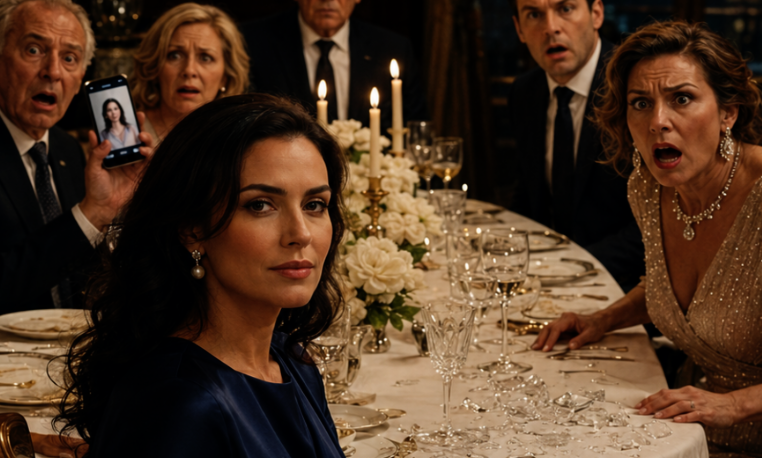
The first thing I noticed was the tremor in Victoria’s fingers. It was barely a ripple under her skin, a subtle betrayal she would have fervently denied had I been cruel enough to point it out. She pressed her palm against the small of my back as we lingered outside the private dining room at The Ivy in Georgetown, her touch an exertion of control. To anyone passing in the citrus-scented corridor, we were merely a portrait of familial support: the confident, glossy-haired older sister guiding her quieter sibling into a consequential dinner. They would have seen Victoria’s champagne-colored dress and the diamond heavy on her hand. They would have seen my understated navy silk and sensible heels.
They would not have seen the sheer terror radiating from her.
“Remember,” she whispered, offering a smile that remained frozen at the corners of her mouth, “don’t embarrass me.”
Somewhere behind the polished mahogany door, crystal clinked. Victoria leaned closer, her voice dropping into a frantic hiss. “Mark’s dad is a federal judge. Not a district judge. A circuit judge. Fourth Circuit. You understand what that means, right?”
I let the familiar scent of expensive perfume and unspoken anxiety wash over me. “I understand.”
I understood intimately. My stomach executed the same quiet turn it managed on the morning of a major sentencing hearing—a physical tightening before consequence stepped into the room. Satisfied with my compliance, Victoria issued her final directive.
“Good. So tonight, let me talk. If anyone asks what you do, just say law. Nothing specific. Just law. Please don’t say anything weird.”
Weird, in Victoria’s carefully curated vocabulary, meant anything that could not be leveraged for social advantage. It meant the unvarnished truth.
The door opened, revealing Mark Reynolds. He was all clean lines and deliberate charm, kissing Victoria’s cheek with the practiced grace of a man who knew he was being observed. When he extended a hand to me, my grip was firm and automatic. For a fraction of a second, his gaze sharpened, perhaps sensing that I did not quite match the meek caricature Victoria had painted.
Victoria swiftly pulled us across the threshold, anchoring herself to Mark’s arm. The private room was bathed in the forgiving, golden light designed to make patrons look affluent and absolved. Beneath a delicate chandelier, Judge Thomas Reynolds rose. He possessed the quiet, silver-haired stillness of a man who never had to raise his voice to command a room. Beside him stood his wife, Caroline, radiating effortless elegance, and his daughter, Catherine, a venture capitalist who held herself with sharp, unapologetic intelligence.
My parents were already there, shrinking slightly under the weight of the Reynolds’ status. My father wore a too-eager smile; my mother’s eyes darted around, cataloging the expense of the floral arrangements.
“Mr. and Mrs. Reynolds,” Victoria announced brightly, her voice lifting an octave. “This is my family. And this is my younger sister, Elena.” She paused—the signature pause she utilized before shrinking my life into a manageable footnote. “She works in law. Government law.”
She delivered the phrase as if apologizing for a mild contagion.
Judge Reynolds turned fully toward me. For one heartbeat, his face held a practiced neutrality. Then, the recognition landed. It was imperceptible to the untrained eye—a subtle tightening of the jaw, a recalibration of a man realizing he had just walked into an entirely different courtroom.
Our eyes met. I offered the smallest shake of my head. Not here.
He possessed a profound capacity for understanding the unspoken. He offered his hand. The grip was warm and deeply familiar, the handshake of a colleague who had passed me coffee during grueling committee meetings and shared the bench on complex public corruption cases.
“Your Honor,” I said softly, a greeting meant only for him.
“Good to see you again,” he replied, his tone perfectly matching mine.
But Victoria heard the word Honor.
Her head snapped toward me, panic flooding her meticulously powdered face. Her fingers dug into Mark’s sleeve. “Elena,” she hissed, “don’t be weird.”
She turned back to the table too quickly. Her hand caught the stem of her wine glass.
It did not fall gracefully. It struck the table’s edge and shattered.
The sharp, violent crack silenced the room instantly. Fragments of crystal scattered across the white linen like glittering accusations, and dark red wine bled outward, a stain no one could ignore. Victoria flushed crimson, stammering apologies as a server materialized to sweep away the debris.
But the silence had already been broken. And Judge Reynolds was not looking at the shattered glass. He was looking at me.
To understand the weight of that shattered crystal, one must understand the architecture of our sisterhood.
Victoria had spent her life treating achievements as currency, requiring an audience to validate her worth. My parents, who ran a successful accounting firm in Northern Virginia, had happily built the theater for her performances. When she was accepted to Georgetown, our house became a shrine to her ambition.
I was the observer. I learned early that silence offered a vantage point. When I was accepted into a state law school, Victoria dismissed it as an embarrassment. I worked nights as a paralegal, fueled by caffeine and the exactitude of the law. I loved the discipline of it. Victoria told everyone I “couldn’t hack it” at a top-tier program, and my parents, eager to maintain the established hierarchy, never questioned her narrative.
Years later, while she cycled through a starter marriage and curated a life that looked perfect on social media, I clerked for a federal judge who later became the Attorney General. I became a federal prosecutor, handling violent crime and public corruption. I won cases not through ruthlessness, but through an obsessive, fluent command of facts. Victoria dismissed it as “doing okay for a government employee.”
At twenty-nine, I was confirmed to the federal bench. I sat as a judge in the Eastern District of Virginia, presiding over cases that commanded national headlines and cases that quietly shaped human lives. I owned a renovated townhouse in Alexandria and found profound, quiet love with Michael, a fellow federal judge.
Through it all, I allowed my family to believe I was a mid-level bureaucrat. It was not born of shame, but of exhaustion. Letting Victoria believe she was the sole success story was the price of peace. I was tired of my life being weaponized in her relentless competition.
Until Mark Reynolds brought our disparate worlds into a violent collision.
The server retreated, leaving a fresh, unstained cloth over the spill. The dinner resumed its unnatural, stiff cadence. Victoria attempted to fill the vacuum with aggressive wedding chatter, projecting a September event at The Ritz for five hundred guests.
“And of course,” Victoria added, aiming a brilliant smile at Judge Reynolds, “Tom will invite so many important people. Mark says you know senators personally. I’ve always admired people in positions of real power.”
She shot a fleeting, triumphant glance my way.
Judge Reynolds set his fork down with agonizing deliberation. “Power is relative,” he noted smoothly. “The most powerful people I know often work quietly, without recognition.”
Missing the subtext entirely, my mother chimed in, eager to align with the Reynolds. “Elena has always been content with less.”
The word less hung in the air, heavy and bruising.
Catherine tilted her head, her analytical gaze locking onto me. “What do you do, Elena?”
Before I could breathe, Victoria answered for me. “She works for the government. Local courts. Nothing exciting.”
“Federal,” I corrected softly.
Victoria waved a manicured hand. “Same difference. Government work.”
My father leaned forward, attempting to rescue the mood with forced joviality. “The important thing is that one of our daughters is successful.”
Judge Reynolds’s voice cut through the room, soft but edged with steel. “What makes you think Elena isn’t successful?”
The question landed like a gavel strike.
Victoria laughed, a brittle, nervous sound. “Oh, success looks different for everyone. She drives a Camry. She lives in an apartment. No offense.”
“What is your title, Elena?” Judge Reynolds asked. It was the calm, methodical tone of a judge setting a trap for a hostile witness.
I looked at my parents, wrapped in their comfortable disappointment. I looked at Victoria, polished and panicked. And then I looked at the man across the table. He offered the smallest nod of permission.
“I am a federal judge,” I stated, the words clear and unwavering. “United States District Court for the Eastern District of Virginia.”
Victoria’s laugh was high and hollow. “Elena, don’t.”
“I’m not joking. I was confirmed thirteen years ago.”
My father’s face went ashen. “That’s impossible.”
Catherine’s fingers flew across her phone screen beneath the table. A moment later, she placed the device on the linen. Displayed brightly was a photograph of me in judicial robes, standing at a conference podium. Judge Elena Martinez.
The silence was absolute. My mother let out a strangled gasp.
Victoria’s face mottled with fury. “You lied,” she hissed. “You let us think you were nobody.”
“I told you I worked in federal criminal law,” I replied evenly. “You decided what that meant. You called my career a disease. When exactly was I supposed to correct you?”
Mark stared at his fiancé as if she had suddenly removed a mask. “You told us she was just scraping by.”
Judge Reynolds held Mark’s gaze. “Judge Martinez is one of the finest legal minds I have ever worked with.”
Victoria shoved her chair back, the legs scraping harshly against the floor. Tears of rage sprang to her eyes. “Do you know what this makes me look like?”
“You’ve been telling them I’m nothing,” I said quietly. “Your first response wasn’t pride. It was anger that you looked bad.”
Mark’s expression shifted from confusion to a cold, profound realization. The woman he loved had built her foundation on someone else’s manufactured failure.
I gathered my purse, the leather cool under my fingers. “I’m tired,” I said, looking directly at my sister. “I am tired of making myself small so you can feel large. I won’t be part of a life that requires me to pretend I am someone I am not.”
I apologized to the Reynolds family for the spectacle and walked out. For the first time in my life, I did not turn back to soften the blow.
The aftermath was both explosive and remarkably quiet.
My phone flooded with angry voicemails from my father and hysterical texts from Victoria. I deleted them all. The next morning, Catherine called to invite me to lunch with her father to discuss a judicial task force, clarifying that Mark was reconsidering the engagement not because of my revelation, but because of Victoria’s cruelty.
Weeks later, the engagement was officially broken.
On a Tuesday afternoon, my clerk announced a visitor. Victoria stepped into my chambers, looking stripped of her armor. She wore jeans and a faded sweatshirt, her eyes red-rimmed. She stared at the walls lined with legal volumes and the heavy oak desk.
“Mark ended it,” she whispered. Her voice cracked. “You humiliated me.”
“If I wanted to humiliate you, I could have done it a decade ago,” I replied, remaining seated. “I was simply done being managed as your liability.”
She sagged against the doorframe, the fight draining out of her. “I love him.”
“I know. But love isn’t enough if you can’t see people clearly.”
The fallout forced an agonizing reckoning within my family. My parents eventually invited me to a quiet dinner—no audience, no performative displays. My father apologized, an awkward, halting admission that they had measured success by the noise it made, entirely missing the quiet substance of my life. I did not offer immediate absolution, but I offered them the chance to try again.
Victoria’s transformation was slower, wrought through therapy and the painful dismantling of her ego. She took a modest job as a program coordinator at a legal aid clinic. When I visited her there, watching her patiently assist an elderly woman with housing forms, I saw a version of my sister who did not require applause to function. She was finally learning the profound difference between being impressive and being useful.
A year after the dinner at The Ivy, I was nominated for a seat on the Circuit Court.
The Senate hearing room was steeped in marble and history. Michael sat in the row behind me. My parents were there, watching with a quiet, stunned reverence. And two seats away sat Victoria, hands folded in her lap, watching me without the shadow of competition in her eyes.
When the confirmation vote succeeded, she did not rush forward to claim proximity to the spotlight. She waited in the corridor.
“I’m proud of you,” she said, and for the first time in our lives, the sentiment was untethered from her own reflection.
Shortly after my elevation to the appellate bench, Michael and I were married. We held the ceremony in the courtyard garden of my townhouse. It was an intimate gathering of twenty people. Judge Reynolds and Caroline attended. Catherine was there, teasing me about the disciplined brevity of our vows.
My parents sat in the front row. Victoria sat beside them. When Michael and I turned to face our guests, Victoria offered me a single, steady nod. It was not an act of submission or comparison; it was an act of witnessing.
Later, as the evening wound down, she found me near the rosemary bushes.
“You look happy,” she said quietly.
“I am.”
She looked at Michael, then back to me. “I’m sorry. For the years. For the jokes. For needing you to be less so I could feel like more.”
There were no excuses attached to the apology. No defensive qualifiers. It was simply the truth, finally allowed to breathe.
We had spent our lives bound by an unspoken contract of concealment. My family had confused visibility with worth, and I had confused silence with safety. It had taken a shattered wine glass to dismantle the illusion.
Months later, Michael and I dined with the Reynolds family again. We gathered at a small, unpretentious restaurant. Mark was traveling, and the air was free of tension. We discussed the law, literature, and the mundane joys of domestic life.
Judge Reynolds raised his glass of wine toward me, the candlelight catching the deep red liquid. “I’m glad you stopped surviving your family in silence.”
I met his gaze, raising my own glass. The crystal chimed softly in the quiet room.
“I am too.”
When the glass had shattered at The Ivy, everyone in the room believed it was the sound of an evening being ruined. I understood now that they were wrong. It was the sound of a heavy, suffocating door finally unlocking. Once the truth had entered the room, it could not be swept away with the broken fragments. We were forced to step out of the wreckage, finally seeing each other in the unsparing, magnificent light.