For nineteen years, I inhabited the profound, often invisible role of raising my sister’s son as my own, and not once did I demand the world’s applause for the sacrifice. I sought no accolades or medals when I paced the creaking floorboards at two in the morning, blindly feeding him a bottle of formula with one hand while meticulously grading a stack of third-grade spelling tests with the other. I did not ask for pity or sympathy when I carefully wrapped his Christmas presents in the Sunday comic strips because the five dollars required for festive paper had to be strictly allocated for winter boots and milk. I never required my parents to express their gratitude when I forfeited a fully-funded graduate scholarship, squeezed a donated crib into my cramped one-bedroom apartment, and deciphered the monumental, terrifying task of motherhood the way a sailor learns a turbulent ocean—by surviving its storms, one agonizing, beautiful hour at a time.
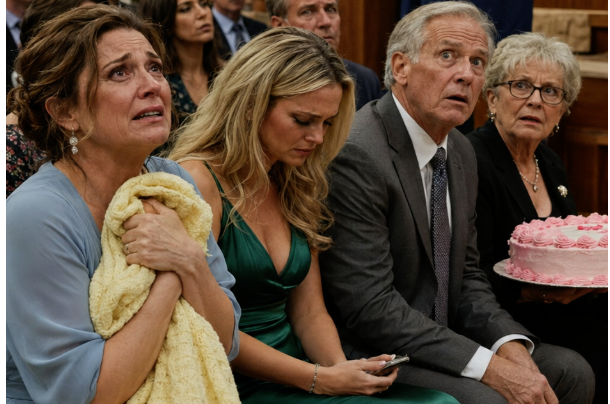
My name is Myra Summers. I was forty-one years old, sitting in the stifling heat of a high school gymnasium, when my younger sister paraded into my son’s graduation carrying a grocery-store sheet cake. The icing, rendered in a sickeningly bright pink buttercream, read: Congratulations from your real mom.
She did not arrive with the quiet grace of someone seeking amends. Vanessa never operated in the shadows; she required a stage, an audience, a spectacle. She swept through the double doors wearing an emerald green dress, her auburn hair cascading in immaculate waves, her heels clicking against the polished wooden floor like aggressive punctuation marks. Beside her walked a man I had never laid eyes on—a silver-haired, affluent-looking real estate investor named Harrison Whitfield, who surveyed the crowded room with the detached appraisal of a buyer. Trailing closely behind them were my parents, Rita and Gerald Summers, moving with the rigid, self-important posture of people entirely convinced that history belongs exclusively to those who control the family narrative.
And there I sat. I was in the third row, wearing the first new dress I had permitted myself to purchase in three years, watching my mother balance that treacherous cake on her lap as if she were holding a sacred relic. For a fleeting second, the sheer audacity of the words threatened to physically knock the oxygen from my lungs.
Congratulations from your real mom.
The phrase sat there on the buttercream, glaring and shameless. It was not from the woman who had spent nineteen years answering the phone when he spiked a fever. Not from the woman who had meticulously signed every emergency contact sheet, every vaccination consent form, and every permission slip for science fairs and museum trips. Not from the woman who knew he despised cooked carrots but would happily eat them raw, who knew he curled onto his left side when anxiety kept him awake, who knew the exact sound of his first word, the terror of his first nightmare, and the quiet devastation of his first broken heart.
I did not stand up. I did not weep. I did not slap the cake from my mother’s hands, although I will not deny that the deeply satisfying image of ruined frosting flashing across the gymnasium floor crossed my mind. Instead, I folded my hands neatly in my lap and directed my gaze toward the line of graduates forming by the door.
Dylan saw it too. He stood tall and steady in his navy blue cap and gown, the gold tassel brushing his cheek. His dark eyes found mine across the sea of proud families. In that moment, he did not resemble the fragile infant I had brought home wrapped in a faded yellow blanket. He did not look like the earnest little boy who had once nervously asked if he could call me Mom. He looked like a young man who had been waiting a very long time for the truth to arrive in a room large enough to hold it. He looked at me, and I instantly understood the silent message in his eyes: Wait.
So, I waited.
To fully understand the cruelty of that cake, you must rewind nineteen years. I was twenty-two, freshly graduated from Ohio State with a degree in education, and standing on the precipice of my own carefully constructed life. I had secured a full scholarship for a master’s program—a golden ticket out of Willow Creek, Ohio, spoken of in our town like a rare miracle. I had a tiny apartment overlooking a fractured parking lot and a sloping maple tree. It was undeniably modest, but it was mine, and I loved it simply because no one else could dictate whether I deserved it.
Then, the two a.m. phone call shattered my quiet autonomy. “Come home,” my mother, Rita, commanded, her voice brittle with the weight of an unspoken catastrophe.
I drove the dark, empty highway anticipating a teenage rebellion. Vanessa was sixteen, six years my junior. She was the undeniable beauty of the family, a fragile girl shielded from the consequences of her actions the way one protects a priceless, delicate vase. If Vanessa failed to empty the dishwasher, she was “exhausted.” If she snapped cruelly at people, she was “sensitive.” I, conversely, was the reliable daughter—a title that masquerades as praise but actually operates as a lifelong sentence of servitude. I remembered the medications, managed the household crises, and absorbed the emotional labor.
When I arrived, my mother slid a grainy black-and-white ultrasound photo across the kitchen table. Vanessa was four months pregnant. The teenage boyfriend had vanished. Rita did not weep for her youngest daughter’s fear or inquire about the baby’s health. Her singular, agonizing focus was the preservation of our family’s social standing. “The neighbors cannot know,” Rita declared, her voice icy, while my father stared silently at the linoleum, present in the room but entirely absent from the courage required to intervene.
Rita retrieved a faded yellow baby blanket from the hall closet—the very blanket I had been wrapped in as a newborn. She pressed it into my hands. “You have to help,” she insisted, effortlessly weaponizing my loyalty. “You’re her sister.” The ultimatum was delivered the next morning: take the baby, or he goes to a closed adoption agency by Friday, and Vanessa returns to high school as if nothing happened. When I asked Vanessa what she wanted, she sat on her bed, trembling, and whispered, “I want it to go away.” It was the terrified plea of a child, not informed consent.
I called my university, withdrew from my master’s program, relinquished the scholarship, and watched my future dissolve.
Dylan was born in July. Vanessa endured an eleven-hour labor, but when the nurse finally swaddled the furious infant and offered him to her, my sister turned her face to the sterile hospital wall. My mother stood coldly by the door. The nurse looked at me. I stepped forward and gathered him into my arms. Instantly, his tiny fist unfurled, and his fingers wrapped tightly around my index finger. His crying ceased. It was as though a profound, invisible tether had been pulled taut between us.
The first year nearly broke me down to my foundation. Dylan suffered from severe colic, screaming relentlessly from eight o’clock until midnight. I walked endless, agonizing miles across my cheap carpet, bouncing him against my chest, humming melodies until my throat felt like sandpaper. I worked as a teaching assistant during the day, rushing home to an endless cycle of bottles, laundry, financial terror, and the crushing isolation of being a mother whom the world deemed “temporary.” When I called my mother in tears, begging for just one night of help, she sighed and said, “You chose this, Myra. Figure it out.” Then she hung up.
Vanessa departed for college in Boston that autumn, her tuition funded by the same parents who claimed they could not afford to help me with Dylan’s pediatrician bills. By October, Vanessa voluntarily relinquished her parental rights via fax from her sorority house during rush week. A family court granted me full legal guardianship. I bought a fireproof safe, placed the stamped documents inside along with the faded yellow blanket, and locked away the legal proof that he was, unequivocally, mine.
The years crystallized into beautiful, exhausting milestones. When he was six, Vanessa called me for the first time—not to ask if her biological son was healthy, but to inquire about selling an old car she had left in our parents’ garage. The call lasted forty-two seconds.
When Dylan was eight, I finally secured a full-time position as a special education aide. That same year, while I was washing dishes, he sat at the kitchen table and asked the question I had anticipated for a decade. “Aunt Myra, how come I don’t have a mom and dad like the other kids?” I dried my hands, sat opposite his serious eyes, and chose absolute truth. “Your birth mom was very young,” I explained gently. “She wasn’t ready to take care of a baby. But I was here. I took you home. I love you more than anything, and I’m always going to be here.”
He absorbed this, nodded slowly, and asked, “I know. I just wanted to call you Mom instead of Aunt Myra. Is that okay?” I broke down, weeping into his small shoulders as he hugged me, finally granting me the title I had bled for.
I revealed the full, unvarnished history when he was thirteen. I laid out the chronology without malice. He retreated to his room for two days, eventually emerging to say, “I’m not angry at her. I’m just sad for her. She missed everything.”
My family’s refusal to acknowledge our reality only grew more toxic. During Thanksgiving when Dylan was fifteen, Rita introduced him to a distant relative as “Vanessa’s son.” Not my son. Not her grandson. Dylan squeezed my hand under the table, and on the silent drive home, he stated he never needed to return to that house. We never did. While I raised a brilliant, kind-hearted teenager, Vanessa collected accolades, an MBA, and two brief marriages, living a life scrubbed entirely clean of her past.
During Dylan’s junior year, his college counselor showed me his valedictorian essay, titled: The Woman Who Chose Me. I read it in my parked car, weeping as his words tore through my heart. He wrote about the yellow blanket, the newspaper wrapping paper, and ended with a devastating truth: Biology is an accident. Love is a decision. My mother made that decision every single day for nineteen years, and she never once asked for credit.
Months before graduation, Dylan discovered a family group chat. For two years, Rita, Gerald, and Vanessa had been discussing my son like a piece of borrowed furniture awaiting retrieval. Rita had typed, When Vanessa is ready, she will take Dylan back. Vanessa had replied, Give me a couple more years. They had completely invalidated nineteen years of my devotion. Dylan had hidden the chat to protect me. Then, Rita called to announce Vanessa had met a wealthy man named Harrison who wanted a “real family,” and Vanessa had spun a tragic tale of being “forced” to give Dylan up. Soon after, Vanessa messaged Dylan on Instagram, addressing him as “handsome,” claiming she was his “bio mom,” and announcing her arrival at his graduation. Dylan’s response was icy and brief.
Which brings us back to the stifling gymnasium, the emerald dress, and the cake.
Before the ceremony commenced, Vanessa cornered us. Placing a manicured hand on my shoulder, she projected her voice. “Myra,” she purred, dripping with condescension, “thank you for taking care of my son. You’ve been an incredible babysitter. But I’m here now. I’ll take it from here.”
Babysitter. The word was a grotesque insult to four thousand packed lunches, midnight fevers, and nineteen years of unyielding love. I caught Dylan’s eye, and his silent gaze again commanded me to wait.
The ceremony plodded through administrative speeches until Dylan’s name was called. He accepted his diploma, winked at me, and stepped up to the podium. He began with expected humor, causing Vanessa to laugh loudly and record him on her phone. Then, Dylan stopped. He folded his prepared speech and gripped the edges of the podium.
“I wrote nine drafts of this speech,” his voice echoed through the silent gym. “But the most important thing I want to say isn’t on those pages. The person I want to thank most today is a woman who was twenty-two years old when she was handed a newborn baby and told, ‘This is your responsibility now.'” The room went deathly still. “She gave up a full master’s scholarship. She bought dollar-store diapers, and figured it out. I had colic; I cried for four hours a night, and she still held me. She wrapped my presents in newspaper. She came to every assembly, every play, every moment when a kid searches the crowd to see if someone showed up for him.”
Tears streamed down the faces of strangers around me. Dylan looked directly into my eyes, fiercely proud. “She is not the woman who gave birth to me. But she is the woman who chose me every single day for nineteen years. Her name is Myra Summers. She is my mother.”
The gymnasium erupted in a standing ovation. In the second row, Vanessa slowly lowered her phone. The cake resting on Rita’s lap had become a glaring monument to their profound self-delusion. Everyone in the room now knew exactly who the real mother was.
On the sunlit lawn afterward, Vanessa charged at me, her composure shattered, accusing me of coaching him. Dylan stepped between us, tall and immovable. “Nobody coached me,” he stated firmly. When Vanessa pleaded, invoking her pregnancy, Dylan dismantled her narrative in front of her wealthy boyfriend, reminding her of the faxed papers and her absolute absence.
Harrison stepped forward, his expression darkened. “Vanessa,” he asked quietly, “did you voluntarily sign away your parental rights?” When she stammered, Harrison understood the depth of her deception. He turned, walked to his car, and drove out of her life.
Dylan addressed my parents one last time, pointing out that in nineteen years, they occupied almost none of his memories, while I occupied every single one. Finally, he turned back to Vanessa. He told her if she wanted a relationship, it had to start with reality, noting she didn’t even know about his severe tree nut allergy. Then, reaching into his vest, Dylan produced the frayed, faded yellow baby blanket. The lawn fell completely silent as he pressed the fragile cotton into my trembling hands. “This is yours, Mom,” he whispered. “It was always yours.”
That evening, Dylan asked if I was angry that he had made our private pain public. I took his face in my hands, weeping, and told him he hadn’t made it public; he had simply made it true. Vanessa called days later, her relationship destroyed, crying genuine tears, but I refused to be her emotional courier and told her to apologize to him directly. My father eventually sent a short, handwritten apology, a tiny fracture in his decades of silence.
When I dropped Dylan off at college, he packed the yellow blanket alongside his vital documents. As we hugged goodbye, he thanked me for choosing him. I closed my eyes and thanked him for letting me.
Years have passed since that graduation day, yet my mind occasionally drifts back to the cake. It stands as a profound symbol of the lies families tell to frost over abandonment and rebrand it as sacrifice. They write “real mom” in sugar and pray no one inspects the bitter ingredients beneath. But true motherhood is not found in grand, public gestures or biological technicalities. It is found in the relentless, quiet devotion of the woman who stays long after the party has ended.