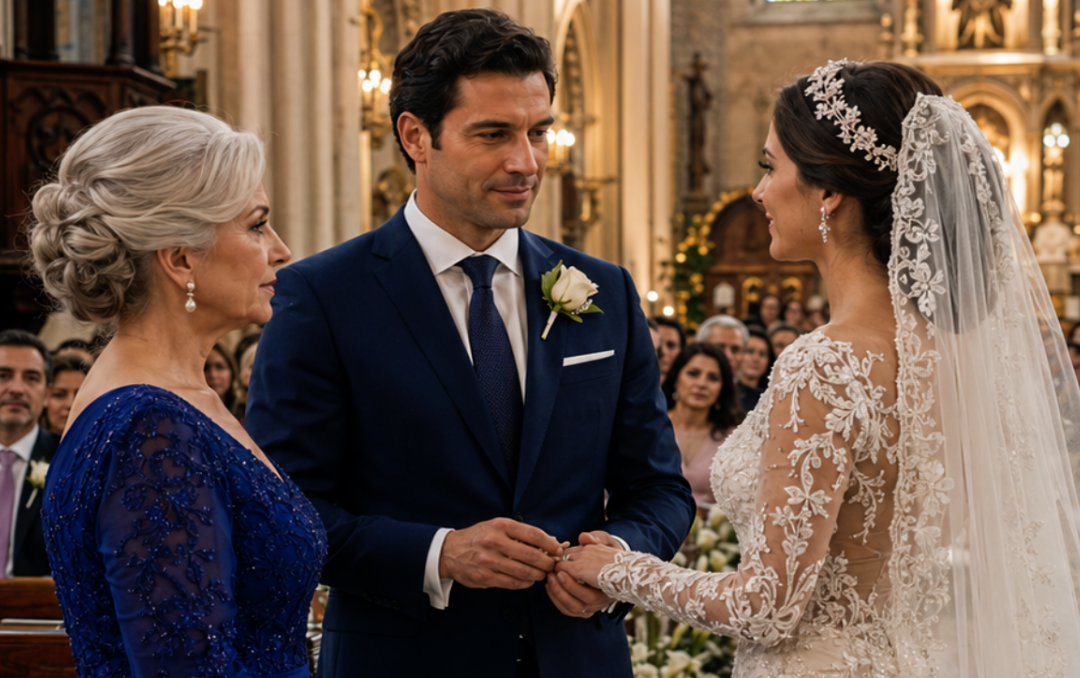
I thought I understood the architecture of love, but I was merely blind to the mechanics of a long con. My name is Charles. Until the day of my wedding, I believed I was a man possessing a clear vision of my future. It took precisely one sentence, spoken in front of two hundred and sixty guests at St. Mary’s Church, for the woman I loved to shatter that illusion and reveal the chilling sociopathy beneath her designer veil. This is not merely a story of a canceled wedding; it is an examination of the absolute dichotomy between performative elite status and authentic human dignity.
The morning of June 15th was a masterclass in superficial perfection. St. Mary’s Church had been transformed into a botanical sanctuary of white lilies and baby’s breath, the sunlight fracturing through stained glass to paint the marble altar in a mosaic of colors. I stood at the front in a tailored navy suit, a forty-four-year-old engineer who believed he had finally found his harbor.
To understand the gravity of what transpired, one must first understand the stark divide between my family and Stephanie’s. My mother, Margaret, sat in the front row. At sixty-nine, she radiated the quiet, immovable dignity of a woman who had spent a lifetime in communion with the earth. She had driven three hours from Willowbrook Farm, her weathered hands—hands that had sustained us after my father’s premature death—folded neatly over a simple blue dress.
Conversely, Stephanie’s family occupied their side of the aisle with the territorial aggression of a corporate acquisition. Her father, Richard, wore a bespoke suit that cost more than my mother earned in an entire season of selling organic produce at the county market. Her mother was a walking display case of aggressively curated diamonds. For three years, they had engaged in a campaign of subtle microaggressions against me, treating my agricultural background as a genetic defect that their daughter was charitably attempting to breed out of me.
When Stephanie floated down the aisle in a ten-thousand-dollar gown, she looked less like a bride and more like a conquering monarch. The ceremony was flawless. We exchanged vows I had spent weeks drafting—promises of unconditional honor that, in retrospect, were entirely asymmetrical.
The facade cracked during the receiving line.
Stephanie was in her element, gracefully accepting the adulation of her peers. My mother had patiently waited at the back, deferring to others as was her humble nature. When Margaret finally approached, she offered a warm, tentative smile, attempting to bridge the vast socioeconomic canyon between them.
“Congratulations, you two,” my mother said softly. She embraced me first, carrying the faint, honest scent of lavender soap and the indelible, earthy aroma of the farm she had managed alone for decades.
Then, she turned to Stephanie with open arms.
What followed was a psychological autopsy performed in real-time. Stephanie did not merely decline the embrace; she recoiled with theatrical, visceral disgust.
“Oh no,” Stephanie projected, calibrating her volume perfectly so the surrounding elite could hear. “She smells like manure. Keep that peasant away from me.”
The air in the cathedral seemed to freeze. I watched my mother’s body go rigid, her arms dropping to her sides as if she had suffered a physical blow. The color vanished from her face, yet she remained stoically silent—a defensive posture learned from years of enduring the dismissive cruelty of “better” society. A cousin of Stephanie’s giggled. Someone murmured, “You’re terrible,” through a highly entertained smile.
They thought it was a joke. They believed the degradation of an elderly widow was an acceptable form of aristocratic entertainment.
“Stephanie,” I said, my voice dropping to a dangerous, calibrated quiet. “Apologize to my mother right now.”
Stephanie scoffed, rolling her eyes as if I were a child throwing a tantrum over a broken toy. “Charles, honestly. She should have cleaned up better before coming. This is our wedding day, not some county fair.”
In that suspended moment, I did not just see a rude fiancée; I saw a void where a human conscience should have been. I reached into my jacket pocket. For fourteen days, an unopened envelope from my late father’s estate attorney had been burning a hole against my chest. I hadn’t opened it because I feared it would change my life. I suddenly realized my life required immediate, radical alteration.
“Take off the ring,” I commanded.
Stephanie blinked, the heavy layers of her makeup suddenly looking like a clownish mask under the harsh light of reality. “What?”
“Take off the ring. This wedding is over.”
Two hundred and sixty people fell dead silent. I watched Stephanie’s expression pivot from arrogance to utter confusion, and finally, to the initial tremors of panic.
“The joke,” I projected, ensuring the sound carried to the back pews, “is that you have absolutely no idea what you just threw away.” I held up the sealed envelope. “But you are about to find out.”
I took my mother’s trembling hand, turned my back on the altar, and walked us out of the church. The heavy wooden doors of St. Mary’s closed behind us, echoing with the finality of a gavel striking wood.
The drive back to Willowbrook Farm was steeped in a heavy, suffocating silence. My mother stared blankly at the rolling countryside, her shoulders curved inward, retreating into the trauma of being reduced to a punchline.
Meanwhile, my phone erupted into a symphony of digital panic. There were twenty-three missed calls from Stephanie and a barrage of texts that rapidly devolved from manipulative apologies (“Charles, please come back, we can work this out”) to aggressive gaslighting (“You just ruined the most important day of my life over nothing”).
The most revealing communication, however, came via a voicemail from her father, Richard: “Charles, this is Richard. You need to think about this rationally. We’ve invested too much in this relationship for you to throw it away over some misunderstanding.”
He did not speak of love or family; he spoke of investments and dividends.
But the catalyst for true illumination came from a phone call with Emma, Stephanie’s sister—the singular anomaly of empathy in that bloodline.
“Charles, I have to tell you,” Emma’s voice trembled over the line as I stood in my childhood kitchen. “Stephanie has been planning something for months. She wants to put your mother in a care facility. She’s been talking to lawyers about how to have her declared incompetent. She plans to sell the farm. She thinks your mother is just sitting on worthless land, but I work in real estate development. If someone sold that acreage, they could make millions.”
I sank into my father’s worn leather armchair. The sheer magnitude of the betrayal was paralyzing. Stephanie had not simply insulted my mother; she had been executing a prolonged, premeditated psychological and financial assassination.
I finally tore open the lawyer’s envelope.
The documents inside defied comprehension. My quiet, frugal mother, who drove a twenty-year-old truck and mended her own clothes, was the sole proprietor of three thousand acres of prime agricultural and commercial development land. The appraisals were staggered across the pages: the property was valued at $12.5 million, generating nearly $2 million annually through sustainable agricultural lease agreements.
When I asked my mother why she had concealed this staggering wealth, her answer was a masterclass in profound philosophical grounding: “Because I didn’t want money to change how people saw you, or how we saw ourselves. Money has a way of making people forget what actually matters.”
She had protected me from the corrupting influence of unearned wealth. Stephanie, conversely, was entirely corrupted by it.
When Stephanie inevitably called again, I answered. Her voice dripped with a cloying, weaponized sweetness, attempting to soothe my “irrational” temper.
I cut through her performance with surgical precision. I detailed the exact acreage of Willowbrook Farm. I recited the $12.5 million valuation and the $2 million annual revenue.
The silence on the line was absolute, followed by a breathless, frantic denial. “You’re lying. You live in a tiny house. You drive an old truck.”
“Because unlike your family, Stephanie, we understand the difference between possessing wealth and being possessed by it. My ‘peasant’ mother could liquidate your father’s entire company without checking her bank balance.”
I then dropped the final guillotine blade. “And I know about the nursing home. I know about the lawyers. I know you planned to declare her incompetent to seize the land.”
The call devolved into a pathetic negotiation, her father eventually taking the phone to attempt a corporate mediation of his daughter’s moral bankruptcy. I hung up, sealing their exile.
But the true depth of the horror was revealed the next morning. Emma called me to Stephanie’s luxury apartment—a high-rise monument to unearned privilege. Stephanie had fled, abandoning a desk littered with the physical blueprints of her conspiracy.
We sifted through the wreckage, unearthing a comprehensive portfolio of fraud.
Forged Power of Attorney: Documents bearing a crude forgery of my mother’s signature, granting Stephanie total control of Margaret’s estate.
Fraudulent Medical Evaluations: A pristine, typed evaluation from a fictitious Dr. Harrison Matthews, falsely diagnosing my sixty-nine-year-old mother with advanced, incapacitating dementia.
The Corporate Conspiracy: A printed email chain with Marcus Chen of Chen Development Group. The correspondence detailed a $40 million development plan for Willowbrook Farm. Stephanie’s emails explicitly stated that the “current owner” would be “safely settled in a care facility” shortly after our June wedding.
The Bribe: A bank statement showing a recent $50,000 deposit from Chen Development, labeled as a “consultation fee.”
This was not a miscalculation or a momentary lapse in judgment. This was a felony. Stephanie had already sold land she did not own, relying on a marital technicality and the systemic erasure of an elderly woman’s autonomy to complete the transaction.
At 6:00 AM the following morning, the machinery of justice began to turn. My mother and I found ourselves in the starkly lit conference room of the district attorney’s office, sitting across from Detective Sarah Morrison and Assistant District Attorney James Walsh.
Detective Morrison was a study in sharp, grounded competence. She meticulously cataloged the forged documents and the damning emails. When she asked my mother if she had ever been examined by the fictitious Dr. Matthews, my mother’s response was a testament to her unyielding clarity: “I’ve seen the same physician for twenty-three years. I manage my own affairs. I may be sixty-nine, detective, but there is absolutely nothing wrong with my mind.”
During the meeting, Richard Manning called my phone. ADA Walsh instructed me to answer on speaker.
Richard’s voice resonated with the arrogance of a man accustomed to buying his way out of consequences. “Charles, this involving the police is going too far. This is a family matter. We can make this right. Name your price.”
When I refused, Richard resorted to the default tactic of the corrupt elite: extortion. “You’re making a mistake. My family has influence. We can make your life very difficult.”
ADA Walsh leaned into the microphone. “Mr. Manning, this is Assistant District Attorney James Walsh. I am recording this conversation, and what you just articulated constitutes criminal extortion. I highly advise you to retain counsel.”
The line went dead. The collapse of the Manning dynasty had officially begun.
Within weeks, the fallout was catastrophic and absolute. Stephanie’s mother, discovering that Stephanie had liquidated $80,000 of family trust funds and “stolen” jewelry to finance her fraudulent deal with Chen Development, disowned her. Richard Manning’s corporate partners, terrified of the PR nightmare associated with felony elder abuse and fraud, forced him into an unceremonious early retirement.
Stephanie, having gambled her entire existence on a sociopathic wager, was sentenced to seven years in a state penitentiary. During the trial, Detective Morrison uncovered that Stephanie had utilized similar, albeit smaller, predatory tactics on two other elderly individuals in the past. There was no leniency. There was only the cold, hard floor of accountability.
Six months later, the doors of St. Mary’s Church opened for a different kind of ceremony.
There were no ten-thousand-dollar dresses or aggressive displays of wealth. There were only thirty-seven guests. At the altar stood Detective Sarah Morrison.
During her investigation, Sarah had spent hours at Willowbrook Farm. She had fallen in love with the quiet rhythm of our lives, the smell of my mother’s cornbread, and the unpretentious honesty of our existence, long before she fully understood the extent of our financial portfolio. She was a woman who spent her life navigating the darkest, most deceptive corridors of human nature, and in our farm, she found an incorruptible sanctuary.
My mother sat in the front row, not as an outcast to be tolerated, but as the revered matriarch of our family, her dignity legally and socially entirely vindicated.
Three years have passed since that day.
We established the Margaret and Sarah Foundation, utilizing the immense revenue from the agricultural leases to provide free legal protection and advocacy for the elderly facing financial exploitation and familial abuse. The farm remains exactly as it was—a testament to stewardship and hard work.
I received a courtesy call recently from a parole officer. Stephanie was being released to a halfway house two hundred miles away, legally barred from ever contacting us, mandated to attend rigorous psychological counseling for manipulative disorders. I felt no anger, nor any vindication. I felt only a profound, echoing apathy toward her.
As I stood on the porch of the farmhouse, watching Sarah show our six-month-old daughter how to plant seeds in the dark, rich soil of Willowbrook, I realized the ultimate truth of my father’s legacy.
Real wealth is not defined by acreage, offshore accounts, or the aggressive hoarding of capital. Real wealth is the absolute certainty that the people sitting at your table love you for the content of your character, rather than the utility of your assets. Stephanie spent her life chasing the illusion of power, only to lose everything. We chose the quiet dignity of the truth, and in doing so, we gained the world.