The gavel fell with a resolute thud, sealing fifteen years of marriage into a tidy stack of legal documents. “This divorce is final,” the judge announced, his voice carrying the weary authority of a man who oversaw the collapse of lives every day.
I didn’t weep. People always anticipate a spectacle in these moments—a sudden outburst, a dramatic exit, or at the very least, a trembling lip. But the reservoir of my grief had run dry months ago. I had mourned our marriage in the suffocating isolation of my laundry room, my sobs masked by the rhythmic thrum of the dryer. I had grieved when I uncovered the first digital trace of her on his phone—a seemingly innocuous message dripping with a toxic, unearned familiarity. By the time I sat in that sterile courtroom, an unshakeable calm had replaced the tempest of betrayal.
I leaned toward my attorney, a meticulously prepared man named Robert Hayes. “Book the tickets,” I whispered.
Across the aisle, Daniel shifted his weight, his posture exuding a potent blend of relief and impatience. He had always abhorred administrative delays, viewing patience as a virtue for the weak. To the untrained eye, including his mother and sister whispering conspiratorially in the gallery, it appeared I was walking away defeated. The settlement was deceptively modest: Daniel retained the primary residence, the lion’s share of our visible savings, and his untouched business accounts. I accepted a modest sum and full custody of the children. They wore poorly concealed smirks, convinced of their absolute triumph.
“Emily,” Daniel remarked casually as the proceedings concluded, adopting the tone of a manager dismissing a subordinate. “I’ll have someone coordinate the visitation schedule.”
“I won’t be available,” I replied, meeting his gaze with a chilling clarity. “You will need to go through my attorney.”
A shadow of irritation darkened his features, but true to his nature, he opted for the path of least resistance, turning away to check his phone. Outside, the air tasted distinctly different—lighter, untethered.
“Are you absolutely certain?” Robert asked as we descended the courthouse steps. “Once I make the calls, the cascade cannot be stopped.”
“I am certain,” I replied.
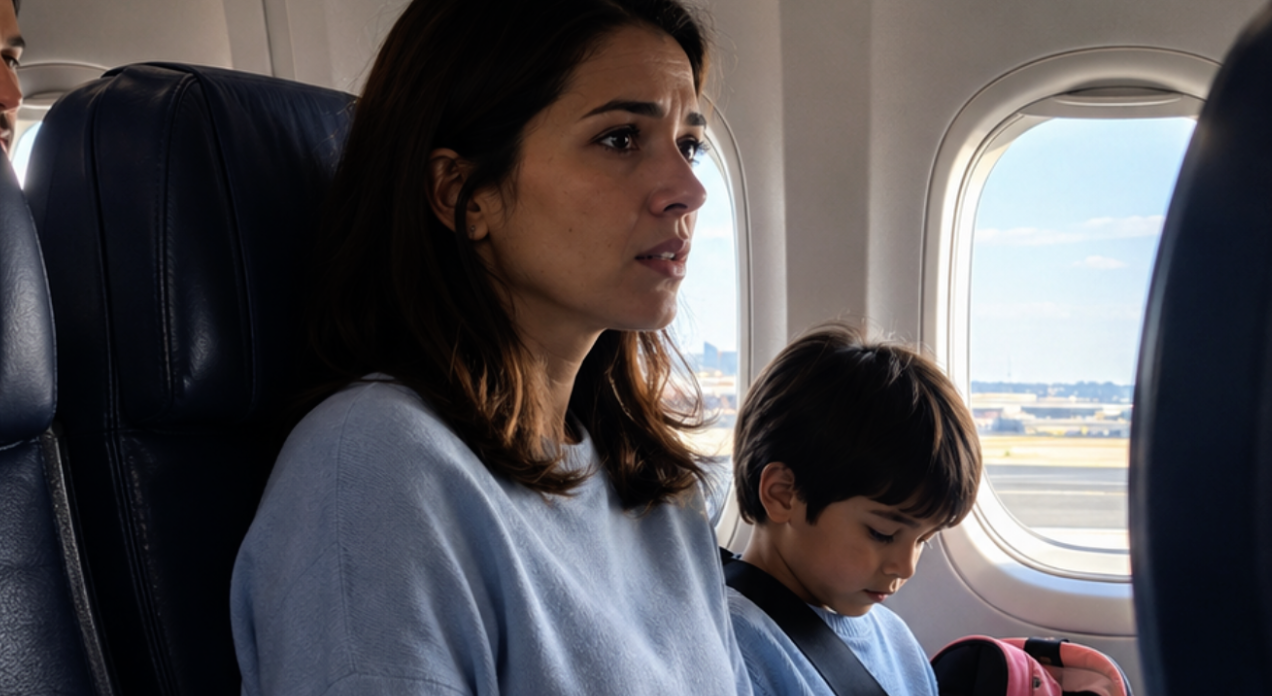
Ten minutes later, I was buckling my youngest son, Noah, into a window seat on a commercial airliner. My older children, Ethan and Lily, sat beside me in a state of stunned compliance, gripping the small backpacks I had packed under the cover of darkness. As the aircraft engines roared to life, propelling us away from the only home they had ever known, I closed my eyes and exhaled. I had spent months anticipating a blow. Now, I had finally set the board.
While our plane broke through the cloud cover, another scene was unfolding across town—one painted in the cheerful, pastel hues of an upscale maternity clinic. Daniel, flanked by an entourage of eight family members, stood with his arm draped protectively around Vanessa. She was twenty-eight, polished to a high sheen, and entirely confident in her newly stolen life. They were gathered to witness the heartbeat of the child they had prematurely crowned as their future.
The ultrasound room was bathed in a gentle, expectant dimness. Vanessa reclined on the examination table, her hand intertwined with Daniel’s. As the technician guided the wand across her abdomen, a grainy, monochromatic image flickered onto the monitor.
“Oh, look at that,” Daniel’s mother gasped, pressing a hand to her chest. “Our grandchild.”
Daniel remained silent, his eyes fixed on the screen, a portrait of patriarchal pride. However, the technician’s practiced smile faltered. Her movements became deliberate, her eyes narrowing as she tapped a sequence of measurements into the console.
“I’m going to have the attending physician step in for a moment,” she murmured, her voice stripped of its earlier warmth.
The word “standard” was thrown out to pacify the room, but the air grew heavy. When the doctor arrived, his demeanor was clinically measured. He studied the monitor, his brow furrowed in a silent calculation that stretched the tension to a breaking point.
“When was your last confirmed menstrual cycle?” the doctor asked, his eyes locked on Vanessa. She provided a date, her voice trembling slightly. He typed the information into his tablet, his expression unreadable.
“Based on the fetal development we are observing,” the doctor stated, his voice slicing through the suffocating silence, “the estimated timeline of this pregnancy does not align with the history you have provided.”
Daniel’s posture rigidified. “What exactly does that mean?”
“It indicates that conception occurred significantly earlier than your described timeline,” the doctor explained, offering no sanctuary for their denial. “Earlier than your relationship would account for.”
The silence that descended upon the room was absolute. It was not the silence of contemplation, but the profound, echoing void of a reality shattering into unrecognizable fragments. Vanessa’s face blanched, her eyes darting frantically. “There has to be a mistake. You’re reading the scan incorrectly.”
“There is no error in the sonogram,” the technician replied softly.
Daniel stepped away from the table, physically severing his connection to Vanessa. His gaze, previously warm and possessive, hardened into a cold interrogation. “Vanessa,” he demanded, his voice dropping an octave. “Is there something you need to confess?”
She offered no response. And in the agonizing chasm of her silence, the illusion of Daniel’s perfect new life began to violently unravel.
Before the shockwaves in the clinic could settle, Daniel’s phone vibrated violently against his thigh. He ignored it twice, blinded by the immediate betrayal unfolding before him. By the third ring, his father gently urged him to answer.
Daniel stepped into the sterile hallway, his patience entirely exhausted. “What?” he barked into the receiver.
“Mr. Carter,” the composed, unyielding voice of Robert Hayes resonated through the speaker. “I am calling to formally notify you of a change in circumstances.”
“The divorce was finalized hours ago,” Daniel snapped, his defensive instincts flaring.
“It was,” Robert agreed amiably. “However, that finalization was predicated upon the financial disclosures you submitted under oath. Based on newly acquired evidence regarding offshore accounts and unrecorded wealth transfers, we have initiated a formal review.”
Daniel’s breath hitched. “That is a gross misunderstanding.”
“The Internal Revenue Service will determine the validity of that misunderstanding,” Robert continued, his tone surgically precise. “As of this afternoon, your primary accounts have been temporarily frozen pending a comprehensive federal audit. Furthermore, the non-disclosure penalty clause you signed this morning has been fully activated.”
Daniel leaned heavily against the clinic wall, the ground beneath him suddenly porous and unstable. The settlement he thought he had engineered to perfection was nullified. The assets he believed were shielded in secrecy were exposed to the blinding light of legal scrutiny.
“You should consult your legal counsel immediately,” Robert concluded before severing the connection.
When Daniel walked back into the ultrasound room, he carried the weight of a man who had lost his empire and his heir in a single afternoon. His mother rushed forward, demanding explanations, but Daniel simply looked at the woman on the table—the woman for whom he had dismantled a fifteen-year marriage.
“Get dressed,” he ordered, his voice devoid of any remaining affection. The word contained the entirety of his ruin.
Thousands of miles away, the air was remarkably soft. It lacked the frantic, electrical charge of the city we had abandoned. I stood on the modest patio of our rental home, a sanctuary I had meticulously arranged over weeks of clandestine planning. The house was small—a far cry from the sprawling estate we had left—but it was clean, bathed in the amber glow of the late afternoon sun, and fundamentally secure.
Lily, ever the perceptive child, approached me as I watched Ethan and Noah explore the overgrown backyard. “It’s very quiet here,” she observed, adjusting the straps of her backpack. “Are we staying?”
I crouched down to meet her gaze, brushing a stray lock of hair from her forehead. “We are starting here,” I told her honestly. She studied my face, searching for the hidden anxieties she was so accustomed to finding, but found only resolve. She nodded, accepting the truth.
My phone vibrated continuously on the kitchen counter. Missed calls. Frantic text messages demanding explanations. What did you do? read one message from Daniel. You think this is over? read another.
I did not reply. A response is a negotiation, an acknowledgment of their power to command your attention. I had surrendered that dynamic entirely. My silence was the final, impenetrable wall between my children’s peace and his chaos.
Over the following weeks, the collapse of Daniel’s world progressed with brutal efficiency. The rumors seeped out—not through scandalous tabloids, but through the lethal, whispered channels of corporate networking. Business partners, allergic to the scent of IRS investigations, began to quietly distance themselves. His financial liquidity evaporated under the intense scrutiny of the audit.
And Vanessa, the catalyst for his supposed rebirth, vanished. I received a single, desperate phone call from her shortly before she left the city entirely.
“I didn’t know,” she wept into the receiver, her voice a fragile shell of its former confidence. “I didn’t know about the hidden accounts, or the investigation. And the baby… I swear I thought the timing was right.”
I listened to the devastation of a woman who had gambled on a mirage. “I didn’t think you knew, Vanessa,” I replied evenly. “But this is not something I can untangle for you.”
“I just needed someone to understand,” she sobbed.
“I hope you find clarity,” I told her, and I meant it. Disconnecting the call, I felt no triumphant joy, no vindictive thrill. There was only the profound realization that actions inevitably summon their own balancing force. She had stepped into a narrative constructed on deceit, and the architecture had collapsed on them both.
Seasons shifted, bringing a tangible permanence to our new existence. The children flourished in the absence of ambient tension. Ethan found camaraderie on a local basketball team, Lily devoured books without retreating into them for safety, and Noah simply grew, his laughter echoing freely through the hallways of our modest home.
The legal untangling of my previous life was a slow, methodical process, navigated exclusively through attorneys. The reassessment of assets yielded a settlement that was genuinely equitable, stripped of Daniel’s financial sleight of hand. I sought no punitive damages, only the mathematical truth of what we had built together.
It wasn’t until a quiet Tuesday afternoon, nearly eight months after the judge’s gavel had fallen, that I finally spoke to Daniel.
When I answered the phone, his voice was unrecognizable. The arrogance was gone, replaced by a hollow exhaustion. “I didn’t expect you to pick up,” he admitted.
“I almost didn’t,” I replied, staring out the window at the swaying branches of an oak tree.
“I’m not calling to argue,” he said softly. “I just… I think I finally understand what you meant when you said you were making things clear. I thought I had everything under control. The house, the money, the future.”
“And now?” I prompted, my voice devoid of malice.
“Now, nothing is settled. Vanessa is gone. The business is… struggling.” He paused, taking a ragged breath. “I’m not asking you to return, Emily. I know that bridge is ashes. But I want a chance to be a father to them. They deserve stability.”
I leaned against the kitchen counter, realizing that my pulse had not quickened. My chest remained untightened. “They do deserve stability, Daniel. But stability isn’t a promise you make; it’s a pattern you demonstrate. It means showing up consistently. Not just when it’s convenient, or when the rest of your life is falling apart.”
“I know,” he whispered. “I’m sorry, Emily. For all of it.”
“I hear you,” I said. It was not a pardon, but an acknowledgment that he had finally perceived the reality of his devastation.
We established ironclad boundaries for his involvement—scheduled calls, supervised visits managed entirely through a neutral third party. He adhered to them, slowly building a fragmented but consistent presence in the children’s lives.
That evening, as the house settled into its familiar, comforting silence, I sat at the dining table with a blank notebook. I wasn’t drafting legal strategies or bracing for the next disaster. I was simply documenting the quiet rhythms of our day.
People often assume that surviving a betrayal requires a monumental, cinematic victory—a moment where you stand over the ruins of your enemy’s life and declare yourself the conqueror. But true victory is entirely internal. It is the moment you realize that your internal weather is no longer dictated by someone else’s storm.
I didn’t annihilate Daniel in court out of vengeance; I merely removed the veil from his own choices and allowed the consequences to breathe. In doing so, I protected the only asset of genuine value: our peace.
If you find yourself standing in the wreckage of a life you thought was secure, do not rush to rebuild in the panic of the aftermath. Pay attention to what is real, not what is promised. Gather the fragmented pieces of your truth, pack them quietly in the dark, and step onto the plane. The quietest decisions are often the ones that permanently rewrite your destiny. I walked away from a hollow empire, and in return, I gained the whole world.