The air inside the Plaza Hotel lobby tasted of polished marble, expensive lilies, and the quiet, unmistakable scent of generational wealth. I had flown over three thousand miles across the country, carrying nothing but a small overnight bag and an unassuming silver box wrapped in a modest white ribbon. When I approached the reception desk and offered my name, the attendant checked the sprawling, leather-bound guest directory. She scanned the pages once, then again, her manicured finger tracing the thick, cream-colored parchment.
When she finally looked up, her professional smile had evaporated, replaced by a soft, agonizing pity. “I am so sorry, ma’am,” she murmured. “Your name is not on the list.”
I stepped aside, the ambient hum of string quartets and clinking champagne flutes mocking my sudden isolation. Pulling out my phone, I dialed my sister. She answered on the second ring, the background noise of her opulent reception bleeding through the speaker.
“What do you want?” Isabella demanded, her voice sharp with practiced irritation.
“I am here, at the hotel,” I said, keeping my tone perfectly even. “They are saying my name isn’t on the guest list.”
A pause stretched between us, filled only by the distant laughter of her guests. Then came her sneer—a quiet, crystalline laugh that held no joy, only cruelty. “You really thought you’d be invited? This wedding is for people who matter, Nadia. Not someone who takes pictures for a living. Go home. Stop pretending you belong in my life.”
I did not argue. I did not raise my voice, nor did I allow the tears that had threatened me for twenty-eight years to finally fall. “I understand,” I replied softly, and severed the connection.
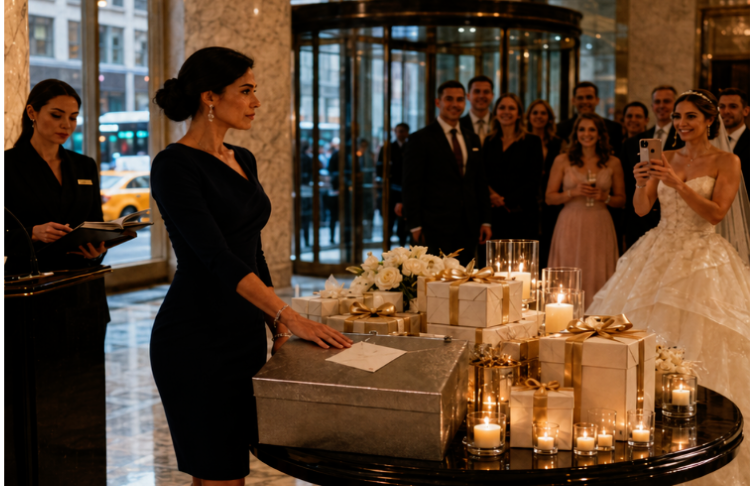
Before I walked back out into the crisp Manhattan evening, I approached the towering, ostentatious gift table. Amidst the mountain of Tiffany blue, Hermès orange, and oversized envelopes bulging with five-figure checks, I placed my small silver box. It was a humble, almost invisible offering. I turned and walked away, knowing with absolute certainty that when my sister opened that box, the life she had so carefully curated would irrevocably unravel.
To understand the sheer magnitude of what resided within that silver box, one must first understand the architecture of our family. We grew up in a sprawling, three-story brownstone on the Upper East Side. To the outside world, the Torres family was a portrait of immaculate success—wealthy, connected, spending summers in the Hamptons and winters attending the right philanthropic galas.
But behind those heavy mahogany doors, there was a strict, unspoken hierarchy. There were two daughters, but only one held any real currency. Isabella, three years my senior, was the golden child. She possessed the larger bedroom overlooking the street, the meticulously curated designer wardrobe, the private violin recitals that my parents eagerly attended. She absorbed the light in every room. I, conversely, learned to survive in the shadows.
The disparity crystallized on my tenth birthday. I had awakened with the breathless anticipation of double digits, envisioning balloons, a tiered cake, and the kind of vibrant backyard celebration Isabella was routinely granted. I ran down the sweeping staircase only to find a hollow, quiet kitchen. My mother, Teresa, was deeply engrossed in a phone call regarding Isabella’s upcoming cotillion. My father, Reuben, had already departed for his firm.
“Mom,” I whispered, tugging at her sleeve. “It’s my birthday.”
She briefly covered the receiver, her eyes distant. “I know, sweetheart. We will do something later.”
Later never arrived. But that evening, the heavy silence of my bedroom was broken by a soft knock. My grandmother, Carmen Delgado, stepped into the room, holding a heavy, rectangular package. She sat on the edge of my bed, her presence carrying the scent of lavender and old paper.
“Happy birthday, my darling girl,” she said, placing the box in my lap.
Inside lay a vintage, metal-bodied camera. It was heavy, complex, and beautiful. My grandmother brushed a gentle hand against my cheek. “You have an artist’s eye, Nadia. You see the world deeply. One day, the world will see what I see in you.”
That camera became my voice. Through its lens, I learned to frame the world I was excluded from, finding beauty in the overlooked and marginalized corners of life. Eight years later, that perspective earned me a full scholarship to the Parsons School of Design. I believed, naively, that this triumph would finally force my parents to see me.
On the morning of my college graduation, I stood in the foyer, draped in my academic regalia, holding a speech I had been selected to deliver. Isabella sat in the living room, casually scrolling through her phone, while my parents hurriedly reviewed a document on my father’s laptop.
“The ceremony begins at two,” I announced, my voice trembling with suppressed hope.
My mother didn’t look up from the screen. “Sweetheart, something came up.”
My father glanced at me, his expression devoid of apology. “Isabella has a vital networking event with Caldwell Capital Partners. It is a major step for her career. We cannot miss it. Photography isn’t a real career, Nadia. Perhaps you should consider something more practical.”
I walked across the graduation stage to a sea of strangers. When I looked out into the cavernous auditorium, there was only one familiar face: Grandmother Carmen, sitting in the front row, weeping with pride. Afterward, she took my hands in hers and imparted a truth that would anchor my entire existence:
“Remember this, Nadia. The most valuable things in life aren’t always the ones people fight over to display. Sometimes, they are the ones quietly passed on.”
Following graduation, I severed the fragile threads tying me to New York. I packed two suitcases, purchased a one-way ticket to San Diego, and disappeared into the sprawling anonymity of the West Coast. I started at the absolute bottom—hauling heavy equipment for established wedding photographers, adjusting lighting rigs until my fingers blistered, absorbing every technical nuance of the craft.
Slowly, methodically, I built my own empire. Over the next decade, Valora Studios was born. What began as a solitary endeavor evolved into a premier enterprise boasting a massive team, floor-to-ceiling studio windows overlooking the San Diego skyline, editorial features in global publications, and an annual revenue exceeding $4.2 million.
My family remained entirely oblivious. To them, I was still the disappointing daughter taking “little pictures” for spare change. Isabella would occasionally call, not to inquire about my well-being, but to weaponize her achievements. She would boast of her corner office, her engagement to Julian Mercer—a scion of East Coast commercial real estate royalty—and explicitly remind me that I was excluded from their “immediate family” celebrations.
I absorbed her cruelty with a quiet grace, secure in the sanctuary of the life I had built. I needed nothing from them.
Then, on a dreary Tuesday morning, the phone rang. It was Andrew Collins, my grandmother’s attorney. Carmen Delgado had passed away at the age of eighty-two.
I flew back to New York for the funeral at St. Patrick’s Cathedral. I sat alone in the third row, watching my parents and Isabella receive condolences with practiced, mournful elegance. Yet, even in the shadow of the casket, Isabella’s whispers to my mother betrayed her true focus: the Delgado heirloom jewelry collection, a legendary cache of gems valued at over $2.8 million.
Following the service, Mr. Collins discreetly guided me into a private antechamber. Sliding a thick manila envelope across the polished oak table, he revealed an addendum to my grandmother’s public will. My breath caught in my throat as I read the notarized document. The entirety of the Delgado collection—every diamond, every vintage sapphire, every strand of pearls—had been bequeathed to me.
Beneath the legal jargon lay a handwritten letter:
My dearest Nadia,
If you are reading this, I am no longer there to speak these words. Isabella sees these pieces as status—as trophies to be admired for simply owning them. But you see their history. You understand that beauty is not about possession; it is about preservation.
Your mother and sister will not accept this easily, but I have watched you grow quietly into someone extraordinary. These pieces belong with someone who will honor them. They belong with you.
All my love, Grandmother Carmen
“There is one condition,” Mr. Collins noted gently. “Your grandmother requested this remain confidential until you determine the precise moment to reveal it.”
The opportunity presented itself months later, orchestrated by a twist of fate so poetic it felt predestined. Margaret Sinclair, a titan of the luxury event planning industry and my grandmother’s oldest confidante, contacted me. She had a high-profile bride in New York who demanded the absolute best photography firm in the country.
“The bride signed the contract weeks ago,” Margaret told me over the phone, her voice thick with knowing irony. “Eighteen thousand, five hundred dollars. Non-refundable. She reviewed Valora Studios’ portfolio and demanded your team. She has absolutely no idea that her estranged sister owns the company.”
My sister had hired me.
Simultaneously, Isabella had begun publicly boasting about her imminent inheritance. At her extravagant bridal luncheons, she paraded the myth that she was Grandmother Carmen’s chosen heir, promising her high-society friends that she would wear the Delgado pearls to the Met Gala. She had even commissioned a custom display case for her dressing room, waiting for a treasure that would never arrive.
When the wedding invitations were mailed, my mailbox remained stubbornly empty. My mother eventually called to deliver the final blow, claiming the 450-guest wedding was “too intimate” for my presence, insisting my attendance would be an “awkward distraction.”
That was the moment the final remnants of my childhood longing dissolved. Clarity, sharp and cold as winter air, took its place. I packed the silver box and boarded a flight to New York.
The ballroom of the Plaza Hotel was a masterclass in excess. Ivory linens cascaded over tables adorned with towering hydrangeas and white roses. Waiters in pristine white gloves moved in synchronized perfection. At the head table sat Isabella, draped in custom couture, radiating the triumphant glow of a woman who believed she had conquered the world.
As the dinner service concluded, the master of ceremonies invited the bride and groom to partake in the tradition of opening a few select gifts before the cake cutting. Isabella floated toward the gift table, her new husband, Julian, at her side. She unwrapped crystal vases and sterling silver with practiced, gracious smiles.
Then, her manicured hand brushed against the small silver box.
“Oh, look at this,” she announced, her voice carrying just enough volume to ensure the surrounding tables could hear. “A gift from my sister. The one who couldn’t even bother to show up properly.”
She untied the ribbon with a dismissive smirk, expecting a homemade trinket or a pathetic plea for affection. She lifted the lid.
Inside rested an envelope.
Her smirk faltered. She extracted the heavy, notarized legal documents, the handwritten letter, and a single photograph of Grandmother Carmen and me. As Isabella’s eyes darted across the legalese—the explicit transfer of the $2.8 million Delgado collection solely to Nadia Torres—the color violently drained from her face.
“This… this doesn’t make sense,” she stammered, her voice trembling, the letter slipping from her grasp to flutter onto the marble floor.
My mother rushed to the table, panic etching deep lines into her face. She scanned the documents, her gasp echoing in the sudden, suffocating silence of the ballroom. “This has to be a mistake.”
“It is a forgery!” Isabella shrieked, the facade of the elegant bride shattering into a thousand irrecoverable pieces. “She forged this out of jealousy!”
Julian, whose expression had darkened from confusion to a terrifyingly calm realization, bent down to retrieve the remaining contents of the box. Half-hidden beneath tissue paper was the final document. He unfolded the Valora Studios contract.
He read the proprietor’s name. He read the non-refundable sum.
“Isabella,” Julian said, his voice dropping to a glacial register. “You hired her company? You told me your sister was unstable. You told me she couldn’t keep a job.”
Isabella spun frantically. “Where is the photographer? Where is she?!”
From the periphery of the room, my lead photographer stepped forward, lowering her camera. “I am sorry, ma’am. I am the lead associate. Miss Nadia Torres is the owner and founder of Valora Studios. We are one of the top-rated firms in the country.”
The silence that followed was absolute. Hundreds of the city’s elite watched as the gilded mythology of Isabella Torres collapsed in real-time.
Margaret Sinclair stepped elegantly into the fray, her voice carrying the undeniable weight of authority. “The documents are authentic. I was present when Carmen signed them. Carmen knew that Nadia saw those jewels as history, while Isabella merely saw them as trophies.”
From the crowd, Jonathan Reeves, a billionaire media mogul and close associate of the Mercers, stood up. “I can vouch for Nadia Torres. She photographed my daughter’s gala last year. Her company is an absolute powerhouse, generating millions in revenue.”
My father stood frozen at the head table, the mathematical recalculations of his entire parental worldview crashing down upon him. My mother gripped a chair to keep from collapsing. Isabella opened her mouth, but for the first time in her pampered, elevated existence, she had absolutely nothing to say.
Julian Mercer placed the contract carefully back onto the table. “Isabella,” he asked quietly, the death knell of their nascent marriage ringing in his tone, “what else have you lied to me about?”
I did not witness the fallout firsthand. By the time the reception descended into chaos, I was seated on a westbound flight, watching the glittering grid of Manhattan shrink into insignificance beneath the clouds. My phone vibrated endlessly with frantic calls and demanding texts from my parents, followed eventually by a quiet, devastating message from Julian, apologizing for his blind complicity.
I turned my phone off. I had no desire for revenge, nor did I harbor the energy to manage their collective guilt. I had simply stopped hoarding the truth to protect their comfort.
The next morning in San Diego, the world had shifted. A guest had recorded the entire confrontation; the video had gone wildly viral, catapulting Valora Studios into a terrifying new stratosphere of demand and permanently staining Isabella’s carefully constructed reputation. Julian postponed their honeymoon, moving back in with his parents to reconsider the marriage entirely. Isabella’s firm, terrified of the public relations nightmare, asked her to take an indefinite leave of absence.
Three days later, my receptionist buzzed my office. My mother was standing in the lobby.
When she entered my sweeping, sun-drenched office, she looked small. Stripped of her Upper East Side armor, she stared at the magazine features and awards lining the walls—the undeniable proof of a daughter she had actively chosen to ignore.
“I came to talk about what happened,” she wept, her composure finally breaking. “We failed you. I thought Isabella needed more because she was always asking. And you… you never asked for anything. I thought you were fine.”
“I stopped needing you,” I replied, my voice devoid of malice but heavy with unyielding truth, “because I knew you wouldn’t be there.”
She wept openly, a raw, ugly cry of profound regret. I did not offer her immediate absolution, but I allowed her to sit in my space. It was a boundary—firm, clear, and uncompromising. I would not close the door on my family forever, but I would no longer contort myself to fit through theirs.
A week later, I walked into the secure vault of my bank and held the Delgado collection in my hands. The heavy vintage diamonds, the luminous pearls, the deep blue sapphires. They were breathtaking. I arranged for the most prominent pieces to be permanently loaned to a museum, immortalized behind glass with a plaque bearing Grandmother Carmen’s name. The rest, I locked away for the future—a legacy of preservation, just as she had intended.
At the bottom of the vault box, the bank manager pointed out a final, small envelope. Inside lay a simple, unadorned pearl bracelet, alongside a note in my grandmother’s wavering script.
I left Isabella something—a simple pearl bracelet. Not valuable, but meaningful. If she ever learns to understand it, I hope someday she will.
I wept then, not out of sorrow, but out of a profound, overwhelming grace. Even in the end, Carmen Delgado believed in the capacity for change.
I do not know if Isabella will ever understand the true value of that modest bracelet. I do not know if my parents will ever fully bridge the chasm they spent decades digging. But I know this: I no longer require their validation to exist.
To be seen is not a gift bestowed by others; it is a territory you claim for yourself. When you stop shrinking to fit into the diminutive spaces people have assigned you, you discover the vastness of your own horizon. You build your own table. You stand firmly in your own truth. And you learn, with breathtaking clarity, that the people who genuinely belong in your life will never ask you to make yourself smaller so that they can feel big.