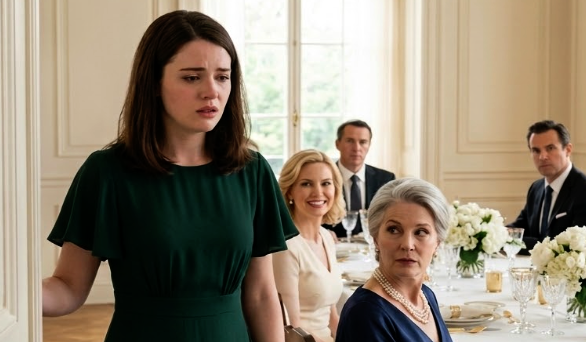
In the quiet, manicured suburbs of middle-class existence, power is rarely seized through overt conflict. Instead, it is negotiated through the subtle curation of roles—the “Sun” and the “Shadow.” My name is Arya Reynolds, and for twenty-four years, I resided in the penumbra of my family’s affection. To understand the events surrounding my grandmother’s seventieth birthday, one must first understand the lexicon of my mother, Linda. In our household, the word “flexible” was never a compliment regarding one’s physical agility or open-mindedness; it was a mandate for self-erasure. To be flexible was to be expendable. To be flexible was to have one’s needs harmonized into silence so that the melody of my sister Madison’s life could remain uninterrupted.
Madison was four years my senior, a woman crafted in our mother’s image: blonde, gregarious, and possessing an innate sense of entitlement that she wore as naturally as a silk scarf. While Madison was the “Sun” around which the family’s schedule, finances, and emotional labor orbited, I was the “Shadow”—the dark shape that existed only to provide contrast and depth to her brilliance. When we were children, this manifested in small, sharp injustices: the sharing of toys that were never returned, the relinquishing of the larger bedroom because Madison “had more friends,” and the cancellation of my piano recitals because Madison had a cheerleading competition. These were the foundational bricks of a hierarchy that would eventually lead to the theft of a thirty-thousand-dollar vehicle. The catalyst for this familial upheaval arrived on my twenty-fourth birthday. For years, I had navigated my life as a freelance content writer, a profession my mother dismissed as a “little computer thing,” from the back of Ubers and city buses. Independence was my sanctuary, but mobility was my struggle. Thus, when I arrived at my parents’ home to find a navy blue Honda CR-V wrapped in a gargantuan red bow, the breath left my lungs.
For ten months, that car was more than steel and leather; it was a testament to my existence. It was the first time I felt seen. My mother handed me the keys with a beatific smile, claiming they wanted me to have “reliable transportation.” In the background, my Grandmother Eleanor—the matriarch of the Mitchell side and the source of the family’s underlying stability—watched with an expression that was unreadable at the time. It was a look of profound, quiet observation, the kind one gives to a chess board before the first move is made.
The betrayal began not with a bang, but with a Sunday roast. Three weeks before Grandma’s birthday, I arrived at the family home to find my SUV parked in the garage, already occupied by my nephew Ethan’s car seat. The explanation was delivered with the casual indifference one might use to describe the weather: “Madison’s minivan is in the shop. She needs it more. You’re single. You’re flexible.”
As the days bled into weeks, the “loan” solidified into a permanent transfer. My inquiries were met with gaslighting. I was called “materialistic” for wanting my own property back. I was told I was “difficult” for pointing out that I had paid for the insurance and fuel. My mother’s rhetoric was a masterpiece of emotional manipulation, framing my sister’s convenience as a communal necessity and my own rights as a selfish whim. I was being edited out of my own life, one “flexible” concession at a time. The setting for the final confrontation was The Rosewood, a restaurant characterized by the heavy silence of old money and the scent of expensive lilies. Forty members of the Mitchell and Reynolds clans had gathered to celebrate Eleanor’s seven decades. I arrived in an Uber, my emerald dress a stark contrast to the white linen of the private dining room. Outside, my SUV sat in a place of honor, now defaced with a “Baby on Board” sticker—a territorial marking that signaled my displacement.
The dinner began with the clinking of crystal and the hollow warmth of family anecdotes. But Eleanor Mitchell was not a woman who suffered from facades gladly. As the main course was served, her voice—tempered like fine steel—pierced the ambient chatter.
“Arya, sweetheart, I noticed you arrived in an Uber. What happened to the SUV we bought you?”
The room fell into a vacuum of silence. My mother, ever the director of the family play, attempted to intervene with a practiced smile. “Oh, Arya gave it to Madison. She knew the baby needed it more. We’re so proud of her generosity.”
It was a lie so bold it bordered on the pathological. It was the moment the Shadow was expected to nod and disappear. But Grandma Eleanor was no longer watching the chessboard; she was flipping it. What followed was a surgical deconstruction of my mother’s authority. Grandma Eleanor revealed the “Zero-Inference” truth: the car had never been a gift from my parents’ meager savings. It had been funded entirely by the Mitchell Family Trust—a legal entity governed by strict stipulations.
Grandma had anticipated my mother’s penchant for favoritism. She had required Linda to sign a legal covenant, a document that bound the funds to my exclusive use. As Uncle Robert read the papers aloud—the registration in Grandma’s name, the trust disbursement agreement, and a handwritten letter of commitment from my mother—the “flexible” narrative disintegrated.
My mother had not only stolen a car; she had violated a legal contract and a written promise to her own mother. The room, once filled with the murmurs of approval for my “generosity,” now bristled with the electricity of scandal. Aunt Patricia, who had spent her own youth as the “flexible” sister to my mother’s “golden child,” rose to her feet. Her intervention was a vital moment of generational healing. She spoke of the psychological toll of being the “backup option,” of the “hidden taxes” paid by the quiet siblings to fund the lifestyles of the loud ones. The climax of the evening was not merely the return of the keys—though that moment, with the silver compass charm resting in my palm, was a victory. The true shift occurred when Grandma Eleanor dismantled the very structure of the family’s financial influence.
For decades, the trust had been filtered through the parents, allowing my mother to act as a gatekeeper of resources. By announcing that she would henceforth deal directly with her grandchildren, Grandma stripped my mother of her primary tool of manipulation. The “intermediary” was removed. The “Shadow” was granted its own light, independent of the “Sun.”
This was a masterclass in Management and Personal Governance. Grandma Eleanor demonstrated that loyalty cannot be coerced through the suppression of one’s offspring; it must be earned through equity. By protecting my boundaries, she wasn’t just returning a vehicle; she was returning to my agency.
To analyze this story is to look at the Sunk Cost Fallacy of family roles. My mother had invested so much in Madison’s success that she viewed my independence as a threat—a resource that could be liquidated to support her primary investment. In business, this is a recipe for bankruptcy. In families, it is a recipe for estrangement.
The “Grandma’s Response” mentioned in the title was not just the words she spoke, but the structural changes she implemented. She recognized that a family is only as strong as its most marginalized member. By enforcing a legal boundary, she provided the framework I needed to finally say “no.” Six months have passed since that night at The Rosewood. The navy blue SUV remains in my possession, a daily reminder that visibility is a right, not a privilege. My relationship with Madison is a work in progress—a slow rebuilding of trust based on the radical new concept of asking permission. My mother and I occupy a space of “Careful Neutrality.” We talk, but the “flexible” era is over. I am no longer the rough draft of a daughter; I am the final publication.
Grandma Eleanor and I still share Sunday tea. She once told me, “I was the flexible one once, Arya. It took me seventy years to realize that when you bend too far to keep the peace, you eventually break.”
I have stopped bending. I have started standing. And in the quiet hum of my car’s engine as I drive toward my own future, I finally hear the sound of my own voice.