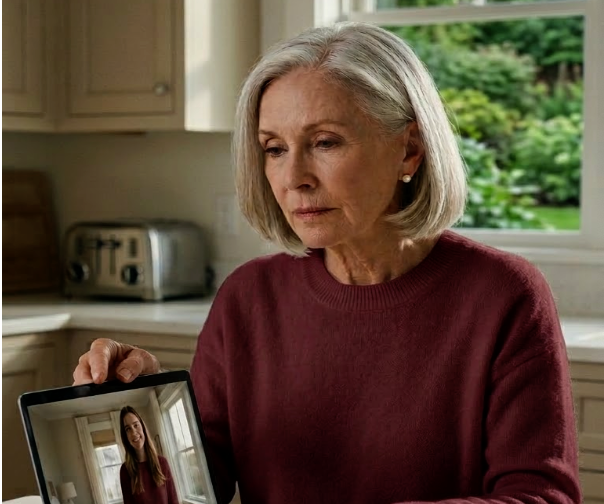
My name is Ellaner Vance, and at sixty-eight years old, I have learned that the most profound terrors do not come from the shadows outside, but from the breach of the one place where we are supposed to be safe. My home is a modest dwelling in a quiet neighborhood, a two-bedroom testament to forty years of labor. I arrived in this city with nothing but a suitcase and a relentless drive to provide for my son, Christopher, after his father vanished into the ether of forgotten responsibilities. I scrubbed floors until my knees were calloused and cooked in sweltering diners until the steam seemed to seep into my very bones. Every piece of furniture, every framed photograph, and every meticulously folded towel in my linen closet was earned through the quiet dignity of hard work.
To understand why I did what I did, you must understand my relationship with order. I am not merely organized; I am a cartographer of my own domestic space. I know the exact tilt of the chairs, the precise number of silver spoons in the velvet-lined drawer, and the specific scent of my bedroom after the morning sun has warmed the cedar chest. When that order began to fray, I didn’t just notice—I felt it like a shiver down my spine. It began with a white mug. It was a delicate thing with small, hand-painted flowers, a gift from a friend years ago. One Tuesday morning, upon returning from the grocery store, I found it sitting in the sink, stained with the dark residue of a coffee I hadn’t brewed. I live alone. I haven’t had a guest on a Tuesday in a decade. I stared at that mug for a long time, the porcelain cold against my palms, feeling the first cracks in my reality.
Then came the closet. I have a ritual of closing my doors—closet, bedroom, pantry—until the click of the latch signals that the world is in its place. Yet, I would return from church or the market to find the closet door ajar, just a few inches, like an intake of breath. My clothes appeared untouched, yet the air in the room felt heavy, occupied.
The most visceral sting, however, came from my vanity. I found a long, obsidian hair tangled in my brush—a stark contrast to my own short, silver crop. It was Amanda’s hair. I knew it instantly. Amanda, my daughter-in-law, who had been part of our family for eleven years. She was the woman who hugged me at Sunday lunches and called me “Mom” with a sweetness that I now realize was a saccharine mask. I tried to gaslight myself, telling my reflection that the hair must have traveled on my coat, but the perfume bottle in my drawer told a different story. The cap was askew, and the scent of expensive jasmine—my favorite, saved only for anniversaries—lingered in the room like a confession. When I approached Christopher, I didn’t go with accusations; I went with a plea for help. I sat him down in his living room, surrounded by the chaos of his children’s toys, and told him about the mug, the hair, and the perfume. I expected concern. I expected a son who would protect his mother’s peace.
Instead, I received the “Old Age Treatment.” It is a specific kind of condescension—a mixture of pity and exasperated patience. Christopher looked at me not as a woman who had raised him alone, but as a biological clock winding down into senility. “Mom,” he sighed, his eyes never leaving his phone for more than a second, “you’re probably just moving things and forgetting. It happens. Maybe you should see a doctor about your memory.”
Amanda was even worse. She took my hand, her voice dripping with artificial empathy. She compared me to her late grandmother, who spent her final years shouting at shadows. At that moment, I realized I had become invisible. My words were no longer currency; they were the ramblings of a fading mind. The betrayal of the intrusion was painful, but the betrayal of being unheard by my own blood was a coldness that settled in my marrow. If they wanted proof, I would provide it. I took three hundred dollars from my “emergency ceiling repair” fund—a small fortune for a woman on a fixed income—and purchased two tiny, wireless cameras. I spent an afternoon learning the technology, my aging fingers fumbling with apps and Wi-Fi passwords until the digital eye was open.
I hidden the first camera behind a row of historical biographies on the living room shelf. The second, I placed atop my bedroom closet, nestled between hat boxes that hadn’t been moved in years. I didn’t tell Susan, my best friend, nor Christopher. This was a private war.
Three days later, the truth arrived on the screen of my smartphone while I was sitting in a park bench after church. I saw the front door open with a key—my key, the one Christopher and Amanda were supposed to use only for emergencies. Amanda walked in with the casual gait of a homeowner. She didn’t look for a leak or a fire. She walked straight to the kitchen, made herself a cup of coffee in my white floral mug, and sat on my sofa.
I watched, breathless, as she transitioned to my bedroom. She opened my closet and began a grotesque ritual of dress-up. She held my vintage dresses against her body, twirling in front of my mirror, her face a mask of longing and something that looked dangerously like entitlement. But the sight that made my blood turn to ice was when she climbed into my bed. She pulled my sheets over her, rested her head on my pillow, and closed her eyes. She slept in my sanctuary, using my bed as her private escape, as if I were already a ghost in my own home. I could have stormed back and screamed. I could have called the police. But I realized that a woman of sixty-eight is often dismissed if she is loud. To be heard, I had to be precise. I decided to play a psychological game, leaving “little surprises” that stripped away her comfort.
The first was a note, left squarely on the pillow where she liked to nap. I wrote five words: “I know you were here.” Watching her reaction through the camera was a revelation. She didn’t just look surprised; she looked haunted. She scanned the room with a frantic, animalistic panic. She took the note, shoving it into her purse as if destroying the paper could destroy the fact of her discovery. Yet, she didn’t stop. The addiction to my space was too strong.
I escalated. I moved a picture frame of my late husband—a man she had never met—and placed it on the nightstand next to another note: “I see you.” The final blow was a printed screenshot from the camera footage. I left it on the bed, showing her a high-definition image of her own face as she tried on my jewelry. Beside it, I placed the very necklace she had been “borrowing.” No words were needed. The image was a mirror she could not look away from. Through the camera, I saw her collapse into tears. She whispered an apology to the empty room, looking directly at the shelf where she suspected a camera might be, and fled. The climax of this journey didn’t happen in my house, but at Christopher’s. I asked Susan to accompany me as a witness. We arrived for our usual Sunday lunch, but the atmosphere was brittle. Amanda looked like a ghost, her skin sallow and her eyes darting toward the door.
“I have something to show you,” I said, my voice steady, brooking no interruption.
I placed my phone on the dining table. I didn’t explain. I simply hit play. The room went silent as the video of Amanda sleeping in my bed began to run. Christopher’s face went through a kaleidoscope of emotions: confusion, recognition, and finally, a deep, burning shame. He looked at his wife, who had buried her face in her hands, and then he looked at me.
For the first time in years, he saw me. He didn’t see a “confused old woman.” He saw a mother who had been violated and a woman who had successfully defended her borders.
Amanda’s confession was a torrent of messy, human complexity. She spoke of her “suffocation” in her own life, her need for a place where she wasn’t a mother or a wife, and how my house—the house of a woman who seemed to have it all figured out—became her obsession. It was a crisis of identity, but she had chosen to solve it by cannibalizing mine. Four months have passed since that Sunday. The cameras are still there, though I rarely check them now. The locks have been changed, and I am the only one with a key.
Amanda is in therapy, working through the psychological knots that led her to such a bizarre intrusion. Christopher has apologized more times than I can count, but more importantly, he has changed the way he speaks to me. He no longer treats my observations as “symptoms.” He treats them as facts.
I learned a difficult lesson at sixty-eight: Love does not automatically grant respect, and family does not automatically grant safety. Sometimes, you have to build a fortress around your dignity and defend it with everything you have. I am no longer invisible. I am the mistress of my domain, and the silence in my house is finally my own again.
I don’t regret the three hundred dollars, the hidden lenses, or the psychological “surprises.” I bought back my sanity. I bought back my voice. And in the twilight of my life, I have learned that while I may be older, I am more formidable than I have ever been.