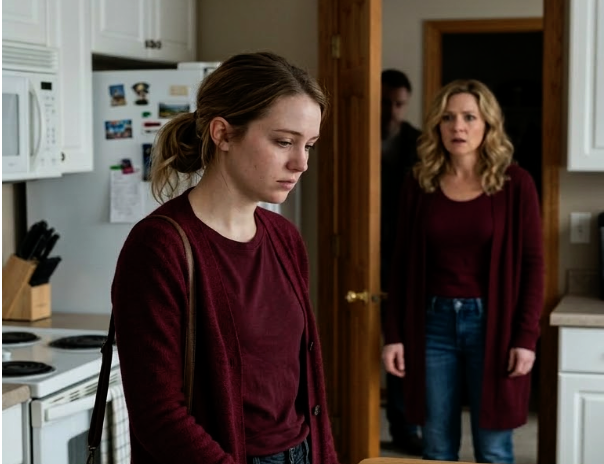
The kitchen in my parents’ house had always been a place of unspoken hierarchies, but that evening, the air felt particularly thick, charged with a tension that signaled the end of my endurance. My mother stood in the doorway, her frame casting a long, imposing shadow across the linoleum floor. Her arms were crossed—a posture of immovable authority—effectively barring my exit. Behind her, my father sat at the table, his silence serving as a heavy, rhythmic nodding of approval for the trap they were about to spring.
“You either babysit your nieces every single day, or you start paying the full rent,” my mother declared, her voice devoid of the warmth one might expect from a parent. “One thousand seven hundred and fifty dollars a month. Your choice, Haley.”
I clutched the straps of my backpack, the weight of my textbooks pulling at my shoulders. I was already late for my shift at the coffee shop, my mind racing with the logistics of the midterm I had to study for and the espresso machines I would soon be scrubbing. But in that moment, the physical world seemed to blur. All I could see was the domestic tableau of exploitation: my sister Britney, twenty-eight and perpetually “struggling,” lounging on the sofa while her two daughters, Madison and Jaden, transformed the living room into a wreckage of plastic toys and spilled juice.
This was the “hard time” my parents had been subsidizing for six years. It was a phrase they used like a liturgical chant to excuse Britney’s every failure. From the whirlwind romances that ended in abandonment to the string of abandoned community college courses, Britney was the family’s eternal victim, and I was the designated laborer. At twenty-four, I was a full-time accounting student and a part-time barista, clawing my way toward a future that felt increasingly like a mirage. To understand how I arrived at that kitchen doorway, one must understand the subtle, corrosive way my family had dismantled my boundaries over the years. It began with the “occasional” help when Madison was born. I was eighteen then, fueled by a naive sense of familial duty. But in a household where one person’s irresponsibility is treated as a disability, the responsible person’s labor is treated as a natural resource—limitless and free.
I remembered the year my grandmother passed away. She had left a modest inheritance, a sum that could have been a life-altering springboard for my education or a down payment on a reliable vehicle. Instead, my parents had funneled it into a sedan for Britney, who needed “reliable transportation” for classes she would eventually drop. I watched that car become a symbol of our divergent paths: she totaled it within months while texting, while I spent my weekends bagging groceries to save for a rusted Honda Civic with a cracked windshield.
The babysitting had evolved into a full-time, unpaid profession. My parents volunteered my time without consultation. I became the de-facto parent, the one who remembered doctor’s appointments, the one who scrubbed the floors, and the one who sacrificed study groups and social lives to ensure the house didn’t collapse under the weight of Britney’s apathy. My social circle had withered until I was a ghost in my own life, a collection of canceled plans and exhausted apologies.
That evening, as my mother issued her ultimatum, the injustice finally crystallized. “I already contribute,” I said, my voice trembling with a mixture of rage and exhaustion. “I clean, I buy my own food, I pay my insurance. Why doesn’t Britney work? Why is her lack of responsibility my financial burden?”
The response was a chilling display of gaslighting. “Britney is a single mother,” my mother snapped. “She has enough on her plate. You have no real responsibilities. You go to school and work at a coffee shop. That is nothing.”
In their eyes, my ambition was a hobby, and my hard work was a luxury. To them, the mental labor of an accounting degree was “nothing” compared to the “struggle” of a woman who spent her days watching reality television while others raised her children. That night, as I worked the closing shift at the coffee shop, the familiar rhythm of steaming milk and grinding beans felt different. It was no longer just a job; it was my war chest. I opened my banking app and looked at the few thousand dollars I had managed to squirrel away in a secret account—money they didn’t know existed.
The ultimatum had provided me with something I hadn’t realized I needed: a clean break. The moral obligation I felt toward them had been severed by their greed. If I was to be treated as a tenant rather than a daughter, then I would seek a better landlord.
The following three weeks were a masterclass in calculated deception. I maintained the facade of the “responsible one,” nodding along to their complaints while I spent every spare hour searching for a way out. I found Whitney, a graduate student in biology who needed a roommate for a quiet two-bedroom apartment near campus. The rent was six hundred dollars—a fraction of the $1,750 my parents demanded.
When I signed the lease, my hands shook. It was the first time I had ever made a significant life decision without the looming shadow of my parents’ disapproval. But even as I felt the thrill of freedom, a darker reality was brewing at home. My father’s hours at the manufacturing plant had been cut again, and my mother, who claimed to be working extra shifts at the dental office, seemed increasingly agitated. They were counting on my $1,750. They had already spent it in their minds. The night of my departure was a study in silence. I waited until the house settled into the heavy, rhythmic breathing of sleep. At 2:00 AM, the world is a different place—the shadows are longer, and the smallest creak of a floorboard sounds like a gunshot. I moved like a ghost, packing the remnants of my life into three cardboard boxes and a few duffel bags.
I stood in my room, looking at the peeling paint and the furniture I had used since middle school. This room was a cell, and the ultimatum had been the final turn of the key. I didn’t wait for morning. I couldn’t risk the confrontation, the tears, or the inevitable guilt-tripping that would follow.
I sent a text to Whitney: I’m coming tonight.
I loaded the Honda in three trips, my heart hammering against my ribs. In the kitchen, I left my house key on the counter next to a brief note. I am moving out. Do not contact me. I need space. I didn’t offer an apology because an apology implies a mistake, and I knew with every fiber of my being that this was the most correct thing I had ever done.
As I drove through the empty streets of Omaha, the cold night air rushing through the cracked window, I felt a strange, hollow lightness. I was twenty-four years old, and for the first time in my life, I didn’t belong to anyone but myself. The disaster my family woke up to wasn’t just my absence; it was the collapse of a house of cards they had built on a foundation of lies. The first barrage of texts came at dawn—confused, then angry, then vitriolic. My mother called me a “traitor.” My sister demanded to know who would watch the kids while she got her nails done.
But the real “massive disaster” arrived two days later in the form of a phone call from a man named Gerald, the landlord of my parents’ house.
“Haley, I’m calling because the rent is three months overdue,” he said, his voice weary. “And since you’re a co-tenant on the lease, you’re legally responsible for the six thousand dollars in arrears and the property damage.”
The world stopped. Co-tenant?
I realized then the depth of my parents’ betrayal. Three years ago, they had asked me to sign “utility paperwork” to help “build my credit.” I had been nineteen, trusting, and overwhelmed. I had signed a lease agreement without knowing it. They had used my clean record and my name as a shield for their own financial instability.
My mother had lost her job months ago and had been faking her “extra shifts” by sitting in the library all day, while the debt piled up. The $1,750 they demanded from me wasn’t for rent; it was a desperate, last-ditch effort to pay off a debt they had hidden from me while legally tying me to the anchor of their failure. I spent the next forty-eight hours in a cold, analytical fury. My accounting brain took over. I found the old text message from my mother: “Hi, honey. Can you come sign the electric bill paperwork? Love, Mom.”
It was the “smoking gun.” With the help of a legal clinic at the university, I presented this evidence of misrepresentation to Gerald. He was a man who had seen the worst of human nature, but even he seemed taken aback by the calculation involved in my parents’ actions. He agreed to remove my name from the lease retroactively, sparing my credit and my future.
But for my parents, there was no escape. Without my name on the lease and without my income, the eviction proceedings began in earnest. The facade of the “struggling but noble” family was stripped away. My father discovered my mother’s unemployment, and the resulting explosion fractured what was left of their marriage.
The disaster was total. They were forced into a cramped two-bedroom apartment on the edge of town. Britney, faced with the actual prospect of her children being homeless, was forced to do the unthinkable: she contacted the fathers.
And here was the most profound irony of all. Once I was no longer there to serve as the buffer, the “vanished” fathers—Tyler and Curtis—returned in limited capacities. They began to take the children on weekends. They began to provide. The children, for the first time, had a semblance of a father figure, not because Britney had sought it, but because she had no other choice. A year has passed since I slipped out into the night. I graduated with my degree and took a position at a firm that manages the finances for non-profits. I live in a small, sun-drenched apartment that I pay for with my own money, and the only screaming I hear is the occasional siren on the street below.
My mother came to see me once, sitting on the steps of my building like a supplicant. She offered an apology that felt like a tattered bandage on a gaping wound. She admitted she was “holding on to control,” but the admission didn’t change the fact that she had been willing to sacrifice my entire future to save her own pride.
I accepted her apology, but I didn’t offer reconciliation. I have learned that forgiveness does not require a return to the scene of the crime.
As I sit here today, I reflect on the difference between being needed and being used. My family didn’t need me to survive; they used me to avoid the discomfort of growth. By leaving, I didn’t destroy them—I liberated them. I forced them to face the consequences of their own choices, a dignity I had been denying them for years by over-functioning.
The disaster they woke up to that morning was the most honest thing that had happened to them in a decade. And the life I woke up to was the one I finally deserved.